comment 0

Dammit I’m Old!

   According to the Census Bureau, the nation’s 90 plus population is soaring; it has almost tripled since 1980, reaching 1.9 million in 2010, and promising to increase to more than. 7.6 million over the next 40 years. Americans are living longer and dying less than ever before!

     People 90 and over now make up 4.7 percent of the population, a number that is expected to  reach 10 percent by 2050. Most of that projection is due to the aging baby-boomers, who drew their first Social Security check in 2008 and now continue to become eligible at the rate of 10,000 people a day. No wonder everyone is worried about the government’s piggy bank. The greying of America is an expensive proposition.

    In spite of all the hype that says people are living better as they live older, the fact is that 60 is not the new 40, and 80 is not the new 60.  That’s bull; the hype may work for advertising purposes to sell vitamins and skin care products, but it doesn’t match the realities for those of us who are well over 60 ourselves and are taking care of someone well over 90. Contrary to what the dedicated optimists among us want to believe, a long life is not necessarily “a blessing” and old age is not exactly a “day at the beach” — even in Miami.

    America has always been obsessed with youth, beauty and health, pretty much in that order. Consequently, as you get older, you start to disappear; others easily walk, and talk, past you unless you assert yourself. Nor are oldsters usually able to remain productive members of the family and society, since multi-generational living and the basis of support that offers is not the cultural norm here the way it is in many other countries. In the US, a vast majority of people over 90 live alone or in nursing homes. This is not a pretty picture, even in the best of circumstances. Disabilities and old age go hand in hand, and not everyone has a competent care-giver or the financial resources to secure adequate care in a residential facility. About 15 percent of those over 90 live in poverty, and most of them are women. 

     My Mother celebrated her 95th birthday last week. I say “celebrated,” though in truth  “celebrated” is a rather grandiose verb choice. A favorite cousin was in town, and my husband, son and I brought an ice-cream cake and balloons for a little party with the other residents in the assisted-living home. Mother looked forward to her birthday, as she always has, even as she shook her head in disbelief each time someone reminded her how old she was. She had gotten her hair done in the morning, her aids had  dressed her in a new outfit, and she opened some birthday cards and a couple small gifts. We all tried to be “celebratory.” 

     The difficulty in celebrating any occasion as you grow older is that there are fewer and fewer pleasures available with which to do it. Dietary restrictions, mobility issues, vision and hearing loss, drug interactions, muscle weakness and fatigue all impose limitations on how much fun one can really have. Nor are there lots of people to celebrate with, since the older you get the more likely you are to have outlived most of your friends and relatives. Given those prospects for my own future, I think I’d better start celebrating more “unbirthdays” pretty soon. 

     The oldest friend I ever had in terms of age died in 2015 at 93. She was actually the mother of a childhood friend of mine, but she truly became my own adult friend over the years. We spoke often and visited when we could. Vibrant in spirit until the very end of her life, she did ultimately die in a nursing home. The last time she was at my house was when she came through San Antonio to fly out to see her daughter (my childhood friend) in California. I took her to the airport where we encountered some confusion and difficulties regarding her wheelchair assistance and procedures at curbside check-in. The people there tried to be nice, but there was this and that, rules and regulations, the “you need to…” and “you can’t…”  Finally, out of patience with the rigamarole and getting tired before her trip had even begun, she said rather loudly, “Dammit I’m old. I can do what I want!” Everybody laughed, the problems dissolved, and I found a new mantra.

     The one good thing about getting older is that you develop the long view (unless you’re stupid and haven’t paid attention to experience). When you have way more years behind you than are left ahead, you get a sense of perspective. You learn to filter out all the noise, dismiss all the social nonsense, and get down to the people and pursuits, and maybe those last bucket-list places, that really matter. Some might call this the acquisition of wisdom, some might call it being selfish or self-centered, and some might call it becoming downright cantankerous. 

     I don’t care what anyone else calls it, I call it freedom. “Dammit I’m old. I can do what I want!”

comment 0

Snow Days


     When I was teaching in public school in Connecticut years ago, snow days, called when the dreary days of winter delivered more of the fluffy (or not so fluffy) white stuff to the area than had been anticipated, offered a welcome hiatus from the usual routine.  A snow day was Mother Nature’s freebie to spend as you pleased, because you hadn’t counted on having it in the first place. It was also an excuse: you were shut in, constrained by cold conditions, and thus not expected to tackle any big chores or fulfill any big obligations because, again, you hadn’t intended to get to them that day in the first place. Ah bliss — you could blame the weather for your lack of industry and sociability!  

     Of course, rarely did I do absolutely nothing on those found days, but I sure did enjoy the freedom of choice. Often I spent the day reading and writing, or sewing, or corresponding with far-away friends. Sometimes I took a nap; sometimes I got into a culinary frenzy, baking cookies or canning vegetables or even creating a lavish weeknight dinner. Oddly enough, snow days always seemed longer than regular days, probably because I wasn’t racing through activities, even fun activities, on a jam-packed schedule the way I did every other day of the week, including weekends. 

         Over time, the term “snow day” became, for me, a euphemism for the unexpected, often serendipitous, break in routine caused by conditions beyond my control: weather, travel delays, loss of power/cable, or some other interruption. Of course, unexpected events aren’t always small, aren’t always pleasant, and don’t always come without forcing still more responsibilities on us in place of whatever has been suspended. (I recall Hurricane Harvey last fall.)  Even dire events, however, can offer new ways of looking at things, since we are compelled to abandon business as usual and to consider more carefully what is ahead.  

     Last week, I had an improbable series of “snow days” due to illness — a terrible cold that confined me to my bed for four full days here in 101 degree weather in South Texas in June. Now I wasn’t bed-ridden with a fever-induced delirium; rather, I just felt too lousy to get up and DO much of anything. So I didn’t. I stayed put. I read and I wrote and I dozed and I read some more while I ate my soup and drank my ginger ale and rubbed with Vick’s Vapor Rub. I cancelled appointments, didn’t watch the news, barely checked e-mail, and let phone calls go to voice mail. I had an excuse: I was sick. I also had the chance to catch up on some much-needed, long-overdue rest, which is probably why I got sick in the first place. Once my episode was over, I quickly realized that nothing was the worse for my having opted out for a few days and that I, in fact, was even better than “just better.” 

     It has been my experience that people in general, but women in particular, do a lot things  they don’t want to do because they have contracted too many obligations to too many others (and even assumed some of the obligations that rightfully belong to others). We get into a rut of routine roles and expectations at home, at work, among our friends, even in clubs and organizations. We begin, in a misguided way, to think we are indispensable. We find ourselves saying “yes” when we really mean “no,” and then grow angry and resentful about it. By the time we decide to break the cycle, we don’t even remember how to say no without a litany of excuses and maybe some guilt attached.

      I’ve spent a fair amount of time over the years in front of a mirror shaping my lips and practicing the long vowel sounds of  “Noooo …Noooo.”  Periods of over-extension and bouts of exhaustion and anxiety have rendered some hard-earned lessons, lessons I still have to review even now in semi-retirement. It takes courage to stand up for yourself, to claim your time and energy as your own, and to put your own priorities first. This is not selfish, it’s what sensible, reasonable people do. The needs and demands others make of us are not all created equal, and very few of those demands are actually of life-or-death importance. Even when they are, it pays to consider the survival advice routinely given to airline passengers: put your own oxygen mask on first before helping others. 

     You’d think at my stage of life, after all the emergencies great and small and disasters major and minor that I’ve been through, that I would no longer have to think twice about what I do and do not agree to. But, old habits die hard. I recently bought a t-shirt that reads, “Sorry I’m late. I didn’t want to come.” 

     And there you have it! The passive-aggressive position of someone who still needs a snow day to say “no.”.

comment 0

What Happens in Vegas …

     I’ve been to Las Vegas often, but not for a while, so when I flew into McCarran International Airport last week to meet up with friends, I was first struck by the sprawl on the ground below, and then by the sprawl of the airport itself. There are now three terminals, all with  conveyances to move you from plane to train to level to bus— and that’s just to get down to the baggage claim!! It took me well over an hour from the time I walked off the flight until I exited the huge off-site “transportation center” in my rental car. 

     By then, I was in the thick of 5 o’clock traffic as I headed out to a favorite fabric store, Quiltique, in Henderson. They were due to close at 6, so I was in quite a snit, not because it was a long drive or because I couldn’t find the street, but because the store these days is “hidden in plain sight” within the (here’s that word again) “sprawling” conglomeration of shopping centers, Walmarts, grocery stores and restaurants that have totally engulfed the area since I was there last. I called them; they waited for me and allowed me to stay past closing. By the time I headed to my hotel on the Strip around 7, I figured the traffic would have eased and the trip would be a breeze, but no. And so the story of Vegas emerged in less than 2 hours on the ground: this place is exploding!

     People are calling Nevada the “future face of America” and nowhere is its countenance clearer than in Las Vegas. That’s not surprising, given that three-quarters of the State’s population live in Las Vegas/Clark County and that the ethnic, social, economic, and political demographics of that area are driving the make-up of the rest of the State.  Clark County’s population alone is at a record high of 2.25 million; it grew last year by 43,000 people; fewer than half the residents are white: most have migrated not only from other countries, but from other parts of America, especially from California; the Clark County school system is the fifth largest in the nation with 154 languages spoken at home, Spanish and Tagalog predominating. (US News, “Best States,” 8/30/2017)  Furthermore, while the rest of the Country argues over immigration, the big hotel owners and the 50,000 member strong Culinary Union (made up of hospitality staff who cook, clean, serve, and work the casinos) not only support it, but embrace it, by offering employees job training, healthcare, classes toward citizenship and hands-on help toward upward mobility.

     Brian Sandoval, a popular Republican Governor, has been in office since 2010  (but not running for re-election this fall) and, since 2016, working with a hugely diverse Democratic legislature.  Together (there’s a concept) they have managed to navigate a long recovery from the Recession and to address critical issues important in their state: water, education, housing, employment and the economy. The make-up of the population may have changed, but that fiercely independent Western spirit long-prized by once conservative Nevada remains an enduring tradition, even though today’s electorate is thoroughly progressive, tolerant, and blue. 

     The weather in Vegas last week was actually quite pleasant, considerably cooler than here at home in San Antonio, which could explain, at least in part, why so many people were out on the Strip. Sidewalks were jammed, much like 5th Avenue in New York during the holidays, and everybody carried shopping bags. Some of the newer hotels don’t have casinos anymore (mine didn’t), but you can be sure that all lobbies lead to shopping opportunities. The Shops at Crystals, for example, are directly accessed through the Aria Hotel and connected by an Aria Express tram to the Monte Carlo Hotel at one end and the Bellagio at the other. This 500,000 sq.ft. retail mecca designed by architect Daniel Libeskind houses 45 luxury retailers including Versace, Dolce & Gabbana, Bvlgari,  Hermés etc. — all the high-end merchants for the high rollers yearning for goods that can’t be found in suburban malls at home. What happens in Vegas doesn’t stay in Vegas anymore; it goes home in shopping bags!

     As a matter of fact, “destination shopping” has become one of the major entertainment draws, especially for international visitors, along with sight-seeing, dining, Mojave Desert adventures, shows, and sporting events. (The Golden Knights professional hockey team is headed to the Stanley Cup finals as I write this).  The effort to clean up Las Vegas, to erase the “sin city” image and make it more family friendly, has resulted in a dramatic rise in tourism and convention traffic, with some 43 million people annually spending about $35 billion while they’re there. However, according to a Las Vegas Visitor Profile Study (Dec. 2017), visitors today, even repeat visitors, tend to be younger, more diverse, married, college educated, and far more interested in activities other than gambling. The Study reported that 77 percent of them spent only 2 hours or less gaming. From what I saw in the casinos, at least half of the tables were closed, and the other half were manned by bored croupiers without players.

     Wandering through the Aria, a truly beautiful hotel designed by César Pelli, I was struck by how much it is NOT evocative of the old Las Vegas. Increasingly, even the themed hotels and resorts built in the 90s, the Paris, the Excalibur, the Venetian, the Mandalay Bay, Caesars, all of which supplanted the icons of the 1950s — the Sands, the Hacienda, the Dunes, and the Boardwalk (where the Aria is today) —  somehow seem quaint in the face of this new Nevada. The Aria, gorgeous as it is, could be located anywhere, in almost any country. Hotels, restaurants, clubs, and shops are all about trends and technology these days. The sleeze, the kitsch, and the naughtiness of Vegas are gone, and so in a way is the romance. And so, by and large, is the humor with which Vegas parodied itself. 

     On my last day I go down to Fremont Street to pay homage to the last vestige of the Old Las Vegas, to take a turn on the roulette wheel at Binions and to check out the cheap souvenirs on the plaza. Most people don’t realize that this is really all that’s left of the original Vegas, the place where the mob ruled, where Hollywood producers made deals under the cabanas around the pool at the Golden Nugget, and where the Rat Pack could be seen having cocktails in the afternoon. Even Fremont Street has been “cleaned up” and renovated, but still most visitors don’t go downtown anymore. It’s too far, too old, and they’re just not into nostalgia. This is the new Nevada, young, active, unsentimental, proclaiming the egalitarianism and pluralism of a new generation. 

     Watch out, America, because what happens in Vegas is no longer staying there.

comment 0

The Good Ole’ Days

I have several friends  who regularly forward those “Do you remember when…” e-mails full of words and phrases and items of daily life that are no longer used, or even recognized, such as rotary phones, manual typewriters, Palmer cursive writing, ruffled petticoats, and so on. They serve to remind those of us “of a certain age” that we are, indeed, getting on, and to suggest that perhaps our best years, “the good ole’ days,” are behind us.

     Now I’ve never been one to wax nostalgic about many things, and I am certainly under no illusion that the good ole’ days were all that good, or good for all that many.  I think the past for all of us, as well as the present, consists of good and bad, success and failure, tragedy and transcendence. No doubt the future will be the same, though if collectively we could remember the mistakes of the past, then maybe — just maybe — at least some of the future would be appreciably better for everyone. But I digress…

     Older people tend to live in the past. They save everything, revive old memories through boxes of keepsakes and yellowed photographs, and live in houses furnished in the freezer of time. They tell you who they were, what they did, and how they prevailed — often with remarkable accuracy of dates and details, even as they are unable to remember what they had for lunch that day. In many ways, living in the past is safer: at least you know how things turned out.  You have a story, with yourself as the main character, and maybe a moral to go with it. Even if the story didn’t end particularly well, it’s still your story and yours to tell however you wish. That’s important because, as I once heard writer Sondra Cisneros say, “… if you don’t tell it [your story], someone who doesn’t love you will tell it for you.” Oh my.

     Politicians and popes aren’t the only ones who pine for a positive legacy. Everyone wants to be remembered well, to leave something significant behind, and to feel as though they’ve had an impact, however small, on their times. The current craze for genealogy research and DNA kits speak to the point: life is brief, but family and reputation endure. Some people leave a legacy of major contributions through philanthropy or humanitarian aid; some leave lasting political, cultural, or historic accomplishments; some leave lasting lessons for an immediate circle of lives they’ve touched, smaller rings of influence perhaps, but no less important. Few of us die without leaving anything behind, a modest financial nestegg perhaps, to heirs or to a cause, or maybe a simple treasure trove of dog-eared recipes or favorite family stories to our loved ones.  Whatever the case and whatever the means, all people as they age, rich and poor, famous and ordinary, start to think about what they will leave behind and how they will be remembered by whomever is left to care.  

     The popular TV show, “Who Do You Think You Are?” dramatizes the highs and the lows of this quest for deciphering a legacy through the avenue of family research. Everyone wants to be related to kings and queens and statesmen and to find out that their ancestors were heroes, but alas, many discover they are related to scoundrels, slave owners, despots and thieves. This is not generally a happy revelation for anybody, but especially not for well-known people finding out dark family secrets in the full illumination of prime-time programming! The reactions of the celebrities to the facts about their ancestors are generally far more indicative of who these famous people really are than the facts they’ve uncovered.

     And so it is for most of us, I think.  We all, Americans especially, like to think that we are “self-made” men and women, unique and forward-thinking, industrious and inventive.  Horatio Alger may have died in 1899, but his rags-to-riches stories are still being written every day in this Country by scores of people in pursuit of The American Dream. We do not, as a people, live in the past; we are always about the future, about more, bigger, better, faster, newer. Nor are we a very old nation. As nations go, we’re barely a pre-pubescent teen, now rebelling against the traditional values of our American family, now testing the limits of tolerance for our outbursts and bad behavior, now trying to decide who we want to be when we grow up. History is not always kind and it may not be destiny, but we repudiate it or, worse, revise it at our peril because, well — “those who don’t remember the past…”

     So, here’s to Mother’s Day this weekend, to all the mothers and the oldsters among us who do remember the past and want to talk about it. Let them describe the way things were back in “the good ‘ole days,” and let them explain why they think they lived in “the best of times.” Listen to the stories, but look for the lesson. 

     And remember that the next time you lament that you’re turning into your Mother.

comments 2

If Truth Be Told…

I was never a big fan of the Bushes, though I did meet Barbara Bush at a luncheon when I was named a White House Distinguished Teacher back in 1990, so I was sort of partial to her and  her particular devotion to literacy and education. It was in June, right after her tour de force commencement address at Wellesley College in which she showed, to an initially skeptical student body, that ardent feminism and fierce independence is not at odds with duty to family, kindness to others, and respect for differences.  

     Recollections of that Washington experience, of Mrs. Bush and her wicked sense of humor, of her white hair and Kenneth Jay Lane pearls, came back to me as I watched the funeral service for her on television a couple weeks ago. Other First Ladies have made significant contributions during their husbands’ tenure as president, of course, but as eulogists pointed out repeatedly, her efforts to bolster literacy in this country became a life-long passion, one that she was still actively pursuing just weeks before she died. Barbara Bush knew the power of words, and she held a steadfast belief in the power of literacy to safeguard democracy and to make America a stronger, healthier, more prosperous society.  As she wrote in her 1994 autobiography, Barbara Bush: A Memoir, “After much thought, I realized everything I worried about would be better if more people could read, write and comprehend.”

     Amen to that!

     In 2016, the Oxford Dictionaries’ word of the year was “post-truth,” a term that describes a situation in which facts are less influential in shaping opinion than emotion and personal beliefs. It implies an inherent disregard for experience, expertise, scientific research and objective facts. In other words, throw out the principles of The Enlightenment, which have dominated Western thought and progress since the 17th Century. Forget any historical or cultural context through which to evaluate current events —we don’t know history anyway, don’t want to study it, and don’t want to admit that there might be lessons to be learned from it. We are, all of us, firmly fixed in the now: we are our own experts, our own “citizen journalists” on social media, our own arbiters of the truth. We are all equal, and we are all entitled to our own opinions.

     Except we’re not, and deep down, everyone knows that, which is why so many people are angry and disgruntled. No wonder our level of national discourse has sunk to new lows; it’s hard to have an “enlightened” conversation with people who eschew the basic values of The Enlightenment. It’s hard to follow the narrative with people who don’t want the facts to get in the way of the story. And for that matter, it’s hard to have discussions with other Americans who seem to have abandoned all concepts of civility, respect, truthfulness, graciousness, decency, and honesty — what were once known as “traditional American values” — who can only counter with insults and vitriol.

     When I was teaching (back when I won that award) and we had classroom discussions, often heated, and classroom debates, always structured and defined, students would sometime dissolve into “everyone is entitled to their [sic] own opinion” when their argumentative skills and their skimpy facts failed them. And I would always counter that,  “No, opinions formed in ignorance without foundation are worthless. You may hold them, but please, don’t foist them on the rest of us.” Today, all these opinions are foisted all the time on everyone, and frankly, it makes me tired. Like Barbara Bush, it makes me worry and fear for the future of our democracy. Ignorance born out of youth and inexperience is one thing; every teacher, like me, has made it a life-long quest to combat that kind of ignorance, but willful ignorance, sustained ignorance, ignorance in adults born of hubris, anti-intellectualism and infatuation with self disgusts me, because that sort of ignorance operates only to subvert and exploit others.  And so yes, go on and call me an “elite.” If being highly-literate, well-read, well-educated, a published writer and an English professor puts me in that category, then I am proud to claim membership.

     Don’t tell me that people, intelligent people, reasonable people can’t tell the difference between “fake news” and real news. Of course they can! Propaganda, which is basically sound bites disseminated to convert and persuade, relies on repetition much as advertising does: if you repeat it often enough, people believe it and it becomes “true.” Spin news, circulated among the “faithful” who only watch, read, listen to, or adhere to what they already believe or want to believe, is known as “confirmation bias,” which means there is never any dissenting version or opinion to be received in the delivery. And news slant, meaning a network or newspaper’s leaning toward liberal or conservative viewpoints, or with great effort and resolve toward balanced non-oppositional poles,  is for the discerning reader/viewer — the one Barbara Bush hoped to educate and elevate through literacy so that he/she could be informed and make reasonable, informed decisions. That’s the reader/viewer I spent most of my life trying to cultivate, both as a writer and as an educator, and that is the reader/viewer I still try to be by exposing myself to a wide variety of news sources and editorial opinions, even the ones I deplore. This is the bulwark of the first amendment and the fourth leg on which our democratic government depends.

     So back to Mrs. Bush.  She was the First Lady in a transitional time, less tumultuous perhaps than our own, but still difficult. Yet, she recognized the importance of words and championed the value of an educated, literate population. Truth is not elusive; it is there, and it is not impossible to recognize, if only people will embrace it.

comment 0

Inspiration

     Inspiration; where does it come from? And what do you do with it when you have it? I, being a writer, write it down: endless notes, ideas, configurations, interpretations, quotations. I have always been an inveterate note-taker, so this is my default mode. Words conjure more for me than pictures, although I do, on occasion, make sketches.

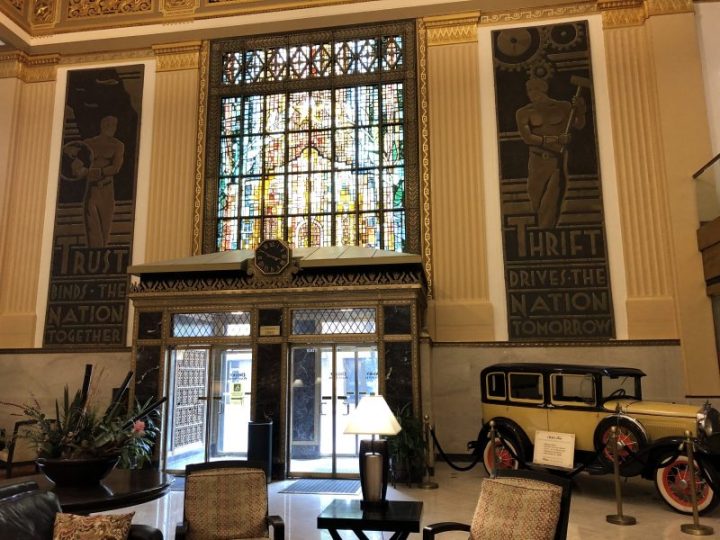
     I have just spent a week, well five days, at the international convention of the Studio Art Quilt Associates here in San Antonio, where inspiration abounded (including from the architecture of the Art Deco Drury Plaza hotel above, built in 1929, where the event was held.). I am proud to say that one of my art quilt pieces, “Busted,” was juried into the exhibition at the convention (see the Gallery), and I was encouraged and supported by the critical commentary I received. More than that, however, I was inspired by some of the other works on exhibit. Wow! What people can do with fabric and how they can translate not only their ideas, but their feelings about those ideas, is …well … inspiring. Other artists inspire and challenge me to do better.

     And then there were the workshops and seminars. One of the speakers, Miki Rodriguez, herself an accomplished art quilter and instructor, inspired me with her challenge to take a risk, to dig deep into your heritage and put yourself out there in your work.  Likewise, the keynote  speaker, Jane Dunnewold, an accomplished art quilter, teacher, and author of  several books, spoke about the need for an artist to take care of herself and nurture an unfolding creative spirit.  Again, “digging deep” was a recurring theme.

     When the conference was over, my art quilt, “Art Glass Quilted” (again, see Gallery), arrived back home after its six-month sojourn from the initial show at the Center for Contemporary Arts in Abilene , TX, to the Museum at Texas Tech University in Lubbock, to the Dallas Quilt show in March. It was nice to welcome the piece back again, and to see that it had withstood its journey well, even though I had been concerned about the fragility of some of the embellishments on it. This will forever be a special work for me since it was my first art quilt juried into an exhibition. Hopefully, with new-found inspiration, there will be more.

     And so I am thinking about more. I am reviewing my notes, looking at my sketches, and reviewing some of the projects I’ve had in mind for quite a while. I have to decide where to go next. I want to grow, but I also want to settle into a style that is uniquely, recognizably me.  Yes, I want to enter future exhibitions, but I don’t want to simply try to meet specific guidelines for a particular exhibition; I want to do work that is from my heart, my memory, my experience, my passion. I want to do work that only I can do. Don’t we all?

     But now here I am today, after a week of inspiration and another week of trying to process it all, right back into the ordinariness of  my ordinary life — filing my income taxes, doing spring clean up, attending to mundane chores like laundry. Whole mornings and whole afternoons evaporate in a fog of  good intentions. Life intrudes; obligations intrude; the world intrudes. They say that “life is what happens while you’re making other plans.” The challenge to that meme is to say “no,” to insist on the priority of your plans and to find the time, the place, and the space in which to nurture the creative spirit. 

     I used to tell my students that “a real writer is a person who writes,” who doesn’t just talk about it or think about it, but who actually does it, regularly. Moreover, a “real” writer generally seeks an audience, wanting to share words and ideas and thereby contribute to the broader conversation of humanity. I think this is true of all artists. The purpose of art, any art, is not only to be a form of individual self-expression, but to be a means through which others might be engaged and inspired. 

     And so here we are back at that word again: inspiration. Ultimately, inspiration produces  work, something that can be evaluated, shared, used or enjoyed by others. Those who pursue the arts, especially those who don’t make a living at it, are often reluctant to call themselves “artists” thinking the title presumptuous, but I think considering one’s self an artist is a matter of seriousness of intention. Everyone starts somewhere, of course, but some go further to build skills, establish a process, and perfect a practice that will ensure ever better results. That, to me, is an artist at work. I’ll leave it to critics to argue about the end product, whether something is or is not art, but from the humblest attempts to the greatest masterpieces, all art matters — even bad art! 

     Collectively, the arts (or lack thereof) define a culture and keep it alive for ages to come. And that notion, in itself, is inspiring.

Miss Leah at Dooky Chase
comments 2

All That Jazz

      New Orleans is jazz.  More precisely, New Orleans is improvisational jazz: a city built on the familiar strains of complex cultural chords — French, African, Creole, Spanish — with ever-expanding riffs and variations on one enduring melody.  With its “blended family” of history, traditions, and superstition, New Orleans is unique among American cities, at once seductively foreign and comfortingly domestic. Founded in 1718 by the French Mississippi Company under the direction of Jean-Baptiste Le Moyne de Bienville, NOLA is celebrating its 300th anniversary this year. 

     We just returned from another trip to New Orleans (pronounce it like a native: “Nu Or’ lins) a couple weeks ago. My husband and I first met  there over 50 years ago, so it is a special place for us. (See more in “Fat Tuesday,” journal dated February 13, 2018.)  We know the city well and we return often for various reasons, especially now that we live within driving distance.  This time, though, we just needed a brief respite from the mind-numbing routines of life. What better place than New Orleans to figure out how to “jazz up” the same old tunes that play day in and day out? 

     We always stay in the French Quarter and always frequent our favorite places, though not ALL of them in every visit, because, well … just way too much food. Besides, given the longevity of the Vieux Carre’s most venerable establishments, we can always count on them to be there for future visits: the Hotel Monteleone (1886) with its Carousel Bar (1949), Arnaud’s (1918), Tujaque’s (1856), Galatoire’s (1905), Cafe Du Monde (1862) — the list goes on and on. As old as they are, they stay current by offering new variations: Arnaud’s, for instance, has opened an adjacent dining room, same menu but less formal, that has live jazz music in the evening. Likewise, Jackson Square with its street artists and musicians, always has the same atmosphere, but with different characters; this time, magicians, jewelry makers and tarot-card readers made the scene. The Presbytere has a changing schedule of relevant exhibits, right now a fabulous Mardi Gras collection and a special exhibit on hurricanes and Katrina. 

     Little stores and antique shops lining Pirates’ Alley up toward Royal Street have been there forever. Invariably, I buy a hat at one of my favorite places, De Marcy, and then usually stop in at the Royal Praline Company for candy, Cafe Du Monde coffee and beignet mix (even though I can buy all that in my local supermarket here at home). Sometimes a brand new shop appears with an interesting twist on old themes: this visit it was a store full of gorgeous, hand-made masks of all kinds — Mardi Gras, Carnival, Venetian, Halloween, generally funky —in feathers and sequins and molded, painted paper maché. 

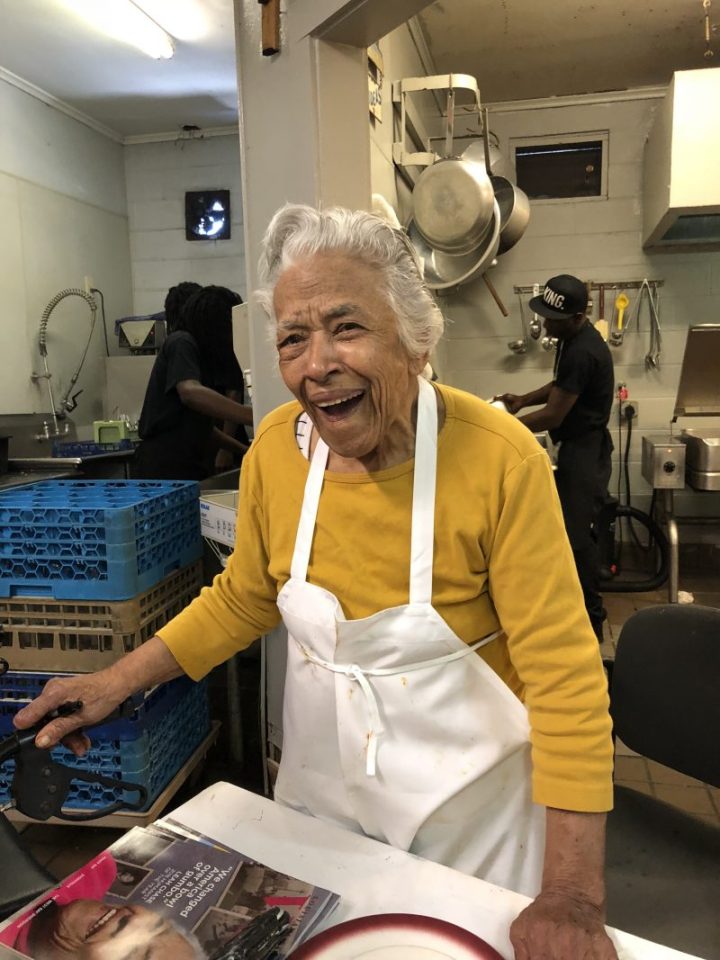
     But I also always come to NOLA with something in mind that I haven’t yet seen, perhaps a new exhibit at the New Orleans Museum of Art or another jazz club or restaurant that someone has recommended. This trip, I finally went to a place that has been on my list for quite a while: Dooky Chase on the corner of Orleans and Miro in Treme. Now unless you know something about Creole cuisine, or the Civil Rights Movement, or African American art, or Harry Connick, Jr., you may not have ever heard of Leah Chase and her restaurant, Dooky Chase, but believe me, she, and it, are national treasures. (Paintings by Gustave Blache III of her working in the restaurant’s kitchen now hang in the Smithsonian Museum of African American History and Culture and in the Smithsonian National Portrait Gallery in Washington, DC!) 

     Brief history:  in 1946, Leah married a musician, Edgar “Dooky” Chase, whose parents owned a little place that sold lottery tickets and po-boys. During the 1950s, Leah and Dooky acquired a house next door and turned the whole business into a sit-down restaurant. Edgar was a musician, a trumpeter with a jazz band, and he was gone a lot, so Leah managed the restaurant, updated the menu and added family recipes that reflected her Creole heritage. Her cooking became legendary. Dooky Chase’s was THE white-tablecloth restaurant in the African-American community, and during the 1960s, the only place where Civil Rights activists, including Dr. King and the Freedom Riders, could meet. Over the years, Miss Leah has hosted Presidents (George W. Bush and Barack Obama), and celebrities (Ray Charles and Hank Aaron), and has won all sorts of honors, from James Beard recognition to honorary college degrees. At 95 years of age, Miss Leah is still working as the executive chef of Dooky Chase.

     But here’s where the complexity of the Dooky Chase melody expands beyond food, or even politics. You see, along with their success, Miss Leah and her husband became major philanthropists and supporters of the arts; she was the first black woman named to the Board of the New Orleans Museum of Fine Arts.  The impressive, serious collection of African-American art that is displayed on the walls of the various dining rooms in her restaurant today (by Jacob Lawrence, Elizabeth Catlettt, John Scott, John T. Biggers, and many others, including contemporary newcomers) is as much a reason for visiting Dooky Chase as the food!

     So we went for the lunch buffet and, while there, I got to meet Miss Leah — talk about the ultimate lagniappe! — who was, yes, at work in the kitchen that day. I had bought her cookbook and wanted her to sign it, but we ended up in an extended conversation that was much more than a book signing. She asked about me, about my life, thanked me for coming to her restaurant. When I complimented her wonderful art collection, she said, “Oh, I got the way better end of that deal. Back in the old days, these young men were all starving artists,  you know. I’d feed them gumbo and they’d give me a painting, so really the collection sort of built itself. Who knew they would be famous?” She laughed.

    This is not a woman who is into famous. This is a woman who is unbelievably humble, hard-working and devoted to her cooking, her culture, and her New Orleans. This is a woman who “improvises” on her themes, for whom food has become art, both literally and figuratively.  And by the way, as for Harry Connick, Jr., Miss Leah cooked for the family and cared for him after his mother died when he was a small child. “He is such a good man, a wonderful man, and I am so proud of him,” she said, showing me photos of him and her.

      New Orleans: multiple keys within a single song — food, music, culture, history, art, hospitality — and all that jazz!  Everything old there is new again, including me.   

Tower of the Americas, San Antonio
comment 0

The Summer of ’68

San Antonio is celebrating its 300th anniversary this year.  April 6 will mark the 50th anniversary of the opening of HemisFair ’68, a world’s fair organized to celebrate San Antonio’s 250th anniversary, but also, not incidentally, to accomplish urban renewal downtown, to revitalize the Riverwalk and increase tourism, to dispel stereotypes of this City as a “backwater” town, and to effectively put San Antonio “on the map.”  It worked. It was a big deal. It was a bona fide World’s Fair certified by the International Bureau of Exhibitions in Paris, and it was the first World’s Fair held not only in Texas, but in the Southern United States. As I said, it was a BIG deal.

I was a college student in San Antonio at the time, in residence all through that summer for the duration of the Fair (April 6- October 6).  HemisFair ’68 was certainly a big deal to me, precisely because it was a bona fide World’s Fair! As a small-town Texas girl who came from a place where the biggest deal was the annual livestock show, I could hardly wait for the expansion of my world that HemisFair promised. I was not disappointed, and I went downtown to visit that world often.

Some 32 nations plus the United States, Texas and Arkansas exhibited. Since the theme was “The Confluence of Civilizations in the Americas,” representation was heavy, of course, by Mexico and the Central and South American countries, but nations from Europe, Asia, and North America were also present. All the countries who could trace their contributions to America were here sharing their histories, cultures and connections. The wonders of it all, the assemblage of the arts and artifacts,  the international foods and entertainments, the exuberance of their presentations created such an excitement, such a world view — well, for this girl, it was the stuff of which dreams are made — and bucket lists. My own favorite country, to which I returned time and again, was Espańa, with its priceless exhibit of exquisite paintings by Goya, Velasquez, and El Greco on loan from the Prado (which I have since visited in Madrid).

And then there were the corporate pavilions. Major Fortune 500  companies such as IBM, GE, Kodak, General Motors, Ford,  and Coca-Cola were here, almost 20 of them, showcasing their products and proudly touting their innovations for the future. I personally loved IBM, where two separate pavilions contained computers that talked to each other. You could create a design, program it into a computerized loom, and come away with a sample of your fabric to take home. (Could this have been where my love of design and fabric arts began?)  IBM also introduced the Selectric® typewriter at this exhibit, which certainly spoke to my aspirations as a writer and subsequently made my life easier for years.

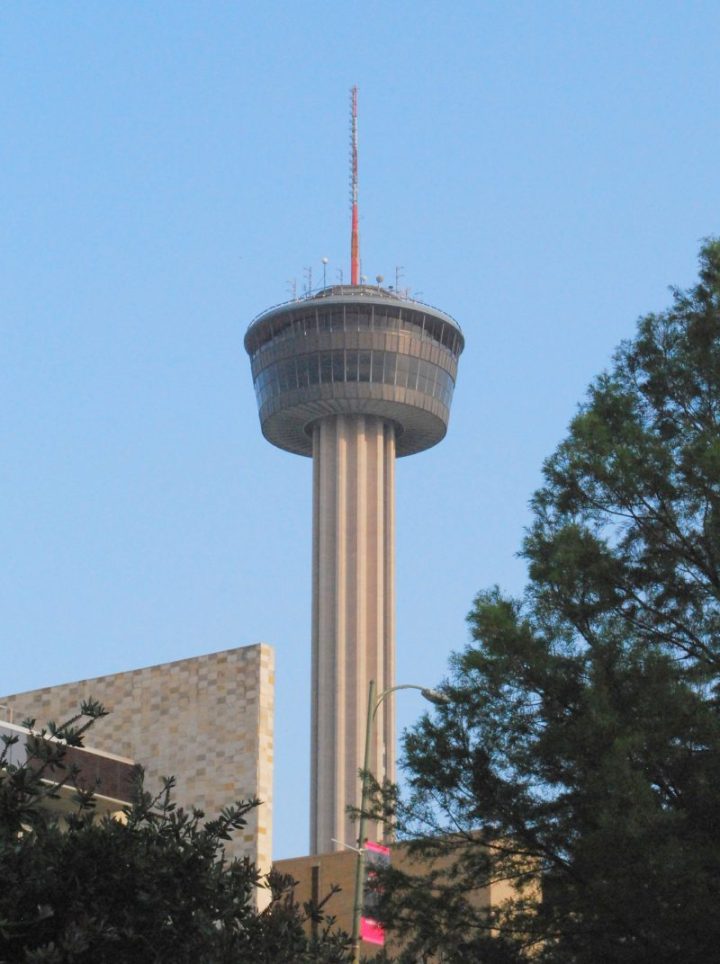
But it was the Tower of the Americas, that 750 foot tower with the revolving restaurant and observation deck on top, which emerged as the enduring symbol of HemisFair and the familiar landmark of the San Antonio skyline. I got engaged in the summer of ’68, and my fiancé (now husband) and I celebrated with dinner in the romantic restaurant atop that Tower. The aerial view was stunning, of course, but the revolving inner platform was  more “stumbling” than stunning, presenting a real challenge for waiters trying to serve diners rotating at a steady clip of 360º every hour. We laughed as our plates and glasses “walked” on the table with vibration, halfway expecting them to spin out by centrifugal force! And then there was the issue of trying to locate your table, which had moved while you visited the ladies’ room — and trying to appear nonchalant about being disoriented.

As I think back on all this now, I realize that the Tower was an apt symbol not only for a world’s fair, but an apt metaphor for America then.  We were reaching for the stars, quite literally through the space program, and yet society was spinning, sometimes out of control. The 1960s were tumultuous, and 1968 was no exception. Dr. Martin Luther King was assassinated two days before HemisFair opened, and Robert Kennedy six weeks later.  There were anti-Vietnam protest and civil rights marches and love-ins and sit-ins and every other kind of  “in.” Then, as now, the nation was divided; then, as now, (we) young people were idealistic, sometimes naive, but feeling the emerging power of our numbers and liking the sound of our own voices. There was even a special youth pavilion at HemisFair called Project Y that invited young people from all nations to raise those voices in music, performance, discussion and debate — a place for the spontaneous “confluence” of cultures to happen.

The general climate of social unrest has been cited by some as the reason HemisFair ’68 lost money (about $7 million by most estimates) and that attendance was not quite up to expectations (roughly a million visitors shy of projections). Yet, the success of the Fair cannot be measured solely in terms of money, or even in a revitalized downtown and a lasting tourism and convention business. Rather, it was the larger world view that drove HemisFair and fostered a collective attitude of inclusion and diversity that is the greater legacy for San Antonio today. With the whole world coming to visit, there was simply no room for discrimination or parochialism (and there still isn’t). Most people don’t realize, for example, that it was HemisFair ’68 that put a de facto end to racial segregation in our city; it was also HemisFair that prompted the legalization of liquor by the drink. so much for the “backwater” politics and policies of the past.

Today, San Antonio is indeed a “world class city” with a distinct character, a diverse culture, and a blended history born of  all the people who have lived here. You can pretty much draw a straight line between HemisFair ’68 and San Antonio’s emergence onto the world scene. We may be only the second largest city in Texas, but we have the biggest heart. There’s even room for me in it!

comment 0

Write On!

(Photo: “La Chascona,” the home of Pablo Neruda in Santiago, Chile)

I have been a working writer for over 30 years. I started as a 10 year old, keeping a journal and producing a little home newsletter. I have been writing religiously ever since. It is not only what I do, but who I am. As a member of the American Society of Journalists and Authors, The Authors Guild, and the National Federation of  Press Women, and with three books and hundreds of articles to my credit, I no longer need to prove that I can write. But I may, on occasion, need to prove, at least to myself, that I can still publish.

An important aspect of publishing is being active in the writing/publishing community vis-à-vis professional organizations, networking conferences, and academic workshops. Things change rapidly in this industry: magazines and newspapers come and go, as do their editors, along with freelance opportunities; the reading public’s preferences shift from print to on-line to social media; consumer trends create special interest groups and demands for new content information. Good writing and reliable reporting are constants, of course, but the marketing of that writing, and the way those “intellectual products” find their audience and get delivered, has changed dramatically.

For the first half of my career, everything centered in New York City. All the big publishing houses, the major national magazines, the best-known literary agents, the national writers’ organizations and, of course, The New York Times were all there. Lucky for me that I was too. Even as a relatively small player in the big city scene, I could easily pop in for editorial meetings, have lunch with my agent, or schmooze with fellow colleagues at big conferences. Yes, there were a few editors and agents in Chicago or on the West Coast, but only a few; mostly it was the literary and little publications that were out in the “hinterlands.”  If you wanted to play with the big boys in commercial publishing, you had to make those connections in New York, and you had to be around to sustain those relationships, or at least be willing to make regular trips East to do so.

Of course, those very early years were pre-computer — pre-everything except the telephone. I realize I’m dating myself here, but I actually wrote my first book on a Smith Corona typewriter, and then typed and retyped the edited rewrites. I considered myself on the cutting edge of technology because my typewriter had a an auto-correct feature! Queries for articles were typed up one-by-one and sent to individual editors in snail mail. The biggest controversy, given how much time the whole submission process took, was whether or not multiple submissions (pitching the same idea to several different publications) were ethical.

A few years ago I relocated down to Southwest Texas and out of the New York area. Since then,  I have not been pursuing national publication; rather, I have started this website and only done a couple print pieces in the local paper. While I am, so to speak, semi-retired, and not really angling for career advancement anymore, I still write. But when some younger members of the ASJA (American Society of Journalists and Authors) in the area started a Texas chapter last year, I was on board. Writing and publishing has, after all, expanded beyond New York, and we are, after all, one group, regardless of age and stage in our careers. Furthermore, there is some obligation for older members to lend their voice, experience, and support  to the development of a new generation of writers.

So, I signed up for the first Texas regional conference. And I singed up for the “Client Connections,” which is basically a speed dating round with editors to pitch story ideas and get assignments. My contacts were with editors of local publications, San Antonio Magazine and Texas Highways, because, well … this is where I am now and this is what I know. Even so, I didn’t have high expectations, mainly  because I didn’t have much confidence in my own abilities to still be competitive. Age and absence from the day-to-day hustle will do that to you.

Ironically, my “speed dating” sessions went well, so well in fact that I walked away with positive responses to several of my ideas. Now I have article assignments and longer-term proposals in the works. Suddenly I have more deadlines than I can handle. Now I have stress!This is what happens when your expectations underestimate your abilities.

It’s okay; it’s affirming. It’s even humorous. The one constant in my life, regardless of my other endeavors, has been my writing. It is my personal and professional identity, my mainstay, my salvation. I have been a teacher/college professor, a corporate employee, a fabric artist, a community activist and volunteer, a mother, a daughter, and a wife, but writing is what  I do, who I am.  As long as I am still doing it, publishing or not, I am me.

But I am glad to be publishing again.

comment 0

Fat Tuesday

So here we are again, already at Fat Tuesday with another Lenten season of sacrifice upon us. Seems it rolls around faster and faster each year, faster than Christmas even, though mercifully, with less stress. Lent is a good time to stay home, be quiet and repent; nobody expects parties or gifts or cards, and the general mood everywhere, even among those who aren’t Catholic, is subdued. (Of course, the grey, cold days of February may account as much for the restrained demeanor as religious devotion.)

But all that seriousness starts tomorrow. For today, at least, “Laissez le bon temps rouler!  Let the good times roll!  New Orleans is at full throttle, as are all those other places that celebrate Mardi Gras (which is French for fat Tuesday). I love New Orleans. My husband and I met there fifty years ago, and we have returned often over the years; in fact, we plan to go back for a few days later next month. Every so often, I need to revisit those romantic highlights: a drink in the Carousel Bar in the Monteleon; dinner at Arnaud’s with a peak at the Mardi Gras gowns in their back-room museum; early morning café au lait and bignets  at Cafe du Monde; Sunday brunch at Commander’s Palace in the Garden District. I need to stroll the misty streets of the Vieux Carré, feel the spirits of voodoo in St. Louis Cemetery, and move to the rhythms of jazz at Preservation Hall. I need the timelessness and transport that only New Orleans among American cities can offer, the food, the music, the atmosphere. I need a break from the ordinary, perhaps these days more than ever; I need romance and glamour and relief!

Obviously, New Orleans is one of those places I’m passionate about, though I have to admit that I have never been there during Mardi Gras. I hear that the population of the city almost doubles during the few days before Ash Wednesday. Good for them and for tourism, but no thank you. The crush of crowds on Burbon Street on any routine Saturday night is enough for me. But I sure have given some fabulous Mardi Gras parties of my own at home, decorated in brassy gold, green and purple with sequined masks, ropes of beads, and French Creole menus including shrimp remoulade, Brennan’s veal grillades, King Cake and chicory coffee.

The first Mardi Gras type celebration is recorded to have been in Louisiana in 1699 a few miles from the mouth of the Mississippi River, about where New Orleans is today. These celebrations, arising out of a French Catholic tradition, were meant to mark the final days of food and drink before the fasting and austerity of Lent began.  The first Mardi Gras parade as we know it took place in 1837 in New Orleans, though the 18th and 19th centuries saw Mardi Gras festivities spread to other southern regions that shared a French colonial heritage, most notably to Galveston, Mobile, Lake Charles, and Pensacola. Mardi Gras parties, parades and balls are still time-honored traditions in many of these cities today.

This year is sort of odd, because Ash Wednesday coincides with Valentine’s Day, which is typically celebrated with champagne and chocolates, two things likely to be “given up” for Lent. Here in San Antonio, in a city that is heavily influenced by traditional Catholicism, the main focus is on the spiritual: statues in church are already covered, schedules for Lenten Masses and confessions have been posted, and re-enactments of passion plays for Good Friday are being planned. Here, the time and energy spent in “letting the good times roll” before the season of sacrifice begins is already being directed toward the bigger celebration of Easter. For the most part, Valentine’s Day is getting lost in the shuffle this year, although I have noticed that some places are advertising special Valentine’s dinners and activities for tonight.

As a matter of fact, we are attending just such “a heartfelt event” this evening at the assisted living home where my Mother lives. Given the ages of most of the residents (and of us!), this is not likely to be a very romantic, much less glittering or glamorous affair, but it marks an occasion, a holiday, another landmark in the year that a family has together. As we get older and our lives get smaller, the days blend one into the other and every day becomes just another day hardly distinguishable from the last. Unless we distinguish it.

So, whether you celebrate Valentine’s Day with hearts and flowers, or Mardi Gras with parades and doubloons, or yes, even Lent with ashes on your forehead, mark the day as special simply because you are still here to enjoy it. Laissez le bon temps rouler!