comments 2

Just Try

   My husband just returned from attending a college reunion in another state for several days. It was good for him to have some time with his old friends, and good for me to have some time to myself without worrying about “what’s for dinner.”  Besides, I have that art quilt deadline bearing down on me, remember? (See explanation of the “Forced to Flee” global exhibit in my August 4 journal entry titled “In the Desert.”)

     Perfect timing: four uninterrupted days to sit in my studio and do nothing but concentrate on my entry. Of course, not exactly; life intrudes. When he left, I was at the embellishment stage of the project which, in this case, meant hand sewing thousands of tiny seed beads along the edges of a desert landscape to mimic mounds of blown sand. This was my fifth, and finally workable solution to this particular design problem, but it was time consuming (about 15 hours) and not without a couple setbacks: my dog (a 130 lb. Greater Swiss Mountain Dog) came in and sat in front of me to watch as I was patiently hand sewing, and then promptly sneezed right into my tray of tiny beads; then the thin, thin needle I was using (the only one I had that would fit) bent and broke, so I had to go out in search of #10 English beading needles. Eventually, with topical embellishments done, layers “sandwiched” and pinned, and a little practice before beginning, I was ready to start the free-motion quilting. 

     So I have begun, but I haven’t gotten as far as I would have liked. Everyday interruptions in my uninterrupted days caused starts and stops, of course, as did some new mechanical problems that cropped up with my sewing machine. Evaluation of  thread colors and stitching patterns made me decide to rip out some of what I had sewn, and complications with a new technique I was attempting sent me back to reference books and You Tube for a refresher. All in all, this whole project has been fraught with false starts, indecision, and technical difficulties from the very beginning. As the submission date nears, I am experiencing a great deal of stress and anxiety, not only because of the looming deadline, but because I fear that my vision surpasses my skill. And that possibility has me questioning the time, effort and commitment I have made to the whole art quilt endeavor at this stage of my life. 

     I recently read an op-ed piece by a Columbia law professor in The New York Times that seemed written just for me, especially right now. It was titled “In Praise of Mediocrity,” and the writer observes that the pursuit of excellence has corrupted our hobbies and inhibited our ability to relax and enjoy our pastimes for their own sake. (Tim Wu, Sunday Review section, September 30, 2018, p. 4). People don’t even admit to admit to having hobbies anymore, because they are soooo busy and have noooo  time for frivolous activities.  You have to be serious. If you’re a jogger, for example, it’s not enough just to run around the block; you have to train for the next marathon. If you’re a painter, it’s not enough to wile away a pleasant afternoon; you have to land a gallery show! (Hmmm…sounds familiar.)

     I think this attitude is particularly American. We are, after all, are a most industrious people who pursue excellence and achievement in everything we do — in education, in the workplace, in our communities, in civic projects, etc. The idea of leisure time, time spent dabbling or simply doing nothing but relaxing, is completely alien to the American character. “Idle hands are the devil’s workshop.” That Protestant work ethic is deeply ingrained. 

     Granted, I am a Type A, and a bit of a perfectionist, but as a teacher/professor, my whole life has been dedicated to excellence. “If something is worth doing, it’s worth doing well,” I used to preach to my students. Sounds good as a motivating platitude, but I don’t have a lot of words of wisdom to help soothe the frazzled nerves of frustration when “your reach exceeds your grasp.”  Not even for myself. Like most Americans, I am product-oriented, not process-oriented. I want to see results and I want to point with pride to my accomplishments — not in competition with anyone else necessarily, but with myself. There are very few things in my life where I will accede that “good enough is good enough.” Not even in housekeeping.

     I have been sewing since I was a teenager, and quilting for over 20 years, but once I began, it became about learning and growing and getting more adept and accomplished. Everything for me is about learning and growing and getting more accomplished. I have been writing for most of my life, but there was never any question that I had to publish, had to achieve a certain level of professionalism. But then, writing and teaching were my professions, so …  I have been cooking for most of my married life, at first barely able to boil water, but then over time, more able. I’m not likely to compete on Master Chef as a home cook any time soon, but I have taken serious cooking courses at the CIA. The only, single activity — dare I say hobby — I do enjoy purely as an amateur, though I had ten years of lessons, is playing the piano. I do it for my own satisfaction, and only play “in public” for my family during  the holidays.

     This whole last year has been a time of reflection and re-evaluation for me, a time of stress and anxiety, yes, but maybe also a time of growth and accomplishment in a survival sort of way. This quilt project is an apt metaphor for what I’ve been through, more of an exercise in perseverance than in art. I will finish this piece by the deadline at the end of this month, but I may not submit it for the juried show if it is not among my best work. And I will be okay with that. The achievement for me right now is in the doing.

     Today is my birthday.  As usual, I am reflective. I am re-thinking my goals and ambitions going forward at this stage of my life. To quote one of my favorite authors/thinkers, Toni Morrison, from her 1993 Nobel Lecture in Literature, “Passion is never enough; neither is skill. But try.”

     I will try, both to go forward and to do my best.

comment 1

In Ruins

   “He who travels to get away from himself carries ruins to ruins.” Emerson

     Okay, I’ll admit it: I am inveterate traveler who needs to travel, needs a regular change of venue, needs to get away, from myself, from my worries, from the ordinariness of my daily routine. Going away rejuvenates me as nothing else can, and that has been true for most of my adult life. At times of extreme stress, major meltdowns, and extended worry, a trip — not even an especially big trip — does wonders to restore my emotional equilibrium and adjust my perspective on my own small corner of the world. So yes, if you want to say that when I am in ruins, I travel to get away from myself … okay.

     I think the reason travel has such a therapeutic effect on me is because of the uncertainty of it all, especially these days. Traveling  demands that I pay attention and be fully present in the moment. The expectation of what might happen and what I might encounter is central to the adventure of  any trip, of course, but it is also incredibly freeing in a personal way, particularly for someone like me who always feels responsible and in charge. But, once on that plane, that train, that ship, or in that car, I leave all the worry about plans, preparations, and arrangements behind because there is simply nothing else to be done. I am forced forward into the present and must deal with whatever occurs. “If something happens, don’t call me,” I always say when I leave. Prior arrangements will prevail.

     Curiously, I have always dealt better with the urgency of the unexpected than with the monotony of sameness. That’s probably because I don’t really pay attention to most of the “stuff” in my everyday life. While many people find the stress and uncertainties of travel — overbooked flights, lost luggage, weather delays, long lines, social unrest, terrorists alerts, accidents, pickpockets — I find that I am actually calmer and more collected when faced with such challenges.  I often surprise myself with my own resilience and ingenuity in these situations. I have been through a lot at this point, from missed flights and nights stranded in dangerous places, to major accidents and medical emergencies in remote locations, to the theft of my bag with everything in it (passport, license, credit cards, money) right before I was supposed to come home. But all these experiences, as harrowing as some were at the time, have helped me develop a fundamental knowledge of how the world works, almost everywhere, regardless of culture, country, or continent; that knowledge, in turn, has made me a more confident and appreciative traveler. 

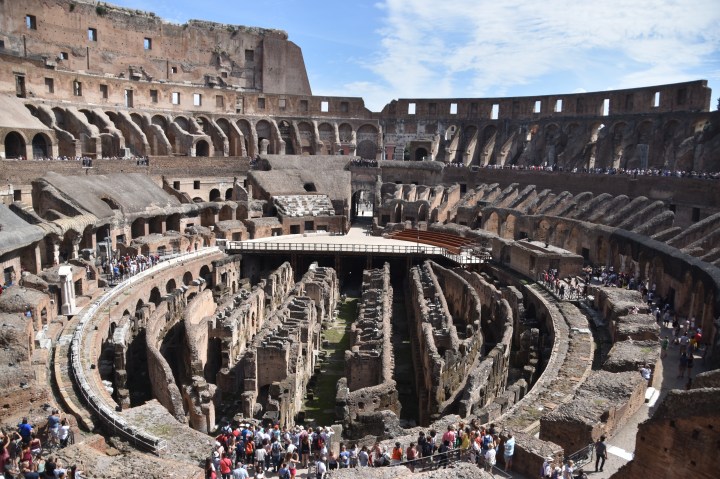
     We just returned from ten days in the Mediterranean, mostly to places we have been before and that we love. Even when you return to familiar places, especially years later, you can find fresh insights and experiences. We went back to both  Florence and Rome, for example, and I was surprised at how crowded and commercial both cities are now from what I remember years ago. The Colosseum and the Roman Forum are still impressive, of course, and I still loved the shopping in Florence and bought a beautiful cameo there. But I did not love the long lines to enter the museums and the crushing crowds in the Palacio del Vecchio that made  admiring “The Rape of the Sabine Women” (my favorite sculpture there) almost impossible. Florence was once a contemplative city, but it isn’t anymore, at least not in September when tourist season for travelers from Europe and Asia apparently hasn’t ended.

     In contrast, St. Tropez is still St. Tropez, with that French joie de vive, with the beautiful shops and the small restaurants and the lingering ghosts of Scott Fitzgerald stories.  I even remembered the streets and found my way back to the once famous Hotel De Ville (now used as a city hall). The Côte d’Azur is a glamorous enclave, out of another time perhaps, but today attracting a new generation of romance seekers and a new incarnation of  the so-called “rich and famous.” Yachts in the basin are, in fact, bigger and showier than ever!

     Further along the Mediterranean Coast into Spain, we stopped in Málaga, the boyhood home of Picasso and the location of a museum containing about 200 of his works. (The much larger, more comprehensive Picasso Museum with over 4,200 works is in Barcelona, where the entire collection is arranged chronologically room by room, beginning with his earliest paintings from his teenage years.) Though we love Spain and have spent time in other parts of the country, we had not been to Málaga before, and it did not disappoint. Nor did the beautiful seaside resort town of Alicante, with its wide boulevards and plain air cafes. And did I mention the lovely wines and cheeses and tapas in all these fine Italian, French and Spanish establishments? 

     Needless to say, “my ruins” have returned home refreshed and refurbished — and five pounds heavier. We needed this trip, because it has been a long, tough year. And I needed this type of trip, one that was a little easier and a little less demanding than our more exotic adventures tend to be. Sometimes more familiar destinations are comforting. Even so, the uncertainty of what you might encounter is central to the adventure of travel, if you are open to it.

     Otherwise, you might as well stay at home.

comments 2

Friendship

     It occurred to me last Monday during a quiet time, quite out of the blue and without any particular prompt, that my house phone had not rung once all weekend. Not once. A few texts had come in on the cell phone, but they were inconsequential: a sale notification or a prescription drug pick-up. I suddenly realized that I/we don’t, as a rule, get many phone calls anymore, unless you count robo calls, which I don’t.

     That led me to realize that the underlying reason I don’t get calls is that I don’t have many friends anymore, at least not local friends with whom I speak and interact often, much less daily. My whole life, I have had an active social life with circles of close friends, not necessarily overlapping circles mind you, but people whom I saw regularly, talked to daily or often, and with whom I was in more or less frequent contact. Those friendships have been cultivated from playmates in childhood, classmates in college, colleagues at work,  and co-workers in various community endeavors throughout my adult life. While I am happy to say that I have maintained most of my closest friendships over these years, I do not now have a local cadre of close friends where I live whose company and conversations I can routinely enjoy. And I miss that.

     Part of the reason for this is that I am retired. Yes, I moved back to my home state of Texas, but most of the people I was close to in my youth have also long-since moved away and created new lives elsewhere, as did I.  My one dear, oldest childhood friend, who lived nearby in Austin and whom I was thrilled to once again be able to spend time with, quite suddenly died of cancer about a year after I moved back. Unfortunately, I have lost several close friends over the years — some at unusually young ages — to accidents, illness, and other unforeseen events. As one ages, of course, death becomes the great “robber baron” of friendships. 

     Another result of being retired is that one is no longer actively thrust into the social activities  automatically generated by career and family; if geographic relocation is also part of a move to retirement, then even the casual friendships developed within local organizations, churches, and other activities are suspended. Suddenly one must actively seek out new ways to connect with others of similar interests and proclivities, commonly done by joining clubs or doing volunteer work. Now I’ve never been much of “a joiner,” and I’m not even much of a networker, especially since the passions I pursue (reading, writing, art quilting) are rather solitary endeavors. I will occasionally attend a  professional conference or make a one-time commitment to a community service project or volunteer effort, but I am really not interested in being regularly scheduled for anything. I just don’t seem to have a yearning to belong in that sort of “tribal” way. 

      Developing real friends, meaningful friends, is an individual enterprise and it takes effort. It can be exciting to venture into a relationship with someone new, but it demands a dedication to openness and exploration, and it requires time and attention. These days, when people are so divided and even conversations about the weather can turn into arguments over global warming, I simply don’t have the patience or the time to be polite. I want intellectual rigor and real discussion, not inane conversation. Maybe I’m just too old to endure the tedium of trying to establish a context from which reasonable people can establish real communication. There is simply no easy way to adequately explain a lifetime of experiences to a new acquaintance and yet, without some frame of reference, how can two people possibly get beyond the banalities of casual conversation, much less forge a real friendship. Who wants to hand out resumés in retirement? 

        My friends are my family and they have been for many, many years. They are the siblings I didn’t have as an only child, but they are better than siblings because I have chosen them — and I am very selective. We choose friends for different reasons. The idea of a BFF aside, no one person can be expected to fill all needs: some are supportive, some are challenging, some are intellectual, some share common interests, and some are just plain comforting. I am proud to say that my life-long group of dear friends is a very diverse group of people who are nothing like me in terms of the accidents of birth — nationality, religion, race, sexual orientation, regional backgrounds or political affiliations. After all, confirmation bias in choosing like-minded friends is no more conducive to personal growth and understanding than it is to discerning the truth from news outlets. We need others to expand our horizons, not constrict them.

     All relationships take work to develop and sustain, but the effort is worth it. I have friends, close friends, of 40-50-60 years or more. They have been a lifeline for a lifetime for me. People who “knew you when” often know you best, so there’s no need to explain or pretend. They know what you’re made of, they get your humor, they see your soul. They will cheer you when you’re right, support you when you’re down, and call you to account when you’re wrong. The best of them will always help you be your own best self, but they will also accept you when you aren’t.

     “Show me who your friends are, and I’ll tell you who you are,” the old saying goes. I will gladly, proudly be judged by that standard. And it’s okay if my phone doesn’t ring as much as it used to. I’m starting to like the silence.

comment 0

Back To School

By the end of August, I am more than ready for the summer to be over, especially here in South Texas and especially this summer. Everything is brown and dry and dead, the unrelenting heat is, well … still unrelenting (at over 100 degrees), and the lazy, hazy days laden with dust and allergens have kept me congested and lethargic. It’s enough already! I’m ready for fall.

     Of course, fall comes here in name and craft-store decorations only. Our heat continues well into and beyond September, along with the threat of hurricanes.  Since school starts in San Antonio in early August, there is but the faintest connection between autumn and the actual resumption of the academic year. All those clichéd commercials showing happy children skipping through fallen leaves toward the school bus are misleading; a more apt local ad would feature happy moms and dads skipping through check-out lines on the back-to-school tax-free weekend held every August.

     Yet, even though I haven’t been in a classroom in almost a decade now, I still experience those familiar back-to-school urges, and still honor many of my same old routines. It’s not nostalgia or that I especially miss the classroom, but rather that years of being a student, and years of being the parent of a student, and decades of being a teacher/professor have instilled certain rhythms in the way I live and work. I am lazy and disengaged in the summer; I am active and productive from September to May. This is what I have been trained to do.

     I began my fall preparations last week with attention to pencils and papers — what else?  I went through and reorganized all my stationery, cleaned out my desk drawer, got refills for my favorite pens, and checked my stash of special occasion cards (lots of birthdays this time of year). As you might imagine, I am a great letter-writer, card-sender, note-jotter; if the U.S. Post Office goes out of business, it certainly won’t be my fault!  Of course I delight in beautiful papers and pens, but I’m also particular about my everyday legal pads and ballpoints.  Even as a kid, I was very persnickety about my notebooks and binders and the contents of my pencil case, so shopping for school supplies was always a BIG event.

     The other big event was shopping for the back-to-school wardrobe. As an adult, especially one living in the Northeast, I adapted this ritual into the changing over of the clothes closet. White linens and light shirts and slacks get packed away in the cedar chest, along with swimsuits and patio dresses, and out come jackets and sweaters, along with the heavier, dressier — what I call “more serious” — clothes needed for meetings and professional activities and the holidays. It’s quite a chore, granted one that made a lot more sense when I lived in a  climate where the seasons would actually change, but still …  Texans might wear flip-flops with a fur-trimmed hoodie when the first “norther” arrives, but even they don’t wear white linen after Labor Day!

     Once I became a teacher, back-to-school meant lesson planning and research for new units I wanted to undertake in the classroom. These days, though, the lessons and research I do are generally occasioned by up-coming travel plans, not for teaching others but for my own preparation. We have a couple trips planned for this fall, including one to Europe, so I have begun to brush up on my language skills and review travel vocabulary.  I also have a reading list to educate myself about some less-familiar destinations. If there’s one thing I know how to do, it’s to “study up!”   

     My fall art projects have already begun — and begun again — on this current art quilt that is due in October (see last journal entry). I am still at it. I have to quit procrastinating, make some decisions, and finally get this underway so I can meet the submission deadline with confidence while still relaxing and enjoying my fall trips. I also have a major magazine assignment ahead of me, as well as a couple other new writing and art projects taking shape in my head. Contrary to popular myth, creativity is not all spontaneous inspiration; like any other pursuit, artistic growth means setting goals and working toward them, practicing, planning and learning as you go.

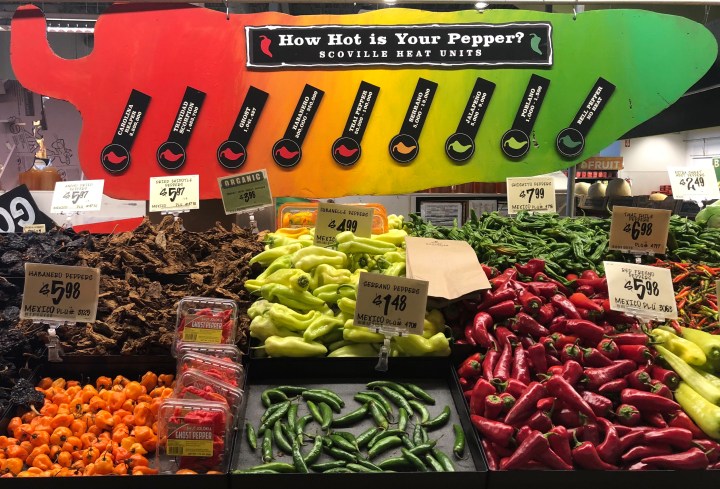
     So, here at the end of August, I’m in a back-to-school frame of mind, hot weather be damned. Luckily, fall is Hatch chili season here in the Southwest, and the consumption of chilies actually makes you sweat and cools you down. Chilies grow in hot climates, and people who live in hot climates tend to eat spicy hot foods. (Note: you don’t think of chili hot in New England cooking, or Scandinavian, or British, or German, or …) Luckily, I have stocked up on my chilies (see above photo),  just in time for back-to-school. I am cooling off and moving into fall.

comment 0

In the Desert

     I love deserts — which is a good thing, considering that where I live is rapidly becoming one. The world’s best deserts, the ones that haven’t been defiled and defaced by over-development and tourist debris, are stark, uncluttered, and magical. They speak to us from primordial places, from the swirl of wind and sea and rock; they point to our beginnings, and maybe foreshadow our ends. From dust to dust…

     I have been fortunate to travel a great deal in my life, as of now to five continents and over 40 countries, but only a few places have moved me to tears. The Sahara in Egypt was one of them. The vast beauty, the metaphysical power, and the historical importance of this area of the Fertile Crescent,  simply overwhelmed me. The first day we arrived in Cairo, however, the sands of the Sahara literally overwhelmed me. The atmosphere was so hazy and full of dust that you could barely breathe, much less see the pyramids (which are usually visible from almost anywhere in the City). I asked our driver if Cairo always suffered from such air pollution. “Oh, this is not pollution,” he assured me. “This is the end of the Khamaseen. It’s been like this for about five days now, but it should be clear tomorrow.” And so it was. When I woke up the next morning, I beheld a stunning view of the pyramids right outside my hotel window!

     The Khamaseen is a desert cyclone that sends sporadic plumes of dust up off the Sahara during a fifty-day period in the late spring. (Khama is the Arabic word for fifty, hence the name.) The winds eventually move over other parts of Africa and the Arabian Peninsula, then on to Europe and across the Atlantic into the Caribbean, and sometimes as far as the coastal areas of the southern US. As if we needed any help from the Sahara to intensify the oppressive heat and drought generated by consecutive days of 100+ degree heat, the Khamaseen arrived in San Antonio this year on July 18 and stayed around for a couple days, bigger and hazier than ever. The good news, though, is that throughout the summer, the dust sits in a layer over the cooler, more humid air above the Atlantic Ocean, and that cap of Saharan dust actually helps to suppress hurricane formation in the Caribbean.  After the trauma and destruction of Harvey last year, from which many of us have yet to recover, it’s about time South Texas gets a break!

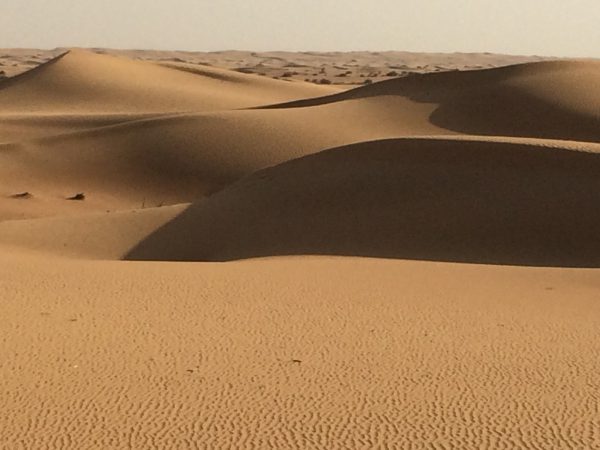
     At 3.6 million square miles, the Sahara is the largest, best-known desert in the world, but there are many others each with a unique character and appearance. (Note: sahara means desert in Arabic.)  Not all deserts are alike. Sands are composed of loose, granular particles made from minerals, organic material and rock; the composition of the sands accounts for color variations from white, to beige, to gray, to pink, to red —  often even within the same desert. Sand particle size can range from almost microscopic (very fine) up to 2 millimeters (coarse).  Atmospheric conditions, shifting winds, and constant saltation cause variations in the height of the dunes and ripples and create the beautiful, constantly-changing patterns on the sand surface. From the White Sands in New Mexico to the Wadi Rum in Jordan to the “singing sands” of the Gobi to the red rocks of the Mojave, each desert has its own unique mystery and magic, its own quiet story to tell about the earth and the people who have managed to survive there.

     My love of deserts notwithstanding, you might still reasonably wonder why I seem more than a little obsessed with such detailed information about them. The answer is that I am basically living in one —thinking about it, dreaming about it, studying it, drawing it, analyzing it, and fretting over how to bring it to life — in fabric. I mentioned in my last post that I had  begun to design a new art quilt for entry into a juried global exhibit this fall. The theme of the show is “Forced to Flee,” to represent a flight for survival from natural disaster, oppression, war or some other peril. The moment the call for entries went out, I knew had the perfect entry idea.

     Several years ago I was in Jordan just when the Palestinian crisis had ended and an early trickle of Syrian refugees had begun. I took a photo of some young men carrying their belongings with them, walking away from me toward some buildings on the horizon in the vast northern desert. The scene is very stark, but very beautiful, one of those accidental “perfect compositions” that all amateur photographers hope for, but rarely achieve. So, there was no question that this picture would be the inspiration for my entry. I gathered supplies, made the basic pattern, and started auditioning fabrics. And then I hit a roadblock, several actually, in trying to capture the desert, with its many color variations and topical patterns, all of which have to be quilted in, along with considerations for wind direction, sun angles, and light reflections. Thus, a composition that seems fairly “simple” in overall design becomes infinitely complicated to execute once you get started.

     Nevertheless, I did get started, then started again, and now have “deconstructed” the basic foundation of the whole thing and essentially started over. With the constant interruptions and demands in my daily life that afford me little uninterrupted studio time, with a welcome trip, but a two-week absence, planned for next month, and with that October competition deadline looming large and coming fast, “the sands of time” have me in more of a haze and daze than the Khamaseen. 

     Pablo Picasso said, “The purpose of art is washing the dust of daily life off our souls.” To that end, I have become obsessed with deserts.

comment 0

Mise-en-place

     A professional restaurant chef won’t even begin to cook until everything is gathered and organized, basic ingredients are chopped, juiced, crushed and otherwise prepared, and everything is set up at the work station. It’s part of the prep for service and it’s called mise-en-place, from the French meaning “put in place;” most cooks, even serious home cooks, are very particular about the  arrangement of their own “meez,” which might include salt, pepper, softened butter, oils, wine, citrus, parsley, herbs, or anything else specific to their menus. Home cooks like me who are making only one meal will go so far as to pre-measure ingredients into individual dishes and line them up in sequence of use. That way, once begun, I can proceed in a smooth and orderly fashion without running around the kitchen in search of the flour while the butter for the roux burns on the stove!  

     I’ve been cooking a lot lately, mostly because I’ve had a string of houseguests, but also because late spring and early summer here bring a bounty of fruits and vegetables to the table.  We’ve already harvested grapes (before they shriveled in the heat) and put up grape jelly, and we dug up enough new potatoes and onions to share with our neighbors.  Our tomatoes, those that didn’t get pecked by the birds, withered on the vine, but there are oh so many beautiful, multi-hued specimens available mostly from Mexico that I can’t be too begrudging about our own crop. And those luscious ears of bi-color, butter-and-sugar corn, at three or four ears for $1 in local supermarkets, are the best to be found anywhere outside of South Jersey in August.

     Of course, THE spring/summer star of South Texas every year is the peach crop. Peaches are plentiful in the markets, but are likely to be even fresher, and cheaper, in the fruit stands that pop up along the roadsides. We usually take a drive up to Fredericksburg in the Hill Country and buy peaches by the peck (or the bushel) to put up peach jam, make pies and peach cobblers, and of course, my fabulous peach tart (above), a Paula Deen recipe which tastes every bit as good as it looks. Why wouldn’t it, with all that butter, sugar, and sour cream! 

     Certainly, great food beautifully presented is a high art and the very best chefs, those earning Michelin stars    Bocuse, Ducasse, Robuchon, Heller and the like — rightfully gain reputations as great artists.  For most of us, though, cooking is a craft involving skills and techniques that can be learned, practiced, and improved over time. I never spent time in the kitchen growing up and was hardly able to boil water when I got married, but I loved to eat and was determined to learn my way around food preparation. Lessons with Julia Child and The Art of French Cooking on PBS, television tutorials in technique with Jacques Pepin and La Technique, and a dedication to collecting cookbooks and attending classes, including at the CIA, helped me do that. The science, the system, the precise sequences of assembling a great meal appeal to me, and I find a certain solace and satisfaction in the orderliness of the kitchen, particularly at times of stress and indecision in other areas of my life. I can count on the process; I don’t experience failure in the kitchen. But, I’m under no illusions; I am not a true culinary artist. I follow recipes and realize some pretty complicated, sophisticated dishes, but I don’t originate them or bring them to new heights. 

     So, once all my company departed, I turned my attention to another creative endeavor where I do have higher aspirations: a new art quilt project that I want to enter into a juried global exhibition this fall. The piece has to be finished and photographed, complete with artist statement and entry forms, by the end of October. Considering that I already have some travel plans in the next couple months and won’t be able to be working on this project with uninterrupted attention,  I’m already feeling the pressure of that impending deadline. 

    Sewing, like cooking, is also a craft involving skills and techniques that can be learned and, like cooking, “recipes” in the form of others’ patterns and designs can be followed and produce some pretty accomplished work. (See my Gallery and pieces attributed to other pattern designers.)  But in the world of the art quilt exhibition, the work has to be original and not derivative, meaning that the artist has to have created the original concept and pattern and then translated that into a fabric. There are myriad decisions to be made along the way, from the basic design and size, to the techniques of construction, to the selection of fabrics and elements, to their arrangement and embellishment. This is not a “paint-by-numbers” kit.

     I love art quilting precisely because of the challenge, but it requires tremendous pre-planning and multiple decisions at every step. So, after I have my design and have drawn my patterns, which is no easy accomplishment in itself, I begin construction with a mise-en-place.  I collect all the tools I will need, the markers, scissors, needles, threads, stabilizers; I gather all the possible fabrics, considering their values and textures and placements in the design; and then I begin auditioning those fabrics and placing samples on the overall pattern. Setting things in place gives me confidence, at least initially. But since there is no exact recipe to follow, the mis-en-place often requires adjustments, backsteps, re-evaluations, and still more decisions. It makes me crazy!

     Which is where I am right now, and why I’m spending so much time cooking with a reasonable shot at a successful outcome. 

comment 0

Dammit I’m Old!

   According to the Census Bureau, the nation’s 90 plus population is soaring; it has almost tripled since 1980, reaching 1.9 million in 2010, and promising to increase to more than. 7.6 million over the next 40 years. Americans are living longer and dying less than ever before!

     People 90 and over now make up 4.7 percent of the population, a number that is expected to  reach 10 percent by 2050. Most of that projection is due to the aging baby-boomers, who drew their first Social Security check in 2008 and now continue to become eligible at the rate of 10,000 people a day. No wonder everyone is worried about the government’s piggy bank. The greying of America is an expensive proposition.

    In spite of all the hype that says people are living better as they live older, the fact is that 60 is not the new 40, and 80 is not the new 60.  That’s bull; the hype may work for advertising purposes to sell vitamins and skin care products, but it doesn’t match the realities for those of us who are well over 60 ourselves and are taking care of someone well over 90. Contrary to what the dedicated optimists among us want to believe, a long life is not necessarily “a blessing” and old age is not exactly a “day at the beach” — even in Miami.

    America has always been obsessed with youth, beauty and health, pretty much in that order. Consequently, as you get older, you start to disappear; others easily walk, and talk, past you unless you assert yourself. Nor are oldsters usually able to remain productive members of the family and society, since multi-generational living and the basis of support that offers is not the cultural norm here the way it is in many other countries. In the US, a vast majority of people over 90 live alone or in nursing homes. This is not a pretty picture, even in the best of circumstances. Disabilities and old age go hand in hand, and not everyone has a competent care-giver or the financial resources to secure adequate care in a residential facility. About 15 percent of those over 90 live in poverty, and most of them are women. 

     My Mother celebrated her 95th birthday last week. I say “celebrated,” though in truth  “celebrated” is a rather grandiose verb choice. A favorite cousin was in town, and my husband, son and I brought an ice-cream cake and balloons for a little party with the other residents in the assisted-living home. Mother looked forward to her birthday, as she always has, even as she shook her head in disbelief each time someone reminded her how old she was. She had gotten her hair done in the morning, her aids had  dressed her in a new outfit, and she opened some birthday cards and a couple small gifts. We all tried to be “celebratory.” 

     The difficulty in celebrating any occasion as you grow older is that there are fewer and fewer pleasures available with which to do it. Dietary restrictions, mobility issues, vision and hearing loss, drug interactions, muscle weakness and fatigue all impose limitations on how much fun one can really have. Nor are there lots of people to celebrate with, since the older you get the more likely you are to have outlived most of your friends and relatives. Given those prospects for my own future, I think I’d better start celebrating more “unbirthdays” pretty soon. 

     The oldest friend I ever had in terms of age died in 2015 at 93. She was actually the mother of a childhood friend of mine, but she truly became my own adult friend over the years. We spoke often and visited when we could. Vibrant in spirit until the very end of her life, she did ultimately die in a nursing home. The last time she was at my house was when she came through San Antonio to fly out to see her daughter (my childhood friend) in California. I took her to the airport where we encountered some confusion and difficulties regarding her wheelchair assistance and procedures at curbside check-in. The people there tried to be nice, but there was this and that, rules and regulations, the “you need to…” and “you can’t…”  Finally, out of patience with the rigamarole and getting tired before her trip had even begun, she said rather loudly, “Dammit I’m old. I can do what I want!” Everybody laughed, the problems dissolved, and I found a new mantra.

     The one good thing about getting older is that you develop the long view (unless you’re stupid and haven’t paid attention to experience). When you have way more years behind you than are left ahead, you get a sense of perspective. You learn to filter out all the noise, dismiss all the social nonsense, and get down to the people and pursuits, and maybe those last bucket-list places, that really matter. Some might call this the acquisition of wisdom, some might call it being selfish or self-centered, and some might call it becoming downright cantankerous. 

     I don’t care what anyone else calls it, I call it freedom. “Dammit I’m old. I can do what I want!”

comment 0

Snow Days


     When I was teaching in public school in Connecticut years ago, snow days, called when the dreary days of winter delivered more of the fluffy (or not so fluffy) white stuff to the area than had been anticipated, offered a welcome hiatus from the usual routine.  A snow day was Mother Nature’s freebie to spend as you pleased, because you hadn’t counted on having it in the first place. It was also an excuse: you were shut in, constrained by cold conditions, and thus not expected to tackle any big chores or fulfill any big obligations because, again, you hadn’t intended to get to them that day in the first place. Ah bliss — you could blame the weather for your lack of industry and sociability!  

     Of course, rarely did I do absolutely nothing on those found days, but I sure did enjoy the freedom of choice. Often I spent the day reading and writing, or sewing, or corresponding with far-away friends. Sometimes I took a nap; sometimes I got into a culinary frenzy, baking cookies or canning vegetables or even creating a lavish weeknight dinner. Oddly enough, snow days always seemed longer than regular days, probably because I wasn’t racing through activities, even fun activities, on a jam-packed schedule the way I did every other day of the week, including weekends. 

         Over time, the term “snow day” became, for me, a euphemism for the unexpected, often serendipitous, break in routine caused by conditions beyond my control: weather, travel delays, loss of power/cable, or some other interruption. Of course, unexpected events aren’t always small, aren’t always pleasant, and don’t always come without forcing still more responsibilities on us in place of whatever has been suspended. (I recall Hurricane Harvey last fall.)  Even dire events, however, can offer new ways of looking at things, since we are compelled to abandon business as usual and to consider more carefully what is ahead.  

     Last week, I had an improbable series of “snow days” due to illness — a terrible cold that confined me to my bed for four full days here in 101 degree weather in South Texas in June. Now I wasn’t bed-ridden with a fever-induced delirium; rather, I just felt too lousy to get up and DO much of anything. So I didn’t. I stayed put. I read and I wrote and I dozed and I read some more while I ate my soup and drank my ginger ale and rubbed with Vick’s Vapor Rub. I cancelled appointments, didn’t watch the news, barely checked e-mail, and let phone calls go to voice mail. I had an excuse: I was sick. I also had the chance to catch up on some much-needed, long-overdue rest, which is probably why I got sick in the first place. Once my episode was over, I quickly realized that nothing was the worse for my having opted out for a few days and that I, in fact, was even better than “just better.” 

     It has been my experience that people in general, but women in particular, do a lot things  they don’t want to do because they have contracted too many obligations to too many others (and even assumed some of the obligations that rightfully belong to others). We get into a rut of routine roles and expectations at home, at work, among our friends, even in clubs and organizations. We begin, in a misguided way, to think we are indispensable. We find ourselves saying “yes” when we really mean “no,” and then grow angry and resentful about it. By the time we decide to break the cycle, we don’t even remember how to say no without a litany of excuses and maybe some guilt attached.

      I’ve spent a fair amount of time over the years in front of a mirror shaping my lips and practicing the long vowel sounds of  “Noooo …Noooo.”  Periods of over-extension and bouts of exhaustion and anxiety have rendered some hard-earned lessons, lessons I still have to review even now in semi-retirement. It takes courage to stand up for yourself, to claim your time and energy as your own, and to put your own priorities first. This is not selfish, it’s what sensible, reasonable people do. The needs and demands others make of us are not all created equal, and very few of those demands are actually of life-or-death importance. Even when they are, it pays to consider the survival advice routinely given to airline passengers: put your own oxygen mask on first before helping others. 

     You’d think at my stage of life, after all the emergencies great and small and disasters major and minor that I’ve been through, that I would no longer have to think twice about what I do and do not agree to. But, old habits die hard. I recently bought a t-shirt that reads, “Sorry I’m late. I didn’t want to come.” 

     And there you have it! The passive-aggressive position of someone who still needs a snow day to say “no.”.

comment 0

What Happens in Vegas …

     I’ve been to Las Vegas often, but not for a while, so when I flew into McCarran International Airport last week to meet up with friends, I was first struck by the sprawl on the ground below, and then by the sprawl of the airport itself. There are now three terminals, all with  conveyances to move you from plane to train to level to bus— and that’s just to get down to the baggage claim!! It took me well over an hour from the time I walked off the flight until I exited the huge off-site “transportation center” in my rental car. 

     By then, I was in the thick of 5 o’clock traffic as I headed out to a favorite fabric store, Quiltique, in Henderson. They were due to close at 6, so I was in quite a snit, not because it was a long drive or because I couldn’t find the street, but because the store these days is “hidden in plain sight” within the (here’s that word again) “sprawling” conglomeration of shopping centers, Walmarts, grocery stores and restaurants that have totally engulfed the area since I was there last. I called them; they waited for me and allowed me to stay past closing. By the time I headed to my hotel on the Strip around 7, I figured the traffic would have eased and the trip would be a breeze, but no. And so the story of Vegas emerged in less than 2 hours on the ground: this place is exploding!

     People are calling Nevada the “future face of America” and nowhere is its countenance clearer than in Las Vegas. That’s not surprising, given that three-quarters of the State’s population live in Las Vegas/Clark County and that the ethnic, social, economic, and political demographics of that area are driving the make-up of the rest of the State.  Clark County’s population alone is at a record high of 2.25 million; it grew last year by 43,000 people; fewer than half the residents are white: most have migrated not only from other countries, but from other parts of America, especially from California; the Clark County school system is the fifth largest in the nation with 154 languages spoken at home, Spanish and Tagalog predominating. (US News, “Best States,” 8/30/2017)  Furthermore, while the rest of the Country argues over immigration, the big hotel owners and the 50,000 member strong Culinary Union (made up of hospitality staff who cook, clean, serve, and work the casinos) not only support it, but embrace it, by offering employees job training, healthcare, classes toward citizenship and hands-on help toward upward mobility.

     Brian Sandoval, a popular Republican Governor, has been in office since 2010  (but not running for re-election this fall) and, since 2016, working with a hugely diverse Democratic legislature.  Together (there’s a concept) they have managed to navigate a long recovery from the Recession and to address critical issues important in their state: water, education, housing, employment and the economy. The make-up of the population may have changed, but that fiercely independent Western spirit long-prized by once conservative Nevada remains an enduring tradition, even though today’s electorate is thoroughly progressive, tolerant, and blue. 

     The weather in Vegas last week was actually quite pleasant, considerably cooler than here at home in San Antonio, which could explain, at least in part, why so many people were out on the Strip. Sidewalks were jammed, much like 5th Avenue in New York during the holidays, and everybody carried shopping bags. Some of the newer hotels don’t have casinos anymore (mine didn’t), but you can be sure that all lobbies lead to shopping opportunities. The Shops at Crystals, for example, are directly accessed through the Aria Hotel and connected by an Aria Express tram to the Monte Carlo Hotel at one end and the Bellagio at the other. This 500,000 sq.ft. retail mecca designed by architect Daniel Libeskind houses 45 luxury retailers including Versace, Dolce & Gabbana, Bvlgari,  Hermés etc. — all the high-end merchants for the high rollers yearning for goods that can’t be found in suburban malls at home. What happens in Vegas doesn’t stay in Vegas anymore; it goes home in shopping bags!

     As a matter of fact, “destination shopping” has become one of the major entertainment draws, especially for international visitors, along with sight-seeing, dining, Mojave Desert adventures, shows, and sporting events. (The Golden Knights professional hockey team is headed to the Stanley Cup finals as I write this).  The effort to clean up Las Vegas, to erase the “sin city” image and make it more family friendly, has resulted in a dramatic rise in tourism and convention traffic, with some 43 million people annually spending about $35 billion while they’re there. However, according to a Las Vegas Visitor Profile Study (Dec. 2017), visitors today, even repeat visitors, tend to be younger, more diverse, married, college educated, and far more interested in activities other than gambling. The Study reported that 77 percent of them spent only 2 hours or less gaming. From what I saw in the casinos, at least half of the tables were closed, and the other half were manned by bored croupiers without players.

     Wandering through the Aria, a truly beautiful hotel designed by César Pelli, I was struck by how much it is NOT evocative of the old Las Vegas. Increasingly, even the themed hotels and resorts built in the 90s, the Paris, the Excalibur, the Venetian, the Mandalay Bay, Caesars, all of which supplanted the icons of the 1950s — the Sands, the Hacienda, the Dunes, and the Boardwalk (where the Aria is today) —  somehow seem quaint in the face of this new Nevada. The Aria, gorgeous as it is, could be located anywhere, in almost any country. Hotels, restaurants, clubs, and shops are all about trends and technology these days. The sleeze, the kitsch, and the naughtiness of Vegas are gone, and so in a way is the romance. And so, by and large, is the humor with which Vegas parodied itself. 

     On my last day I go down to Fremont Street to pay homage to the last vestige of the Old Las Vegas, to take a turn on the roulette wheel at Binions and to check out the cheap souvenirs on the plaza. Most people don’t realize that this is really all that’s left of the original Vegas, the place where the mob ruled, where Hollywood producers made deals under the cabanas around the pool at the Golden Nugget, and where the Rat Pack could be seen having cocktails in the afternoon. Even Fremont Street has been “cleaned up” and renovated, but still most visitors don’t go downtown anymore. It’s too far, too old, and they’re just not into nostalgia. This is the new Nevada, young, active, unsentimental, proclaiming the egalitarianism and pluralism of a new generation. 

     Watch out, America, because what happens in Vegas is no longer staying there.

comment 0

The Good Ole’ Days

I have several friends  who regularly forward those “Do you remember when…” e-mails full of words and phrases and items of daily life that are no longer used, or even recognized, such as rotary phones, manual typewriters, Palmer cursive writing, ruffled petticoats, and so on. They serve to remind those of us “of a certain age” that we are, indeed, getting on, and to suggest that perhaps our best years, “the good ole’ days,” are behind us.

     Now I’ve never been one to wax nostalgic about many things, and I am certainly under no illusion that the good ole’ days were all that good, or good for all that many.  I think the past for all of us, as well as the present, consists of good and bad, success and failure, tragedy and transcendence. No doubt the future will be the same, though if collectively we could remember the mistakes of the past, then maybe — just maybe — at least some of the future would be appreciably better for everyone. But I digress…

     Older people tend to live in the past. They save everything, revive old memories through boxes of keepsakes and yellowed photographs, and live in houses furnished in the freezer of time. They tell you who they were, what they did, and how they prevailed — often with remarkable accuracy of dates and details, even as they are unable to remember what they had for lunch that day. In many ways, living in the past is safer: at least you know how things turned out.  You have a story, with yourself as the main character, and maybe a moral to go with it. Even if the story didn’t end particularly well, it’s still your story and yours to tell however you wish. That’s important because, as I once heard writer Sondra Cisneros say, “… if you don’t tell it [your story], someone who doesn’t love you will tell it for you.” Oh my.

     Politicians and popes aren’t the only ones who pine for a positive legacy. Everyone wants to be remembered well, to leave something significant behind, and to feel as though they’ve had an impact, however small, on their times. The current craze for genealogy research and DNA kits speak to the point: life is brief, but family and reputation endure. Some people leave a legacy of major contributions through philanthropy or humanitarian aid; some leave lasting political, cultural, or historic accomplishments; some leave lasting lessons for an immediate circle of lives they’ve touched, smaller rings of influence perhaps, but no less important. Few of us die without leaving anything behind, a modest financial nestegg perhaps, to heirs or to a cause, or maybe a simple treasure trove of dog-eared recipes or favorite family stories to our loved ones.  Whatever the case and whatever the means, all people as they age, rich and poor, famous and ordinary, start to think about what they will leave behind and how they will be remembered by whomever is left to care.  

     The popular TV show, “Who Do You Think You Are?” dramatizes the highs and the lows of this quest for deciphering a legacy through the avenue of family research. Everyone wants to be related to kings and queens and statesmen and to find out that their ancestors were heroes, but alas, many discover they are related to scoundrels, slave owners, despots and thieves. This is not generally a happy revelation for anybody, but especially not for well-known people finding out dark family secrets in the full illumination of prime-time programming! The reactions of the celebrities to the facts about their ancestors are generally far more indicative of who these famous people really are than the facts they’ve uncovered.

     And so it is for most of us, I think.  We all, Americans especially, like to think that we are “self-made” men and women, unique and forward-thinking, industrious and inventive.  Horatio Alger may have died in 1899, but his rags-to-riches stories are still being written every day in this Country by scores of people in pursuit of The American Dream. We do not, as a people, live in the past; we are always about the future, about more, bigger, better, faster, newer. Nor are we a very old nation. As nations go, we’re barely a pre-pubescent teen, now rebelling against the traditional values of our American family, now testing the limits of tolerance for our outbursts and bad behavior, now trying to decide who we want to be when we grow up. History is not always kind and it may not be destiny, but we repudiate it or, worse, revise it at our peril because, well — “those who don’t remember the past…”

     So, here’s to Mother’s Day this weekend, to all the mothers and the oldsters among us who do remember the past and want to talk about it. Let them describe the way things were back in “the good ‘ole days,” and let them explain why they think they lived in “the best of times.” Listen to the stories, but look for the lesson. 

     And remember that the next time you lament that you’re turning into your Mother.