comments 3

Look Up to the Sky

 I have always loved the sky. My father did too. Having been an Army Air Corps flight instructor during WWII, he became a commercial airline pilot afterward. His passion was planes and flying.  When I was little — I mean really little, like 4 or 5 — he and I used to lie on our backs in the vacant lot next to my childhood home down in Victoria. During the day, we’d watch the clouds (if there were any) and identify types, shapes and movements, and at night, we’d look at the stars. He taught me to find the constellations, showed me how to locate the North Star and recognize the visual differences between a star and a planet. Whenever there were forecasts of planetary sightings, the Milky Way, dramatic moon phases, or any other phenomena, we were out there, on our backs, getting dirty and getting chigger bites.

     Those are among the most vivid memories I have of my father, and I still remember much of what he taught me. He died before Sputnik was launched (1957), but by then I was already going out by myself to study the sky, looking for shooting stars or, later, satellites. Fortunately for me, I married a man who went to a maritime college and spent years at sea, so he too loves the sky, as well as the water (as do I).  We think nothing of setting our alarms to get up to view comets or passing space stations, or driving to a perfect spot for a better photograph of a super moon, or even making a 400 mile trip out to West Texas to see the Marfa Lights!

     So of course, with solar glasses and newly-acquired special camera lenses in hand, my husband, son and I were psyched for the solar eclipse on October 14. Although San Antonio offered a prime location in the viewing path, we elected to go down to the Gulf Coast. A friend had generously offered us his lovely condo down in Rockport for the weekend, and we were grateful for the chance to get away together and excited about the seeing the eclipse over the Bay.

     The October eclipse was what is called an “annular” eclipse, which means that the moon is closer than its maximum distance from the earth so that its shadow is not quite large enough to completely cover the sun during the eclipse. Our view did not reveal the so-called “ring of fire,” but more of a ring of bright white (which explains why I chose the more dramatic photo of the partial passing above for this post). Nor did the annular eclipse create a total darkness at 11:54 a.m., but rather a glowing dimness more akin to dusk. 

     We have another eclipse to follow, this time a total one coming up on April 8, 2024. Once again, San Antonio is centrally placed in the 10,000 mile path that will stretch from Mazatlán in Mexico, up into Texas through the Edwards Plateau in the Hill Country, and then Northeast through 13 states all the way up to Maine and into Canada. In a total eclipse, the moon falls within the darkest part of the earth’s shadow called the umbra and, thus, it completely covers the sun. This creates total darkness for about 4 minutes, depending on where you are in the path. (Just a note: many religious scholars and historians have suggested that a total eclipse is what took place when Christ was crucified.)

     Accounts of solar eclipses go all the way back to the ancient Greeks. The poet Archilochus spoke about the eclipse of April, 647 B.C.E. The Greeks believed that the heavenly phenomenon was the work of the gods, that the sun and the moon were fighting. No doubt this is what spawned the many beliefs that have arisen through the centuries and and found their way into not just Western culture and mythology, but into the traditions and beliefs of countless other cultures.  In in spite of modern science and recorded data about solar and lunar eclipses, many of these superstitions persist (as they do about other heavenly phenomena).

     Some of these superstitions read like “old wives’ tales,” such as pregnant women shouldn’t watch an eclipse lest it harm their baby, or that food prepared during an eclipse will be poisoned. Sort of reminds you of some of our more recent superstitions, such as those theories about wind turbines or Covid vaccines, doesn’t it?  Beyond all the particular beliefs, however, is the enduring myth that eclipses are generally harbingers of things to come — mostly bad things.  

     The catalogue of bad omens includes war, natural disasters, major life changes, world-wide health epidemics, calamitous celestial events, even the end of the world itself.  These astrological forecasts are all perfect examples of confirmation bias in that they are based on coincidence and presume to establish a cause/effect relationship between the cosmic universe and human events. Never mind the scientific fact that eclipses happen with regularity and can be mathematically plotted and predicted across thousands of years, as Sir Issac Newton noted over 300 years ago. 

     So, if something awful happens during an eclipse, some people will forever link the two events and insist that the eclipse caused, or at least foretold, their personal disaster. Meanwhile, they will overlook any good things that might have also happened during an eclipse in their lifetimes. Maybe the basic human impulse is to find somebody or something else to blame for one’s own misfortune. That certainly seems to be the dominant human behavior today.

     As for me, whomever or whatever I might try to blame for my failures and disappointments, it will never be the sky. During the forty years I lived in the Northeast, the single greatest thing I missed about Texas was the sky, that pure and perfect blue, cloudless, limitless daytime sky that stretches from horizon to horizon from almost any vantage point, even in cities. The pure gold of a sunrise, the brilliant fire of a sunset, the deep blackness of a starry night, or the rolling storm clouds that bring bolts of lightening and torrents of rain — there are always reasons to look up to the sky. Infinite beauty, spiritual inspiration, and personal humility are to be found there. 

     I’ll be looking up this weekend because there is a full moon out and a forecast for our first arctic mass bringing cooler fall temperatures. Promises a perfect night for Halloween, don’t you think?

comment 0

Waiting for …

According to MIT Professor Richard Larsen who studies such things, Americans spend roughly 37 billion hours a year waiting. Yes, I said “waiting.” A 2022 consumer survey, “The State of Waiting In Line” (on waitwhile.com) identified waiting in retail check-out lines as the most common situation, but lines in restaurants, pharmacies and grocery stores are also close contenders for the biggest time wasters. As you know from your own experience, all this idle waiting breeds feelings of boredom, apathy, annoyance, frustration and anger.

     At the risk of aggravating you further, let me itemize the many ways in which you wait in line: at retail stores, grocery stores, banks, restaurants and fast-food establishments, pharmacies, gas stations, movie theaters and ticket booths, airport security, and let’s not forget the proverbial post office. I’m sure you can think of more. There is the waiting for your name to be called in a waiting room: at medical offices, in legal, professional and municipal offices, at beauty salons and spas, at the DMV, and even when reporting for jury duty.

     Those who commute by car know well the waiting involved in traffic: time spent at stop signs and traffic lights, railroad crossings, construction lane closures, traffic jams and gridlock, waiting in the “zipper” feed, traffic accidents, even at curbside pick-up! And then, of course there is the ever-present waiting on-hold: on the phone or for return calls, for airline reservations, to make appointments, to solve a billing problem, or just to get information. And let’s not overlook the interminable generalized waiting for meetings to begin, test results to be completed, late friends to arrive, packages to come, or service people to show up. It’s exasperating! If you divide that 37 billion hours by the total population, it all comes out to about 113 hours per person per year, depending on your age, your particular work and commuter patterns, and where you live. 

     And if all that aggravation isn’t bad enough, that isn’t all there is. These common situations test our patience all the time, but by far the most troubling and trying to me are situations that I call “anticipatory waiting.” Examples include everything from simply waiting for the local weather to change to waiting for some grand improvement in social, economic, or political conditions in the world. You might be waiting for your personal luck to change, or for a difficult personal period like the Covid pandemic to end, or even for something wonderful to happen such as a job promotion or a lottery win. The waits in these situations seem interminable because there is no immediate resolution in sight, and often not even a satisfying or recognizable end result if you finally reach one. These are the “be-careful-what-you-wish-for” waits that cannot be tallied in hours or days, but only in sleepless nights, upset stomachs, and existential angst. In effect, you find yourself  Waiting for Godot.

     For those who might not recognize the reference, Waiting for Godot is a play in two acts written by Samuel Beckett (1906-1989) and first performed at the Théatre de Babylone in Paris in 1953. Originally described by critics as a “play in which nothing happens,” it has become the iconic theatrical work of what is known as the Theatre of the Absurd. While rooted in the foundational philosophy of existentialism, the origins of this literary movement hue more to the absurdist ideology of Søren Kierkegard, which proposed that the inherent meaning of existence in the universe may exist, but humans are not capable of finding it. Thus we are doomed to the absurdities of life without intrinsic purpose. Heavy stuff, indeed.

     At first, Beckett’s play got a rocky reception because audiences simply didn’t understand a drama without a narrative arc and a clear beginning, middle, and end in the conventional sense.When Godot first opened in the United States in Miami in 1956, it was promoted as a comedy (the subtitle of the play is “A Tragicomedy”), but the audience of mostly Florida vacationers walked out by the droves. It was reported that the taxis which brought theatre-goers were waiting outside for their patrons to exit before the second act even began. 

     But, of course, the lack of a clear resolution and a final ending was the whole point: who is Godot, why are the characters waiting for him when they are repeatedly told that he will not come (until maybe tomorrow), and why is everyday the same over and over again? What is the point of endless banter and discussion? What is the point of existence itself?  The philosophical questions and the whole enigma of who/what Godot represents has become the stuff of infinite inquiry and endless academic literary dissertations (including my own). And Beckett, himself, offered no help insistently refusing to better clarify scenes and characters, much less identify who Godot was supposed to be. “If I knew, I would have said so in the text,” he often quipped  when asked.

     Eventually, in the turbulence and chaos of the 1960s and ‘70s, Waiting for Godot found receptive audiences and brought Beckett fame and success along with other Theatre of the Absurd playwrights such as Harold Pinter, Eugène Ionesco, Jean Genet, and Edward Albee. Absurdism explores a complex reality in which we create the value of existence by affirming and living in the present, not by merely talking about it with some abstract expectation for the future; that philosophy resonated with a new generation of people who were angry and disillusioned with the status quo and out of patience with old cultural norms and institutional values. 

     Obviously it still resonates. Today, seventy years later,  Waiting for Godot continues to be staged and performed in theaters around the world. The latest New York production opens off Broadway in Brooklyn at the Palonsky Shakespeare Center next month. In our own days of such chaos, uncertainty, and disillusion, are not we all here still Waiting for Godot?

comments 2

Days of Awe

    We are within the ten-day period between Rosh Hashanah, the Jewish New Year, and Yom Kippur, the Day of Atonement. In the Jewish calendar, these are known as the High Holy Days, also called “The Days of Awe.” The exact dates change, but the season is always early fall; this year, the New Year began at sundown on September 15 and the Day of Atonement ends at sundown on September 25. It is a special time, a holy time for the Jewish people, a period of  reflection, repentance and hopeful resolution for the year going forward. 

     I am not Jewish, though I do have a Jewish ancestor who left Germany in the early 19th century for religious reasons, and I do have many, many Jewish friends. My first job as a newlywed in New York City, as a matter of fact, was with a shirt manufacturer in the garment district founded by two Jewish brothers. It was there that I learned not only all about New York City, but also all about Jewish holidays and traditions. I was, you see, the only “shiska” in the company (not necessarily a disparaging term), as well as the only former Texas cheerleader my co-workers had ever met! They were delighted to educate me in the “ways and means’ of Manhattan, to tutor me in Yiddish words and expressions, and to share their particular brand of dark Jewish humor. 

       Since I had been both a cheerleader and a teacher in Texas, it was assumed that I was positive and experienced in dealing with difficult situations, so I was soon put in charge of handling buyers, fielding complaints and tracking merchandise shipments. I was young and naive, of course, but I was determined and I learned fast; this was my first job in the Big City and I loved it. Our company was in the Empire State Building on the 54th floor (halfway up), and I gladly rode the subway to Penn Station, walked the few blocks up and over from Herald Square  in sweltering heat or freezing rain, and held my breath all the way up in the express elevator every single day because I was so eager to get to work. (Yes, I did get stuck, but only once — with the sales director of our company, no less!)

     I had gotten married in July and moved to New York and started interviewing for jobs later that summer. I was determined to work in one of the two industries that I considered  quintessentially New York: the garment industry or Wall Street. From the moment I walked into this iconic Art Deco building, I felt that was where I was meant to be. My interview was conducted by the vice-president right out in the big middle of the general office. It was a warm and lively exchange with other employees occasionally chiming in with questions or comments. I accepted the job offer on the spot and started to work that day. 

     That was in September, right before Rosh Hashanah. I worked as office manager for that company for almost three years before leaving to write my Master’s thesis and complete my degree, but what I learned about Jewish history and traditions, the appreciation for Jewish humor and perspective, and the enduring friendships I made at my first Big City job have stayed with me for over 50 years now. I often think of that place and those people, especially in the fall, and when I do, I smile.

     This period in the fall around my birthday (early October), is always a serious and contemplative time for me personally, and it usually coincides with the High Holy Days. Somehow, Jewish or not, that seems appropriate to me. Often, my birthday actually falls on Yom Kippur, and I have experienced many poignant events and encounters on that particular day over the years. The Days of Awe are about repentance, forgiveness, and acceptance. Those are not easy virtues to pursue, especially in the mean and ugly climate of today’s national discourse and in the war-torn world around us. Repenting requires saying, “I’m sorry,” forgiveness requires saying, “Okay, I absolve you,” and acceptance requires saying, “I am at peace with that.” As for hope in the future, well, this is the year 5784 in the Hebrew calendar. We’ll see if we can last that long. 

     The traditional greeting for the Holy Days is G’mar Hatimah Tovah, meaning may you be sealed for a good year (in the Book of Life). I like that: The Book of Life. It helps me remember and it makes me smile. L’Shana Tova.

comments 2

It’s About the Garbage

     The first notice came in our community newsletter enclosed with the monthly water bill. The local contract for waste removal was expiring and had to be renegotiated. Of course garbage fees would be going up (isn’t everything?), but residents had choices that could mitigate some of the increase. We were encouraged to read the enclosed information sheet with details and comparative rate plans, and then contact our elected officials to express our opinions. 

     One of our choices was to reduce our current collection schedule from twice a week for garbage and once a week for recycling, to once a week for garbage and once every other week for recycle. Regardless of what we chose, we would be  upgrading from traditional manual rear-loading trucks requiring two or three workers to ASLs (automated side loaders) requiring only one human operator. All cans were to be the standard 96 gallon size and those who might need  extra cans could rent them for an additional fee.The new equipment promised to be more economical, more efficient, safer and more environmentally responsible. For whom all  these benefits were intended wasn’t immediately clear.

     Having experienced the challenge of handling these huge, robotic-retrieved cans down at my Mother’s house in Victoria, I knew first-hand how difficult they were to maneuver, how heavy they were when full, how exacting their placement at the curb had to be, and how impossible it was to find somewhere to store them, especially here in Texas where houses don’t have basements and home-owners use their garages for parking everything but their cars. My Mother, slight and elderly as she was, simply could not manage them at all (though she could keep them in the garage since she no longer had a car). Kindly neighbors gave her a hand.

     So, I wrote our mayor here about my experience and the problems I foresaw among the many retirees in our own neighborhood. Residential responses to this garbage proposal were robust, to say the least, but I sensed that the deal was already done since we were only negotiating with one company, Republic. (Waste Management had been our previous service.) In the end, “it was decided” (notice past tense, passive voice)  that the pick-up schedules would remain the same every week, that a giant dumpster would be located down at city hall for lumber, yard brush, boxes, cans, and any other debris that would not fit into the 96 gallon can with lid closed, and that our bill for all this efficiency and economy would go from $30 a month to $45. (The pick-up truck you would need to haul your bulky debris down to the dumpster was your problem.)

     Garbage disposal in growing urban areas has been an issue since the early 20th century. The first open-topped trucks used to collect household refuse began in the 1920s, but foul odors and waste falling from the back soon required covered trucks for better sanitation. In 1937, George Dempster invented the Dempster-Dumpster system in which wheeled-waste containers were mechanically tipped into a truck. Those containers were known as Dumpsters, which is how the word “dumpster” entered our language. The city of Scottsdale, Arizona, introduced the world’s first automated side loader, the grand-daddy of our very own ASLs, in 1969. Interestingly, our new provider, Republic Services, is based in Arizona and is the second largest waste company in the Country with a revenue of $13.5 billion in 2020. (Waste Management Inc., based in Texas, is the largest refuse company with a $19.7 billion revenue in 2020.)  Obviously, there’s big money in garbage — just look at our politicians!

     Anyway, community arguments aside, friction started in my house once the decision was made and the huge cans (measuring 34” x 28” and 40” deep) were delivered.  We have a landing on top of three steps down into the garage from the house, and we have always put our recycle box and garbage can right below the landing. I could simply walk out and toss small garbage bags into the can or drop bottles and papers into the recycle bin without going down the steps. But now, my husband wanted to put both big cans by the banister. I said no. They are so deep and so large that I couldn’t imagine having glass bottles shattering into the recycle bin or having to deep-dive into the garbage can when I inadvertently throw something away by mistake (which happens regularly in my fits of “pick-up and put-away”).  But my husband was adamant; he didn’t want the cans stored outside.

     So, we argued back and forth. Now he and I have had ONE big argument in our 54 years of marriage, but the garbage threatened to become the second one. I wanted him to leave the smaller can/bins right below the banister where I could easily manage them. Finally, I said, “Either do this for me, or we get a divorce.” Who ever heard of threatening divorce, not over money or the children, but over garbage??!!

     Ultimately, I sort of prevailed and we can laugh about this now, but the compromise isn’t all that great either. I have smaller bins right below the stair rails and the huge cans are stored in the garage in our third bay. Getting around them every day is a pain, as is hauling them out to the curb. Moreover, we are now putting out garbage less often than even weekly because we simply don’t have enough to fill such large containers. Is all this more economical? For us, no, but for Republic yes, because they only now pay for one employee on the truck, not two or three.  Is it more efficient? Again, not really for us, but it is faster for Republic because the transformer-type arms on the truck do all the work and can collect 300 gallon containers in 30 seconds if the driver doesn’t have to exit the vehicle.  Is it safer, perhaps, since there are fewer employees on the routes and no threat of injuries due to lifting. Finally, is it environmentally advantageous? Probably so, if the corporate claims of responsible landfill technology and recycling are true.

     The new trucks and the new schedule started just before Labor Day. Our house is at the very end of a small, tight cul-de-sac and I happened to be sitting at my desk facing out when the first big, blue truck with its one, lone driver came lumbering down the street. Of course, people don’t read and don’t follow directions, so on this day, the poor man kept having to stop and climb out to reposition cans correctly before then climbing back into the truck to resume the twenty-point turns needed to get around the cars parked inconsiderately on the street. 

     And suddenly, the whole scene made me sad.

     For 15 years, we had a rear-loading garbage truck operated by three guys who would jump on and off, lift and throw, laugh and wave. Sometimes if a resident was out hauling a bag to the curb, one of the guys would stop to lend a hand. We got to know them all, thanked them when we saw them, even gave them year-end bonuses at Christmas. Their presence always reminded me of the people in Mr. Roger’s Neighborhood, ordinary, everyday people like Mr. McFarley (a deliveryman), Chef Brochett (a baker), or Officer Clemmons (a policeman). They were not titans of industry, but just regular people whose jobs mattered to the community and who did those jobs with joy and pride.

     It took the Covid pandemic to make us realize how important some seemingly “unimportant”  workers were, and how crucial camaraderie and friendship in the workplace are to one’s self-respect and emotional health. Now, post-pandemic, we have an extreme shortage of “essential workers” and an epidemic of loneliness and alienation. As I watched the young driver of the new garbage truck that day, all I could think of was how lonely and alienating it must be for him to be in the hi-tech cab of that vehicle all day, every day, all by himself, discouraged from even once emerging from the driver’s seat lest his efficiency quota not be met. 

     I am all for technology and innovation, and I have to admit that researching garbage collection has brought me a new respect for the marvels of engineering that can make our lives easier, safer, and more efficient. But everything comes at a cost, and every move forward loses something from the past. 

comments 2

In Abeyance

  I am living in abeyance right now. Abeyance: the dictionary definition of the word is “a state of temporary disuse or unattended dormancy.” In other words, a state of suspension. Yep. That’s pretty much where I am, and for someone as goal directed and generally industrious as I, this is a very strange place for me to be.

     I’ve been trying to determine what factors have led me here. The first contributor that most immediately comes to mind, of course, is the weather. It is so god-awful hot and dry here, and has been for almost two months now, that you can hardly breathe when you go outside. Our days are 103° to 107° every single day; by noon we are already at 100° and the height of the day isn’t reached until five or six in the afternoon. You run out to the grocery store or do a few errands for an hour or two and then you have to come home and lie down. Needless to say, everyone you meet is grumpy and out of sorts. 

     With record-setting temperatures comes severe drought, and drought comes with severe watering restrictions. We are allowed to water with an in-ground sprinkler system only a few hours a week on one assigned day. It isn’t enough. The lawn browns, flowers and shrubs shrivel, and trees begin to droop and lose their leaves. We can water by hand any day, but you better get outside with that garden hose early to do it since it is already approaching 90° by 9 a.m. It is so depressing to watch everything you’ve cultivated with care and pride just whither and die.

      Okay, so I shouldn’t complain. After all, I was raised in Texas and knew what I was getting into when we retired here. But somehow, conditions seem to be getting worse each year, not just here, but everywhere. How many records have been broken this year alone for wildfires, floods, tornadoes, hurricanes, earthquakes, glacial melts and extreme heat all around the world.  “Everybody talks about the weather, but nobody does anything about it,” as the old saying goes, but these days no one even wants to talk about the bigger issue of climate change. No one wants to poke the bears of  big oil, fossil fuels, and over-development; it’s easier, and safer politically, to simply put that issue “in abeyance.”

     It is perhaps the lethargy of a long, hot summer that has put me into an unattended dormancy where personal chores and professional projects are concerned. I have a list of things to do that aren’t much fun, but necessary: things like updating my website, dealing with some bookkeeping issues, handling some financial matters, and making some long-overdue phone calls. Not only do I have to gather all the pertinent information to tackle these various chores, but I have to have the presence of mind, and the patience, to do it. I just don’t right now, so I have put them all into abeyance — where I’m ashamed to admit that they have been already residing for quite some time.

     This lackadaisical attitude has also affected my fabric art. While I had intended to take several months off in the spring to re-evaluate my stylistic direction and to design a group of works in a unified series, I now realize that fully eight months of the year are gone and I haven’t actually done any new art quilt projects at all. I have thought about it, and read and studied up on  techniques, and made sketches, but I think I have fallen into what a friend of mine accurately identifies as “paralysis by analysis.” Yet, in spite of my over-thinking, I have come up with a unified idea at last, but now I am increasingly indecisive about elements of the plan and distracted by so many fabric choices and techniques at my disposal. I keep starting and stopping, putting momentary decisions into abeyance for later. 

     But there is no later — not in art, not in writing, not in anything really. You either do it, or you don’t. Abeyance is an excuse that leads, at best, to endless postponements and, at worst, to nowhere else. 

comments 2

The Big Easy

 My husband and I just spent a few days in New Orleans. The City is special for us because we first met there, later honeymooned there, and have returned many, many times over the years to celebrate our wedding anniversary in July. Yes, we usually go in July and, yes, we went during the heat wave this year, but since temperatures here in South Texas have been running well over 100º every day, we figured that days in the 90s would be pleasant by comparison. But then we forgot about the humidity, which brought us a new appreciation for the word “sultry.”

     Then again, sultry is part of the charm of New Orleans, which isn’t called The Big Easy for nothing. Lazy languid days, brief tropical showers, hidden patio gardens in which to sit and rest, while strains of street jazz play in the distance. Nobody hurries here; the biggest hustle may be racing to catch a streetcar. New Orleans is a walking city, but no one really walks here either, they saunter, stopping periodically to enjoy a little lagniappe, to poke into an antique shop, or to gawk at the beauty of the French-Creole architecture and fern-laden iron balconies.

     Tradition has it that New Orleans got the moniker “The Big Easy” because black musicians in the early 1900s found getting gigs here easier than in other Southern cities. There was, at one time, also a dance hall in town called The Big Easy. Over the years, though, writers and journalists began to apply the phrase to the city as a whole because of its gentle people and slower pace of life, and that meaning resonates with me. I love cities, but while New Orleans is the largest city in Louisiana (at roughly 365,000 population in the City proper, just over a million in the greater metropolitan area), it qualifies as a small city more by virtue of what it offers than by its size: outstanding museums and art collections, fabulous restaurants, wonderful music and entertainment, gracious hotels, great shopping experiences, and a unique cultural history. These are the things I look for everywhere I travel.

     But a city, any city,  is more than just the sum of its parts. I am especially attuned to how a destination, city or country or region, “feels” when I visit. I look for places that have “a there there,” to modify a quote from Gertrude Stein about Oakland, CA (wherein she said there was “NO there there”). So many cities in America these days are just vast expanses of four-lane roadways punctuated by nondescript shopping centers and endless Walmarts with the occasional turn-in to a residential neighborhood. There is no real downtown center to anchor them, much less any overall character to describe them. You could just be in Anywhere, USA. 

     One of the things I love about living in San Antonio is that there is a “there” here. There is a downtown, in which one can walk to restaurants, shops, and attractions and experience first-hand the culture and the history of the City. The distinct, dominant character is decidedly Hispanic, Mexican mostly, with Spanish spoken almost everywhere and Latinos comprising 63% of the resident population, but SA is also a hugely diverse “minority-majority” city. Elements of the  heritage from all those original native peoples and later settlers can be identified everywhere in our foods, music, art and architecture, and in the many different ethnic festivals and celebrations held city-wide each year. 

     New Orleans satisfies my heart’s desire in this same respect because there is definitely “a there there.” In our recent stay, we visited old haunts (literally, the Voodoo shrine of Marie Laveau in St. Louis Cemetery) and explored new ones, such as a most interesting pharmacy museum (did you know that the very first licensed pharmacy in the US was in New Orleans?) The pharmacy museum happens to be next door to the Napoleon House, famous for it po’boys and mufflettas, which I can’t even begin to describe! We had crawfish étouffée at Deanie’s, a local favorite, and a French 75 (made the original way with cognac, not gin) at the Richelieu Bar at Arnaud’s before enjoying our usual anniversary dinner. We strolled Jackson Square, spoke with artists exhibiting their works along Pirate’s Alley, and of course, I visited Chapel Hats on St. Peter Street, where I bought yet another great, packable straw hat with a big black bow in the back. We also visited authors’ haunts this time, including the Faulkner Bookshop (in the house where Faulkner lived early on and wrote some short stories when he was young and just starting out) just a few doors up from the hat shop. And then, of course, we always ended up at Cafe dú Monde and the French Market.

     So, yes, it was hot and sticky and we were forced to call an Uber from wherever we had finally found ourselves, but New Orleans knows no equal in terms of good vibes and fond memories. I could rapture on and on about The Big Easy, but I have to stop because I have an urge to make red beans and rice for dinner tonight. 

     After all, it’s summertime, and the livin’ is easy.

comments 2

Revenge Living

 If you’re a fan of night-time television dramas, you might recall a series on ABC named Revenge. Vaguely inspired by a famous nineteenth-century novel by Alexander Dumas (The Count of Monte Cristo ,1844), the series premiered in 2011 and ran successfully for four seasons. As its title indicates, the story was about a young woman who shows up as a new resident in an affluent community in the Hamptons on Long Island to exact her revenge on families who had wronged her 20 years earlier. It was a very popular show with lots of intrigue and suspense, enhanced by moody, menacing moments on misty, wind-swept beaches. The series finale in May, 2015, was watched by 4.8 million viewers. Obviously, people just loved watching a vindictive character trying to get even.

     Considering the political dramas playing out on national reality TV every day, seems American viewers still do. Revenge is in the air and everyone feels wronged or affronted by someone or something. Anger and frustration — over politics, war, Covid, the economy, the climate, racial bigotry, crime, religion —has been building for years now, and at this point, has turned us all into some variation of an angry mob in our own heads. We are determined to exact retribution. 

     Enter “revenge living.” In case you haven’t heard of it, this is a current phenomenon being cited and studied by consumer analysts, cultural commentators, and psychologists and it describes an en-masse societal response to the hardships and inequities of the Covid epidemic. After three years of various degrees of shut-downs across the Country, people are not only celebrating the suspension of all Covid restrictions, but they are lashing out with a vengeance on the loneliness and isolation those restrictions cost them. This determination to get “revenge” on Covid has produced some irrational behaviors and amusing incongruities. 

     For example, a recent Bloomberg News reported that, although chocolate prices are rising considerably, the demand is also going up. Purchases of chocolate are expected to reach almost $26 billion this year. Evidently, buying is up thanks to the phenomenon known as “revenge living.” according to Carl Quash, an analyst at Euromonitor,  (“As Prices rise, so does demand,” Bloomberg News, 7/11/23). It sounds counterintuitive, given headlines of an inflationary economy, but spending in almost every segment is up. Even those who are personally feeling the pinch in the cost of everyday necessities, groceries-gas-rent, won’t hesitate to splurge on luxuries large and small. 

     The cruise industry, which was hit hard during Covid, is enjoying not only a robust renewal, but bookings that far out-pace pre-Covid levels. New ships and expanded itineraries have become available so fast that some international ports have resorted to restricting dockings. Likewise, in spite of crew shortages, outrageous performance delays, and airfares that are roughly 50% higher than last year, airlines and airports are reporting record traffic. The TSA reported screening over 2.8 million people on the Friday before July 4th, more than the previous high for Thanksgiving in 2019. AAA expected 50.7 million travelers to drive 50 miles or more for the July holiday, even with higher gasoline prices, outpacing a previous pandemic record of 49 million in 2019. We are in the midst of “revenge travel” and no one expects this wave to slow down until after Labor Day. 

     And then there’s revenge shopping. Malls, or at least brick-and-mortar stores, are back while trucking, shipping, and on-line shopping are decidedly down. People want to go out. They were cooped up for so long and forced to live so much of their lives on line that now, with the opportunity to actually visit a store, they are eager to try on clothes or to look at and feel a purchase before buying it. The same with restaurants. We have all discovered the convenience of curbside pick-up of our favorite dishes, and that is a convenience that is probably here to stay, but there is still something special about getting together with family and friends in a favorite eatery. Restaurant dining is way up, movie theatre attendance is up (especially now with the Barbie film), and people are giving Covid its comeuppance by daring to go out and about and enjoy themselves. 

     Everyone is on the move, and I can certainly attest to that. We have suddenly had an unusual number of visitors this year so far, none of whom we have seen in over three years. And, after having been virtually nowhere for three years ourselves, we have made two international trips and one larger domestic trip so far this year with another planned in the late fall. (Yes, we finally got Covid in New Zealand in February, but that’s beside the point.)  It is all understandable: the loneliness, the alienation, the isolation that Covid engendered was difficult, if not devastating, for many, and this kind of break-out retribution is proportionately in line with the necessary compensation and inherent justification of our collective revenge. 

    Yet, as I write this, I can’t help but feel that all this is against the backdrop of Mother Nature’s revenge for this, our summer of discontent.  Temperatures in San Antonio have been  over 100 degrees for over 21 days now, a record here along with those being set all over America and the world. Mother Nature is not happy. She has been ignored and discounted for so long and she is now exacting her own revenge. We need to pay attention. 

     “Revenge is best served up cold,” goes the familiar saying, but Mother Nature is serving it up hot. This may be the greatest example of “revenge living” in 2023.

comments 2

More About Beer

  In Texas, especially in the summer, it’s all about beer and tequila. Decades of commercial advertising featuring rugged cowboys or wealthy patróns, along with memories (both real and imagined) of throwing back tequila shots with beer chasers in Border-town bars have enshrined both beverages in the popular culture. These days, the latest innovative coupling of the two is what is called the “beer-rita.” This concoction is the gravity-defying delivery of a 7 ounce mini or “pony” bottle of beer (Mexican brands creatively labeled with the diminutive Spanish suffix “ita” or “ito” as in Coronita and Modelito), with the bottle turned upside down into a frozen margarita and served in a large goblet. The beer-rita is the perfect tribute to our dual heritage from native Mexicans and early German immigrants here in South Texas — and trust me, it is delicioso!

     But the real subject here is beer, specifically Lone Star Beer or “The National Beer of Texas” as it has historically been called. The Lone Star Brewing Company was founded right here in San Antonio back in 1883 by a group of local German-American businessmen and “one other,” a silent partner. This turned out to be none other than  Adolphus Busch, the beer magnate of Anheuser-Busch in St. Louis. 

     According to a brief history that appeared in the San Antonio Express-News, before the wave of German immigrants came into Texas in the 1840s, most beer was made at home. These were heavier ales and stouts that didn’t need aging.  In 1855, hotelier William Menger opened the first commercial brewery in the State in San Antonio, the Western Brewery, that produced a lighter, lager beer German settlers preferred, but it closed in 1878 just as the railroads were arriving. By then, Northern breweries were already taking advantage of the growing Texas market by shipping beer by rail. Thus, the Busch operation, The Lone Star Brewing Company, saw a competitive opportunity by opening a local brewery bottling lagers, thereby cutting down on shipping costs and catering to local tastes. (“Lone Star Brewing Co. brought mass-produced beer to San Antonio,” SA Express-News, Paula Allen, 1/3/2018)

     The Lone Star Brewing Company opened in a wooden structure on the San Antonio River down on Jones Avenue in 1884. It didn’t take long, however, for success to require expansion. A new four-story building designed in an Italianate Romanesque style with towers and parapets was completed on the site in 1885. The original building is still located there. As the operation continued to expand,  the 20 acre campus on the banks of the San Antonio River became a model of the “science of brewing,” and a private rail spur right at the front door made Lone Star a model of shipping efficiency!

     The brand’s heyday came to an abrupt end, however, with the enactment of Prohibition in 1919. Over the next several years, the brewery complex had many non-alcoholic reincarnations,  but it gradually fell into disrepair until it was rediscovered in 1972. The brewery was purchased by the San Antonio Museum Association, added to the National Register of Historic Places, and eventually transformed into the San Antonio Museum of Art, which is what it is today. When it was christened in 1977 by then Mayor Lila Cockrell, a bottle of beer rather than a bottle of champagne was used for the ceremony. When the Museum officially opened to the public in 1981, its advertising announcement was “We’re Brewing Art.”

     Today, the San Antonio Museum of Art is the only accredited museum of art in the United States that originally served as a brewery. Examples of adaptive reuse among art museums in Europe are fairly common — the Louvre, formerly a palace of the kings; the Musée d’Orsay from a Paris train station; and the Tate Modern in London from a power plant — but SAMA is a notably rare example of such reuse in America. 

     Acquisitions and expansions since its opening has made SAMA a world-class museum that the City points to with pride. It houses the outstanding Nelson Rockefeller/Robert Winn Latin American folk art collection; stunning works from the ancient Mediterranean World including Egyptian, Greek and Roman art; an extensive collection of Asian art and Chinese ceramics; extensive European and American paintings from classic to contemporary; and a 7,000 square foot special exhibition space (where I was first encountered the fabulous art glass of Dale Chihuly many years ago). There is even a lovely restaurant serving Tuscan fare called Tre Tratttoria across the courtyard right on the River..”

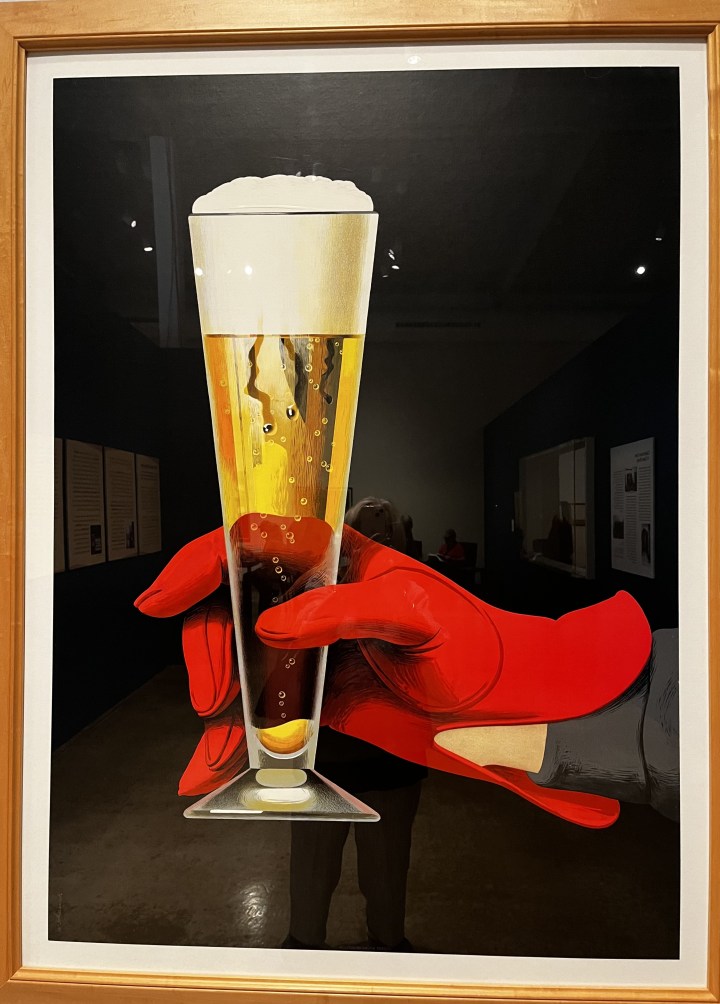
     Just recently, in honor of the Lone Star Brewery’s original inception 140 years ago, a new exhibit opened at SAMA dedicated to the history, art and architecture of the museum facility itself (see poster above) Not surprisingly, the slogan for this special exhibit is “Still Brewing Art,” which is consistent with the Museum’s stated mission to “… preserve, exhibit, and interpret significant works of art representing a broad range of history and world cultures, which will strengthen our shared understanding of humanity.”

     I am proud to be a member of this Museum community, but I also must admit to a personal memory of Lone Star. You see, after Prohibition closed the Jones Avenue facility, the Muchlenbach Brewing Co. of Kansas City bought the name and began producing Lone Star beer down on what is now 600 Lone Star Blvd. on the South side of San Antonio. Lone Star beer was made there from 1940 to 1996. When I was an undergraduate student here in San Antonio years ago, my friends and I used to go over to that Lone Star brewery on Saturdays to enjoy the free (and liberal) tastings offered there — no questions asked about ID. 

     Lone Star Beer is still produced here in Texas (by Miller Brewing in Ft. Worth, I believe), but it isn’t always easy to find, and almost impossible to find in other states. But, to my nostalgic delight, at the opening of “Still Brewing Art” a couple weeks ago, they served — what else? — Lone Star beer! And they didn’t ask me for my ID this time either.

comments 3

Chill!

 I am amused by the new Bud Light™ commercial. “Chill like you’re retired,” it proclaims just in time for summer. Sure thing. My husband and I are retired, but it’s 103º here in San Antonio and even our pool is at 92º! Now we like beer as much as the next Texan, but who are we kidding… Chill, really???

     When I first heard the commercial, it was sort of funny, but then the more I thought about it, the more I wondered what kind of stereotype was at work. Okay, so I get the gist of the chill claim that a “cold one” always helps to cool someone off  in the heat (though actually a non-alcoholic drink is far preferable for hydration). I also get the subliminal image of relaxing around a pool or on a beach in permanent-vacation mode (though I personally don’t know any retirees, including us, who are totally carefree and spend their lives on a permanent vacation — even if that is what the realtor promised them about that place Florida). 

     Then I thought that perhaps this slogan was a sort of double entendre alluding to the recent boycott of Bud Light™ by anti-trans groups that began back in April when a transgender woman and TicTok influencer, Dylan Mulvaney, promoted the brand on her Instagram account during March Madness. Now I seriously doubt that this meaning was the original intent of the ad, but “chill” seems to be especially good advice for everyone in these hot-headed days of hyper sensitivity and “woke” indignation.

     But I digress… Maybe I’m just being too analytical about a beer ad. After all, the whole notion of “retirement” does have a valid aspirational connotation, an element of hope and a dream of an easier existence, especially among those who are younger and struggling to get a leg up, to pay their bills and raise their kids. Most people who are under fifty seriously doubt that there will be any social security left by the time they are in their “golden years,” and we all know that defined-benefit employee pension plans have pretty much gone the way of the dodo bird.  According to the Survey of Consumer Finances (usafacts.org) about half of American households had no retirement savings accounts at all as of 2019.

     The more I think about this ad slogan, the more I realize that it is the stereotype of the retired person that I’m really questioning. Even though we Baby Boomers are the wealthiest generational cohort alive today, we aren’t all wearing plaid pants and riding around in golf carts. Come to think of it, none of my friends fit that image and only a few of them even play golf at all. We were the activist generation, after all; golf (and golf carts) are too slow and too much the “Mad Men” era.

     No, retired Boomers are much more likely to be found walking their neighborhoods for exercise and/or purpose, or out canvassing opinions for their HOAs, or running for local office. Some are still working, though probably not for pay, as artists, writers, educators, librarians, musicians, counselors, consultants or executive board members dedicated to philanthropic organizations. Since three-quarters of all prime-age women (ages 25-54) are in the paid workforce today, with 84 percent of them working full-time, all those activities in the community that used to be done by women at home and available during the day — at garden clubs, at church, in civic organizations, in hospitals, in soup kitchens, as  literacy volunteers and school tutors, and anywhere else free labor was necessary — are now shouldered almost exclusively by retired women. Volunteer activities can easily turn into more work and more stress than any full-time job, especially if you’re good in those roles. Believe me, I know.

     Some of my retired friends are grandparents, of course, and  every one of them has expressed, at one time or another, genuine worry about the future quality of life for their grandchildren. Their worries are rooted not in the current culture wars, but in very real fears about the economy, the climate, the international tensions, and the political disfunction and stability of our country.  Today’s retirees, especially the Baby Boomers, far from being worry-free and totally chill, seem especially concerned about their adult children and committed to helping them and their families.  Over seven million grandparents live in households with their grandchildren, and another 2.3 million grandparents are totally responsible for raising their grandchildren, often legally adopting them. These are senior citizens who are taking care of kids, driving carpools, cooking meals, doing household chores and contributing financially to their well-being. They are hardly retired.

    Every time I use “We’ve been busy” as a reason for why we haven’t done something or been available, our son responds, “You two are the busiest retired people I ever heard of.” Now I don’t know about the busiest — not a title I really want to pursue —  but I do admit that we aren’t sedentary, aren’t low-key and certainly not “chill” about ceasing to learn and grow and being committed to the things and people we care about.  Sometimes, in fact, like this week while trying to get this blog written and up on a posting schedule I impose on myself, I get downright stressed out!

     I need to go have a beer and chill.

comment 1

It’s Summertime

…and the livin’ is easy. So goes the song, and so goes life here in South Texas. June has come, but so far, the extreme heat has been delayed and drought has been mitigated. Instead, we’ve developed a rather sultry, somewhat tropical climate — exactly what the famous song always brings to mind. Regular rains and daily showers have replenished the acquifer, rolled back some watering restrictions, and rendered lawns and gardens lush for the first time in recent memory. It is wonderful.

     Our grass is green, our garden is producing, and summertime crops are already coming in: tomatoes, onions, green beans, potatoes, and of course, all the herbs right outside my patio doors. I have beautiful flowers — wildflowers, roses, and sunflowers — in the house all the time, and the bougainvillea are an explosion around the pool. If it weren’t for the chiggers and the mosquitoes, we’d have it made in the shade! Bless my husband, the Johnny Appleseed of all this beauty and abundance. The garden in full bloom lifts my spirits and makes me smile.

     It also makes me feel like “livin’ easy” and enjoying a time out, and I’m doing exactly that. I’m taking these June days slowly, recuperating from the very busy last few months of travel, houseguests, home repairs, and more houseguests. We aren’t planning anymore big trips this year, only perhaps a couple days in “the Big Easy” in July for our anniversary. It is so nice to wake up in the morning and realize that the day is mine more or less to do as I please. That is what I really call livin’ easy.

     As Melissa Kirsch wrote recently in The New York Times (“The Morning,” June 3, 2023), “Setting intentions for summer is the low-stress, seasonal version of New Year’s Resolutions.” In her article, Kirsch introduces the term “JOMO” (the joy of missing out) as the perfect antidote to the anxiety-inducing “FOMO” (fear of missing out). I happily learned about the joy of missing out during the pandemic, and so now, employing those same skills of carefree carelessness, I am determined to use this summer to sit and ruminate rather than run myself ragged.

     I do have a few things to think about, especially regarding my art quilting. I had already decided earlier after an exceptionally busy 2022, filled with exhibitions and a gallery representation, to take some time off to explore where I might be headed next in my creative life. This entails not only contemplation, but also a good bit of research about techniques and some serious self-criticism of my own work. My goal going forward is to do projects that challenge and excite me, not just those geared toward entry into specific shows and exhibitions. I want to establish my own distinctive style building on the skills and abilities that I recognize as my strengths, while also finding new inspirations to propel me into an expanded creative zone. 

     Closely related to all this is my website, where I also have some re-imagining to do. www.thenarrativethread.com is important to me, because it intertwines the “threads” of my art with the “threads” of my life, as stated on the Home page. I am a writer, first and foremost — have been for almost all my life — and I am committed to the discipline of posting regular essays (twice a month) in the Journal. But I really need to update the website as a whole, particularly the Gallery of my art quilts, to better showcase my recent fabric arts to which I devote so much time and attention. That means I have to do some “studying up” to improve my technical site management skills. Time and patience, peace and quiet — more contemplation.

     I have a few other “meditative projects” underway for the summer, as well. I’m also in the process of updating and reorganizing all my hundreds (yes, literally hundreds) of favorite recipes. My son had begun collecting family favorites into a small cookbook years ago and he even put out a couple new editions over time. But since that last “new edition” so long ago, I have attended the CIA in San Antonio, taken specialty cooking classes under the tutelage of some famous chefs, and come a long way myself as a home cook. Our family tastes have changed, and so have modern attitudes toward fresh ingredients and home entertaining. Even recipes get out-of-date, you know, and I now have stacks of new favorites in a messy pile at the end of my kitchen counter. They have to be organized and collected into a new, current version of our cookbook, and that entails editing the old versions in a data base while also adding new entries. Time and patience, peace and quiet …

     Finally, I am also currently bringing our travel scrapbook up to date. Since we hardly went anywhere at all during the pandemic, you would think I would have had plenty of time to catch up through all the pre-Covid trips foreign and domestic, but somehow all my attention shifted to daily activities at home rather than memories of excursions far away. Happily, we are now going out and about again, and I am allowing myself the luxury of reliving the joys of past destinations while also contemplating new ones. Scrapbooking is a fun hobby, and a travel scrapbook is an especially appealing diversion in an “easy-livin’” summer.

     Hope you find some projects you can tackle this summer without having to break a sweat. After all, the livin’ is supposed to be easy.