comment 0

A Gentleman Farmer

     May has been a busy weather month here in San Antonio. Typically, May always the most severe weather, notwithstanding hurricane season, and precipitation usually peaks in May. We have already had 10 inches of rainfall so far this year, which is the most in over a decade and which makes everyone hopeful.  Even so, all of Bexar County is still under Stage 2 water restrictions and is considered to be in a “moderate drought,” according to Eric Platt, a meteorologist for the National Weather Service in the Austin/San Antonio office.

     Yet, we know the heat is coming. In fact, we are already flirting dangerously close to the 100 degree mark and the summer hasn’t even officially started. Last year, we had 75 triple digit days, the most since records began in the late 1800s. Given the way our weather patterns have been going, the 2024 Old Farmer’s Almanac prediction for Texas is hardly big news: “Hold on to your umbrellas … and tune up your AC,” it advises. “Summer is coming early this year, and it may bring the hottest temperatures in recorded history.”

     Okay, so what else is new? The weather is becoming extreme everywhere, SouthTexas has always been hot as Hades, and people, including me, are generally tired of talking about it. After all, why worry about what you cannot control, much less can’t even see coming (such as the sudden devastating Derecho storm in Houston last weekend). Of course extreme weather events make me concerned about climate change, but more immediately, I always think about our poor dedicated farmers who live so vicariously from season to season, crop to crop, who try to make a living while dealing with the whims of Mother Nature. Theirs is a life of hope, despair and frustration that I can’t even imagine living.

     But I do get a small glimpse of that life in my dear husband. He’s a New Yorker who never even saw a farm until we started visiting my relatives in South Jersey as newlyweds but now, over the years, he has truly become a “gentleman farmer.” He has always loved nature, plants and animals and seems just intuitively knowledgeable about the natural world. He built a greenhouse at our first home and, ever since, we have had enough acreage for lawns, trees, and gardens at every house we’ve owned (including here). Most of those years were up East in Connecticut, which came with it’s own winter weather challenges, and then we moved here to San Antonio where the “plant hardiness zone”  is the exact opposite of New England’s.

     When we first moved here after retirement, while backhoes were digging a pool in the back yard that was then no yard at all but an expanse of  dirt, dust, rocks and limestone, a dear friend from Connecticut came to visit.  She stood on our patio, looked out and said, “My goodness. What ever possessed you to move to such a godforsaken place?” I have to admit that even though I am a native Texan, I was thinking the same thing about my darling husband’s insistence while house hunting on “some property” for gardening. But he, my Gentleman Farmer, is nothing if not persistent, patient and optimistic. He had a vision, and he knew that he could transform our acre of parched land into a garden of delight — maybe not a lush garden, mind you, but certainly an orderly and productive one.

     And now, here we are years later with a yard that is the envy of the neighborhood. We have raised beds of flowers and vegetables, we have a stone meditation area called “tranquility base” among a cluster of trees, we have flowering crepe myrtles along the back fence and Texas lilacs in bloom along the side property lines, tropical plantings around the pool, and even a chef-proud herb garden right outside our patio doors. After years of study and trial and error and involvement with the San Antonio Garden Center, my dear Gentleman Farmer has become a master gardener himself. Does he spend hours outside every day, even in the winter as weather permits? Yes. Has he had failures with new experiments? Yes. Has he lost trees and shrubs and gorgeous flowers in un-anticipated weather events? Yes. Have some crops failed and favorite plantings like fruit trees and gorgeous hibiscus met their demise? Yes. But he has the patience and the determination to try and try again. That is the essence of a farmer’s resilience, no matter what the crop.

     Now let me be clear here. My husband and I are not farmland people; we are city people. We like the hustle and bustle of big metropolitan areas, the delights of fine restaurants, the cultural enrichments of museums and live theatrical performances, and beyond that, world-wide travel. Personally, I prefer indoor activities, such as reading, writing  and art quilting though I do love the natural world. I just don’t necessarily want to be out in it, in the heat, the dust, the cold, the bugs, the rugged terrain — eww! 

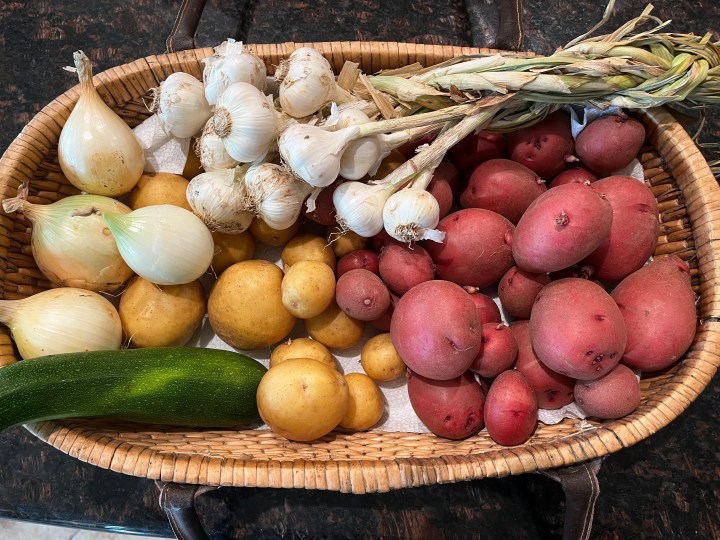
    Believe it or not, though, even if I’m not a pioneer woman, I can also cook and clean, can and preserve, wash and iron, sew and craft, and generally do all the traditional homemaker things with the best of them. I never took home ec in high school, but as a newlywed, I learned to cook because I love to eat; I learned to sew because I love beautiful fabrics and interior design; I learned to clean because I can’t stand clutter and dirt; I learned to can and preserve because I want to enjoy all the freshness of those peppers, onions, tomatoes, strawberries and other produce that can’t be preserved otherwise. And I absolutely love all the roses and lilies and mums and poppies and wildflowers and irises that my husband grows for me, with which I make floral arrangements in our home (which I also learned through the San Antonio Garden Center), and all the fruits and vegetables, the potatoes, string beans, tomatoes, squashes, corn, peppers, onions, garlic and more that he cultivates in all those raised beds. (Yet, even though I like wine, I did draw the line at stomping the grapes he grew; we just made jelly instead.)

     In a world full of fear, chaos, and controversy, the eternal optimism of all farmers, even gentlemen farmers, gives us a ray of hope for the future. I embroidered a pillow for my husband with a quote from Audrey Hepburn: “To plant a garden is to believe in tomorrow.” Gardens may bring but small joys amid life’s greater disappointments, but sometimes they are all we have to cling to. 

     And boy do those fresh spices gathered from outside my patio door make  great Italian food!

comment 0

Letters to Live By

  Letters. Gifts of thought for an audience of one — you. Neither as transient as a phone call nor as expedient as an e-mail nor as perfunctory as a text message, a personal hand-written letter is valued precisely because it isn’t technological, because it reminds us of days when people took the time to think, to care, and to deliberate before they spoke. 

     In the time-honored tradition of personal correspondence, words mean something: they are chosen, often with great pains, to impart just the right meaning. Indeed, one of the greatest consolations of receiving a personal letter is that it can be saved and savored over and over again, its lines revealing yet another layer of meaning each time it is reread. Who among us doesn’t have a stash of letters somewhere, however small, that were just too special to throw away?

     That specialness is inherent in letter-writing because knowing that another person took the time to write this message, this note, this card just for you makes you feel special. (And that, by the way, is why so many people, including me, are bothered by these single-spaced, long-winded computerized “family yearly resumes” about people whom you do not even know that masquerade as personalized holiday greetings.) Writing should be personal, as well as informative.

     Specialness works the other way too, in that a letter can’t help but reveal the writer. Whether typed on customized letterhead or written by hand on idiosyncratic stationery, rare is the letter that fails to present the personality of its author on the page. And I don’t know of any avid letter-writer who isn’t an absolute fanatic about paper and pens and ink and envelope size, and even the design of the postage stamp! We are as fastidious about all that as we are about the clothes we wear.

     And then there’s what’s inside: the words. All of us are so readily seduced by the freedom, and the hubris, of the opportunity for uninterrupted discourse that we find it almost impossible to conceal ourselves. Even in the most business-like letter, pretense is hard to  sustain past the salutation and the first sentence or two. Wittingly or not, through tone and mood and choice of language and expression, our fantasies and fears and foibles will reveal themselves, even more so when the receiver knows us well and can “hear between the lines.”

     The quiet, private nature of letter-writing allows many people to be more truly themselves on the page than anywhere else. The verbally reticent are more articulate, even humorous and playful, because they have time to think about what they want to say. Conversely, the more verbose among us (myself included) become calmer and more succinct without the immediacy of speaking. And almost all of us find it easier to write about sensitive topics — love, hurt, fear —than we do to talk about them. We are consoled by the fact that if we don’t get the words right the first time, we can start over and try again, notwithstanding the fact that once written and sent, words can’t be retracted (which is why one should never send an angry letter immediately)..

      From the time I was a youngster in school with pen pals and far-away cousins, to the three years of engagement to my far-away fiancé, I have always been an avid letter-writer. I have saved years’ worth of letters and notes and postcards from my husband, my son, old friends and colleagues, former students and their parents, and even some well-known people. Taken together, they run the gamut of purpose and emotion: accolades and praise, disappointments and regret, anger and love, acceptance and rejection. Were they all organized into some sort of chronological order, which they probably never will be, they would offer a complete biography of my interpersonal relationship, with some interesting insights on history, work, and culture, as all letters do.

     The continued existence of these letters and cards in cartons and file cabinets have been an immeasurable source of joy and reflection for me over the years, even though I don’t dig through them regularly. But each time I come across one of them in a drawer or a folder, I am immediately transported back in time and circumstance while the real or imagined face of the writer floats in my mind. Of course, letters from those who have died are especially sacred, even if they were fussing at me when they wrote them. Their lessons continue to be letters to live by.

     My long history of letter writing is at least partly responsible for turning me into a professional writer as an adult, I’m sure, but it is most certainly responsible for teaching me to appreciate the unique power of self-expression as a way to stay connected to a lifetime of friends and family members who are scattered all over the globe. That I have maintained such close relationships, even sustaining my engagement over a three year period while my fiancé, was out of the country, is a tremendous source of satisfaction and pride for me.

     “People don’t write letters anymore,” or “they don’t send cards or thank-you notes anymore.” I hear these laments all the time; perhaps you’ve said them yourself. Remember, though, that you have to write letters in order to receive them, and that you have to encourage written correspondence among your friends and family (as I am doing even now) so that it becomes a routine, even a preferred way of communicating.

     In this hectic, harried world, what could be more satisfying than spending a few minutes alone in private conversation with someone dear to you? And at still a few cents an ounce, what other pleasure is so popularly priced? So, if you are one of those kindred souls who continues to persevere in penning personal messages even when those you care about claim that they don’t have the time to reciprocate,  then I hope this will validate your efforts and remind you why you persist in writing letters to live by.

comment 0

F R I E N D S

     From September, 1994, to May, 2004, a very popular, award-winning television sitcom aired on NBC called “FRIENDS.” It was about six friends in their early 20s and 30s who lived in Manhattan and it followed the ups and downs of their daily lives.. It explored questions of sex, love, careers and relationships at a time in life when everything seems possible and your friends become your family. 

     The show was light and funny and it made stars out of Jennifer Aniston, Matt LeBlanc, and Matthew Perry, among others, but there were also poignant moments with important messages. Beyond the show’s decade-long popularity, it was also critically acclaimed. As an expert in pop culture from the University of Buffalo wrote, “Friends is one of those rare shows that marked a change in American culture.” The images of young people and the lifestyle they depict centers around creating and sustaining relationships between friends running their own lives and relying on help from each other. (Wikipedia article, “Friends”)

     Hmmmmm…. Sounds like my life, my whole life, as an only child with a single mother and only a couple relatives even living in the same part of the country. My earliest friends were made before I started first grade and, one of them, who was later the maid of honor at my wedding, is still my friend. Our mothers were friends, our grandmothers were friends, and we actually played together in a playpen as toddlers. We still talk regularly even though our lives have taken remarkably divergent paths over seven decades.

     My larger group of childhood friends continued to be made throughout elementary and high school and yes, except for one of my earliest, closest friends from first grade who has since died, we have all stayed in touch regularly too. (Actually, we  now see each other more often since I have retired back in Texas.) Next are my college friends, all made in my freshman year and three of whom have remained consistently close to me all these years, (again, except for one who recently died). On and on it goes, from those special friends made during my early-married years, to those found in the various places in the country that we lived, to those developed  among colleagues and cohorts in my adult and professional life.

     Believe it or not, though most of these people do not live near me, haven’t for years in most cases, I’ve managed to sustain a relationship with many of them over time and distance and in spite of vast differences in backgrounds and lifestyles. Of course, not all these are intimate friends, if they ever were, but many are a great deal more than simply names on a Christmas card list. We stay in touch, we call or write occasionally, we visit when one of us is in the other’s “neighborhood,” and we show up, at least emotionally, when needed.

     I get amused when the author of a book or an expert on the art of friendship touts a relationship of 20 or 25 years’ duration as being so exceptional. Are you kidding? I’m talking friends of 70 plus years and counting all the way down to my “newest friends” made in retirement of only 17 years. If it sounds as though I’m boasting, well, I am. As the saying goes, you can’t choose your relatives, but you can choose your friends, and for the most part, I think I have chosen wisely. 

     From the very beginning, my friends were cultivated because they were important people in my life. Whether they were classmates or work colleagues, teachers or mentors, neighbors or common community members, I chose them because they inspired me to grow and learn and I trusted them to help me be my better self. (Now that I think about it, that is exactly the reason I married my husband 55 years ago!) As a line in the lyrics from the Friends theme song states, “…even at my worst, I’m best with you.” (I’ll Be There for You,” recorded by the Rembrandts, 1995) I should add to that sentiment: “Even at my worst, you will forgive me and accept me for who I am.”

     It takes work and attention to sustain any relationship, never mind a close one, but I have always considered the effort worthwhile and am proud of the diverse “cadre of compadres” I know and love. Of course, people change and can grow apart, sometimes seriously, and  unfortunately I have lost two or three once-good friends along the way. Sadder still are the greater number of good friends I have lost to mortality, many at younger ages years ago from totally unexpected causes. I miss them all, even those who disappointed me at some point, but I remember them and am still grateful that they were part of my life.

     There is an old Spanish saying going back to the 16th – 17th century: “Muéstrame quiénes son tus amigos y te diré quiénes eras.”  Show me who your friends are and I’ll show you who you are. I have always loved this saying and used to often quote it to my students. So I say go ahead. Look at my friends. I will be proud of the comparison you make and it will be true.

comment 1

Introducing …

     She arrived unexpectedly last Friday, just like my son did years ago — don’t they always. But she is everything I wanted, and more — just like my son was. And in fact, my now-grown son was actually there with me at the dealership for the delivery.  

     Introducing my new Cadillac 2024 CT5 Premium Luxury, with a V-6 dual-turbo charged engine, in Raven Black with Sahara Beige interior! She is beautiful, if I say so myself.  I have named her “Sassy,” because she is smart and fast, just like me and just like I need her to be going forward. Of course, given all the new technology in cars since 2011, there is a significant learning curve for me to measure up to her smartness, but I’m getting there. A couple technology lessons at the dealership, a quick read through the owner’s manual (yes, thank goodness, they still provide one), and some fiddling around with settings and dashboard buttons while idling in my driveway are gradually getting me up to speed on information. Some inaugural drives up on open country roads are going to get me literally up to speed (but not this weekend with all the eclipse traffic here where I live).  

     Anyway, it’s good, it’s exciting, it’s necessary, it’s time. As one ages, it becomes not so much  about the age at which you need to quit driving, but rather about the time at which you have to recognize any physical and/or emotional limitations that impede safety. Any limitations at any age, of course, result in a waning of driver confidence behind the wheel and that makes any reasonable person afraid.. For example, I have friends who will no longer drive after dark because of limited peripheral vision or eye disease; friends who don’t drive on freeways because of heavy traffic and hesitant defensive-driving responses; others who won’t drive on  inter-states because they are intimidated by big trucks and high speeds, especially in bad weather. Those living in or near a big city or in a big state like Texas, where public transportation is virtually nonexistent, end up becoming daylight prisoners of their immediate neighborhoods or simply homebound altogether. 

     Yes, years of driving experience count, but self-confidence makes, and has always made, the difference between a good, able driver and a poor, timid one. I’ll admit that I am an aggressive driver, but when you live in place where other drivers are also aggressive, you need to be able to hold your own. And a big part of confidence, for me at least, is an automobile that drives the way I drive and one that I can absolutely trust through any and all driving condition. “Sista” did that for me, taking me through fracking country passing 18 wheelers, through floods and hurricanes and dust storms, in winds and fog and mud rain, over ice and hoar frost and even snow. Whatever it was, whatever the urgency that forced me to be behind the wheel at all, I knew I could count on her. “Sista” saved my life more than once.

     These days, the incredible navigation, communication and safety technology built into new automobiles should inspire even more confidence in the driver, as long as the driver learns how to properly manage it all.  It’s early yet in our relationship, but already I have a good feeling about “Sassy.” I hope she will prove as unfailingly steady and trustworthy as “Sista” was. As someone who lost her young father in a fatal car accident on the highway to Houston when she was six years old, I am keenly aware that my life, and the lives of those with me and around me, depend on it.

comment 0

Springing Forward

  Spring has come to South Texas, though it isn’t a spring as most people visualize it.  Spring here means clean-up, much like the fall season in New England, with leaf blowers whirring and edgers shaving and big lawnmowers riding over and over the grass to mulch the detritus of winter. Live Oaks have shed their leaves and covered the ground in February and then, in March, the buds start to appear for new growth. All the lawn maintenance crews are out and about and all the neighbors are assessing the damage from this winter’s brief, but significant, freezes. And so here we go again, another season of unexpected surprises in South Texas, which actually, has always characterized Texas weather.

     What has been nice these days is that the sun rises a little after 7 and so it is daylight by the time I get myself out to walk with the girls at 8. The daylight wakens me early enough that I can go in, do my recumbent bike, lift weights, and even strike some yoga poses before heading out for my walk. But, alas, that will change this weekend with the return of Daylight Savings Time. Springing forward an hour means that, at least for a few weeks, it will be dark again in the morning. Bummer. I am not a morning person to begin with.

     But what has come seemingly early this year are the bluebonnets, god bless ‘em. They are suddenly everywhere — down the side streets in my neighborhood, along all the highways and interstates, even in patches on individual farms and ranches. They seem especially plentiful this year — not sure why — maybe because there were a couple really deep cold freezes, and then a lot of rain in earlier January. A mystery, for sure, especially since grass and lawns aren’t yet green. But I’ll take it. Next to the expansive Texas sky, the bluebonnets along all the roadways are the most  beautiful, spirit-lifting signs Mother Nature has to offer. 

     So, I go down a side street where I walk every morning and where the bluebonnets are plentiful in the spring. I take my floral clippers, so as not to rip up the flowers by the roots, and I gather enough bluebonnets to make a bouquet for my kitchen and a small one for my desk. In Texas, if the law is the same as it was when I was growing up (I’m not sure it is, but I don’t care), people are free to cut wildflowers alongs roadsides as long as they are not along public Texas highways where TXDOT continues to seed them each year (and, given the speed limits, where you would be killed if you tried).  If you cut them early, like now, they are tall and sturdy; as they grow taller and stronger, over the next couple weeks, however, they block the sunlight for the ones coming up later, which are then shorter and weaker.

     As I have written here before, when I was a kid, my Mother and I would go down to Colletta Creek, out on the country roads south of Victoria, and we would pick bluebonnets and Indian pinks and Indian paintbrush by the buckets-full. There were sooo many. The biggest worry was not replenishing the beds, but the snakes that could be lurking underneath. This was always the week or so before Easter, and then we would come home and make huge wildflower arrangements for the house. I would use the leftovers to “feather” my Easter nest in front of the fireplace and the flowers would last, somehow, for days! 

     Wildflowers were the ultimate symbol of spring, but a distant cousin of ours, Mrs. Ernst, cultivated a yard full of Easter lilies for sale every year. A yard full — front and back, tall and white, like trumpets blowing in the breeze. Still can’t imagine how she did that, since I can’t ever get my purchased Easter lily to grow again even when I take meticulous care of it and try to follow all the instructions for saving and replanting. Anyway, from Mrs. Ernst we had vases full of regal, white Easter lilies in the house, which also lasted incredibly long. You don’t see Easter lilies as cut flowers anywhere anymore, and you only see a few potted ones for sale in garden centers for a short time. People used to put fresh lilies on gravesites at Easter, but you don’t see that anymore either. Everything these days is artificial — ain’t that the truth!

     Traditions, practices and, of course, trends change over time. Easter in Texas was always about lilies and wildflowers, new outfits and Easter bonnets, bunny nests and baked hams, holy week and the stations of the cross, and no meat on Good Friday, even if you weren’t a Catholic. Some of us hold on to the remnants of these practices in an attempt to keep faith and hope alive. 

     And then we spring forward from there, as in this weekend, in an effort to save the daylight in our hearts.

comment 0

Enjoy Now!

  I have always been a worrier, perhaps because I have always lived for the future. Plans, goals, benchmarks all dominated my thinking for many, many years, not only for myself, but for my family, my students, and my colleagues. I was so goal oriented that you would have called me driven. But then, how else would I have accomplished all of my goals and dreams from youth, as well as my other goals along the way into adulthood. That was until retirement; then I had to construct a whole new set of plans for the future. I would travel, I would write, I would continue learning, I would spend time with my friends, and I would support and enjoy my family. But even with those happy plans, I couldn’t get rid of worry. What if…? was always in the back of my mind.

     As one ages, one hopefully learns from experience that the things most feared rarely happen, while the things one never sees coming are the very threats that cause one’s undoing: death. loss, illness, natural disasters, domestic catastrophes, random accidents. As the old saying goes, “Whatever CAN go wrong probably will.”  Nevertheless, with the benefit of age and hindsight, patterns emerge, priorities begin to assert themselves, and the truth becomes remarkably clear: the past is over, the future hasn’t happened yet, and the present is all there is. 

     There is a big difference between worrying about the future and striving toward it. The current prevalence of mandates to “live in the present,” “practice mindfulness,” “develop an attitude of gratitude,” “live one day at a time,” “take time to smell the roses,” — all these mantras, while clichéd perhaps, contain a fundamental truth: you can’t foresee the future, and you certainly can’t control it.  All you really have is the present and, if you spend all your time worrying about what might happen in the future, you essentially squander the time you have to live right now.

     Younger generations, Millennials  (b.1980 – 1994) and Gen Z (b. 1995 -2009), have long since recognized their present reality and acknowledged rational limits to future possibilities. Some might say it’s because, sadly, that younger people don’t have the high aspirations or see the unlimited prospects that previous generations did. While that’s probably true, it’s still sad. Certainly, we Boomers thought we could have it all/do it all/be it all and we would kill ourselves trying. Yet, there is a certain solace, even a quiet power in recognizing limitations amid the reality of what is. “It is what it is,” as everyone quips today. Ironically, we are all, old and young  alike, now coming to understand that. My young friends, ie. my former students, call it “living in Realville.” Sounds right to me, though I have a more classic name for it.

        Stoicism is a school of philosophy that flourished in ancient Greece and Rome. Essentially, it professes that a well-lived life is achieved by the practice of virtue. In other words, it is not what you say, but how you behave that matters, and it is not what you accumulate, but what you do with what you accumulate, because things are neither good or bad in themselves. One of the main virtues of Stoicism is living in the present, and so “It is what it is” is merely the contemporary expression of that philosophy. Thinking about, worrying about, stressing over the past and the future is futile. It’s our loss when we nonchalantly ignore the positive realities of the present — the beauty of the sunrise, a clear blue sky, the crystal oceans, a magnificent landscape, the presence of the people we love — all the simple, natural wonders before us.  Appreciation and awareness of the now is perhaps our last hope to some solace and sanity in a complicated, chaotic, and often ugly world.

     Now I’m not suggesting that accepting the realities of present life situations is always easy; far from it. In times of great stress and difficulty, acceptance can be one of the hardest, most daunting challenges we face. But the powers of appreciation and awareness — and I don’t just mean “gratitude journals” — may soften the landing from a sudden fall into chasms sadness and desperation. I’m talking about waking up grateful for another day, deciding how to make that day the best day you can, and then embracing whatever is available that might make you happy. 

     Perhaps it is a new outfit, or an additional decorative touch to your hone. Maybe it is a small day trip, or reading a really good book, cleaning out a closet or talking to a friend. It doesn’t have to be a lavish indulgence or an expensive purchase; it just has to be something satisfying, like eating chocolate ice cream or watching a good movie or looking for shooting stars.

     I have been going through somewhat of a difficult time myself lately, and have thought a lot about what can make each day not only tolerable, but pleasurable and meaningful, because each day is all we have. There is a philosophy called “presentism,” which literally insists that the present is the ONLY reality and that nothing else, past or future, even exists. I can’t quite go that far, because we are all human, we all have memories of our past, and we all sometimes worry about the future whether we want to or not. But I have, at this late stage in my life, finally found a new mantra for living with life’s vicissitudes: Enjoy now, worry later!

     And that’s what I intend to do — especially when my new car arrives.

comment 0

Not Just a Figure of Speech

Cadillac was founded by Henry Leland in 1902. It was named after a French explorer, Antoine Laumet, a commoner who presumptuously changed his name to that of a nobleman, Antoine de la Mothe Cadillac, when he founded Detroit in 1701. Hence, the moniker “Cadillac” as a symbol of noble excellence was embedded in the brand from the very beginning. 

     Over the years, the term Cadillac as a figure of speech has been used to laud  everything from Obama’s healthcare plan to comprehensive insurance coverage, from WW II fighter planes called the “Cadillacs of the skies,” to everyday consumer items like Huffy bicycles and home appliances. Even the extra large shrimp from the Texas Gulf Coast are called Cadillacs. While the reputations of the various models of the car itself may have waxed and waned over the years, the Cadillac name has endured as a synonym for luxury. 

     Today, it is the third most preferred luxury brand after Lexus and BMW, and its performance and reliability rank up there with the best of all autos. Currently, the CTS 5 (the latest incarnation of the Catera Touring Sedan first introduced 15 years ago) has a 5 star safety rating in all three NHTSA (National Highway Traffic Safety Administration) safety crash tests. Cadillac is owned and manufactured by General Motors and the cars are still made in the United States; way back in the 20th century, Cadillac was the first to introduce the idea of interchangeable parts to the industry, which revolutionized car production forever. 

     Incidentally, interchangeable parts among all General Motors brands, and Ford Motor Company brands, also explains why Cadillacs and Lincolns became the luxury vehicles of choice for wealthy landowners, ranchers and oilmen living and working out in the vast, remote areas of Texas. Rich or not, nobody wants to break down in the rural hinterlands driving a Maserati. 

     But back to Cadillac, which is where I came to be after pondering Sista’s looming repair bill. Since I hadn’t anticipated being in the market for a new car, I was unfamiliar with current models so I spent time on line researching what Cadillac was offering.  (According to market research data, car buyers these days spend approximately 14 hours researching their purchases on-line before actually shopping.)  A visit to my dealership to look at cars confirmed what I had seen. All the hype and most of the inventory featured the Lyriq, an EV, and the new XT6 SUVs. (My husband drives an XT5.)  Among the 134 vehicles on my local dealer’s lot, there was a smattering of Escalades (not for me since I’m not a rock star or a politician) and a few sedans like Sista, now called the CT4 and the CT5. It was clear that if I bought a new Cadillac, it would have to be one of those. 

     Even though the lot was not filled to capacity, it was still overwhelming to me considering how totally empty it had been all during Covid and for months thereafter. I had arranged to meet a sales advisor, but had also asked our son to meet us because he’s the real car enthusiast in the family and is always up on the latest automotive trends. Plus, he actually likes doing this sort of thing!

     So, we gathered for the test drives. First up was a CT4 turbo charged sedan. “Yes, it’s a 4 cylinder engine, but believe me, you’ll be surprised by the power,” said the salesman as we piled in. Sitting in the driver’s seat, I noticed that even with all the new technology and “infotainment” in the dashboard, the car did have some familiar features and a nicely-done interior. But it seemed small, close; the top of my head barely cleared the sunroof mechanism and the console between me and the passenger seat was small. 

     We took off.  Before I even exited the dealer lot, however, I was already feeling claustrophobic, though I did have to admit that there was a certain get-up-and-go when I pressed the accelerator. The ride was “zippy,” more like a sporty Baby Beamer than the smooth glide of a Cadillac, but then, as we headed up the on-ramp to the Interstate, there it was: the labored whirrr of the 4 cylinder engine, turbo or no turbo. “Nope,” I said. “This isn’t going to do.”  

     Back to the dealership. There I learned that if I wanted a 6 cylinder sedan, it had to be a CT5 V-6 dual turbo and there were only three of those models on the lot. The salesman pulled up in a white one with Sahara beige interior. Again we piled in, much more easily this time, I might add. We took out on the same route as before, but this ride was so much more comfortable. The car was only a few inches wider and longer than the CT4, but what a difference. The interior was roomier and the engine was smoother — no whirs or grinds as we ascended the on-ramp. “Yes,” I said, “this is much more like it.”

     We went back to the office “to negotiate.” I did like the car, but there were two main problems with this particular vehicle: there were some upgrades that I didn’t want and didn’t want to have to pay for, and then there was the biggest drawback: it was white!! Summit white!! I hate white. We discussed price, incentives, trade-in, but I kept coming back to the fact that the car was white. Finally he asked exactly what it would take for me to be “color blind.” I gave him a number and, surprisingly, he agreed (after checking with his boss). It was a good deal but, ultimately, I was still reluctant to confirm the sale that day. He wasn’t happy, but that’s the the way it goes…

     In between calls from the salesman and his boss, and in discussions with my husband and son, I continued to think about all this for a few days. This was a big decision and it boiled down to an existential issue: if this were to be my last car purchase, should I “settle” for something that wasn’t exactly what I wanted?

     My son suggested we get on line and configure the exact CT5 V-6 for me in Raven black with Sahara interior, a Bose sound system, and 20 inch wheels. I had no idea that nearly 30 percent of new car sales these days are completed this way in the “build-and-buy” programs of auto manufacturers through their local dealers. (No doubt this is another now-preferred practice resulting from low inventories during Covid.) Anyway, up she popped on screen: my next “Sista.” The following week, I took the order into the dealership. They got the sale and I’m happy. The car will be here in the spring.

     All I have to do now is think of a new name for her. I’m excited. Its arrival is something to look forward to, though I am still driving Sista with nostalgic affection these days. For me, Cadillac is not just a figure of speech, it is a love of the cars and a loyalty to the brand based on 40 years of good experiences. 

     And FYI: No, I am not getting any incentives from Cadillac for these posts. 

comments 5

About My Sista!

  I drive a 2011 Cadillac CTS V-6 , 3.6 L. She is raven black with ecru leather interior, she has a little over 100,000 miles on her, and she flat moves — in and out, over and under, around and through. I have driven this car through floods and hurricanes, hoar frost and ice storms, light snow and mud rain, debris-hurling winds and fog so dense that I couldn’t see the car in front of me. I have gone from zero to 60 in a few seconds and passed 18 wheelers pushing 100 mph. I have driven long miles in several states and long, hard miles all over Texas, especially through fracking country. This vehicle has saved my life more than once and I trust her implicitly. 

     In short, I love this car. I call her “Sista” because she has been, for 13 years now, my only companion, my sibling as it were, driving those hard miles back and forth to my hometown of Victoria to take care of my aging Mother. Truthfully, memories both good and bad of my retirement years here in Texas are heavily associated with this vehicle and, while I don’t generally form an emotional attachment to a physical object, I have to admit a real affection for “Sista.” I have taken good care of her and she has taken good care of me in return.

     So it was that a few weeks ago I found myself dismayed by the sounds she was suddenly making: was it arthritis? In spite of her good looks, was she suddenly showing her age? Part of it might have been the cold weather, as it often is with arthritis of any sort, but then, when it got warmer, the noises didn’t abate. So I called up my Cadillac service manager (with whom I have a long and steady relationship) and complained: “My car sounds like I’m driving an old bed with a mattress whose springs have sprung. Maybe we need a lube job or some shock absorbers?”

     I took Sista in for an evaluation. She was there for diagnostics for a couple days before my service manager got back to me. Yes, no surprise that she was a little creaky because all the struts, shocks, links, control arms, stabilizers, even the sway bar (whatever that is) — all original to the car—  needed to be replaced. And oh yes, while we were at it, there was the matter of the 100,000 mile routine maintenance that was now a bit overdue — fluids, filters, spark plugs, disks, wiper blades, etc. And I needed an oil change. 

     I was sitting down at my desk when he called, and it was a good thing because then I didn’t have far to fall when he gave me the estimate for all this: a tad under $8,500! While I was exclaiming in shock and starting to hyperventilate, he was quick to add that I didn’t have to do everything at once. The routine maintenance should be done now, but I could tackle the parts replacements bit by bit over a few months. “The creaks and groans may bother you, but the car isn’t going to fall apart or leave you stranded anywhere because it needs shock absorbers,” he assured me.

     I guess it was my heavy breathing and sudden silence that prompted him to add, “Why don’t you think about this and call me back when you decide what you want to do?”  

     Think about it indeed, and talk about it. I vacillated back and forth all day long. I called him back with questions, then got a valuation of my car, then called back with an initial go ahead, then called again to withdraw it. Everyone in the discussion, the service manager, my husband, and my son, was surprised at my indecision because they all realize how much I love Sista and they all know that she easily has another 100,000 miles or more ahead of her. But still …

     Lest you think this is all an ado about nothing, let me give you some backstory. I have been driving a Cadillac for 40 years. With the exception of my very first one, they have all been black with a light interior and a big engine. I drove Eldorados until they quit making them, and then I reluctantly moved into a V-6 when I bought the CTS. I have been driving since I was 13 years old (with a learner’s permit allowed in Texas at the time), and have always driven GM cars — first Pontiacs and then Oldsmobiles before Cadillac. And, lest you think I am some road-raging, gas-guzzling, speed demon, I hasten to add that I have never gotten a ticket and I have never, thank god, had a major accident. But I do insist on a car that will get out of its own way.

     These cars drive the way I drive and they possess the speed and the agility to drive defensively in the 16 lane freeways and 85 mph speed limits of Texas. They make me a confident driver and, at this point in my life, I don’t plan to change horses in the home stretch. But let me tell you that I was NOT ready to buy a new car right now. First of all, I hate buying cars: the whole “let me talk to my manager” routine, along with the test driving and the yada-yada-yada of negotiating price and then the rigamarole of financing. Even when you know what you want, it’s a hassle. Years ago, I used to just call up my Cadillac salesman at the local dealership and say that I wanted “another one.” But of course, these days post-Covid and with SUVs and EVs dominating the market, there is not likely “another one” to be had. 

     But back to Sista. I decided to get the oil changed and then to go pick her up and bring her home. Even then, with the cost of the diagnostic and the oil, I had a tab of just over $300. And that made me think about this whole situation. Even if I do all the work and Sista is “as good as new” for a while, there will inevitably be more repairs and maintenance along the way. Sure I love her and she can be on the road for another 100,000 miles or more, but can I?  How much more will I spend on upkeep in the coming years? And then, will I find myself approaching 80 years of age and having to buy a new car for however long I might be driving after that. Does any of this make sense?

     So now, a simple car repair has become an existential dilemma, forcing me to think about the future and to face the fact that whatever I decide and if I buy a new car, it is likely to be my last. I’m going to have to mull this over with Sista. Stay tuned.

comment 0

Savoring the Small Things

    I have never been person who clings to the past. I’m not terribly sentimental and I carry  forward neither grudges nor regrets. When I recall the past at all, it is because some small reminder, a photo or a song, conjures up usually happy memories of a person or a place that make me smile. Unfortunately, I have several friends who live perennially in the past, and as we age, they seem to disappear further and further into it. It’s probably no coincidence that Alzheimer’s patients regress in the same way.

     I have lived in the future all my life. My father died when I was just six years old, and so I learned early on that things change suddenly and that nothing is forever.  My “go like hell” race toward the future is an obvious result of this early trauma. My whole life has been about “what’s next”? And, as I’ve grown older and most of my goals have been achieved, I have found it increasingly difficult to settle into the “presence” of my life, especially my retired life.

     And then Covid came along. Funny how things happen. We basically sequestered ourselves for three years, and I found the isolation somehow comforting, and surprisingly creative. It was like a great, long snow day: no responsibilities, no social obligations, no travel, no guests, no plans, no  nothing. An excuse for just being. You couldn’t visualize the future, so you couldn’t live in it. It was all here and now, and for the first time in my life, that seemed to suit me just fine. Finally, all the admonitions to “live in the present,” to “take one day at a time,” to go slowly “step-by-step” and “take time to smell the roses” began to seem possible. 

     We’ve been hearing about “mindfulness” for years now, ever since Jon Kabat-Zinn, a Ph.D. professor of medicine at the University of Massachusetts  medical school, founded the Mindfulness-Based Stress Reduction Program in 1979. Originally intended to help treat a variety of conditions in both healthy and unhealthy people, mindfulness practices have now become so commonplace both in healthcare and in popular culture as to border on cliché.  Of course we all need to pay attention, but to everything? Could it be that heightened attention to every event and experience collectively serves to contribute to a national epidemic of anxiety and depression?

     Maybe there’s another way. I’ve been reading and hearing a lot lately about a new movement afoot called “savoring.” While savoring is also a form of present-moment awareness, it is different from mindfulness in that it focuses on the positive and pleasurable rather than on all present-moment experiences. It is a matter of distance vs.intimacy, I think: mindfulness encourages people to observe their own experiences and thoughts in a more detached, objective way, whereas savoring promotes a deepening engagement with experiences that are specifically pleasurable. The theory is that the habit of savoring the moment, however fleeting and even under stressful conditions, can reduce overall anxiety by releasing positive emotion.

     Developing positive emotions during periods of high stress and anxiety in your life is not as simple as it sounds, however, and involves a great deal more than just the self-help advice found in books like The Power of Positive Thinking (Norman Vincent Peale, 1952).  Given the horror and chaos of the world around us today, telling someone to “be positive” is akin to telling a depressed person to “just cheer up.” Meanwhile the politics of fear and threats of violence and retribution that dominate our national discourse do nothing but promote the negative emotions of a primitive “fight-or-flight” response to everyday problems. Not a productive way to build resilience.

     Savoring, on the other hand, prompts us to slow down, be quiet, and consider alternative ways of  handling even difficult situations, perhaps even to find some positive meaning in them. We might, for example, savor the beauty of nature and  the sunrise of each day while stuck in heavy traffic, or we might notice the kindness of a stranger in the supermarket amid a long check-out line. We might savor our home environment through organizing and redecorating, appreciating anew the pleasure and security of our everyday surroundings. We might savor the thrill of anticipation of a future plan or purchase, or even relish a bit of sudden good news that we haven’t yet shared with anyone else. We can savor the meals we cook, the books we read, the memories we have, and above all, the people we love. We can let all the other nonsense go.

     To live in the present, you have to find those sustaining moments in your life and let go of the things that you cannot reliably anticipate or change. January is a good time to try to accomplish this, because January is a “non-month.” It is dark, cold, uneventful, and usually a quiet time, a month of less is more, much like the months of Covid were. Here we can find a respite from the craziness and chaos of the holidays, and if we turn off our cell phones and the incessant noise of the news feed, maybe even find time to think and reflect. And then maybe we can learn to  savor the small things. 

comment 1

Nots for New Year’s

Here we are again at the “intermezzo” of the year, before old becomes new again. We’re eating leftovers from Christmas, picking up all the trash, putting away dishes and gifts (if any), and settling down to write some notes, review the year, and yes — engage once again in that traditional year-end folly designed to assuage our guilt for lapses in character and behavior and to try anew by inscribing our high-minded ideals on paper. It’s time for New Year’s Resolutions.

     We all know how this goes. You want to improve, you want to be better, you want to bolster your efforts toward making positive choices going forward. For that reason, resolutions are almost always stated in the affirmative: to lose weight, to be more patient, to help those in need, to eliminate bad habits, etc. etc. If you’re like me, you might have a copy of the resolutions you made last year to help you assess your progress (or the lack of it) and reformulate your goals for this year. And again, if you’re like me, you might find that your new list becomes little more than a stronger reiteration of your old one. Oh well … self-improvement is a heavy life, even heavier as we get older, it seems. 

     This year, I have actually been brave enough to go back and review resolution lists going back ten years or so (yes, I keep a journal of these things), and guess what?  Many, too many I’m afraid, of the exact same resolutions have appeared over and over again year after year. Covid apparently made me lazy because, since then, I haven’t even bothered to change the language. I’ve just begun to add a snarky comment at the end of the old year— something like, “Hey! Six out of ten ain’t bad” or “Am I to be, or not to be, ever any better?” — before copying the old goals on to the new list.

     So after this unhappy stroll down memory’s Failure Lane, I have decided that maybe the problem is not so much my lackadaisical attempts at betterment, but rather simply a matter of the wording of my intentions, the point of view of the desired change, if you please. For example, I’ve always focused on positive statements, the things I want to do, but honestly, positivity is not my usual mode. So this year, I’m going to focus on the negative, the things I do NOT want to do. The list is a little shorter, which may portend a better success, but it is also born out of experience rather than aspiration. This may finally be my recipe for success with New Year’s Resolutions.

     To begin: First, I will not persevere in reading to the bitter end a book that I do not like out of a sense of guilt for not having finished it. This includes not only current new works I acquire, but also the classics which I have never finished such as Ulysses by James Joyce, The Hobbit by Tolkien and several of Shakespeare’s plays (Egads!). Now for an English professor, a writer and an undergrad drama major, this is a BIG step. I don’t take saying “no” to great (or supposedly great) literature lightly, but enough is enough. Besides, I’m downsizing my library and it’s time that many of these books find a home somewhere else.

     Secondly, I will not any longer say “yes” when I really mean “no,” nor will I hesitate with my response or try to make excuses as to why not. No is no, from here on out; it’s a matter of self-preservation. This includes everything from jobs and service for organizations, to social  invitations and professional events, to meaningless meetings on trivial topics, to favors for “friends” and accommodations for visitors. The answer is simply NO. (You can add a “thank you” if that makes you feel better.) We bring so much stress on ourselves in trying to meet other people’s needs and expectations, and we have no one but ourselves to blame for that. I am at an age, and a stage, where I simply cannot afford the additional anxiety that half-hearted commitments ultimately produce.

     Lastly, I will not ever take any flights longer than two hours in economy class, nor do I want to take anymore long-haul flights (over 8 hours) in any class at all! While we’re talking nots and nevers, I am also through racing through airports to make connections on flight schedules that were cutting it too close to begin with even before any unforeseen delays occur. For that matter, I’m through racing anywhere, for anything, on any kind of conveyance whatsoever — taxi, bus, train, plane, ship, tender, carriage, rickshaw, or camel. My husband and I have been fortunate to have traveled all over the world to six continents (no thank you to the Antartic), to roughly 50 countries, and to almost all of the U.S. states and possessions. I am forever grateful for the wonderful experiences I’ve had, the people I’ve known, and the resilience I’ve shown even in the worst travel moments. I’ve raced, trekked, hauled, climbed, and slept sitting up with the best of them, but I think I’m done with anything that isn’t slow, easy, and unabashedly luxurious 

     That’s it. It’s a short list, though considering how much of my life has been spent wrestling with these three NOTS, it pretty much covers everything I hope not to do again. Old habits may die hard, but acceptance of yourself and your limitations also comes with age. My time has come.