comments 2

Come Hell or High Water

Photo: A home in the Harvey floodwaters; photo by Luke Sharrett/Bloomberg


The rains start gently, tentatively, as though they need to practice after months of prolonged drought. Over the next day or two, they build into steady showers — not unwelcome, mind you, since they bring the cooler temperatures of fall after a hot, dry summer.

We are sitting, my mother and I, out on the lovely Spanish-style patio in the courtyard of the famous Warm Springs Rehabilitation Center in Gonzales, Texas.  Founded on the banks of the San Marcos River in 1937 during the height of the polio epidemic, Warm Springs got its name from the artesian well of healing mineral waters nearby, which not surprisingly in Texas were discovered during drilling by Producers Oil Company of Houston in 1909. Over time, Warm Springs built a national reputation as one of the most comprehensive rehabilitation and treatment centers for victims of traumatic injury in the country.

I had flown into South Texas from Connecticut in an emergency a couple weeks earlier because my Mother, who still lived in my hometown of Victoria, had suffered a massive stroke. She was totally paralyzed on one side, couldn’t speak, and barely able to recognize me when I arrived at her bedside. It was devastating, and distressing, and overwhelming; I promptly had to exercise her power of attorney, take over her life, and take a leave of absence from my own.

Initially, I had been told that my mother would probably need custodial care for the rest of her life, but now here we were, barely three weeks later, sitting outside on a cloudy October afternoon. The road back was destined to be a long one, but “come hell or high water,” we were determined. Even though she couldn’t speak or read or write yet, she was getting the intensive therapies she needed at Warm Springs and would, hopefully, be able to go home at some point and resume her life. But now, with the clouds thickening and the rain beginning to fall again, she frowned and pointed upward as we moved inside. I knew she meant I needed to get on the road for the 70 mile drive back to Victoria before the skies opened up.

And open they did, into rain that lasted for days, though most of the 22-30 inches that fell did so in less than 24 hours. Ultimately, the floods in South Texas of the Guadalupe and San Antonio River basins between October 17-31, 1998, became a national disaster — this after the area had already been declared a national disaster due to drought earlier that summer. How could that be? There wasn’t even a hurricane!

But in fact, this “atmospheric event” of a low-pressure trough with high water vapor was caused by hurricanes far, far away, one near Baja and one near Acapulco. The rains fell, the rivers converged and over-flowed, and the earth was just too parched to absorb it all. The results were catastrophic: record flash flooding, which most forecasters missed, turned into $750 million in damage; the Guadalupe River in Victoria crested at 33.8 feet above flood stage, putting much of that city’s downtown totally under water, and completely flooding many neighboring small towns and surrounding farmlands.  Remember the famous photograph of the cow stranded on a rooftop above flood waters?

Of course Warm Springs on the banks of the San Marcos River flooded, as well, and I got a call in the middle of the night that my Mother had been airlifted by military helicopter from the roof and evacuated to … parts unknown. I located her eventually in Halletsville, TX, but it was several days before the water receded and the roads were clear enough for me to go get her.      Ultimately, we survived through “hell and high water,” but it took months before she, and I, could return to our lives.

That was nineteen years ago. Mother still lives in Victoria and I have now retired and live in San Antonio, which is a little over two hours away. Three weeks ago, one of her neighbors called to tell me that Mother had had “an event.” He suspected stroke, called EMS, and she was rushed to the hospital. I arrived as fast as I could; when I saw her in the ER, I thought that was it.

When we walked into her room the next morning, however, she was sitting up in bed. “Hi,” she said weakly. She had a major infection, along with some fluid on the lung, and probably several TIAs along the way, but she was going to make it, according to her doctor. “I feel good about this one,” he said. Three days later she was moved into the hospital’s Rehab unit; that old “come hell or high water” determination resurfaced.

With her settled in, I returned home for a weekend to grab what I needed to stay in her house in Victoria for however long I needed to. I would, once again, have to resume power of attorney and manage her care and affairs. She was doing well in rehab, getting physical, occupational, and speech therapy every day, though she tired easily and needed to build strength. Now the frantic search was on for a skilled nursing/rehab facility to which she could be transferred after Medicare’s allotted twelve-day stay was up.

A couple days into the week, I made a trip to the local HEB (a huge supermarket chain in Texas) to buy some things I preferred to cook and have at her house, rather than the Pringles and cheese sandwiches she favors. Wow! Welcome to madness! The parking lot was full, there were no shopping carts, and inside looked as though the place had been looted. The bread aisle was bare, the dairy was depleted, and people were searching area stores on their cell phones to find available water. “What on earth is going on here?” I asked a guy in front of me with a cart full of Budweiser in the very long, quick-checkout line for those with fewer items.

“A hurricane is coming,” he answered. “Haven’t you heard? Better stock up. They’re even running out of beer!”  He eyed the wine in my own basket and smiled.  Tsk, tsk, I thought. These people must not be real Texans, to let a little tropical storm in the Gulf get them all in a tizzy.

The very next day, on Thursday, August 24, I’m at the hospital for a team evaluation meeting that doesn’t take place. The hospital is going on half staff, and the rains and winds have begun. I try to talk to people to make some arrangements, but everyone is in “hurricane mode.” The doctor in charge assures me that he will not put my Mother out on the street with an umbrella, and says, “Go. Get back to San Antonio before the roads flood. Your mother is safe here, we have generators.”  Once again, South Texas is coming off a severe drought. This strikes me as  “deja vu all over again.”

The rains don’t start gently this time; they come in squalls. At her house, the neighbors help to move her patio furniture, board all the windows, and secure things that might blow. Now the rain is torrential, in sheets; I drive back to San Antonio late in the day.  Harvey hit the next day as a category 4 hurricane directly into Rockport, Texas, which is directly south of Victoria on the Gulf; the eye of Harvey lingered over Victoria for a couple days thereafter, before moving on up the coast to Houston.  (Ironically, we had just been down to Rockport with my Mother two weeks earlier to shop and have our usual summer seafood dinner there at Charlotte Plummer’s restaurant.)

And then, of course, I got that phone call again two days later, late at night, that Mother was being evacuated to … San Antonio … Austin …? It ended up being to Gonzales.  I had a meltdown, because Gonzales is exactly where she had been airlifted from 19 years ago. Sort of like muscle memory… or PSTD.  Or “deja vu all over again.”

But she landed in a lovely country hospital all last week. I wish she could have stayed; she seemed to thrive there. But then, late Thursday night, she was moved back to Victoria, where there is still city-wide contaminated water (though the hospital assures me that they are chlorinating), where there are still areas of no electricity (including her house), where there is considerable wind damage (including her house), and where there are shortages of food, water, gasoline, and other essentials. We went down on Saturday, after waiting three hours in line in San Antonio for a tank of gas to make the trip (while the price per gallon was being raised as even we sat in line). Victoria is in a shambles. So am I.

This saga will continue for a while, I fear, but I am headed back down to Victoria tomorrow. I have enough gas to make the trip, though I have nowhere to stay until the electricity gets turned on. But hey, I drive a Cadillac. I can get wi-fi and sleep in my car.

“Come hell or high water.” This time I have both, again. Cosmic symmetry?

comments 2

Fast and Slow

I stopped by a Whataburger the other day, something I don’t do too often, but I just HAD to have a milkshake. The drive-thru line was out to forever, so I ran inside to get it, which is often quicker. Even so, I still had to wait; seems the “fast” in fast food has become a relative term.

While waiting, I examined a wall-size photo mural of what was obviously the first Whataburger, a nostalgic picture of happy families and smiling children racing toward the familiar orange-and-white striped A-frame building. “That was our first Whataburger,” the lady behind the counter told me when she saw I was studying the scene. “It was in Odessa, Texas.” Actually, it wasn’t; the first Whataburger opened in Corpus Christi on August 8, 1950, a fact substantiated on their website.

I have always associated Whataburger with the summertime (maybe because it is always hot in South Texas), and I can vividly recall how excited I was when the first one opened, in the summer, in my hometown. It was probably sometime in the mid-to-late 1950s, and my mother drove me over there. I felt as though we had finally arrived, that my little town was now on the map because it had its very first fast-food chain restaurant (well … stand). I didn’t know at the time that it was only a regional chain, but never mind…The burgers were different from the ones I was used to from local sellers: they were much larger (5 inches) and had everything on them: pickles, onions, mustard,  mayonnaise, lettuce, tomato and even ketchup, I think. And then there were those milkshakes.

The next to arrive in town was Wienerschnitzel, which first opened in Los Angeles in 1961 and then operated mostly in California and Texas. “The Wiener,” as my friend Judy and I used to call it when we walked there from her house, sold — what else? — hot dogs smothered in chili and cheese and onions. Yum. You could buy two — somehow you always ate two — for about 25 cents; to this day, Wienerschnitzel promotes their hot dogs in meals of multiples. I just saw a sign outside one advertising six dogs and three large fries for a bargain price.

But the hands-down milkshake winner, then as now, was Dairy Queen, though they didn’t open in my town till after Wienerschnitzel did, which is curious since we have always joked that a town can’t make the roadmap in Texas until it has a DQ. Even though Dairy Queen began in Illinois in 1940, and today is owned by Berkshire Hathaway with franchises all over the US and Canada and in 18 other countries (we visited one in Shanghai, above), DQ is still thought of as a “Southern thing” for some reason. Again, must have something to do with the heat. DQ’s motto today is “Fan Food, Not Fast Food;” believe me, nothing will make you a fan faster than meeting the challenge of melting chocolate coating over a soft-serve cone on a hot summer’s day.

Of course, in the vast pantheon of fast food, nothing is more notable, more loved and reviled, than McDonald’s, whose golden arches have become not only ubiquitous in the American landscape, but recognizable symbols of American expansionism the world over. Founded in its franchise form by Ray Kroc in 1955, McDonald’s production-line approach to food preparation pioneered and truly delivered “fast” food for the very first time. In spite of its phenomenal growth, McDonald’s didn’t open in my hometown until after I had moved away (but I soon found them elsewhere).  Today The Golden Arches generate $27 billion a year serving 69 million customers a day, and I’ll admit that I’m one of them. I absolutely love the Big Mac — and I think I wear it well.

Ironically, it was the opening of a McDonald’s restaurant near the Spanish Steps in Rome in 1986 that sparked outrage by journalist and political activist Carlo Petrini, who inadvertently created the “slow food” movement with his much-publicized protest of  the fast life that fast food represented. Petrine identified the loss of conviviality and communal sharing, the abandonment of the joy of cooking, and the inability to savor a well-prepared meal as modern abominations. Now some might dismiss this as “typically Italian,” given that country’s love of food and wine and afternoon respites, but then think about it: Taking the kids to McDonald’s for dinner instead of cooking a family meal you eat together? Hitting the drive-thru and eating your own breakfast/lunch/dinner on the run all alone in your car?  Hastening the epidemics of obesity, high cholesterol and diabetes with all those oversized fries and sugary soft drinks? Fast life indeed…

Over time, the slow food movement promoted slow cooking methods, and then slow gardening morphed into the farm-to-table craze, and then slow goods (production) became defined as using artisan products, sustainable methods, being eco-friendly, green, ethical  — always with emphasis on quality over quantity. The ground-breaking book Fast Food Nation by Eric Schlosser (2001) moved the discussion beyond just food into all the related political/ethical  issues created by the fast food industry, such as marketing and globalization, agriculture and food processing, wages and working conditions, and yes, even the health of the American family.

The slow-but-sure result of all of this has been nothing short of a world-wide cultural shift to a Slow Movement, with the “slow” epithet being applied to everything from fashion— creating garments and accessories by hand or recycling vintage clothing; to media—particularly television, focused on ethical production and reduced media consumption; to parenting— less-scheduled children and the landing of “helicopter” parents; to technology —emphasis on research and reflection, rather than just speed and efficiency; to travel— immersion in a destination and staying in one place long enough to enjoy it! Whatever the subject or activity, the Slow Movement is about slowing the pace, taking the time, and paying attention.

Hey, I’ll drink to that — slowly — with a good cold glass of Rombauer chardonnay, which I promise to savor.

comment 1

Dog Days

I’m grumpy. It’s hot. It hit 106 this weekend. I know, I know… it’s San Antonio in the summer, so of course it’s hot.  I was born and raised down here, without air conditioning I might add, so I should know about hot as well as anyone, but still…  It is dreadfully, awfully, terribly, unbearably hot. And I am well aware that this part of the country is not the only place that’s suffering. Even my friend in the Pacific Northwest can make that claim.

It’s not only hot here, though, it’s ugly because we have a drought. The grass is dead, the flowers have faded, the trees look limp, and the vegetables, including the jalapeños, have all shriveled and died. When it’s too hot for peppers, you know the situation is dire! The swimming pool is steadily evaporating and what water  remains registers a “cool” 91 degrees. No matter; it’s too hot to swim anyway, and the pool is too far to reach.  You open the door from our den to the outside and the bomb of white-hot heat that that goes off in your lungs is enough to make you keel over before you can make it across the patio.

We are surely, certainly, absolutely, thoroughly in the Dog Days of summer. Everyone is unmotivated, uncomfortable, and generally unconcerned about anyone or anything else except making it to fall.  Even our usually energetic Swiss Mountain Dog, Mac, always the first one to bolt out the door for a walk or a ride or a meet-and-greet, has taken to lying on the couch (where he isn’t supposed to be) under the big overhead fan for hours at a time. Apparently, the Dog Days of summer are even too much for a dog!

Many people think that the expression Dog Days comes from exactly that: the image of an exhausted, over-heated canine with his tongue hanging out, panting and plopping down onto the pavement. Actually, though, the descriptive expression dates from ancient Egypt and has its origins in astronomy.  So-called Dog Days refer to the period around the summer solstice when the star Sirius rises at roughly the same time as the sun. In the Northern Hemisphere, this period ranges from early July to mid-August or so. For the Egyptians, this was the new year, the time when the inundation of the Nile began and the land got replenished. Interestingly, the hieroglyph for Sirius was a dog.

The ancient Greeks identified Sirius as the “the dog star” at the tip of the nose of a dog constellation, Canis Major, but they hardly saw the season of Sirius rising as welcoming. Rather, they and Romans developed superstitions about Dog Days, claiming that they brought not only heat and drought and storms, but bad luck, fever, and madness of all kinds, including mad dogs. Some of those beliefs endure to this day, reinforced by modern horror stories of deaths due to closed cars, heat prostration in homes without air circulation, and heat stroke at marathons and football practice. Sadly, eleven children died of heat suffocation in closed cars in this country just this last month in July.

For most of us, thankfully, the effects of Dog Days aren’t quite so dire, though the lethargy and moodiness created by unrelenting heat is a real phenomenon which has been studied and documented by researchers. As reported in a recent column by Dr. Oz, extreme heat makes people tired and less willing to help others. “Heat triggers an inflammatory response that boosts stress hormones, aggravates residual pains or aliments, and amps up mood-altering hormones.” (San Antonio Express-News, 7/31/2017) In other words, people tend to get “hot under the collar” in hot weather.  They are not nice, even here in the friendly “Hi y’all” state. This is not encouraging news in America, where aggression and aggravation are already at a fevered pitch everywhere, regardless of the temperatures.

Meanwhile, I’ll confess: I don’t feel friendly either, nor do I feel especially well physically. I am listless and uncomfortable and I just don’t want to be bothered. I don’t like to shop in the heat, finding the stores too hot and the getting in and out of cars , with those bombs of white-hot heat hitting me,  too debilitating; I don’t like to cook in the heat, finding the prep too much trouble and the heat from the oven or the fire from the outdoor grill just too much to endure; and I certainly don’t like to walk, or garden, or do any outside activities, finding them all too sweaty and more arduous than I can endure.  As the Victorians so properly put it, the Dog Days are just “… the hottest, most unwholesome time of year.”

So, I remain unapologetically grumpy, and tired and listless and uncomfortable. I have historic precedence and modern research as my rationale to do so. In The Seven Year Itch (1955), Marilyn Monroe put her underwear in the fridge to soothe the New York summer heat. As for me,  I’m going go to lie down with Mac on the couch under the fan. It may not be the 1950s, but Mac is a pretty “cool cat.”

comment 0

Anniversaries

My husband and I are celebrating our 576th month wedding anniversary this week. In each of the first 100 of those months, we exchanged little greeting cards, a romantic gesture to mark the date and to celebrate our progress as a couple, much as teenagers do when they manage to sustain a relationship for more than a few weeks. While we were hardly teenagers, we were still young enough, and naive enough, to consider ourselves remarkable. “Hey! Another anniversary and we’re still married.”  This was, after all, the era of Woodstock, of free love and flower children; couples didn’t last very long, much less bother to get married in the first place.

Anniversary. The word comes from the Latin anniversarius, meaning “year” and “turning,” though anniversaries don’t always count years. People track daily, weekly, or monthly anniversaries of having quit smoking, for example, or of having maintained a dietary program. Birthdays are anniversaries. The remembrance of major events, personal achievement, national holidays — all are anniversaries of sorts. We even have words for anniversaries that become too numerous to count: centennial, sesquicentennial, bicentennial.

Not all anniversaries are happy, of course. Many mark catastrophes that have left death and destruction in their wake and emotional scars on entire populations: 9/11 comes to mind. Psychologists have a name for the grief and anxiety survivors often experience on or around the anniversary of a traumatic event or personal loss: “the anniversary reaction.”  Some people struggle openly with such reactions, while others may have only a vague idea, if any at all, why they experience a recurring malaise at certain times of the year.

Good or bad, happy or sad, what all anniversaries have in common is that they mark a remembrance and serve as a way of reminding us to not take anything, or anyone, for granted — not love, or life, or freedom, or security, and especially not the presence of those who are dearest to us. Gratitude for what we have while we have it may be the one true secret to joy in life, and the best antidote to experiencing debilitating loss and regret later.

So this week, my husband and I will celebrate our 48th wedding anniversary (in years), along with the “coincidental 48th anniversary of the Apollo 11 moon landing (a lesser commemoration, to be sure).  We will get all dressed up and go out for a lovely dinner at one of our favorite restaurants. Yes, we will exchange anniversary cards both serious and silly, and we will toast to our good fortune in being alive and well and together in love. And we will be grateful, because we know what we have is rare; we may no longer be young and naive, but we still consider ourselves and our relationship to be remarkable.

A lasting marriage is one thing, and there are all sorts of ways and reasons why couples stay together in spite of their problems and dissatisfactions. But a good marriage, a truly happy, fulfilling marriage, is something else again. Any marriage counselor will tell you that “marriage takes work,” work to develop the interpersonal skills required in any partnership. But actually, marriage takes more than that: it takes awareness. Relationships are never static; they grow or diminish, move in different directions “for better or worse.” The wedding ceremony isn’t the end of the courtship dance; it’s only the beginning. You have to pay attention if you want to keep dancing in the right direction.

My mother was widowed when I was a little girl, so I was raised by her and my grandmother. (Interestingly, my husband’s mother was also widowed when he was a boy, which probably accounts for why gender issues and divisions of domestic labor have never been points of contention between us.) Growing up, I was the only kid with a single working mother, so my models of the typical family were found in the homes of my friends with whom I spent so much time. Even as a youngster, I could feel the undercurrents and readily see that some marriages were better than others, that some homes were happier and more harmonious than other, and that the state of the marriage and the home were somehow related.

My best friend from 5th grade on was Judy, and she lived nearby on top of a small grocery store and gas station they ran. Her family, she, her parents and her two brothers, became my second family and have remained so for my entire life, though only Judy and one brother are now still living. Her mother and father, Mr. and Ms. P as I called them, had a very traditional marriage: Ms. P cooked and cleaned and yelled at the kids, and Mr. P worked long hours and was entitled to rest and relax when he got home. Everyone deferred to Daddy — but Mom called the shots.

These were not people of wealth and sophistication. They lived modestly, often frugally, but always with joy, generosity and gratitude. There was a love you could feel in their home, a genuine, palpable affection among them that welcomed and embraced everyone else. And there was humor, always humor, even in times of hardship and disappointment.

Judy and I grew up and moved away, she to the West Coast and I to the East Coast, but I stayed close with her parents who lived well into their mid-90s. On the occasion of their 70th wedding anniversary (yes, in years), they took a cruise to Alaska. They became quite the “celebrity couple” on the ship, and were honored on the last night at the Captain’s gala. The MC congratulated them on their anniversary and then asked for the secret to their long and happy marriage. Ms. P thought a second and simply said, “Just be nice.”

Mr. P didn’t have to think at all. “Just do what she says,” he replied.

And that’s how you have a happy anniversary year after year.

comments 2

Chihuly in the Sky

It’s hot — most days over 100 degrees.  It’s South Texas. It’s July. Of course it’s hot!

For people in more northern parts of the country, summer brings welcome relief to the gray, cold, heavy days of winter that seem to linger too long. Summers mean a change over in wardrobe, from winter sweaters to summer whites; it means men don’t wear jackets and women don’t wear hose. It means cleaning up the yard, clearing the deck of fall and winter debris, and  firing up the grill. It means making weekend trips to the shore, stocking beer in the pantry, and digging out recipes for potato salad and cold slaw. In short, for most of the country, summer means relaxing into that school-is-out, livin’-is-easy lifestyle — casual, convivial, even chic.

But not in Texas. Here, summer means a descent into environmental hell: budget-wrecking electric bills for the AC that runs 24/7; swimming pools like bath water at 90 degrees; citronella candles and bug sprays in battle with mosquitos; chiggers and ants in the lawn, cockroaches and millipedes in the house, and sun screen and sun lotion and sun hats on everybody everywhere every day.  Oh, but yes, there’s beer in the cooler and margaritas in the freezer, because damn it’s hot!

Texans don’t especially love summer, which may be why the 4th of July isn’t celebrated here with quite the fanfare that it is in say Boston, or Washington or New York. When you live in a place where fireworks are often banned as a fire hazard, the holiday tends to lose some of its “sparkle.” When I was a kid growing up down here, July 4th meant going out to the drive-in movie theatre where the hamburgers and hot dogs in the concession stand were grilled for you  and where there would, in fact, be fireworks overhead at intermission, if fireworks were allowed at all that year. We would sit out on the hood of the car and watch them spiral downward almost close enough to touch — until I invariably got scared and scrambled back into the car.  To this day, I have never really liked fireworks.

But then there are the pyrotechnics by Grucci, which is in a class all by itself — virtually a “Chihuly in the sky,” full of color and wonder and whirling fantasia. The Gruccis of New York have been in business for six generations in America and are affectionately known as “America’s First Family of Fireworks.” Little wonder: they have staged the official inaugural fireworks for every US president since Ronald Reagan in 1981. Their fiery starbursts and exploding chrysanthemums have rained down on Olympic Games, World’s Fairs, America’s Bicentennial in New York, the Millennium on the Mall in Washington, and on countless other holidays and celebrations across the country and around the world. These days there are other big pyrotechnic companies competing for their business, but Grucci still sets the standard. (And you can catch a Grucci display this July 4th, either in person or on TV,  bursting over the Charles River in Boston.)

I don’t have many fond Independence Day memories, but a couple of the most vivid do involve Gucci, such as being at America’s Bicentennial in 1976 with Operation Sail and fireworks over the Hudson River in New York or, some years later, sitting out on a boat with good friends on Long Island Sound with Grucci overhead being choreographed to the music of “Dirty Dancing.” Mostly, though, the July 4th picnics and cookouts and treks to the beach all blend together, highlighted here and there by sometimes humorous, sometimes less-than-fond recollections of horrendous traffic, hot-as-Hades temperatures, and minor mishaps with barbecue grills and firecrackers.

Memories have a way of coming full circle, as does so much in life. On a recent July 4th evening, I found myself once again sitting on the hood of a car to watch fireworks. This time, though, I wasn’t at a drive-in movie theatre, but here in “Military City” San Antonio, parked outside the fence around Randolph AFB, where a broad collection of  off-the-highway humanity had gathered to ooh and aah at the lighting of the Nation’s birthday candles. And ooh and aah we did, all of us, expressing spontaneous enthusiasm for the show and general good will toward each other. There were no marching bands, no empty political slogans, not even much flag waving. There was simply us, a wildly diverse group of gathered spectators — kids and grandmas, old and young and middle-aged, black and white and brown, with coolers and lawn chairs and blankets alongside pick-ups or Cadillacs or Camrays— all of us there simply sharing a pride of place in America, a moment of — dare I say it? — unity.

The fireworks may not have been Grucci “Chihuly in the sky” that night, but we certainly had a “rainbow coalition” on the ground. Now there’s a concept worth trying to recapture and a memory worth holding onto, especially this year.

Happy Birthday USA.

comments 4

About Arts n’ Crafts

I can still recall how I felt that day, now over 30 years ago, when I had my first piece of writing accepted for publication. Thrilled wasn’t the word; I became positively giddy when the editor called. I had recently been laid off from my high-school teaching job and had decided that, instead of trying to find another position, I would devote one solid year to my writing. I had to determine, once and for all, if I could establish a viable freelance career, which had been a dream of mine since I was a girl. If at the end of that first year I had published nothing and gotten nowhere, then I would give it all up as a youthful fantasy and go look for “a real job.”

Not surprisingly, that first published article, “Teachers: Migrant Workers of the ‘80s,” came directly out of my own experience, which gave it a distinct voice of authority on the page. “Write what you know,” the old adage goes, and so I did.  By the end of that first year, I had published seven more articles in newspapers and magazines, including one in The New York Times, and even had my first book contract in hand. Finally, I could call myself a “working writer;” finally I could join my local press club and become an official member of those national writers’ organizations; finally I could attend those big writers’ conferences with big-name authors and not feel like an interloper.

Over the years I have continued to write what I know — and what I see and hear and want to find out more about. I may not have gotten rich and famous, but I have enjoyed a satisfying freelance career that has brought me pride and pleasure, and even some awards along the way. Eventually, I also returned to teaching — teaching writing, mostly, and thus entering endless academic debates over whether writing is an art or a craft or whether it can be taught at all.

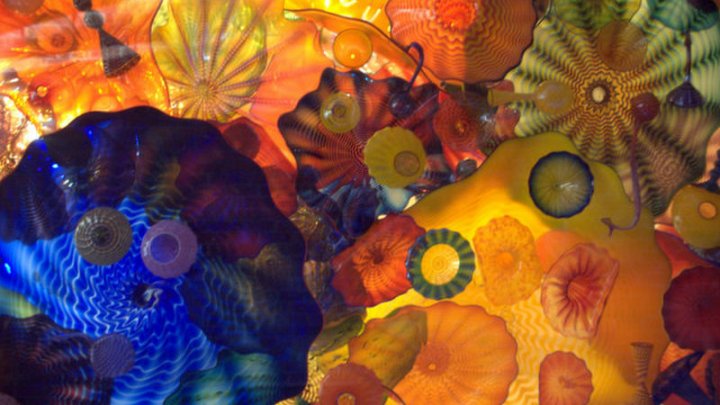
I bring all this up because I have just been notified that one of my art quilts, “Art Glass Quilted,” has been accepted into a exhibit opening in September at the Center for Contemporary Art in Abilene, TX. (See the detail shot above and the full quilt on my Gallery page.) This time, “thrilled” is the word for how I feel at the news, because it means that I am beginning to reach a standard of excellence I have set for myself. Last year, I joined the Studio Art Quilt Associates, an international organization of artists, teachers, collectors and exhibitors, to help me define those standards and develop my craft; not only is “Art Glass Quilted” the first piece I’ve had accepted into a juried exhibition, but now I also feel somewhat less presumptuous in calling myself a “fabric artist.”

The piece was inspired by some handmade Lalíque crystal medallions decorating the grand staircase of a cruise ship I was on in the Mediterranean a while back. I have always loved art glass, and used to collect small vases by Gallé, Daum Nancy and others. I decided to see if I could capture the luminescent frosting and sparkle of art glass on what is clearly a pieced quilt. Attempting to translate one artistic medium into another presented some formidable challenges in design and execution, but I was determined. With each new project, I have been trying to develop new techniques and push myself beyond the boundaries of traditional quilting into more original, unexpected work.

Publication, exhibition, performance, and sharing one’s work in a larger community are all forms of validation that encourage creative people to keep creating. Writers, artists, actors, musicians, and designers most often work in a space inside their own heads, sometimes for years, before any sort of validation, much less public recognition or financial renumeration, comes. The notion of “bursting onto the scene,” or being “an overnight success” belies and belittles the painstaking development of craft and process, trial and error, submission and rejection that always underpins any apparent success.

Inevitably, in talking about creative work, the old familiar question arises: “It may be good, but is it art?”  I’ll leave that determination to critics, judges, and Aristotle, but I do believe that the basic skills of craftsmanship, which are the foundations of any art can, indeed, be taught and practiced and honed to produce consistently high levels of performance, even among people who are not especially talented. The passion, the inspiration, the originality — these are the inexplicables that some might call “talent,” which must come from within the individual. They cannot be taught, but their influence on a creative work is distinctive.

Art or craft? Talent or competence? Vocation or avocation? Do you care? At this stage of my life, I certainly don’t. I’ve had the arguments, established the careers, survived the rejections, and emerged still enthusiastic enough to be thrilled by creative achievements of any kind and lucky  enough to have the time to pursue them. I’m already auditioning fabrics for my next project.

Meanwhile, I’ve also started looking into Abilene and plans to attend the exhibition opening this fall. After all, I could be on my way to becoming the “Grandma Moses” of the art quilt set. I wouldn’t want to miss my debut!

Filed under: art
comments 2

“Brooching” the Subject

On a trip to South Africa a couple years ago, I ran into one of my tour companions in a famous jewelry store in Johannesburg. She had evidently been there quite a while pondering the purchase of a pair of truly magnificent, and expensive, yellow diamond earrings. “Can I wear these with jeans and flip-flops?” she asked me, indicating her current attire.  “Sure,” I said. “Why not?” Thus affirmed in a decision I’m sure she had already made, she bought the earrings, immediately put them on, and happily flip-flopped out of the store.

People, even “women of a certain age,” just don’t dress up much anymore. And they surely don’t wear brooches. Brooches demand a certain dressiness, a jacket or scarf or bodice on which to pin them, whereas other pieces, such as rings or watches, or even diamond earrings, more easily adapt.

Since ancient times, jewelry has been not only an instrument of enhancement, but also a public statement of wealth, status, and position — which is exactly how the term “statement piece” originated. Royalty has always used jewels as symbols: think of all those scepters and crowns. In more modern days, jewelry has become a common symbol of recognition or special occasions, i.e., the engagement ring or a gold watch. Even those who aren’t rich and famous can enjoy famous pieces. Liz Taylor’s 33 carat diamond from Richard Burton or Princess Diana’s diamond-encircled sapphire, for example, have become so iconic and so desirable that they are reproduced at every price point and available to everyone from tony shoppers on Rodeo Drive to home shoppers on QVC.

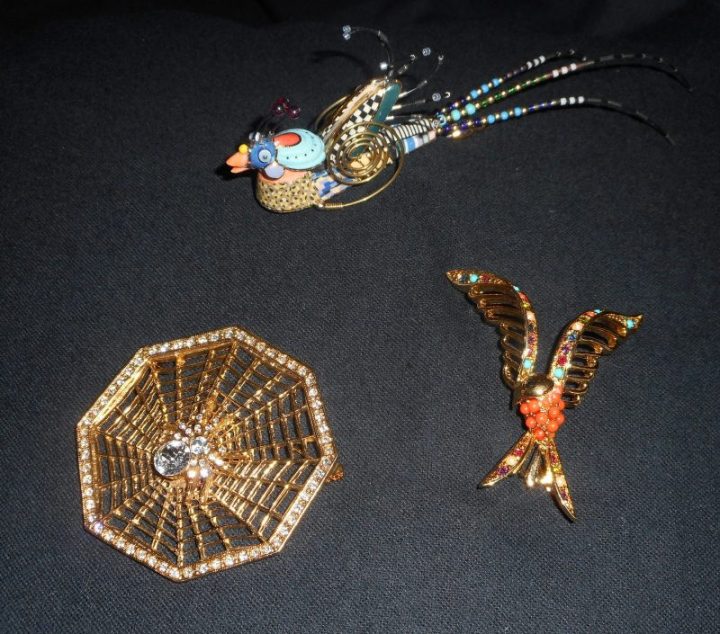
One of the highlights of our recent trip to Southern California was happening on a special exhibition at the Reagan Presidential Library: “Read My Pins” is a display of over 200 signature brooches, most of them costume quality, owned and worn by Madeline Albright. Those who are old enough to remember her will recall that her lapel jewelry began to be remarked upon when she was part of President Clinton’s cabinet as our Ambassador to the UN (1993-97), later becoming more noticeable, and more of a diplomatic “messaging” tool, when she became our first female Secretary of State (1997-2001). (My own copy of her “spiderweb with spider” pin is shown above.)  In her illustrated memoir, Read My Pins: Stories from a Diplomat’s Jewel Box, we not only learn about the origins of many of these brooches and their key roles in moments of  diplomatic history, but we also learn about the Secretary, about her humor and humanity, and her evolution into a confident, independent leader.

The jewelry a woman wears says a lot about her, not only about her personal taste and style, but about how she views herself. Once upon a time, the jewels a woman wore said more about the wealth and prestige of the man who gave them to her, and his view of her, than it did about the woman herself. An old wives’ tale warns that “…if a woman buys herself diamonds, she’ll never get them from a man.” That warning may have had merit back when women were little more than chattel and dependent on men for both their net worth and their self-worth, but it’s hardly relevant now. Today’s women, single or married or divorced, are accomplished, independent, and affluent enough to buy their own jewelry and make their own statements. They celebrate their commitment to themselves and are not shy about sporting the rewards to prove it.

The word brooch has its origins in the Latin word broccus , which mean “projecting.” Madeline Albright used her brooches in ways true to the intention of the word. Through them, she was able to project hope, to protest frustration, to communicate pride in herself and respect for others. In an international diplomatic community still dominated by men, she made a statement and became a presence through something so entirely feminine as a pin.

Sometimes the strongest statements are the subtle ones.

comments 2

California Smilin’

There are some places on earth that just make you smile. California is one of those places and, having just returned, I am happy to report that it is still there. Despite dire predictions of its imminent demise due to earthquakes, fires, floods, and Jerry Brown, everything is still pretty much as it’s always been, especially in Southern California: the jacaranda are blooming, the surf is crashing, and the traffic is barely moving. The sun shines even when it doesn’t because, as Joan Didion famously put it, “The future always looks good in the golden land because no one remembers the past.”

Actually, California exists in the never-ending, ever-expanding present, which is probably why I like it so much. I, too, feel “present” when I’m there. The state’s long and varied history, from early Native Americans through European and Spanish explorers, up to being a Mexican territory and then US statehood in 1830, stretches seamlessly into today’s sprawling, bustling beauty of urban development and breathtaking natural landscapes. The state’s official motto is “Eureka,” a Gold Rush exclamation meaning “I have found it.” Evidently, a lot of people have.

At just about 40 million, California is the most populous state in the union, and one of the world’s most diverse concentrated populations.  No one race or ethnic group constitutes a majority, 27 percent of residents are foreign born, and more immigrants settle in California than anywhere else in the country. In short, the American Dream is alive and well there. Even as its roots are deeply buried in the discovery of gold, the production of fame, and the lure of technology, the future is always NOW in California, and it’s always exciting.

This recent trip was with my husband, not my mother, and it began in San Diego, a beautiful city that defies every stereotype of a Navy-base border town. We spent a wonderful day in Balboa Park, home to museums, galleries, botanical gardens and the famous San Diego Zoo. Initially constructed for the 1915-16 Panama-California Exposition to commemorate the opening of the Panama Canal, the buildings in the Spanish Renaissance style are situated along the broad El Prado walkway (where you’ll also find a fabulous restaurant by that name).

No trains for us this time; rather, we rented a car and drove up the Coast, making a stop in tony La Jolla, for an elegant dinner surfside in The Marine Room (since 1941), and a visit to peaceful Mission San Juan Capistrano (1776), where mud nests in the stone ruins await the return of the swallows from Argentina on St. Joseph’s Day.  The mood is calm and gracious this far south, but the atmosphere changes decidedly as you move into Orange County. Multi-lane avenues and intricate freeways connect Pacific piers and volleyball-crazed beach towns with the manicured suburbs situated in Santa Ana Canyon. Tall palms wave over all like flags on a racetrack.  This is the Southern California everybody recognizes: “Gentlemen start your engines.”

We stopped in Long Beach to “up our glamour quotient” by staying on the Queen Mary.  She was launched in 1936 as the grandest ocean liner ever built, and was considered the “only civilized way to travel” by European royalty and Hollywood movie stars, whose photos are all over the ship. One-way trans-Atlantic passage in a first-class stateroom, which was our room accommodation, was $1056 in the 1930s — enough money then to purchase a house! Few people realize that for five years during WWII, The Queen Mary performed as a troopship and transported more than 800,000 Allied troops. She was retired in 1967 and remains permanently moored in Long Beach as a hotel and tourist attraction.

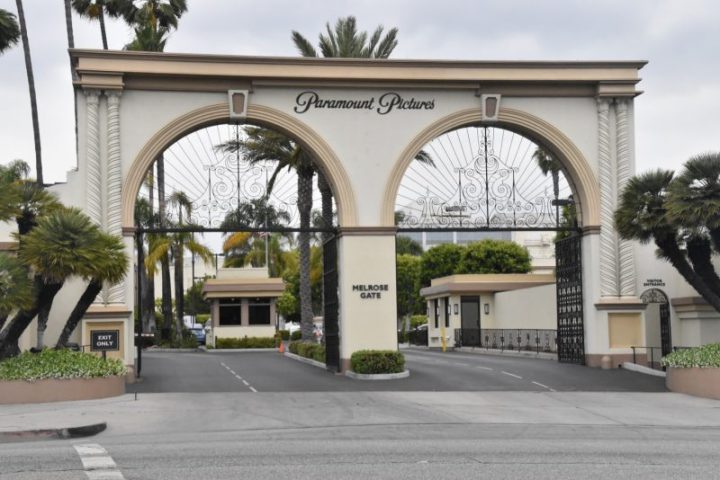
Having hobnobbed with the ghosts of the greats on the ship, we were ready for prime time players by the time we hit LA.  First stop: Paramount Pictures, founded in1914, is the only major motion-picture studio still operating in Hollywood. This the studio that has garnered numerous best picture Oscars, including for “Titanic” and “The Godfather,” the studio that created such stars as Gloria Swanson, Rudolph Valentino, Gary Cooper and Bob Hope, the studio that took over Desilu Productions and the beloved Lucy, and the studio that still today produces major motion pictures and currently popular television shows such as “This Is Us.”  Paramount is not only a historic landmark, but a defining symbol for all things Hollywood, including our movie star president Ronald Reagan. You walk through the iron “wishing gates,” and you understand the hopes and aspirations of all those casting-call extras who waited outside hoping to be chosen, all those golden dreamers who were drawn to Hollywood — all those who still are.

I had to revisit Hollywood Boulevard, the Walk of Fame, Grauman’s Chinese Theatre (1927) and the historic Hollywood Roosevelt Hotel (1926) where my Mother and I stayed 60 years ago. The whole strip is a bit seedy now, full of souvenir shops and throngs of tourists, but the sidewalk is still studded with stars and the notable handprints/footprints in cement in front of the Chinese Theatre remain mostly intact. Maps to the homes of celebrities in Beverly Hills (updated!) are still sold on the street corners, and bald guys smoking cigars and driving Bentley convertibles still cruise down Rodeo Drive. It’s all there, still — the real and the imagined, the past and the future, the sublime and the ridiculous — now and then and forever.

And it all makes me smile.

comment 0

Toward Sunset

The Sunset Limited, the oldest named train in the United States, runs 2000 miles from New Orleans to Los Angeles. Put into service in 1894, it was Southern Pacific’s premier train, offering both westbound and eastbound service in a little over 43 hours at a speed of just under 50 mph. The Sunset Limited is still operated by Amtrak today, albeit with less frequency and a great deal less style than it possessed in its heyday.

In 1950, The Sunset Limited became a “streamlilner,” a stainless-steel, diesel-powered connection of some 15+ cars that included a formal dining car, an informal grill/ lounge, overnight sleeping cars configured as full bedrooms, compartments or roomettes, and “chair cars” with reclining leg rest seats. All were operated by the famous Pullman Car Company, founded by George Pullman who had pioneered the development of the “sleeper berths.”  Before commercial airlines and an improved highway system offered more convenient alternatives, the sleek, streamlined  passenger trains of the 1950s were THE most elegant, THE most stylish, and THE most comfortable way to go long distances.

So that’s how we went, my mother and I, to California on our first big vacation in 1957. Not that we were wealthy or particularly sophisticated, you understand, but we were in need of an adventure and the newly-opened Disneyland beckoned.  Everyone, her friends and family in our small Texas town, told her it was “unseemly” for her to take off across the country alone with a little girl — she was recently widowed and I was only nine. They insisted she simply couldn’t do such a thing, but she said “Watch me.”

We boarded The Sunset Limited in San Antonio, where the romance of train travel began the moment we stepped into the beautiful Sunset Station (photo above). Built in Spanish Mission Revival Style in 1902, Sunset Station is no longer used as a terminal now, but it is on the National Register of Historic Places and is still rented for special events. Walking there today, I am struck by how small it is, considering that San Antonio was a major passenger hub in the 1950s, with trains not only going East to West, but North to Chicago and connecting up the East Coast. But back then, I had the perspective of a little girl who had not been on any big trips or spent time in any big cities. Like Harry Potter transported through a train-station portal, I walked into Sunset Station that June and fell in love with both.

We boarded about noon and were escorted to our private compartment. I was delighted. It had a large picture window with a fold-out table and banquette benches on either side so we could sit and watch the passing landscapes. These benches, our porter later explained, folded down and turned into beds. We also had our own tiny bathroom, a full-length mirror, and enough storage space for our carry-on “train cases.” As nice as these accommodations were, however, I was already visualizing the passenger-train mysteries I had read, and so could hardly wait to get out into the public cars to identify suspicious characters who might be plotting nefarious deeds!

We went to lunch in the club car, where I had my very first triple-decker club sandwich held together by frilly toothpicks. To this day, I never make a club sandwich without using frilly toothpicks and I never fail to smile at the memory. It took a little practice to get our “rail legs,” especially for my mother in her high heels, but we made it to the lounge where we played Go Fish with a deck of blue, Southern Pacific playing cards. (Actually, I think I still have them somewhere.)

That evening, of course we dressed up for dinner in the full-service dining car, its tables for four covered in white and set with fresh flowers and fine china. The steward seated us, handed us menus, and explained that our orders were to be written on small order cards. Choices were extensive: appetizers and salads, dinner entrées and specialty dishes, homemade desserts. Always a hearty eater, I decided on steak, the most expensive item on the menu at $2.75. Another lone passenger had been seated with us and he and my mother were talking quietly when the waiter set my meal down in front of me. “Oh my goodness!” the man suddenly exclaimed. “She’ll never eat all that.” And then it was my turn to say, “Watch me.”

As we headed toward sunset, we watched the land roll by, crossing the High Bridge of the Pecos River and rumbling toward El Paso; the next morning, we awoke in the desert of Arizona between Phoenix and Yuma, and then moved on into Southern California. Finally, after 30 hours and a dozen stops, we pulled into Union Station in Los Angeles. I was exhilarated, even though there hadn’t been a murder aboard!

The train trip alone was quite an adventure, but that was only the beginning of a magical week. Disneyland, with its jungle cruise, spinning tea cups and rocket to the moon, provided unimaginable thrills — and favors for my future Disney birthday parties. We stayed  at the grand Roosevelt Hotel in Hollywood, itself a sort of Fantasyland, promoting movie studios and glamorous stars with their footprints in concrete at Grauman’s Chinese Theatre. I have a postcard from the famous Brown Derby Restaurant on Vine (no longer there) that my mother sent to my grandmother.  She wrote, “We had lunch here today and Stephanie got autographs from five movie stars!”

This great adventure of ours was 60 years ago, and my mother and I (she’s 93) still talk about it as “the trip of a lifetime.”  It was the first of many trips that instilled a passion and shaped a lifetime for me, but only because my mother dared to be bold, to show me that the world is a wonderful place with much to teach and little to fear.  In recent years when I was about to depart for Egypt — or China or Africa or Turkey or the UAE  —people would say, “What? Where? You can’t go there.”

Watch me.

comments 2

Fiesta! Una Cosa de Mujer

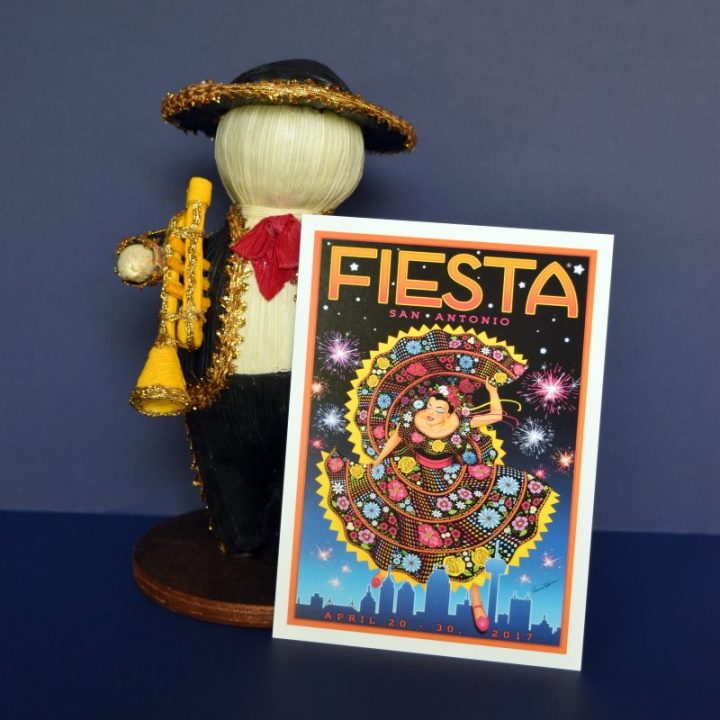
Fiesta starts in San Antonio this week, a sure sign that the doldrums of winter and sacrifices of Lent are over and that the weather is certifiably warm enough for beer and margaritas. Fiesta is ten-day city-wide celebration of Tex-Mex history and culture that has been going on for 126 years now. What began as a small parade of flower-bedecked carriages in front of the Alamo in 1891 has evolved into an internationally-known celebration that truly offers something for everyone at every age for every interest and at every taste level. Fiesta attracts around 3.5 million visitors each year to San Antonio; the Battle of Flowers Parade, alone, draws almost a half million spectators along its route.

There are several parades during Feista, in the streets and on the River, with flowers, flames, and lights; there’s even one for pooches. There are the foods of Fiesta: Mexican, German, Cajun, Gulf seafood, barbecue, even flaming Cheetos, all with beer and margaritas, of course. There is the music: mariachis, along with the San Antonio Symphony, conjunto tejano, military and marching bands, and rock groups and New Orleans jazz, not to mention the musicians and mimes in Market Square. And then there is the pageantry and tradition of it all, from the stunning coronation of the Queen of the Order of the Alamo and her royal court, to the craziness of “Cornyation,” the irreverent satire and outrageous spoof of Fiesta royalty that has raised millions of dollars for AIDS-related charities. Proceeds from all Fiesta events, by the way, go toward charities and conservation, and the entire enterprise depends on thousands of local volunteers.

Not surprisingly, most of them are women. In fact, the whole Fiesta celebration was begun by a woman, Ellen Sladen, the wife of a congressman, as a salute to the heroes of the Alamo and the Battle of San Jacinto. It was her idea to decorate those carriages in front of the Alamo back in 1891, and to have two lines of them confront each other and the occupants pelt each other with fresh flowers — thus, the Battle of Flowers. Today, the Battle of Flowers Parade is the only one in the country to be planned and directed completely by women; it is second in size only to the Tournament of Roses Parade.

Fresh flowers are no longer used on the floats, however; rather, paper and foil flowers are handmade by Mary Rose Garcia and six other women, all relatives of her mother who began doing this in 1923. These women work five days a week, 8 hours a day, from late January to April, to make what is needed for the 38 floats; this year, that amounts to over 15,000 new flowers, many in the new colors of dark green to enhance the 2017 theme of Global World Heritage locations. (The four San Antonio missions, plus the Alamo, were named, collectively, as a UNESCO World Heritage site in 2015.)

Then there is the Chair of the cascarones, overseeing a group of 25 female volunteers who make the 25,000 to 30,000 confetti eggs that are sold, and cracked over the heads of revelers, during Fiesta. Having a cascarón cracked over your head is supposed to be good luck, and is a Mexican tradition enjoyed throughout South Texas all year long, especially during the Eastertime. (As a teenager, when a boy cracked a cascarón on my head during our spring carnival, it meant he liked me. I used to make cascarones for that spring carnival as a student when I was in Catholic school, but we won’t get into that now.)

And finally there are the seamstresses, the talented and patient women who painstakingly hand embroider and embellish with thousands of beads and sequins the 10 foot trains that trail the dresses of the 25 duchesses and the princess of the royal court. Under the direction of the Mistress of the Robes, who determines the theme, and local designers who then interpret that theme, seven women work from the previous August to create these extravagant garments. (The female royalty is chosen each year by the all-male members of the Order of the Alamo, and King Antonio, who escorts the Queen and who is usually two or three times her age, is chosen from among the all-male members of the Texas Cavaliers. But we won’t get into all that either right now.)

Suffice it to say that, by and large, Fiesta is a woman’s thing, una cosa de mujer. Yes, it is a wonderful event, a genuine source of civic pride and distinction for San Antonio, for South Texas,  and for all the various cultures and traditions that co-mingle here, but it has a legion of “behind the scenes” heroines who are all too often unsung. That, too, is a Texas tradition.

So what else is new?