
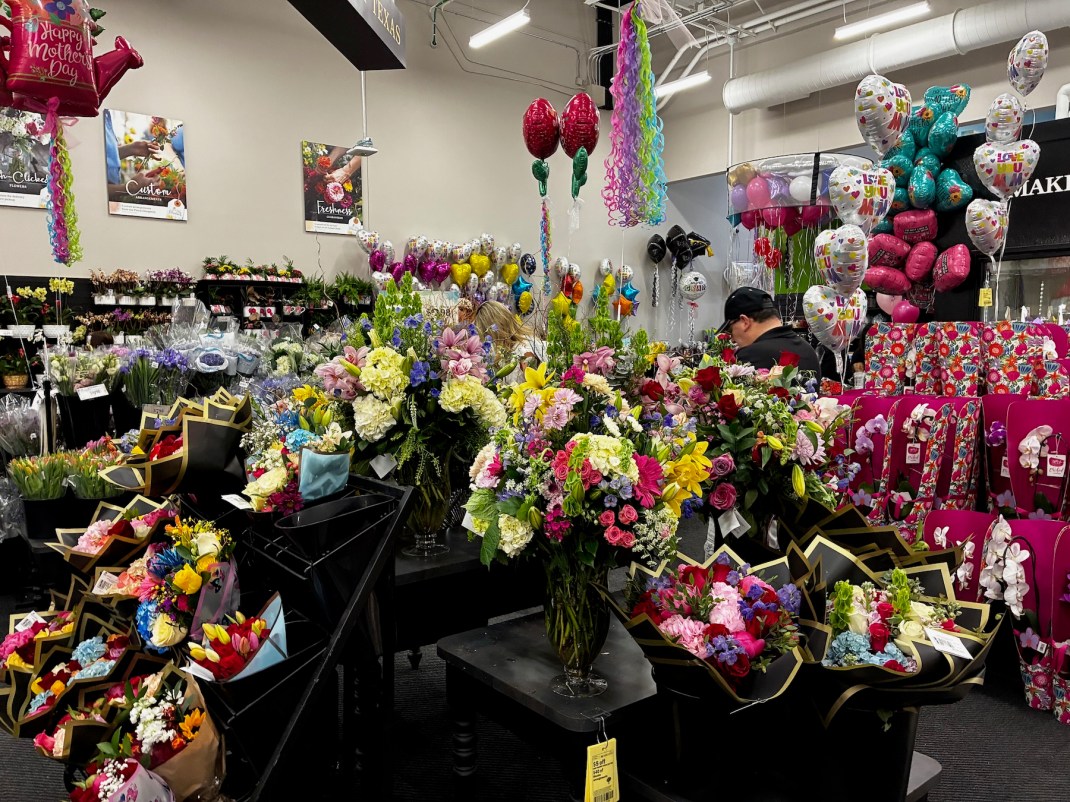
I was out shopping this weekend, and oh my! Traffic was outrageous, stores jammed, and check-out lines ridiculously long. How could I have possibly forgotten about the commercial bonanza of Mother’s Day, when floral sales alone almost eclipse those of #1 Valentine’s Day. Even my local grocery store was selling $100 bouquets and $300 floral arrangements. (See photo above.)
Such commercialization almost destroyed the Mother’s Day holiday as it was established in the United States back in the early 20th Century. You see, the holiday originated in 1908 when Anna Jarvis held the first Mother’s Day service at Andrew’s Methodist Church in Grafton, West Virginia, to honor her own deceased mother, Ann Reeves Jarvis. Ann had been a peace activist who cared for wounded soldiers on both sides of the American Civil War, and she later created Mother’s Day Work Clubs to address public health issues. She and another peace activist and well-known suffragist, Julia Ward Howe, urged the creation of a “Mother’s Day for Peace” to promote the amicable settlement of international conflicts and honor all mothers, especially those who had lost sons in war.
In 1908, however, the US Congress rejected a proposal to make Mother’s Day an official holiday (joking as only men could that they would then also have to proclaim a “Mother-in-law’s Day”). However, owing to the persistence of Anna Jarvis, by 1911 all U.S. states observed the holiday. Finally, in 1914, President Woodrow Wilson signed a proclamation officially designating the second Sunday in May as Mother’s Day.
But what had started as a liturgical service soon turned into a “Hallmark holiday.” By the early 1920s, Hallmark and other companies had begun to sell Mother’s Day greeting cards and promote the day as an occasion for candy and flowers as well. Anna Jarvis was appalled; she had established the day to emphasize sentiment, not profit. So she began to organize boycotts, threaten lawsuits, and even got arrested for disturbing the peace at one point! Nevertheless, the American celebration of “Mother’s Day” (note singular, not plural possessive) endured and many today actually give credit to the floral industry for its sustained success.
Something of a liturgical emphasis lingers, too, in that family church attendance on Mother’s Day is the third highest after Christmas and Easter, and the mother’s place in the family and society, as well as motherhood and maternal bonds in general, continue to be the dominant themes of the holiday. Today, Mother’s Day is celebrated annually in some way and on some day in over 40 countries around the world. Ironically, the concept of the holiday gained in popularity throughout the world mostly due to its commercial promotion in the United States. Various countries and cultures have incorporated slightly different meanings emanating from their own religious, historical, or legendary traditions, some of which go back hundreds of years, but we and they all share the same intention: to honor a mother who, as Anna Jarvis believed, is “the person who has done more for you than anyone in the world.” (“Engaging Families,” US Department of Education, Dec. 14, 2017)
In spite of all the traffic and crowds and frenzied shopping, I think Anna would be more than happy with how America has managed to partner salesmanship with sentiment over the last hundred years in order to preserve the holiday she originally envisioned. Mother’s Day today promotes an awareness of women’s needs, rights and freedoms; applauds the strong women who influence through motherly roles such as teachers, nurses, mentors, and public servants; and, most of all, celebrates the unparalleled responsibility and the indomitable power of a mother’s love and care in a child’s life —whether that child is seven or seventeen or seventy.
What a blessing it is to have had such a mother, and what a humbling opportunity it is to strive to be one to my own child.

