
“I scream, you scream, we all scream for ice cream!”
My Mother loved ice cream. Of course, living in South Texas with the unbearable, unrelenting heat, who wouldn’t? But for her, a member of the post-War generation, the sudden ready availability and popularity of the frozen treat in local grocery stores after years of rations and shortages was yet another welcome sign of renewed hope, optimism and prosperity for the future. In 1945, the U.S. Navy actually commissioned the world’s first floating ice cream parlor for service members in the Western Pacific. It cost over $1 million to build.
Following the end of WWII, national consumption of ice cream in America reached over 20 quarts per person a year. Conveniently, just as all the old “ice boxes” in homes were rapidly being replaced by modern refrigerators with freezers, ice cream sold in pints in local stores appeared for home consumption. As was characteristic of so much business and industry during the post War boom, small diary farmers saw the opportunity to expand their operations from selling milk, butter, and cheese to freezing cream by mixing salt with ice and — Voila! Ice cream began to be produced in small creameries and became available even in rural areas all around the country.
Actually, the formula for this frozen concoction was not a new discovery. Way back in early Rome, snow was flavored with honey to create what was arguably the very first frozen treat. Later, buffalo milk was frozen during the Tang Dynasty in China (618-907AD) and, supposedly, Marco Polo brought that recipe back to Italy. By the 16th Century, ice cream was an established luxury in Europe, but only for royalty and the elite. In America, the first ice cream factory was established in Pennsylvania in 1851 by Jacob Fussell who made small batches with surplus milk and cream from his dairy. His little enterprise was so successful that Fussell later went on to pioneer mass production in Baltimore in 1854 and began shipping ice cream to New York City and Boston. Today, he is considered the father of the commercial ice cream industry in the United States.
When I was a little girl — I mean a “little” girl — my Mother would come outside on a hot summer’s day chanting, “I scream, you scream, we all scream for ice cream.” And I’d come running because from very early on, I loved ice cream too. She would open a fresh pint from the freezer and I can still conjure up in my mind’s nose that wonderful, intoxicating smell of vanilla when the lid came off of a new carton. “How much do you want?” she’d ask, and my answer was always the same: “All the top and a little bit more.” This little ice-cream ritual continued on into my adult life even when my Mother was in her 90s; I’d open a fresh carton on a hot summer afternoon and we would both laugh and chant “All the top…”
As I grew up and she and I were out shopping or running errands, we would often treat ourselves to a stop at the Valley Gold Creamery on Laurent Street in Victoria. There behind a wall of windows alongside the main entrance was a genuine, old-fashioned ice cream parlor complete with a long, smooth counter and swivel stools. Walking in on a scorching hot day was like entering another world in another country from Texas. It was always cold inside, and so quiet, almost reverent. Behind the counter and standing in front of deep bins of ice cream and and multiple bowls of toppings was the attendant, usually a guy, wearing a typical white soda jerk hat. He was always friendly and eager to serve.
And he was a master of all the fancy concoctions that you didn’t, or couldn’t make at home: customized banana splits with flavors of your own choosing, topped with syrups, nuts and candy, and piled high with whipped cream and a cherry on top; specially made sundaes with whatever flavors and toppings you like; custom-made milkshakes, chocolate, vanilla or other flavors, blended to whatever thickness you preferred. And then there were always special offerings, huge bowels of colorful scoops made to be shared or odd flavors begging to be tried. (No doubt the “friendly” attendants and exaggerated offerings of these early local ice cream parlors were the inspirations for the well-known and much-beloved Friendly’s restaurant chain known for its Fribbles and Awful-Awfuls that came to prominence in the Northeastern United States.)
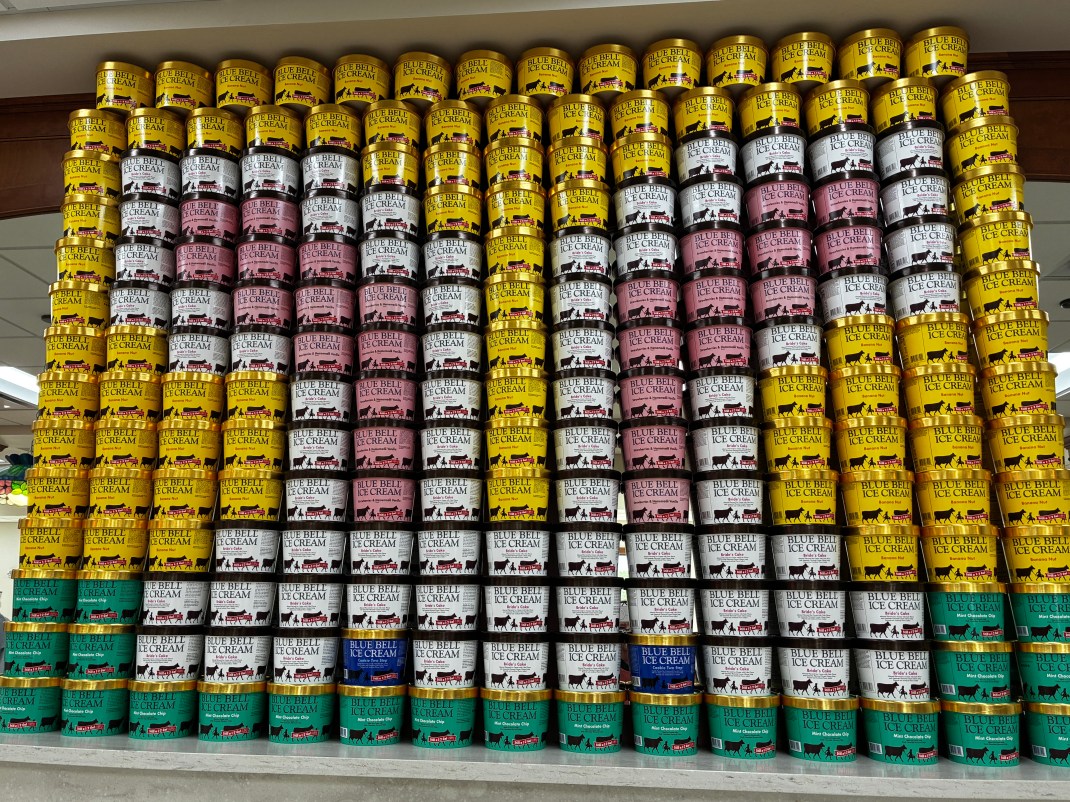
I think the love of ice cream endures because of nostalgia. At this point in our history, it is associated with a childhood in a simpler time when a scoop of ice cream didn’t cost $5-6. It conjures memories of homemade ice cream churners on the pack porch for family picnics, leisurely visits to ice cream parlors on a summer’s afternoon, a quick stop at a Dairy Queen or a Carvel on the road, and a mark of pride in a brand with history and quality such as Blue Bell.
We recently made a day trip up to Brenham, TX, to visit the now famous Blue Bell Creamery. Some say it has been cranking out the best ice cream in the country since 1911. Originally formed as the Brenham Creamery Company that made butter back in 1907, the name changed to Blue Bell Creameries after the bluebell, a Texas wildflower that bloomed in the hot summer months. Blue Bell was initially sold only in small towns around Brenham, but in 1960 it branched out to Houston, and then crossed state lines into Louisiana in1975. Today, Blue Bell ice cream is the undisputed pride and joy of Texas. A nationally-known brand, sold now in 24 states, it produces over 60 flavors, 20 year round with 40 available seasonally. It has remained family owned for over 100 years.
We drove out to Brenham last week in search of wildflowers, which have been sorely missing in this spring of devastating drought in South Texas, and we didn’t find any. But we did find a delightful afternoon visit to the Creamery which is still in full operation, and which made us smile with the recollection of all those childhood ice cream memories. Do I buy Blue Bell in my local HEB market here at home? You better believe it!
In these parts, I scream, you scream we all scream for Blue Bell ice cream!

