comments 2

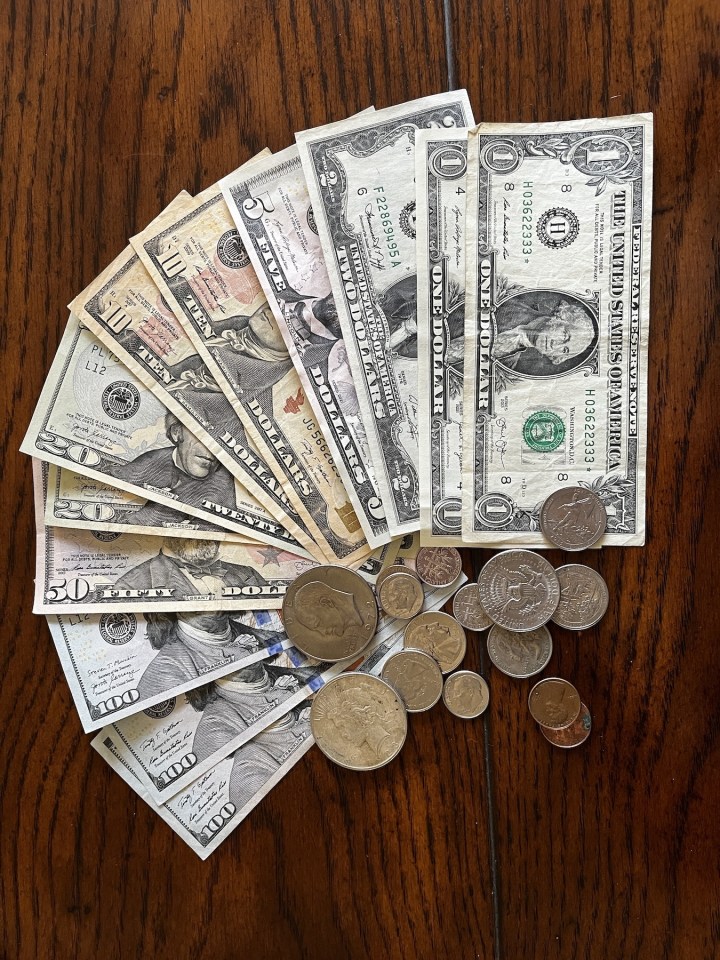
Money, Money, Money, Money $$$

 So here we are moving up to tax time. I don’t mean to be smug, but I got our taxes completed and in at the end of February. Not that I am expecting any big refund or anything, but in light of the dismantling of government agencies and the slashing of staff, I thought I’d better clear up any questions or difficulties I might have well before the lights went out and the phones were disconnected at the IRS. 

     I also calculated my RMD (required minimum deduction) from my IRA for 2025. Figured I’d go on and take the cash before the whole account melted away. Also had a small stock trading account that I had been playing with for years which I cleared out before Inauguration Day. Again, take the money and run,  tax or no tax, before the “market hits the roller coaster.”  (No, I’m no genius market predictor, though I did work on Wall Street for a few years; mostly I just have a healthy skepticism, and some good sense.)

      “Money, Money, Money, Mooo—ney” Remember that opening chorus from Donald Trump’s reality show The Apprentice? It came from a song by the O’Jays called “For the Love of Money” (1973). Ironically, that title comes from the Bible, 1 Timothy 6:10: “For the love of money is the root of all evil.” Most people don’t remember any of the lyrics of that song, much less any of the lessons from the Bible or the series. God + Money: “It’s not personal, it’s just business.”

     If you look in the dictionary, you will find money defined as a “medium of exchange, coins or banknotes,” for goods or services. Lydia, an ancient country located in today’s central Turkey, is widely credited with minting coins as the first standardized currency around 650 BCE, but the use of various metals as a form of exchange dates back to ancient Babylon around 2000 BCE. Paper money goes back thousands of years to China, Carthage, and the early Roman Empire. In its long history, “coins of the realm” have been, for the most part, regarded simply as a method of convenient transfer. 

     America was late to the money game, and some might say that once we entered it, we broadened the definition way beyond efficiency.  On April 2, 1792, Congress established a coinage system in “The Mint Act” and the first U.S. mint was created in Philadelphia. While early forms of paper money, called “bills of credit” or IOUs, existed in the colonies in the 1690s, the U.S. government didn’t begin to issue official paper bills until 1861 in order to finance the Civil War. In 1869, the Bureau of Engraving and Printing started to print U.S. banknotes for general circulation. 

     It seems to me, as a life-long student of American history and culture, that money has come to represent a great deal more from the very beginning than just a convenience of exchange. Back in Colonial days, Puritan John Winthrop (1588-1649)  promoted the notion of a “godly commonwealth.” He was a lawyer, not a minister, but he still can be credited for having laid the foundation for what has become America’s overriding dedication to the power and the privilege of wealth. Let’s not forget that our “founding fathers” were all wealthy landowners who believed in noblesse oblige, even as they also believed that their own good fortunes meant God was smiling on them. God means for everyone to be happy and well; through hard work and right reason, everyone can become successful (just ask Ben Franklin as “Poor Richard”). 

     From Andrew Carnegie and his gospel of wealth (1889), to Oral Roberts and his prosperity gospel (1947), to Joel Osteen at Lakewood Church in Houston (1999), this is the clarion call  from America, that “shining city on a hill” —  oddly enough, a phrase first used by John Winthrop and which later became the center of Ronald Reagan’s political career: God means for everyone to be happy and well-off; those who aren’t must be doing something wrong. 

     Think about the through-line from all of this, from power and privilege and noblesse oblige to prosperity gospels and the “city on a hill,” and then consider how we, as a culture and a government, view the less-fortunate among us, the poor, the disenfranchised, the disabled, the different, the other. “In God We Trust” first appeared on U.S. coins during the Civil War and was later declared our national motto. In 1955, the 84th Congress mandated that the motto appear on all American currency. And thus we make the connection: God + Money = the American Dream. If you can’t achieve at least a version of it, you must be doing something wrong.

     I first read Scott Fitzgerald’s The Great Gatsby in junior high. I was immediately captivated by the romance of the Roaring Twenties society, the opulence of the settings of wealthy enclaves on Long Island, and the blatant hedonism of the characters. The novel is narrated by a wide-eyed friend and observer, Nick Carraway, who claims to be normal and moral, but who also admits that he, himself, is a member of a well-to-do Midwestern family. Already, just a couple pages in, even a youngster like me began to mistrust him as a narrator. “The rich are different from you and me,” Fitzgerald wrote. “Yes,” came Ernest Hemingway’s famous retort. “They have more money.”

     Over the years, I have read this book countless times. I have studied this novel in graduate school, I have written about it in publications, I have taught it in high-school honors classes, and I have instructed graduate students in education on how to teach it. Each time I reread it, I gain new insights into the American experience and our collective character. To me, The Great Gatsby is the one, true Great American Novel because it explores the disillusions and dilemmas of the  American Dream; sadly, it also explores how that Dream goes bad. The Great Gatsby merits required reading in every American lit class (provided schools haven’t banned it yet). 

     Nick has a line in the very first chapter about the story he is about to impart: “… as my father snobbishly suggested, and I snobbishly repeat, a sense of the fundamental decencies is parcelled [sic] out unequally at birth.” In other words, morality is a rarity in the pursuit of wealth and power. God + Money -minus- character = a corrupted Dream.

      Money, Money, Money, Mooo—ney “For the Love of Money” could be our national anthem.

comment 0

Sacred Silence

   As a youngster, I went to a girls’ Catholic school. Those were the days when an order of nuns were still the teachers and the ones in charge. Our school was across the street from the nuns’ convent, which was adjacent to the church (photo above) built in 1903. This is the church my Mother and I attended and where I was married, but my history with this church and school goes back even further: my grandmother went to this Catholic school, but never converted nor graduated; my Mother went to this Catholic school and converted when she was 12; and I had been “converted” as a baby and so went there for a full twelve years and graduated.

     The school emphasized all religious traditions and holidays, of course, but Lent was taken especially seriously at Nazareth Academy. Each year, we would have a Lenten Retreat of some sort, even in the lower grades. In the upper school, the retreat usually consisted of two full days, during which we were encouraged to be serious in demeanor and not to talk, except out of necessity. Academic classes were suspended so that we could attend religious services, hear speakers, engage in study groups, go to confession, and take time to meditate and reflect. Since the church and convent were in close proximity, we were allowed to wander the quiet convent grounds and gardens in our free time, which made contemplation, prayer and reflection much, much easier. No noise, no distractions — way before cell phones.

     Those early years of retreat may be where my initial association of a sacred silence with a  spiritual life began. Notwithstanding the Old Testament stories of a booming voice in a burning bush, I don’t think God shouts. Rather, I think God can only be heard through our own inner voice in the silence of the heart. Back in the early days of my Catholic education, one could attend Mass and still pray and think and reflect in the moments of silence that existed within the larger ritual of the service. The few prayers that were recited or the songs that were sung were “incantational” in nature, meditative and soothing in their rhythmic familiarity, even if the words were in Latin.

     I sometimes attended Protestant or Jewish services with my non-Catholic friends, but those services were pretty much as reserved and predictable as my own. My first exposure to a different kind of worship was through the Pentecostal tent revivals that regularly came to town. My best friend and I used to sneak into the back of the tents just to see what all the crowds and commotion were about. And commotion it was: the preacher, generally a non-denominational firebrand, oversaw the laying of hands, the expulsion of demons, the speaking in tongues, the conversions to faith, and the general praising, glorifying, singing, swaying and other emotional manifestations attributed to the influence of the Holy Spirit. It was wild, but we didn’t make fun of these revivals, as some people who attended did; we simply watched and listened and then talked about how very different and yes, odd, this kind of experience was.

      The Second Vatican Council of the Roman Catholic Church took place from 1962-1965 with the express purpose of updating and directing the life of the Church into the 20th century and beyond. It was a historic event that introduced big changes to the Church both in liturgy and in structure. The vernacular replaced Latin as the language of the Mass, the importance of scripture was revitalized, the roles of lay people, including women, were  expanded, and the foundation for updating the Rules of Canon Law were laid. As the saying goes, “the windows were opened for the breeze to blow through” — which I welcomed, by the way, but those windows also opened to some of the evangelical influences already stirring in society. Eventually, we had our own charismatic Catholics, healing ceremonies, and congregational celebrations of what used to be private rites and rituals (baptisms, funerals). Everything was about fellowship and community ministry. We got away from the quiet contemplation of religious observance just as society also got away from the quiet contemplation of everything else.

     Last week I went to Mass on Ash Wednesday for the service to be followed by the distribution of ashes, but I left before the ashes. The church was too crowded and I had had enough of people praising and singing, and coughing and talking and babies crying. In the Mass of my local church, there is not even a 30 second period of quiet (I’ve timed it): every single minute is filled with either prayer, singing, praising, preaching, or greeting. It makes me tired. I’m afraid I can’t find solace in the noisy community of a congregation; rather, I now like church best when there is no else one around. 

     This attitude was no doubt solidified by Covid, when for over two years I watched the Mass being live-streamed from a church without attendees in the peace and quiet of my own home. I looked forward to those Masses every week and found them to be the most spiritually rewarding church services I had experienced in a very long time. Once we got passed Covid, though, the whole world seemed to have erupted with some sort of evangelical fervor, whether that fervor is religious, political, ideological, or the “Swifties!” The pre-Covid noise resumed again, at even higher decibels.

     So now I seek the quiet corners in a church when no one else is there. It isn’t easy, because a lot of churches are locked during the day, but I try the side doors. Sometimes I attend a weekday Mass because it is lower-key and there are fewer people, and sometimes I just go to visit at an off-time. I can pray the rosary or make the Stations of the Cross or read my meditations. Most of all, the silence of an empty church invites me to sit and think, or not to think; it allows me to listen to the whispers of the Lord.

     This Lent I will once again recall and try to capture the peace and quiet I found in the Garden of Gethsemane on a trip to the Holy Land in 2015. On dusty paths amid scraggly olive vines, there truly does exist a sacred place of sacred silence in that Garden just outside the city walls of Jerusalem. Christ knew he would be able to hear his Father there before the crucifixion.  Likewise, if I can find some sacred silence in my life, maybe I can hear some words of encouragement for the trials I face. Remember, God doesn’t shout. 

comment 1

About the Presidents (But Not This One)

    I have a thing for Presidential Libraries. It doesn’t matter who the president was, when he was in office, or what politics he espoused. If he was a President of the United States and has a library to visit, then I”m there, not so much because of the man himself, but because of the insight into the history of the times that he and his administration represents. 

     The Presidential Libraries are not libraries in the downtown on-the-corner sense; rather, they are a combination of  archives and museums, a repository of artifacts and documents available for study and discussion. Operated by the National Archives, the libraries and their holdings are declared  to belong to the American people. The idea of a Presidential Library was conceived by Franklin D. Roosevelt in his second term as a way to preserve and protect for future generations the vast amount of presidential papers, gifts, mementos, and other materials he had accumulated while in office.  (Up until that time, previous presidential papers had been lost, destroyed, or sold for profit — hmmm — not totally unheard of even in recent times.)

     Roosevelt raised private funds for his initiative, and then turned everything over to the US Government to be administered through the National Archives. In 1955, Congress institutionalized this policy through the Presidential Libraries Act, amended in 1986. The tradition of an archival library of former presidents continues — at least so far (although current government firings and significant funding reductions are impacting both the preservations of the archives and the operations of the Presidential libraries. Check for times and availability before you go to visit.)

     There are officially 13 Presidential Libraries (for which you can obtain a stamp in a Library “Passport” to record your visit at the Library’s admission desk.)  So far, I have visited 8 of those existing 13. In addition, the National Archives and Records Administration also operates three other Presidential collections which I have also visited: Washington at Mt. Vernon, VA, John Adams at the Boston Library, and Jefferson at Monticello, VA. Like any visitor, I have my own opinions on which are “the best and the worst,” according to my own standards, of course.

     I’ll begin with Roosevelt’s, which is at his home in Hyde Park, NY. It was the first such library and the only one to have been used by the sitting President. It is impressive, and beautiful, probably because Roosevelt was a wealthy aristocrat, as well as being a formidable leader in formidable times. The Kennedy Library, located at Columbia Point outside of Boston, is impressive on the outside, having been designed by noted architect I.M. Pei, but a bit shallow on the inside, in part because of the very short tenure of the 35th president, but also because “Mama Rose” narrates her son’s life within the larger context of the Kennedy family.

     By all accounts, the most visited Library is the Ronald Reagan Library opened in 1991 in Simi Valley, California. Without question, it is stunning in both setting and design, but it seems to me to be more about “Ronnie and Nancy’s love story” and their finely-curated image forged  along their journey from Hollywood to Sacramento to the White House.  A portion of the fallen Berlin Wall, however, is a noteworthy monument to what was arguably Reagan’s greatest  achievement as President.  

     Personally, though, I prefer the Nixon Library in Yorba Linda, California, which has much, much more to offer in the way of historical record and honest reflection. It underwent a $15 million renovation in 2016, and today presents, unabashedly, a staggering collection of  papers, tapes, films, photographs and gifts related to one of the most completely documented, complicated, and troubled administrations in American history. Remember, this was the administration of the moon landing, Watergate, Vietnam and trade with Red China. 

     But my favorite Library is Bill Clinton’s in Little Rock, AK, and for some of the same reasons as Nixon’s. The archival and museum holdings here are also among the largest in the Presidential Library system, and the candor with which it is ALL presented and available to the public (including the scandals of Whitewater, Travelgate, Monica Lewinsky) shows a rare willingness to be totally open by a living politician. But beyond the historic collections, as a writer, the uniformity of the Library’s design and theme has enormous appeal to me. First of all, the building is done in a steel and glass modernist design which cantilevers from downtown out over the Arkansas River, echoing his campaign slogan of “Building a bridge to the 21st century.”  The building is also the first silver certified LEED design (Leadership in Energy and Environmental Design), later upgraded to platinum (2009), meaning that it is fully sustainable, made of renewable materials and totally energy and water efficient. It is a design wonder and perfectly suited  to its downtown Little Rock location.

     Of course I have been to the libraries of my “home-boys’” in Texas often, and I mostly  appreciate them for their design and their research facilities. The George H. W. Bush Library on the campus of Texas A & M University in College Station is a sprawling marvel. While a rather modest library of artifacts, it is an incredible facility for research and study facilities for national and international conferences including housing for participants and scholars. The LBJ Library on the University of Texas campus in Austin is, likewise, a Mecca for scholars and historians.  The 10 story building houses documents and materials recording LBJ’s 40 year political career, most notably his pivotal contributions to Civil Rights. I especially love the remarkable sense of humor shown in all the proudly displayed foreign gifts that characterize his unique features and foibles. 

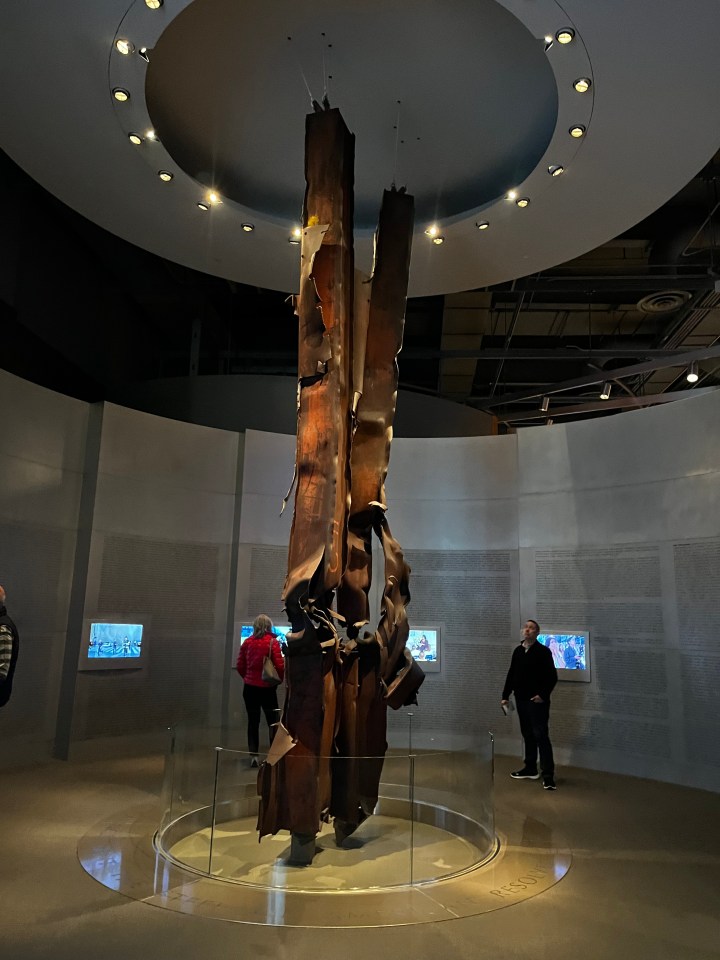
     Finally, when we were in Dallas recently, I got to visit the George W. Bush Library on the campus of Southern Methodist University. I was never a big fan of “Bushie” at the time of his presidency, but the library, which focuses on the key decisions and significant issues of his administration, made me realize in retrospect what monumental events occurred during W’s presidency: 9-11, the Iraq War and Saddam Hussain, Hurricane Katrina. The “Steel of American Resolve,” a section from the World Trade Center that dominates the 9-11 area of the Library (photo above), along with photos and other artifacts including the bullhorn The President used in lower Manhattan after the attack, is a moving reminder of that terrible event. Overall this Library is a humble, respectful and factual record of an ordinary man suddenly in charge of a nation in extraordinary times.  

     The Barack Obama Presidential Library is the 14th Presidential Library to be administered by the National Archives and Records Administration. Unlike all others, this is the first fully digital Presidential Library. An estimated 95 percent of all the records of the Obama administration were born as digital records and so they are stored and preserved as such. The more accessible Obama Presidential Center is currently being constructed on Chicago’s South Side by The Obama Foundation and is scheduled to open in 2026. 

     The Presidential Libraries offer an accessible and informative view into American history through the lens of the times and the events of the era. That view is perhaps more important and urgent today than ever before. The Spanish philosopher George Santayana famously said, “Those who cannot remember the past are condemned to repeat it.”(1905). The Presidential Libraries of the United States provide a valuable link to our collective past and a tacit warning about the failure to learn the lessons from our mistakes. We need to heed that warning.

comment 0

You Never Know …

     A dear old friend of mine texted me last week that he was in the hospital and had just been told that he had only a few months to live. His text was bizarre, full of Woody Guthrie quotes and quixotic quips that gave lie to the seriousness of the message. As well as I thought I knew this person, I still wasn’t sure how he wanted me to respond. Besides, I didn’t even know he was sick, much less seriously so. 

     Three days later, he was dead. 

     As well as you think you know someone or something or some situation, you never really know… But I should have known. After a lifetime of working with and listening to students and their families, after interviewing countless couples and writing about their weddings and marriages and family dynamics, after being a journalist for an alternate newspaper and reporting on politics and education and women’s issues, and after being generally one of those people who, even as a girl, apparently always walked around with a sign on her back reading “lay it on me,” you’d think I’d be beyond misreading insouciance and better at deciphering subtle messages.

     Aside from personal experience, I have a long professional history and expertise in classic literature, especially American literature, to draw on for lessons that have informed my life and themes that have shaped my perspective on reality. The biggest take-away from all of this reading and study is quite simply that “things are never as they seem.” From Gatsby’s outward appearance of wealth and success to Macbeth’s misperceptions of“fair is foul and foul is fair,” to Poe’s untrustworthy narrator in “The Tell-Tale Heart,” looks are deceiving and words are not always truthful. It is a surprisingly universal literary message across time and place and cultures, one that we would do well to heed today even if we haven’t read all the books.

     The warning about duplicity also rings true in our interpersonal relationships. Leo Tolstoy ,in the opening to his novel Anna Karenina, wrote: “All happy families are alike; each unhappy family is unhappy in its own way.” There’s a guiding principle for marriage counselors everywhere. An old truism among those counselors and professionals is that you cannot know a marriage from the outside. No one else outside of an intimate relationship can ever really know what someone else is feeling, fearing, or going through. Sometimes, even those involved in those very intimate relationships misread each other’s feelings. It would do well for friends and extended family members to remember that before they butt in to a personal situation.

     Ultimately, the truth or accuracy of any situation always depends on one’s perspective. This is probably the reason that eye witness testimony in legal cases is considered the least reliable. No doubt most of us at some point have been an eyewitness — to a protest, an altercation, an accident etc. — where different viewpoints and prejudices affect the interpretations, the actual truth of what happened. Just look at the events of January 6 in our own recent history. “The truth” of what we all witnessed in real time on television has been reinterpreted and repackaged according to the prevailing perspectives of a few. We’re back to the what-is-truth controversy.

     The confusion of image with reality is especially dangerous today, when social media promotes not who you are, but who you appear to be. All the markers of appearance — clothing, houses, cars, fame, companions, performance — lead us back to The Great Gatsby again. Who are these people anyway? What makes them worthy of notice, much less emulation? Sadly it is the very promotion and constant exposure to all those media influencers that create such devastating effects on personal identity and self-image, particularly among our young people, while also inculcating moral and cultural values that have no real foundations in truth.

     If I sound circumspect, even a bit jaded, perhaps it’s because I have become so over the years. I’ve often been told that I am unflappable, rarely ever surprised by the behavior of others, much less shocked. In the context of teaching and reporting and working with the public, that’s a positive attribute I think; in the context of personal relationships, I’ll admit that it’s something of a protective posture. I like to think that if I have reasonable expectations of others, then I will rarely be hurt or disappointed by their actions, nor will I easily misread them.

     But in the case of my friend last week, I did misread his missives. I thought he was just being his usual overly-dramatic self, and while I ended up saying “Vaya con Diós, mi amigo,” (following his Spanish lead in the texts), I was surprised, and then saddened, by the sudden result. We don’t always anticipate events as well as we like to think we do. You just never know…

comment 0

Of Fire and Ice

 After a week of below freezing temperatures and a sleet/ice/snow storm that closed roads and highways, cancelled schools and government offices, and disrupted meetings and appointments all over South Texas, I am only now thawing out while writing this. We didn’t get as much snow in San Antonio as they did farther East (6” in Houston), but this was the first measurable snowfall we’ve had here since the disastrous winter storm four years ago in 2021. 

     No doubt you remember that weather event no matter where you live; it was the one that resulted in a total power-grid failure and left us without heat and electricity in our homes for days, and without our Senator “Cancun Cruz” who fled to Mexico.That storm left us with more than 6” in the City; before that, the last measurable snowfall we had was in 2017. The fact is that  we do seem to be getting more severe winter weather recently, including snow. I only remember it snowing once in my life in all the years growing up in South Texas and that was a mere dusting hardly worthy of all the excitement. 

     Ah, the weather: “Climate is what we expect; weather is what we get,” Mark Twain famously said. Of course, these days, the controversy between the climate and the weather is a hot topic. I sit here in my sweater watching the news every night about the horrendous fires in Southern California. Add to that, coverage of record snows and ice in the South and into the Northeast. Climate or weather, wherein lies the cause, and “who-in” lies the blame?

   Here in South Texas, our greatest weather events have always been hurricanes. As I look back, I realize that I have been in the biggest of them: Carla, Harvey, Celia, Ike. But having lived in different parts of the Country and traveled elsewhere around the world,  I have also been directly involved in other major weather events: earthquakes, tornadoes, floods, blizzards, volcanic eruptions, hoarfrost (frozen fog), gale-force winds at sea, and crippling drought here at home. Yet, other than having to evacuate our apartment building in New York for a night-time fire, I have never, thank god, had to endure the paralyzing fear or devastating loss experienced by the rapidly advancing flames on those living in the path of a full-on forest fire such as those in California.

     Allow me to deviate for a backstory here: A number of years ago, we sold our longtime home in Stamford, CT, in order to make a pre-retirement move farther up County. Now I loved that home in Stamford; we had lived there for 23 years, raised our son there, built our careers there, and established our place in the community. The house was a long, low, mid-century modern style (a Better Homes & Gardens design winner in the 1970s) situated on a hill that sloped down to a private lake. Being a newly-built modern house in an established neighborhood of traditional New England colonials, it took forever to sell. But we persevered because it was time for us to go, to downsize and move on. The people who finally bought it brought in architects and contractors to draw plans and they promised to upgrade and expand the house. That made us very happy.

     Watching the California fires unfold over the last several days, with the initial blazes, then the hopes of containment, then the rash of new eruptions, then the tragic loss and grief of whole communities that have ended up with nothing left of their lives has made me grateful for having survived my own past weather events relatively unscathed. As I witnessed bereaved  homeowners gradually return to their Pacific Palisades neighborhoods to sift through the debris and detritus for some remnants, however small, of their former lives, I have been reminded of “the loss” of that Stamford home.

     Once we had moved, we were still living near Stamford. I still worked there, we had friends there, doctors and services there — in many ways, it was still “home” to us. My husband never wanted to even drive by our old house when he was down there, but I was curious about all the renovations and wanted to see how they were coming along. So one day a few weeks after we had moved, I drove on over by myself, turned down the street by the lake, and maneuvered, as best I could, toward the steep hill of the driveway through all the trucks and construction vehicles. Finally, I just parked the car, got out and walked to the top of the incline. And there, to my complete shock, I found nothing left but an exposed basement. I stood there stunned and immobilized, and then I started to cry. 

     A man in a hard hat came up alongside me and asked, nicely, who I was and what I was doing there. I explained that I was the former owner of the house no longer in front of us and that I wanted to stop by and see how the new owners’ promised renovations were coming along. All I  wanted to know now was what happened to that promise. “It became clear that all the plans for re-design were too costly,” he said, “and so it just made sense to raze the house and start over.”

     Back home later I called my son, who is an architect, to tell him the news and express how angry and upset I was. “They broke their promise,” I moaned, “and now our beautiful home is gone.” He listened to me sniffle and snort for a while, and then, very simply said, “Mom, it was just a house and the house is not the home. You have your memories and they go with you.”

     Of course, we had left that house in Stamford with a great deal more than just the clothes on our backs, so my experience of that loss is hardly equivalent to the losses Californians are suffering. But I have often recalled my son’s realistic observation on that particular day when I have faced other instances of loss in my life. His comment speaks to a universal truth: You don’t need things, any things really, to tell you who you are and who you love as long as you have your life and your memories. It’s a hard truth, but one worth remembering.

     So much for the past and memories hot and cold. Meanwhile, here we are in the present in 2025, where hell has begun to freeze over.    

comments 3

The Sound of Silence

   Perhaps the most memorable song from the 1967 film The Graduate is Simon and Garfunkel’s “The Sound of Silence.”  Who can forget the final scene when Elaine, in her white wedding dress, and Ben, in his white hoodie, plop themselves down, breathless and laughing, in the back of a city bus while dismayed passengers look on? What on earth have these kids done!  And no sooner does the camera pan back to the faces of the kids themselves than we see their own expressions devolve from exuberant laughter and excited anticipation into blank stares and vacant bewilderment. Now they too wonder what on earth they have done!

     Critics of the lyrics generally agree that the song is about the difficulty of communicating emotionally, especially in an atmosphere of constant distraction and noise. Some critics have even suggested that the lyrics were prophetic warnings of increasing social isolation as the 20th century progressed into a world of instantaneous information and ever-expanding technology. Even the plot of the film can be seen as a prescient warning, particularly to my own Boomer generation, of the pitfalls of  “dropping out” of traditional roles and rules without adequate forethought. Just look at the upheaval that subsequently ensued in the 1960s and ‘70s.

     Now in the 21st century, we can all attest to the generalized anxiety and alienation brought on by the constant chaos of misinformation and the unrelenting demands of social media. Cell phones buzz and ping and ring all day, cable television blares breaking news, and even printed headlines shout from the page. So much noise, so much distraction, so much busyness — in the aftermath of the isolation of Covid 19, we have multi-tasked ourselves into a collective case of ADD. I don’t know about you, but there are days when I, too, want to get on a bus (better yet, in my new car) and flee, just like Elaine and Ben. But where to go to get away from it all…

     As observed by MSNBC’s commentator Chris Hayes in a recent New York Times essay, “The endless diversions offered to us in every instance we are within the reach of our own phones means we never have to do the difficult work of figuring out how to live with our own minds.” (Opinion section, 1/5/2025)  And the work of our own minds is found only in silence. Busyness abates boredom, Hayes contends in his essay, but we cannot escape our own mind. And in our mind is the ultimate sound of silence, the interior sounds of thought and evaluation that help us focus our attention on the things that really matter.

     I have, of late, been cultivating the sound of silence through the avoidance of noise and chatter and all the distractions and ancillary worries and demands that come at me every day. I have decided that I cannot afford them, or most of the people who deliver them. My patience and my mental health simply won’t allow it. You might say that I have stepped off the treadmill of talk and tuned in to keeping my own counsel. Call me anti-social or reclusive or even downright misanthropic, but in the end, each one of us has to navigate that private existential space in our heads between hope and despair.

     Different people have different ways of trying to navigate that space and, indeed, there is a whole industry of self-help books, diet and exercise routines, and psychological practices offering assistance. Whether it’s prayer or journaling or mindfulness, or even The Life-Changing Magic of Tidying Up, all these approaches attempt to help us develop the discipline to resist the outward distractions of the world and cultivate the composure of a centered self.  But, to quote Hayes again, “We cannot escape our own mind; it follows us wherever we go. We can’t outrun the treadmill. Our only hope of peace is to force ourselves to step off whenever we can.”

     In other words, regardless of whatever situational problems we might have, our real problem is always an existential one, and to cope with that problem, we have to be still. In these difficult times of constant chaos and crisis around the world, we have to listen for the sound of silence in ourselves. And once again I return to the final lines of my most favorite poem, “Ash Wednesday,” by my most favorite poet, T.S. Eliot: “Teach us to care and not to care. Teach us to sit still.”

     Amen.

comment 1

The Gift of Time

You reach an age, or a stage, in life where you really don’t need anything new and have no interest in acquiring anything more than you have. (Well, okay, so some “more is better” types don’t, but I’m talking about normal people.) Anyway, we have reached that stage, now giving away, selling, and disposing of waaaay more than we buy. So, not needing or wanting anything new, we three decided not to give Christmas gifts this year. Instead ,we decided to gift each other with the gift of time spent and enjoyed together, a family field trip of experiences and shared company. 

     My husband, our son and I have just returned from a few days in Dallas. We called it a holiday “family field trip.” We three have often traveled together and we travel together very well because we all enjoy the same things and look for the same kinds of activities. (This was a pattern that we started when our son was small, when we took him absolutely everywhere with us, inside and outside of the Country.) 

     This trip to Dallas, to enjoy a road trip in my new car,  was designed to stay in a luxury hotel with a spa, have great meals at good restaurants, go to the Dallas Museum of Art (where there was a special Frida Khalo exhibit), stroll (and shop) through Eataly in Dallas, visit the George W. Busch Presidential Library (I have a thing for presidential libraries, regardless of their political affiliations, having now been to eight of the  thirteen ), and to see some friends. And of course, we also found other diversions along the way, including an enlightening personal tour by veteran employees of the historic Neiman-Marcus flagship store downtown on Main Street (1910), probably the last grand-dame department store left in America.. 

     This was really an enlightening visit to a city that we had been to, but not spent much time in for years. Good choice for a quick holiday getaway (and even the traffic on I-35 cooperated.)  But, the whole point of the trip, really was not about the destination or the sights or the diversions, but about our being together for a few days. This was a gift of time for us to spend with each other without the worries and concerns of everyday daily life where we live. 

     Emerson famously said that those who travel to get away from themselves are “bringing ruins to ruins.” Perhaps, though I don’t think getting away with those you love most are exactly escaping, nor could I say that Dallas is exactly in ruins — at least not yet. Most people need a break, a change of venue, if you will, and sometimes just getting away locally will bring as much happiness and relief as an extended journey. At least that was our experience this week..

     So here we are at the end of another year as Father Time is about to shuffle off into the sunset taking his bag of memories with him. Even though 2024 hasn’t been the greatest of my life, I am grateful to him for having let me have another year to love, to laugh, to learn, and yes, even to struggle. After all, it is only through struggle and disappointment that we truly grow in patience, compassion, and significant connection to others. As the late Archbishop Desmond Tutu said, “We don’t really get close to others if our relationship is made up of unending hunky-dory-ness.” (The Book of Joy, p. 111) 

     I don’t know about you, but I’ve long since given up on the tired routine of making New Year’s Resolutions. Rather, better to realize that there’s no guarantee of “doing” later, “becoming” later, “reforming” later. In this life, later is always now! So now we need to appreciate the gift of time we have, to use it wisely and to share it generously with those we love. 

     You might say that the gift of time is the “gift that keeps on giving,” even after we’re gone. Hope you will remember that in the New Year.

comments 2

Puppy Love

 Fifty years ago this Christmas we got our first “show” puppy (meaning a pure bred canine with all the lineage and breeder certifications behind it to qualify for American Kennel Club shows). He was a surprise gift from my husband, probably a subtle incentive intended toward prompting me to want to start a family. (It worked; our son was born the next year.) At any rate, I consider that Christmas to actually be the beginning of “our traditional family,” one of enduring puppy love.

     That first puppy, Nero, was a Rottweiler. He had been flown to us from a reputable breeder in Montgomery, Alabama, with whom we ultimately became good friends. He was such a darling thing, a cute little black-and-tan wriggly with big paws that indicated his growth to come. It was love at first sight, of course. But then, we noticed some problems: he couldn’t walk well, he couldn’t stand, eventually he could hardly move. We took him down to Auburn University in Alabama, one of the premier veterinary schools in the country, where they determined that our darling puppy had been dropped or mishandled in transport and had arrived with a fractured vertebrae. And so that became the sad ending to that first Christmas beginning.

     From that experience, we vowed never to ship a dog again, but we did  promptly drive down and pick up another show puppy named Pharo. He, too, was a Rottweiler, and he was a show stopper! He easily became a champion of this and that and everything. He was super smart, pranced and preened and did all the right things in the show ring, but he was a brat and not easy to live with. Gradually we had two more Rottweilers along with Pharo,  one of whom was his mother, also a champion, that we retired from our breeder friend.

     We and our Rottweilers became bonafide  “doggie people” on the show circuit for ten years or more and even our young son handled Pharo in the show ring. My husband especially became very, very involved in the Medallion Rottweiler Club (of which he is still a member) and we regularly traveled to shows and specialties. Most people who simply have family pets or adopt (bless them) from a rescue site don’t realize what a huge “doggie subculture” exists in pure-bred show dogs and breed clubs. Nor do they realize that these breed clubs don’t exist to be snobbish, but to preserve and perpetuate the character, the strengths, and the reputations of breeds that they cherish. 

     Sadly, the reputation and the quality of the Rottweiler breed had begun to suffer in the late-80’s due to back-yard breeders and adverse publicity about the breed’s more aggressive tendencies. Meanwhile, we had earlier encountered our first Greater Swiss Mountain Dog, owned by August Busch III, in St. Louis at Grant’s Farm, which is the home of the famous Clydesdale horses. That Swissy, named Casar vom Neuhof, was much larger than a Rottweiler, but a gentle giant who acted as a good-will ambassador welcoming all visitors. His big-hearted temperament was impressive as his size.

     We never forgot that first encounter with Casar, which prompted my husband to research this  rare breed and to become obsessed with photographing them at dog shows. Through the Greater Swiss Mountain Dog Club of America (GSMDCA),  we acquired our own Swiss Mountain Dog, Baron of High Ridge in 1989. Baron soon won Winner’s Dog and Best of Breed in a Specialty Show right out of the puppy class; from there he was “discovered” by advertising talent agents and ultimately, became the corporate mascot called “Network” featured on ads and in appearances for Sun MicroSystems. Baron was magnificent, to say the least. He was so well-trained that he could walk the streets of New York City with no leash and could sit at photo shoots under tables laden with food and never even sneak a snack. He was a true professional, and a photographer’s joy.  (Not to mention that his royalties from print ads and personal appearances with the CEO of Sun MicroSystems paid for two semesters of our son’s education at a private university.) 

     Next in line was Ike (Derby’s Eisenhower), Baron’s son. Ike had Baron’s good looks, but even more of a dedicated competitive show and obedience spirit. He was incredibly smart and easy to train, even if a bit more high-strung than his father. “Mom, you finally have a dog that is you,” my son said. With his compulsive energy and drive, Ike ended up with more championships, drafting titles, and obedience degrees than most people we know. And through training him, my husband became a judge and a trainer himself, an active member of the GSMDCA and their first delegate to the American Kennel Club. Between the dog shows, the demonstrations, the drafting clinics, and the active promotion of the breed for recognition by the AKC in 1995, my husband’s lifelong passion for canines became his dominating interest.

     Over the years we have had three more Swissys, often overlapping, all out of Baron’s bloodline: Duke, then Kaas, and then Mac. Sadly, the larger the breed, the shorter the lifespan, so most of these magnificient companions only lived to be 8 or 9 years old. Mac, our last Swissy (pictured) enjoyed exceptional health his whole life and made it to the ripe old age of 11, which was quite something. But arthritis finally got the better of him as he lost muscle strength, so we had to put him to sleep right before Thanksgiving this year. It was incredibly sad, not only because it is truly a loss of a comforting and beloved family member, but also because we knew that as we ourselves were getting older, Mac would have to be our last large-breed companion. Moreover, his passing also marks the end of our active “doggie years,” particularly for my husband who has devoted so much of his life and love of animals to the cause of their protection.

     Roughly 66% of American households have some sort of pet, more today than ever before. Much of this growth is rightly attributed to the loneliness and stress ignited by the Covid epidemic, and the apparent remaining stress of a chaotic world situation. The family dog population has increased from 52.9 million in 1996 to 87.7 million in 2024. (FYI: The cat population has remained fairly stable during the same period.)  It doesn’t matter whether the family pet is a pure-bred dog or one rescued from a shelter. What matters most is that “Fido” lives with you in your home and is given the love and opportunity through care and training to become an active member of the family. 

     The average IQ of most people is somewhere between 85 and 115; the average house dog has been shown to have an IQ of about 100, and a developed vocabulary of about 250 words, which is roughly equal to that of a small child between 2 and 3 years old. With the right training, some exceptionally intelligent breeds can develop a human vocabulary of about 1,000 words.  In other words, your family dog is probably smarter than most of your friends and relatives!

     God knows that they are more loving, more devoted, more forgiving and more understanding. They intuitively know when you are sad or lonely or depressed or even just sick with a cold;  they will sit by your bed, look into your eyes and nurse you with their wet noses. There is a reason that canines are the first choice for comfort and service animals; they really are a man’s — and a woman’s — best friend.

      Saying good-bye to our Mac is equal parts profound gratitude for his life with us and profound grief for his loss. And saying good-bye to 50 years of being devoted “doggie people” is now the sad ending of puppy love this Christmas season.

comments 3

Glad Tidings

Okay, so here we are in the middle of November with Thanksgiving around the corner and the Christmas holidays in our sights. I don’t know about you, but so far, the month of November has been a real bummer for me. Between Thanksgiving being the anniversary of my Mother’s death, my art quilt “Fire In The Sky” not getting juried into the international show, various health issues among friends and family, bothersome little catastrophes around the house, and of course, all the noise over the election, things are not, as they say, “going swimmingly.”

     But I grasp for the good news which is: the election is over!!! We now have two full months before the new administration becomes official. That means that there are NO campaigns, NO solicitations for money, NO robo calls, NO ads on television, and NO coverage of rallies or conventions. No rah-ha or blah-ha, no noise. Blessed peace. We need to enjoy it while we can. There is plenty of time after January 20 to tune back in to all the chaos and mishegas if you must, but for now, let it rest.

     Since the election was apparently clean and decisive, we are also spared the accusations, the lawsuits, and the endless drama over a contested election which could have gone on and on for months. Granted, only 63% of registered voters turned out this year, and yes many are already trying to assign blame for who did or didn’t do what, but really we all share the blame for every election result whether we like it or not. In a democracy, the people choose their leaders, so this is who we are and what we’ve chosen in 2024. It’s done. Get over it.

     I for one have already begun looking for small ways to be glad this holiday season. First of all, I have put a strict limit on I-phone news updates, social media, podcasts, cable news and political pundits. I have returned to my one, reasonable mainstream evening news program (NBC Nightly News) that covers the nation and the world, and that’s it for media. Too much chatter, too much noise. I refuse to let all these people live in my head throughout the holidays; it’s already too crowded in there anyway. 

     Contrary to popular opinion, talking about and hearing about and worrying about what-ifs only reinforces all those fears and worries and what-ifs (unless you’re talking to a therapist, of course). I don’t want to talk about it or hear about it either, even with people who might agree with me. This year especially I’m trying to create a quiet place in which to find reasons to be glad and to plan a lovely, calm, un-fussy holiday season at home beginning with Thanksgiving. 

     Though dinner will be just us, I’m setting the table in the dining room and using my best china and crystal. Why not the best for those I love the best? I’ve already put out some seasonal decorations, already made my traditional brioche and put it in the freezer, already stocked special wines to accompany the meal, and already ordered an entire turkey dinner, complete with pies, from a gourmet market here in town. We will watch the Macy’s Thanksgiving Day parade, nibble on baked brie, and laugh about our shared memories of Thanksgiving dinners past (the good, the bad, and the ugly).  And we will be thankful that our little family is here together right now.

     Finally, in a month, and in a year actually, that hasn’t been too great, I should be glad that not only am I not the Thanksgiving turkey, but that I don’t even have to cook it!

comment 1

Election Malaise

A malaise is defined as a general discomfort or illness that is, ironically, difficult to define — but not always. The word comes from the French root mal, meaning bad, and aise, meaning ease. Bad ease — you’d better believe it. Couldn’t be a better description for the tenor of the country now in the midst of this 2024 election cycle. As always, the French have been prophetic.

     I’ve sensed the malaise for a while now even here in Texas. In previous presidential elections Trump signs and flags and banners blanketed the general landscape and every residential street, but this time there is a dearth of signage altogether. On our own cul-de-sac, there are only five political yard signs, two for Tump and three for Harris. Driving around the City, I also notice that there are few bumper stickers on cars at all, not even for any local candidates. I take this as both a good sign and a bad one, thinking that perhaps people are still deciding on whom to support, or that they are afraid to advertise their affiliations, which is concerning and sad.

     I’ve also sensed a general cultural malaise in terms of enthusiasm for the seasons, the holidays, and any autumn community activities. Granted, it’s hard to celebrate fall when we remain in a drought, when daytime highs still hoover around 90º and when the only leaf color on any trees is a dead brown. In our neighborhood, few houses this year had any Halloween decorations at all, and fewer still were open and lighted to welcome trick-or-treaters. In years past, many residents set up tables in their front yards displaying their treats or even grilled hot dogs to give out along with chips and sodas inviting neighborly conversations. This year there was none of that.

     All there is this year, all there has been for too long, is an absolutely incessant barrage of political robo calls, text messages, and television ads. I was under the impression that once you had voted, all these solicitations stopped. Obviously, I was wrong. Actually, the closer we’ve gotten to election day, the more insistent and urgent the messages have become. I’ve been getting five or more text messages a day, some from down-ballot candidates whom I’ve never heard of in other states, but most from opposition candidates in the party in which I am not registered! Note to self: never donate to either national party committee again because they all obviously share their donor list with everyone else. 

     I just read that the total amount of money spent on the 2024 elections has reached 16 billion dollars — yes, BILLION; the presidential race alone accounts for two billion of that. Here in Texas, the Cruz vs. Allred senate race is not only the most expensive in Texas history, but the most expensive senate race in the country running now just shy of $200 million dollars. It’s obscene. Think of all the good that could be done with that amount of money, all the people who could be fed, all the suffering that could be alleviated, all the disasters that could be relieved. It makes me sick.

     We can thank the Supreme Court ruling in Citizens United vs.the Federal Election Commission (Jan. 21, 2010) which undid campaign finance rules that had existed for more than 100 years. Enter the free-wheeling era of Super Pacs and Dark Money spent by the biggest corporations and organizations and the millionaires and billionaires who wield political power through them all. The argument in the ruling was that Citizens United (a conservative non-profit group) had the same “free-speech” right to support and donate to political campaigns as an individual person does. The result of granting “personhood” to corporations and groups, however, meant an almost immediate expansion in political spending, thereby increasing the already outsized influence of wealthy donors, big business and special interests. At a time of growing wealth inequality in the US, this decision served to reinforced the idea that democracy serves the interests of the wealthy few while the power of the ordinary citizen is almost negligible. And we are surprised that so many potential voters today are cynical, unaffiliated and/or totally disengaged?

     According to the U.S. Census Bureau 2020 Report on Presidential Election Voting, more people turned out to vote in 2020 (154.6 million) than in 2016 (137.5 million). It was the largest single increase between consecutive presidential elections since records of voting and registration began being recorded in 1964. The 154.6 million voters in 2020 constituted roughly 66% of those eligible to vote. The Bipartisan Policy Center reports that roughly 244 million Americans are eligible to vote in the 2024 election; in order to equal 2020’s turnout, 162 million ballots need to be cast by end of day tomorrow. Let’s hope it’s more; please god let’s hope it is an absolute  landslide! 

     Whatever way the election goes, my greatest hope is that it’s decisive. Otherwise, we are in for more of the same chaos, confusion, and court challenges that have dragged on for years already. I don’t know about you, but I am just so sick of all of it. The campaigns are too long and too expensive, not to mention too ugly and too violent. Even Donald Trump recently admitted that he’s been campaigning for nine years. Insiders say he is exhausted. I guess so —aren’t we all? 

     There is a famous quote from Joseph de Maistre, a French philosopher, writer and lawyer who lived in the period right after the French Revolution: “In a democracy, people get the leaders they deserve.” That quote has been reiterated many times and attributed to many different leaders — not always accurately — including Thomas Jefferson who amended it to “The government you elect is the government you deserve.” I don’t think any of these leaders/philosophers were being sarcastic about democracy. You see, in a democracy, especially one here in the United States where we are a nation of proud individualists, people tend to vote for those whose policies will benefit them personally, not necessarily for those who prioritize the interest of the common good or society as a whole.

     This is where we are now in this election, I think. The main issue, on several levels, is  “looking out for number one.” If my fellow Americans are unable to move beyond themselves, to look to the lessons of history and to take the long view of what is before us, then so be it. We are a nation of short-sighted, gullible, selfish people. No doubt our election malaise will continue long past November 5. I hope a generalized malaise is the only thing we suffer.