comments 2

Enough Already!

     Enough. We use the word all the time, but what does “enough” really mean? Is it synonymous with the end, as when we scold a whiny child saying “Enough!”  How about “That’s enough” when we push back from the dinner table, or “Enough of this” as an expression of frustration with a tedious task? 

     Sometimes enough is already too much.

     In a response to a letter from a parent about the limits of support for an adult child, syndicated advice columnist Carolyn Hax identified  “the personal search for enough “ as one of the major challenges of adulthood. That one simple observation —stated as it was within a much larger discussion of what constitutes good enough, hard enough, happy enough, reliable enough, honest enough—struck me as so succinct and so profound that I couldn’t help but wonder why it had never occurred to me before. Certainly, in a more-more, faster-faster, bigger-bigger consumer culture like America’s, we have become a nation of grown-up children who obviously never conquered that particular developmental challenge!  The dire consequence of that failure, of having too much or not enough and lacking the maturity to acknowledge which is which, now finds its collective expression in the political, social, and economic divisions of an angry, suspicious population.  

     Incongruities abound in such a culture and constantly thwart the efforts of those of us who do try to define enough for ourselves. BOGO! screams the sign. “But I only want one,” I say to the cashier, who insists that I take the extra one as well. Retailers must have a storage problem too. Where is Costco going to put all those huge pallets of toilet paper and paper towels and diapers if they don’t sell them, and where are we supposed to put them when we get them home?  Once the garage is full, then we’re forced to live like hoarders inside our houses, with boxes under the beds, dishes stacked on counters, and everything else from extra clothes to Christmas wrap to tchotchkes headed to Goodwill piled in the guest room. Never mind where to put the car (or the guests); most families where I live seem to have more cars than they do licensed drivers, so the garage wouldn’t be adequate anyway, even if both (or three or four) of them were empty. Who can recognize enough when it’s buried under all the clutter!

     Prioritize,  downsize, simplify: these have become the mantras of our age, but they, too, beg the question of enough because they all require that choices be made — and one choice inevitably precludes another. If you’ve spent any time around small children you know that they have a hard time accepting limits and understanding that they can’t have it all.  Sometimes, so do adults. The classic conundrum of the early women’s movement, the working woman vs. the stay-at-home mom, compelled many of us, myself included, to challenge out-dated gender roles in an effort to prove that women could do it all, be it all, and have it all — even without a wife to pick up the slack!  What we learned during those long years of career-building, child-rearing, family-managing and house-keeping is that yes, one can perhaps have it all, but only sequentially, not all at once all the time every single day. Ironically though, having learned that lesson and knowing it to be true, many of us, both women and men, continue to live our lives juggling wants, needs and expectations in a perpetual quest to find the right balance.

     Having enough is not always about the possessions or the money per se, but more often about what those assets come to represent. In an essay about the “post-economic” super-rich (those who have no financial need to work), writer Alex Williams describes the pursuit of wealth as a competition with others that turns into a personal addiction. (“Why Don’t Rich People Just Stop Working?” The New York Times, Oct. 17, 2019) Studies of the super-rich over the years have often shown that those at the top tend to work longer hours and spend less time at leisure even when longer and harder cannot possibly enhance the bottom line. Evidently, they just don’t know how to stop; their entire raison d’être comes from capitalism and their relentless pursuit of success becomes a lifestyle drug. Without more projects, more goals, or more money, these individuals face a loss of personal identity and an existential void. There is never enough to allay those fears.

     But more than enough does register with some.  Witness Bill Gates’ and Warren Buffett’s Giving Pledge, in which a growing number of billionaires in American and around the world have pledged to give away at least half their wealth during their lifetimes or in their wills. While philanthropy will not solve the problems of income disparity, the moral obligation to share the outsized wealth of a few can address some of the social and cultural needs that government cannot. Philanthropy is truly the gift that keeps on giving; foundations such as those created by 19th century families of great wealth such as the Carnegies and the Mellons are still operating and contributing today.

       Wealth and well-being are relative concepts in every age and at every socio-economic level. What sociologists call the “relative income hypothesis” is a normal human tendency to compare ourselves with others around us. Such comparisons activate some of our best impulses — a generosity of spirit and a willingness to share our own good fortune — and some of our worst — jealousy and resentment at the good fortune of others. Either way our attitude depends on how we define enough. To paraphrase an oft quoted maxim, “Gratitude is the attitude that what we have is enough.”  

     With the season of Thanksgiving upon us, this is a good time to take stock, to look at the life we have and to evaluate how well we are living it. Perhaps a few “attitude adjustments” are in order to make those prayers at the Thanksgiving table more meaningful and sincere this year.  Whatever you do, though, keep the prayers short and simple, lest someone blurt out “Enough already!” 

comment 0

Close To Home

  Halloween is commonly considered a time when the barrier between the physical and the supernatural worlds is especially fluid.  The late fall holiday has its origins in the ancient Celtic festival of Samhain, when the dead were thought to freely roam the earth. People would lite bonfires to ward off evil spirits and wear costumes to deceive ghostly relatives who might kidnap them and whisk them away to the underworld. In 835, as an attempt to diminish the influence of  “pagan” celebrations, Pope Gregory III designated November 1 an official Catholic holyday to honor saints and martyrs. It is called All Saints’ Day and is still observed by Catholics and some Protestants today, but it never really supplanted the traditions of Samhain. 

       Over time, October 31 became known as All Hallow’s Eve, or Halloween, and adapted many of the practices of the ancient Celts. The secular holiday was largely popularized in 19th century America through Irish immigrants who brought their customs and beliefs, both Celtic and Catholic, across the Ocean. But of course, here they encountered a New World, a land of genuine optimism that had long since set aside old superstitions in favor of practical progress toward a modern age.  Thus, the American incarnation of Halloween had to mock old-world fears and lampoon evil spirits with its costume parties and frightful fun. Today, the scariest thing remaining about Halloween in the U.S is the amount of money spent on it  — about $9 billion last year. 

     So this is how we got to the itchy latex masks, the tacky polyester costumes, the ghoulish props of blood and bones, the bats, the cats, the rats and all the other common accoutrements that make Halloween not scary at all. Even the haunted houses and midnight horror movies promoted around the country are so full of character clichés, gratuitous gore, and elements of ridiculous melodrama that you end up more likely to die laughing than to die of fright.

     Such silly nonsense. When I was a girl, I handed out candy to little goblins and occasionally attended parties with some friends, but mostly I avoided all the craziness and stayed close to home on Halloween. We lived with my grandmother, who had been born in the 19th century, and thus was already quite old; she was not exactly a fun-loving person. Like so many children of European immigrants (German, in her case), she was extremely superstitious, she read cards, believed in charms and curses, and had her own first-hand tales of mysterious characters and local legends to tell. She did not take Halloween lightly and certainly did not think the day was suitable for frivolous merry-making. Call it schadenfreude if you wish, but I loved sitting at the kitchen table after dinner listening to her stories of dastardly deeds and fitting endings dealt by the hand of fate, and I carefully weighed her warnings about the evils lurking all around us.   

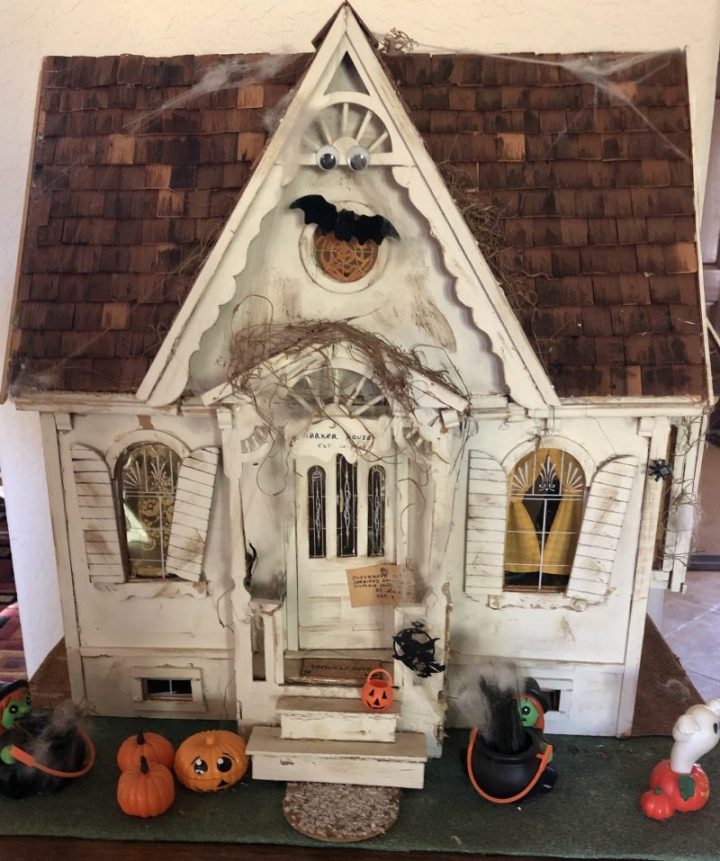
     My Mother, on the other hand, was a fun-loving person. She decorated the house, baked cookies or cakes, and improvised fun craft projects for every holiday. I’ve written here before about the elaborate birthday parties she/we planned, often employing a Halloween theme for my early October celebration. An accomplished miniaturist, she made and furnished the haunted house pictured above for my 46th birthday, and shipped it to me in Connecticut!  It stands as a model not only of her sense of fun and her love for me, but also as a vivid reminder of all those Halloweens she and I shared.

     My Mother was not a superstitious person, but she was a reader and enjoyed murder mysteries and Gothic tales. One of her favorite authors was Edgar Allen Poe. While my grandmother shared “true” stories of  local mayhem and misfortune, my Mother shared literary classics such as “The Black Cat” and  “The Tell Tale Heart.” Needless to say, I took to these tales and to others like them, perhaps because I am naturally inclined to contemplation in the dark days of fall and winter.  Even now as a fifth-generation American, all those early authors, Hawthorne and Wharton and Bierce, speak to my ancient Irish, German, and English roots in their depictions of the physical, spiritual and psychological underpinnings of ancient fears. These depictions are not usually overt; they are subtle, implied, suspenseful, and all the more frightening because your own imagination fills in the blanks. It is in literature, especially in American literature, that the true terrors of Halloween —  the existential fear of the unknown and the recognition of our own mortality — find meaningful expression. 

     My favorite Halloween story was, and still is, Washington Irving’s tale of the headless horseman in “The Legend of Sleepy Hollow.” The headless Hessian was supposedly decapitated by an American cannonball during the Battle of White Plains, which took place around Halloween in the Revolutionary War of 1776. This harrowing but humorous tale presents Ichabod Crane, a hapless Connecticut schoolteacher, in arduous pursuit of the comely Katrina Van Tassel, daughter of a wealthy Dutch aristocrat. Returning at night from a party at the Van Tassel estate, where the men had reveled in shocking ghost stories and boasted of encounters with the horseman, Ichabod soon finds himself being pursued through Sleepy Hollow by the Hessian himself. At least we think he is actually pursued. In any event, Ichabod disappears and is never heard from again.  Imagine my delight when, years later while living in Connecticut,  I realized that the setting of this famous tale (and the author’s home) was merely a short drive away over the Tappan Zee Bridge to Tarrytown, NY. 

     There are other headless horseman stories, of course (including one based on a South Texas folk tale about an Irish adventurer in the War with Mexico), and many more Gothic tales of  horror and suspense, but the point is that classics endure because they are authentic and meaningful no matter how many times we revisit them. They force us to confront the fundamental truth of our existence whether we want to or not, and dare us to persevere in spite of our nighttime fears. Now if that isn’t a real trick-or-treat proposition, I don’t know what is!

      So, if you want to be safely spooked and spiritually enlightened this Halloween, stay in your house, eat some candy, and read — unless, of course, your house is haunted.

comments 2

Friday Night Sounds


For most people, the sounds of fall are rustling leaves, a whispering wind, or maybe the mournful whistle of a distant train. For me as a girl growing up, the unmistakable sounds of fall were the cheering crowds, the drumming bands, and the exuberant exclamations of Friday night football announcers at the stadium not too far from my house. When the air was clear and the wind was just right, I could hear it all, envision it all as I sat out in our swing on the front porch. I would smile and listen and dream about being in high school myself one day and becoming part of it, maybe even becoming a cheerleader. 

     Now you might think that all the drama of Friday Night Lights, in the book (1990), the movie (2004), and the television series (2006-10), was somehow a gross exaggeration of the intrigue and importance of the high-school football scene, but you would be wrong. For countless small communities — and even some not-so-small communities, like San Antonio — high-school sports, especially football, embodies the essence of school pride and serves as the centerpiece of social life in the community (pep rallies, parades, fund raisers, overnight trips, athletic scholarships, school championships, and awards dinners). Moreover, football figures prominently in the social hierarchy of the school: the quarterback, the team captains, the MVPs,  the cheerleaders, the pep squad, the Homecoming court, even the coaches and the adults in the booster clubs. These are always popular members of “the in crowd”  in town because football, especially in Texas, is not only a BIG thing, but likely the ONLY thing going on.

     Of course, times are changing and so is awareness. While football remains far and away the number one most popular sport in America, safety issues, especially Chronic Traumatic Encephalopathy (CTE), have become major risks even for professional players (note this weekend’s concussion of Pittsburgh Steelers’ Mason Rudolph), much less for younger boys whose growing bodies and defensive skills have not yet fully developed. The result is that youth participation in the sport continues to drop. According to the National Federation of State High School Associations, 20 schools nationwide have eliminated football altogether,  including junior varsity and freshman programs; fewer than 1.04 million high school students played in 2017. (Bogage, The Washington Post, 8/28/18)  Add increasing district costs, demographic shifts, political controversy, collegiate athletic scandals, and growing interests among youngsters in other international Olympic sports to the parental concerns about gridiron injury and it’s easy to see why football at all levels is undergoing something of a “market correction” these days.

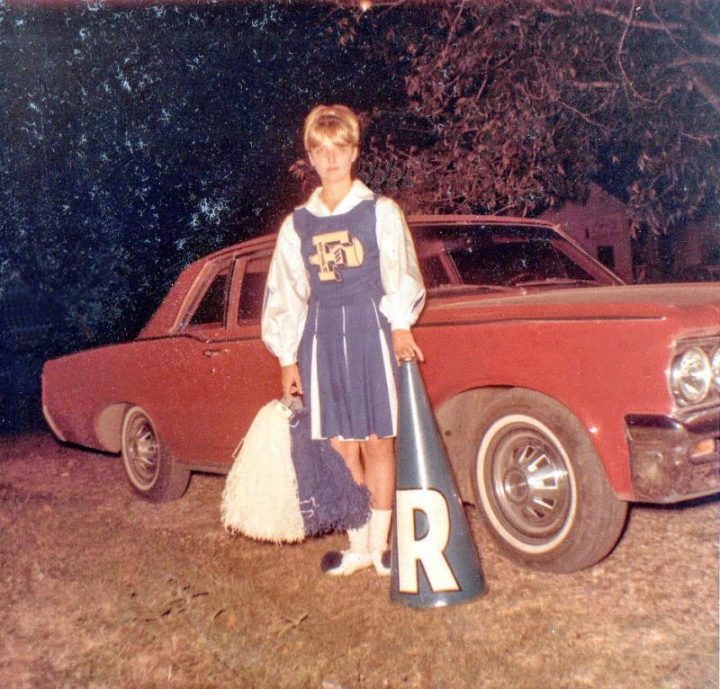
     Even so, fall is still synonymous with football for most Americans, and not just in Texas. I’ll admit that my fondness for the game today is rooted more in my high-school experiences than in any present devotion to the Texas Aggies or the Dallas Cowboys. You see, those long-ago dreams conjured by the Friday night sounds on my front porch did actually come true: I was elected cheerleader in 9th grade. My friends Judy and Nancy were elected too, proving at least in part that practice really does make perfect, or perfect enough. Our hours and hours of incessant jumping and tumbling and dancing, outdoors like popping corn in the heat, and indoors until window panes rattled, were “not for nothing.”   

     In our school, there were six cheerleaders, all female, elected by the entire student body. Popularity was part of it, of course, but performance and commitment counted for a lot. I can still remember that day as a freshman walking out into the middle of the huge gym to face the entire student body to give my speech about why I wanted to be a cheerleader (as though any girl in the audience needed to be told and any boy really cared) and to do my audition yell. I also recall swearing to myself that I would never pray for anything else in high school if I won that day; I considered it a small miracle when I actually did — and a bigger miracle still when I continued to win every year thereafter until graduation (and so did my friends).

       I was fortunate to be elected to other things and to receive other honors in high school, but nothing ever even came close to giving me the pride and the confidence and the teamwork that being a cheerleader did. I knew everyone, and everyone knew me. I extended my friendships far beyond the small cliques typical of most teenage girls and I built relationships not just within the school, but in the community at large. I grew into a leader, refining the skills of organization, communication, and motivation that would prove to be my strengths as an adult. Cheerleading even got me my first teaching job as a camp instructor for the National Cheerleading Association the summer before college! 

     You can say what you want about the cliché of being a blond Texas cheerleader, but I can tell you that there are worse ways to be identified. Years later, as a high-school English teacher in Connecticut, my students often referred to me as “a cheerleader” because I would never give up, not on a project, or a problem, or any of them. Even my Mother, bless her, in her later years after multiple strokes, used to joke that I was the proverbial cheerleader in her camp.

     The memories of all those long-ago Friday nights, the lasting friendships and positive lessons they generated, still comfort me and make me proud even now, especially as the South Texas weather begins to turn to echoes of fall and I celebrate another septuagenarian birthday tomorrow. Friday night sounds still echo in my head, and they’re good.

comments 2

Farther Off 5th

  The harvest moon has been glowing beautifully in the evenings here in the last official week of fall. It’s still hot outside, of course, but the days have taken on a fallish flavor, slightly cooler, slightly duskier, slightly less intense. The mood has prompted me to my long-standing, post-Labor Day ritual of the changing of the closet. Even though seasons don’t change here all that much, I still persist in packing away my summer clothes (mostly white/light linens) into the cedar chest, and pulling out my fall and winter clothes (dark cottons and a few sweaters). 

     Now you would think, given where I live and the fact that I am more-or-less retired, that this “changing of the wardrobe” business would be fairly quick and easy, but you would be wrong. It took me four days this week. First comes the culling of the closet, you see, and the folding of the items to be stored: linens and short-sleeve blouses, shorts, swimsuits and cover-ups, patio dresses and palazzo pants. From there, it’s on to the cedar chest where I’m met by the piles of fall clothes last placed on top in the spring. Some of these items get aired outside, some go into the laundry, and some that had a dubious determination in the last change-over, as well as older, heavier pieces that have lain in the very bottom of the chest for a long time, must all be reevaluated yet again. 

    This cedar-chest ritual was established during 40 years of living up East and working and teaching and needing a professional wardrobe that could handle any weather challenge from snow to rain to summer heat. Now, of course, things are a little different and wardrobe demands are dictated more by the travel destinations we have in the offing than by local weather patterns. But as the saying goes, “Old habits die hard.” Certainly, this particular habit gets decidedly longer and harder each year, and I’ve been trying to figure out why. 

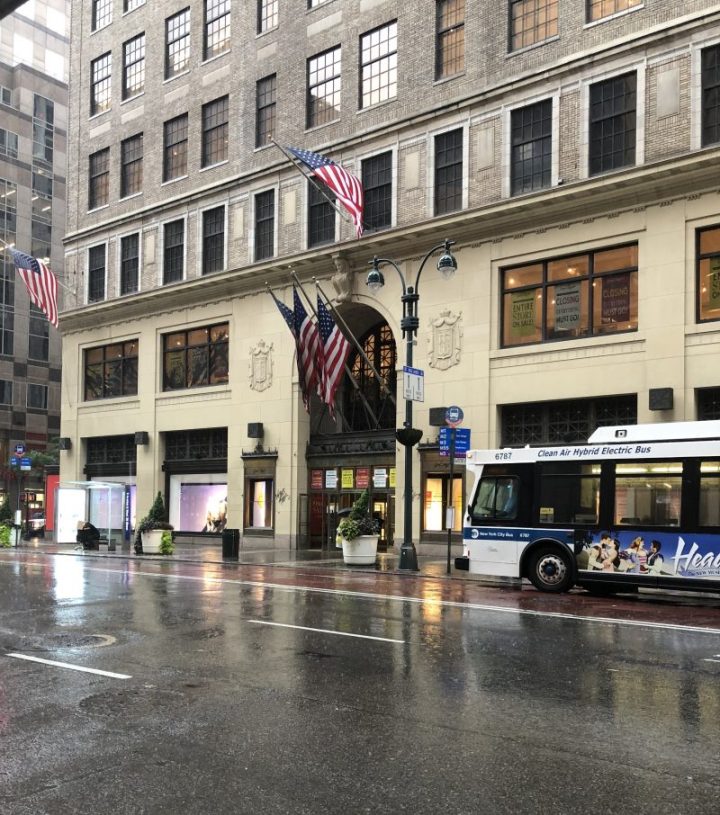
     Maybe it’s because my very first job as a newlywed in New York City was in the garment industry. I worked in menswear in an office on the 54th floor of the Empire State Building at the corner of 34th Street and 5th Avenue. Not only was I right across from the venerable B. Altman & Co. department store (my favorite until it closed in 1990) and just three blocks down 5th from the flagship Lord & Taylor store (closed in January of this year), but I could easily walk farther up 5th on my lunch hour to Sak’s, Bonwit’s, and Bergdorf’s; the Macy’s at Herald Square was my daily subway stop! (For a fascinating history and information about the grand names of retail, see thedepartmentstoremuseum.org, an on-line museum.)

     Mid-town Manhattan was then, and to some extent still is, an international mecca for shoppers, as well as the epicenter of clothing manufacture and retail sales in America. And there I was, a newly-arrived young woman from Texas, right in the middle of it all. I had always liked clothes, of course — what girl didn’t?— and I had even acquired a passing familiarity with the sewing machine, but this was waaaay more of an immersion in style and fashion than the occasional mother-daughter shopping trips to fancy department stores in Corpus (Lichtenstein’s, sold 1972) or Houston (Sakowitz, bankruptcy 1985) or San Antonio (Frost Bros., bankruptcy 1988) that I had experienced while growing up. This was the real deal, the everyday living-and-working deal at the source along 5th Avenue. 

     My workplace colleagues, native New Yorkers all, were eager to show me their City and equally generous with their time and knowledge about the garment industry. This is where I learned about design and construction, quality and workmanship at different price points; this is where I began to develop my own sense of style and to understand that good taste is not only about price (just ask style icon Iris Apfel); and this is where I began to shop seriously and choose wisely, to appreciate lasting value, and to see clothing as an investment in one’s self.  

     My love affair with fabrics really began as I visited mills, watched weavers and designers at work, and experienced the “feel in hand” of a material’s body and weight. To this day, I have to touch a textile, whether in clothing, on furniture, or on the bolt, before I buy. I soon acquired my own sewing machine, took specialty courses and tailoring classes and developed my home skills with the help of Vogue® designer patterns. From apparel, I moved on to home decor, to sewing draperies and window treatments, table linens and upholstery. Ultimately, I found quilting — or rather, quilting found me — and then art quilting. And now here I am, having come full circle, albeit within different, concentric circles.

     All those lessons from long ago still resonate but, at the same time, they have been more broadly interpreted and applied over the years. Yes, the solid black-grey-taupe palette of the typical New York woman continues to dominate my wardrobe today, even as I dwell among the prints and pastels favored in the South. I still buy “investment” pieces, though not as many as I used to, and I still read the “Style” section of The New York Times and peruse the fashion pages in the Sunday edition.  Remarkably, I even have a few, very few, articles from those early years when I lived and worked in New York: a well-worn black fedora, a stunning pair of Bruno Magli evening shoes, an iridescent taffeta ballgown skirt, in taupe. Timeless pieces all, whose time has come and gone, along with the needs, the youth, and the figure of their wearer.

     Clothes become a tactile scrapbook. One touch brings to mind the circumstances of where, when, why and how we acquired these garments, and going through them forces us to confront the realities of what will likely never be again — whether it’s fitting into that size, or living in that place, or attending those parties. We hold on to our favorites, to the hat or the gown or the scarf, because we fear that by giving it away we will lose the memories of the people and the image of who we were, of who we like to think we still are. And that is unsettling.

    And that, I think, is at the core of why it is taking me longer and longer to get through my closet each season. I’m moving farther and farther off 5th, and it doesn’t look like I can get off this bus.

comments 2

September Morn

Ah, September at last. It’s been a long year, and a long hot summer, so the arrival of September brings relief, at least to the spirit if not yet to the body. With my biological clock having long ago been set to the circadian rhythms of the academic year, I feel automatically buoyed by the prospect of a fresh start in a fresh season (one that is my favorite) when back-to-school days roll around. 

     I got a jump start on fall over the Labor Day weekend when I made a quick trip up to Connecticut to surprise a dear friend on a landmark birthday. Actually, the trip was a last-minute decision, since I had lost track of exactly which birthday it was and so didn’t realized it was a big one until I called her to let her know that a gift was in the mail. She told me that her daughter was giving her a party over the weekend, not only just for her, but probably as much because the whole family needed a reason to celebrate after what had been a difficult year of illness and loss for all of them. 

     I felt badly when I got off the phone and decided that if I could get a flight and make the party in time for a surprise, then I would go. Better to celebrate than to mourn, after all. As it turned out, there was one airline that could get me from San Antonio to Hartford on the weekend, and one cheap(er) seat left. Obviously, it was meant to be, so I booked it. 

     The gods smiled on me the whole way: no delays, no weather, no traffic, and even an upgrade at the rental car desk from the “roller skate” I had reserved to a Chevy Malibu with a real engine. I soon found myself zooming down I-95, singing along with the radio as I drove.  No fall colors dotted the Connecticut hills yet, but the day was crystal clear, autumn crisp, and sky blue, as many often are in early September in the Northeast. It immediately brought 9-11 to mind.

     It has been eighteen years ago now, but anyone who lived and worked in the greater New York area then, as I did, can still tell you exactly where he/she was on the morning of September 11, 2001, and exactly how the news broke of the first crash into the North Tower of the World Trade Center at 8:46 a.m. (EST). Then, as now, I was driving the Connecticut Turnpike, singing along with the radio on a glorious fall day, on the way to my Tuesday morning classes at the college. 

     Coincidentally, my husband was also driving I-95 at the same time, headed into Manhattan for a meeting. The news of the attacks came on the radio: first of the crash into the North Tower, which no one could readily identify; then the crash into the South Tower a few minutes later, which began to suggest an orchestrated attack; and finally, the crash into the Pentagon at 9:37,  which confirmed all our worst fears. By the time I pulled into the school parking lot a little after 10, there were already preliminary reports of some “incident” unfolding in Pennsylvania. I got out of the car and stood looking up into the sky on this beautiful, flawless day, feeling glad to be alive and to have lived the life I had lived — and then I called my husband to say good-bye.

     The days and weeks after that were spent in a state of suspended animation — closed schools, closed bridges, closed airspace, constant fighter jet and helicopter flyovers, stockpiling of food and water — all in anticipation of the next big event. Thankfully, it didn’t come, but those of us who were there then never believed it couldn’t happen again, and we certainly never forgot. I had booked a trip to Texas for early October that year, I remember, and there was much anxiety about that in discussions between me and my Mother and my son, who was also down in Texas in graduate school. Once the airspace reopened in New York, I decided I had to go as scheduled; I couldn’t live my life in fear.  And I still feel that way now, having since made many trips all over the country and world, to Europe, Egypt, Africa, Asia, the Middle East and wherever else terrorists have or might have struck. My resolve comes from 9-11. 

     Oddly enough, so does my most vivid recollection of a perfect fall day.

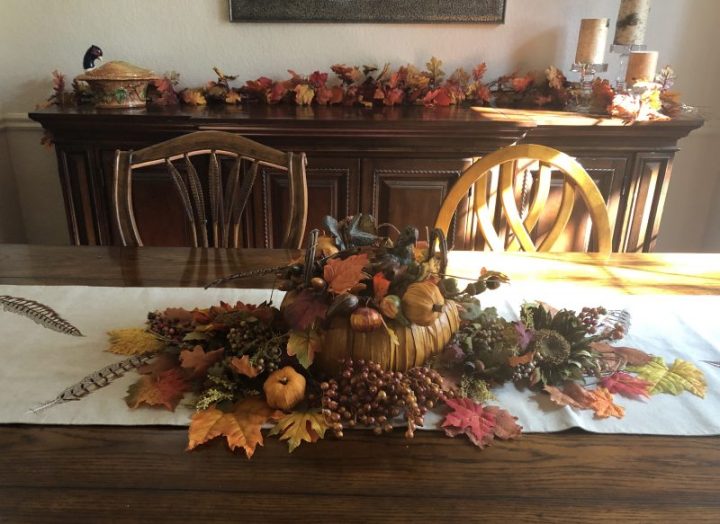
     I returned home from Connecticut last week to find skies here crystal clear and blue, too, and even temperatures slightly cooler — down to the high 90s. Knowing there would be little else beyond my own decorating efforts to suggest that fall had arrived in San Antonio, I had taken a collapsible bag with me on the weekend to fill with an “artificial autumn” from my favorite crafts and home stores up there. Thus, inspired by a few days in New England, nurtured by the warmth and affection of dear friends, and armed with some props to dress my house for the season, I am now enjoying fall, at least indoors, waking up each day glad to be alive and living the life I’m living. 

     “September morning still can make me feel that way.” (September Morn, Neil Diamond)

comments 2

St. Tropez South

     I was last in Rockport, Texas, in August of 2017, about a week before Hurricane Harvey hit. My Mother and I often went down from Victoria “to the Bay,” as we called it, sometimes staying at the Lighthouse Inn for a couple days or sometimes driving farther out to Mustang Island and Padre.  As she got older and more frail, however, we began to make only day trips to Rockport, usually in early August, to enjoy a seafood lunch at our favorite restaurant, Charlotte Plummer’s on Fulton Harbor. Afterward, time and temperature permitting, we’d do a little browsing for “coastal treasures” in some of the many shops and galleries that line Rockport’s central business district down Austin Street.

     In case you’ve only heard mention of it during hurricane season, Rockport is (or was) a town of about 10,000 people situated along a string of communities collectively called the Coastal Bend that includes Aransas Pass, Port Aransas, Ingleside, and Corpus Christi. The area is smugly referred to as the Texas Riviera. Rockport is known for its long fishing piers, its rich bird life, the historic 19th century Fulton Mansion, the Texas Maritime Museum, and the Rockport Center for the Arts. The Rockport Art Festival, held annually around July 4 since 1970, is one of the largest juried art festivals in the United States. It has not only gained national attention for Rockport, but it has also helped establish the reputations of several important Coastal Bend artists, among them Steve Russell and Robin Hazard.  

     I was in Rockport for a few days over last weekend. My husband, son, and I stayed in a friend’s lovely, recently-renovated (since Harvey’s destruction) condominium on Copano Bay on the backside of the Gulf. The weather was hot, of course, but the waters were calm, the sky was blue, and the vibe was lively.  Boats unloaded at the Paradise Key Rockport Yacht Club boat ramp, (using the word “yacht” loosely). Tourists shopped, fishermen came and went, and the Paradise Key Dockside Bar & Grill was hopping,  As it happened, we were there exactly on the two-year anniversary of Harvey’s arrival on August 24, 2017. I hadn’t planned it that way, hadn’t even remembered the exact date, but somehow being there was fitting, and somewhat bittersweet. All the memories of my Mother’s stroke, of her love of the South Texas Gulf, of her evacuation and the hurricane damage to her house, and subsequently of her long, not-quite complete recovery and relocation up here to San Antonio seems forever connected in my mind to Hurricane Harvey. Maybe that’s because the storm brought two of the longest years of my life.

     Even now two years later, there is still a lot of damage remaining in Rockport, and in Victoria, and in other Harvey-ravaged areas of the South Texas Gulf. Entire city blocks were blown away by the Category 4 winds. Fences remain blown down and full of debris, trees are still upended by the roots, buildings are laid waste in rumbles of lumber, and businesses are boarded up and maybe closed forever. On our first night, we had dinner at Charlotte Plummer’s in their brand new, light and airy upstairs dining room, because the old space and the outside deck had been blown away. (In spite of  heavy damage, Plummer’s was one of the first businesses to reopen to serve the locals a mere two weeks after the storm.)

     On Saturday evening, I attended Mass at the one Catholic church still in operation in Rockport and the pastor reported from the pulpit that “Today, finally, FEMA showed up to assess our damage.” He commented that they came, they saw, and they left.  The owner of my favorite women’s shop talked about how she was closed for almost a year after Harvey, and is still arguing even now with her insurance company over claims. According to our condo-owner friend, the problem with recovering and rebuilding after such a wholesale disaster is not only funding the restorations, but also finding reputable contractors who can do the work in a timely and reliable way. Judging by the piles of ruble and the abandoned concrete foundations, lots of property owners have just given up and walked away. Estimates are that about 20 percent of the resident population has been displaced.

     The town had planned a street festival downtown on the 24th to commemorate Harvey’s second anniversary. The stores and galleries were open with special promotions, and art and craft vendors, stage musicians, and food trucks (with funnel cakes!)  spanned the median. It was already wicked hot, over 100° by late morning, and then intermittent rains came which further dampened the turnout, but the joyous mood and the pride of survival endured.  People who live in hurricane country are nothing if not resilient, even as they are ever-mindful of disaster.

     Having been raised on the Gulf Coast, I guess I am one of those people, both literally and figuratively. It felt good to be down “at the Bay” again, to relive some happy memories, to make peace with some sad ones, and to see signs of rejuvenation, even in myself.

     Life goes on, and now we enter hurricane season once again. And Dorian is on its way. 

comment 0

Vive l’amour!

It hit 108.7° (42.6C) in Paris at the end of July, breaking a previous record of 104.7° set in 1947. The chief architect working on the Notre-Dame cathedral said he feared the vaulted ceilings damaged in April’s fire could collapse because of the rapidly drying support walls. “Il fait chaud, très chaud!” people moaned, as they fanned themselves. Tourists plunged feet first into the fountains of the Trocadero by the Eiffel Tower; Parisian women pulled their scarves from around their necks and soaked them in the waters of the Fountaine de la Concorde to cool their fevered brows.  Even the French find it hard to be stylish and sophisticated under such extreme conditions.

    My husband and I landed in Paris on our 50th anniversary. Somehow, the heat seemed welcoming and appropriate, since it had been 104° in South Texas on that July day when we got married half a century ago. The church where our wedding took place is one of the oldest in Texas dating back to 1824. Adjacent to it is the convent of the Sisters of the Incarnate Word,  coincidentally an order founded in 1625 in Lyon, France, from which five nuns ultimately came to establish a school for girls in my hometown. It is still in operation, albeit with more lay teachers than nuns; my Grandmother went there, my Mother went there, and so did I for 12 years. 

     Needless to say, the women in my family and the women in the convent share a long history, which in part explains why they were so excited to have me and my bridal party get dressed there on my wedding day.  They did the best they could to accommodate us in their antique-filled front parlor by moving furniture and bringing in full-length mirrors and huge standing fans. Of course there was no air-conditioning in this ornate Spanish Mission style motherhouse built in 1904.  In a scene reminiscent of Maria’s wedding day among the Sisters of Nonnberg Abbey in The Sound of Music, here were my six bridesmaids and I donning formal dresses and trying to perfect hair and make-up while extreme heat melted lipsticks and giant fans blew headpieces across the room with the hot force of a jet engine. 

     Memories of my wedding day kept coming back to me on our entire anniversary trip to France, prompted by the similarities of extreme temperatures, the lack of air-conditioning in old buildings, and the dominant influence of the Church and its cathedrals and convents in French history, art and culture. Moreover, since Paris was the home base of an international company for which my husband was working when we married, and through which he continued to build his career, that City has been a major presence in our lives over the years. He/we traveled there often, made friends there, and came to understand and appreciate all things French — especially the food and wines! 

     Paris is inarguably one of the most beautiful, most romantic cities in the world, so what better place could there possibly be to celebrate a marital milestone. Since we know the City well, we could just BE there, just walk and wander at leisure and enjoy each other’s company without the typical tourist burden of having to visit every iconic landmark and every major museum. As a plus, there were the summer “Les Soldes” (clearance sales) in July, just before French residents head off for their own vacations in August, which actually makes shopping in Paris almost affordable.

    I did my share of shopping, as always, for the exquisite papers and stationeries and beautiful tabletop linens. We stayed in a hotel right across from the Tuileries, on the Rue de Rivoli,  a perfect location from which to walk to the Place Vendôme, the Palais Royale, the Avenue de la Opera, and the Place de la Concorde, where the obelisk from Luxor is placed precisely on the site of the infamous guillotine of the French Revolution. Even with such a macabre history, this location is still inspiring and beautiful.  And of course we walked down the Champs-Élysées and over the Ponte de la Concorde to the Left Bank and and into Saint-Germain.

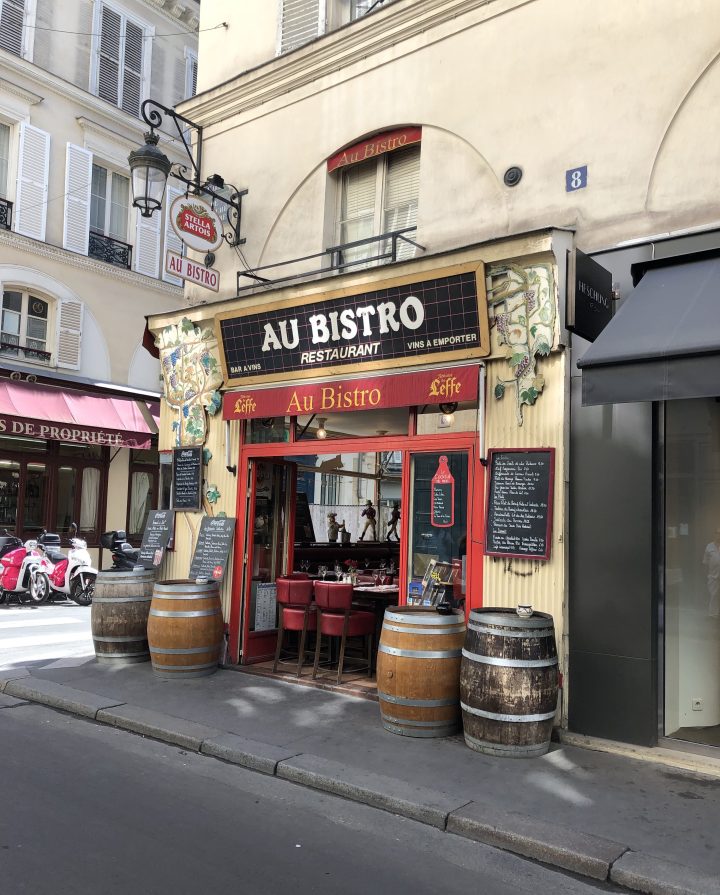
     On the night of our arrival, we celebrated our anniversary with an elegant dinner at a restaurant in Saint-Germain,  Brasserie Vagenende, a Belle Epoque establishment from 1904. It was exquisite. (And here’s that date of the motherhouse in my hometown again — another remarkable the coincidence.) The food and service were so wonderful and the ambiance soooo French and sooo elegant. Over the course of the weekend, we revisited other favorites, including the historic (and yes, touristy) hangout of 20th century writers and artists on the Left Bank, Les Deux Magots, and Harry’s New York Bar down from Le Opera on the Right Bank, the  infamous Hemingway watering hole and proclaimed home of the French 75 (which is one of my favorite drinks.) 

     And then, after our idyllic Paris weekend, we took the train to Lyon to board a river cruise  down the Seine through Burgundy and Provence. Our adventure continued. More about that later.

Vive La France!    

comments 4

We’re Golden

     Next week marks the 50th anniversary of a major event in American history: the Apollo 11 moon landing.  On July 20, 1969, at precisely 4:18 p.m. EDT, Neil Armstrong fulfilled the promise of a new generation by becoming the first man to set foot on a dusty surface some 238,855 miles away. Roughly one-fifth of the world’s population (500-600 million people) watched the moon landing on TV or listened live on the radio. My new husband and I were among them.

     I remember it all, all the excitement and anticipation as we raced to our hotel to get there in time to see Armstrong take “one small step for man, one giant leap for mankind.” The poor cab driver. “We’re in a hurry,” we said by way of introduction,  as we loaded my nine pieces of overweight-over-limit, drag-it-all-along-with-you luggage into the car at the New Orleans airport.  “Hurry, hurry,” we urged as he made his way through afternoon traffic to the Monteleon. “We have to see the astronauts land on the moon!”  It was all so important, so fitting because, you see, we had each just taken significant steps of our own and made one giant leap together into the future. We had just gotten married!

     The celebration of wedding anniversaries goes back almost as far as the social institution of marriage itself, which historians commonly trace to the Holy Roman Empire. Traditionally, husbands crowned their wives with a silver wreath on their 25th anniversary, and a gold wreath on their 50th — if they lived so long. (Average lifespans in the ancient world are estimated to have been only 35-40 years.)  Legends of Methuselah aside, today’s improved health and longevity have made it possible for more and more couples to celebrate their golden wedding anniversaries. 

     Demographics show that roughly 7 percent of currently married couples have been married 50 years or more. I’m assuming those statistics refer to those married to the same partner and not to those with 50 cumulative years of serial monogamyalthough given the rapidly rising number of centenarians in America, it might be possible to be in a second marriage for 50 years. But I digress …  The point is that those of us hitting this landmark have defied the odds of both death and divorce and have weathered together all the other unexpected obstacles in life to get here. We deserve to celebrate!

     Our son, old enough now to be celebrating anniversaries of his own were he married, has been anxious about what he might do for us to mark this special occasion. When we lived in Connecticut, we had a big party with a renewal of vows for our 25th, so he asks, “Can I throw you an anniversary party?” We laugh and demur; we don’t have enough friends where we live now to fill our dinning room, much less a hall. “How about a bigger TV or a new mattress?” he suggests — both of which he thinks we really should have. Bless him, he keeps trying.  Finally, we agree to a new barbecue smoker and a plan for a long weekend for the three of us together on the Gulf Coast later this summer. At this point in our lives, my husband and I really don’t need any more “stuff.” As friends and family members fade away, all we really want more of is time, time spent with each other and with those we love.

     In the early days of my career as a writer, I specialized in weddings and marriage and was a contributing editor to Modern Bride Magazine for several years. I interviewed numerous couples at various stages of their unions, consulted many counselors and family therapists, did “on site” research at catering venues, wedding expos, and in bridal shops (including spending the day as an “undercover consultant” in the famous Kleinfeld’s bridal salon in New York). It was what I always called “happy writing,” in that people were delighted to talk about their romance and relationships and yes, with hindsight humor, even their wedding-day disasters. Through writing three books and hundreds of articles on almost every aspect of planning a wedding and creating a new couple-family, I not only learned about the whole bridal industry, but I also gained deeper insights into the hopes and values couples brought to their married lives. Inevitably, every story, every interview, every anecdote gave me yet another perspective on my own.

      Couples celebrating landmarks are often asked what makes for a successful marriage. Dear, dear parents of a childhood friend of mine who were married 75 years before one of them died were asked on a celebratory cruise to cite their secret of marital success. “Be kind,” she said. “Do whatever she tells you to do,” he replied. People laughed and nodded assent at such sage advice.

     If anyone asks me that question, my answer would be simple: the freedom of choice. You see, my husband and I were both raised by young, prematurely widowed mothers, which explains a lot about our natural compatibility. We both eschew traditional gender roles, for example, because we watched our mothers do it all; we both share a keen awareness of the vicissitudes of life, so we never fail to be grateful and to enjoy what we have while we have it; and we both believe in planning for self-sufficient adulthood with a good education, a strong work ethic and practical life skills. Thus, we came together as independent people with goals and dreams of our own, but with the same expectation that any  meaningful partnership has to be built on strength and equality. Marriage is but one lifestyle choice among many, after all, not simply the default mode.

    We chose to get married because we wanted to, not because we needed someone else to complete us, and we have continued to choose to be married because we wanted to, not because we had to, or were in a rut, or ever felt we had no other choice. There is always a choice. Every time either of us comes up the driveway, we are reiterating that choice, reaffirming our commitment, and recognizing that home is wherever the other one is. We choose, and we are chosen; we love and we are loved. Could there be any better formula for marital success than that?

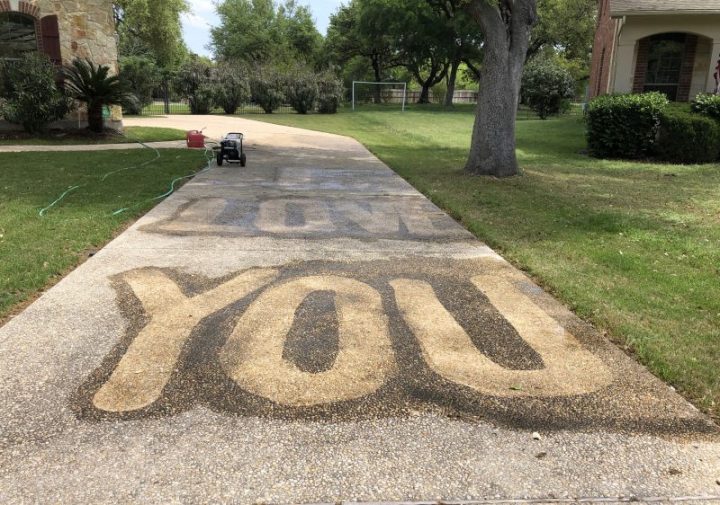
     Sometimes, like when  I come home to a power-washed message writ large on the driveway as I did just the other day, I have to marvel at our 50 years. I would have no more foreseen this back in the day as “a man in the moon,” as they used to say.  But then, there was one. Happy Anniversary.

comment 1

In the Cloud: Part 2

      Bexar BiblioTech is the first and only all-digital public library in the United States. It is here in San Antonio, in the 7th largest city in the Country with the largest Hispanice majority population (64 percent) and the second highest poverty rate (after Detroit) among America’s 25 largest cities (U.S. Census Bureau 2017).  San Antonio also ranks 60th in overall literacy, so it’s probably safe to assume that we suffer a digital divide here, as well as a language/cultural divide. 

     You must be a resident of Bexar (pronounce with a silent x) County in order to obtain a library card. The first location opened on the City’s south side in 2013, the second on the west side in 2015, and the third on the east side 2018. I mention locations because poverty, under-performing  schools, and immigrant populations are clustered in certain areas. Bexar BibioTech  (the name itself an appropriate adaptation of biblioteca, the Spanish word for library) had over 400,000 visitors in the first four years. Obviously, this is an urban idea whose time had not only come, but was long overdue.

     Digital access has been available at large public libraries for years and many colleges have had all-digital libraries, but Bexar BiblioTech is the first totally bookless public library. Patrons can check out           e-readers, access books, data bases and other resources for use on their own devices from the cloudLibrary app, and even obtain personal hot-spots to use at home where there is no available internet. All of this serves both an underserved and a mainstream population, and it comes at a fraction of the cost of a physical library. The reader-writer-teacher in me is proud of San Antonio for this innovation to encourage literacy and make information and technology more broadly accessible.

     But yet …  There are human trade-offs to life in the cloud and I haven’t been able to stop thinking about that since my last post.  Browsing among bookshelves can provide serendipitous discoveries, especially in libraries that still use the Dewey Decimal System of classification that arranges volumes according to disciplines and fields of study. You might say the Dewey was sort of a precursor to internet surfing, in that once you located your desired book, the ones next to it and then on down the shelf would both relate to and then expand on the topic. Those time-suspended hours of diversion and delight going “down the rabbit hole” in library stacks are among my most magical, and most valuable childhood memories. 

     Yes, I love my Kindle, and it sure beats paying overweight baggage fees for all those books we readers drag on vacation, but somehow curling up and snuggling with a Kindle is not the same, even in a coach seat. It’s about the “feel of a book,” the actual picking up and looking through and browsing when you don’t know exactly what you’re after.  Yes, Amazon allows you to take a “look inside” before you buy,  but you can’t examine the book jacket, feel the heft, or peruse pages of your own choosing.

     I’ve always maintained that, outside of the special people in my life, books have been my closest companions so I am, admittedly, persnickety about them. But it occurs to me that the sensual — the touching, tasting, smelling, seeing and hearing — is really what’s missing from living in the cloud. For example, unless you’re ordering something you already have, how can you shop for perfume without smelling it, fabrics without feeling the weave and texture, or shoes and clothes, particularly intimate apparel, without trying them on? There are no samples to taste from food emporiums on-line, no testers to verify the color and consistency of beauty products, no actual displays of sheets and towels and dinner plates to help you gauge the quality and finish of home goods. 

     People keep predicting that brick-and-mortar stores are going the way of the dodo bird, but how many of us continue to go to a retail store to look for an item before we come home and buy it on line? (This rather duplicitous activity probably explains why there are so many shoppers in malls without any shopping bags.)  Our physical senses inform our choices and the opinions of others, salespeople and shopping companions, validate our decisions. Since the beginnings of commerce in souks and stalls and storefronts the world over, the human interaction, the give and take and bargaining and arguing, has been part of the fun of shopping and the satisfaction with the purchase. 

     The human voice —its tone, rhythm, inflection, mood, emotion — needs to be heard. My mother always said that she knew exactly how I was and what had been happening from the moment I said “hello” on the telephone.  I used to tell my students that the best writing allows you to “hear” the author’s voice on the page, but even with all CAPS and exclamation marks, you can hardly establish much of a voice in a routine e-mail or a limited character twitter feed. At least I-Tunes lets you hear a few bars of music before you download the song!

     And so we come back to the telephone, which is where I began a couple weeks ago. An update: the U.S. House of Representatives is about to consider a a new anti-robocall bill called “The Stopping Bad Robocalls Act” (original, huh?). Supposedly, it will slow down and penalize some of the nearly 5 billion robocalls that targeted Americans’ mobile devices last month alone. Not only are the unrelenting calls annoying, but now they have become downright dangerous as they compromise personal information and overwhelm critical communication lines to hospitals, doctors, and other important responders. The FCC will be charged with enforcing the new law and with trying to deter any new robocall technology. 

     So, will politicians support the effort by limiting their own soon-to-begin campaign robocalls? I doubt it. Maybe I’ll just get rid of my landline.

comment 0

Living in the Cloud

     There was a time when my phone rang almost constantly while I was at home, and my answering machine filled up with call-backs when I wasn’t — and I KNEW all these people and wanted to talk to most of them.  I liked talking to them. That was then. Now my phone hardly rings at all, and when it does, I generally don’t even answer it. So, what happened between then and now?

     Automated technology happened, which better enabled those annoying telemarketers to fill up your phone machine with messages during the day, and to interrupt your restful evenings with unsolicited pitches at home, especially during dinner-time.  In order to facilitate compliance with the Telephone Consumer Protection Act of 1991, the Do-Not-Call Implementation Act of 2003 was signed into law by George W. Bush. The FTC’s Do-Not-Call registry list began that June. We all started signing up, but it wasn’t always easy to do. Success of the effort was sporadic at best, and temporary, since mechanisms for automated dialers and access to number directories expanded faster than the registry’s ability to keep up. 

     So then what happened? Mobile devices happened. First there were pagers and beepers — important tools of communication not only for emergency responders and those in vital need-to-reach positions, but soon enough for the self-styled-self-important everywhere, including drug dealers. High schools made “no pagers” part of student dress codes. (I know, I was teaching.) BlackBerry introduced its e-mail pager in 1999, then its phone in 2002, and CEOs everywhere rejoiced. President Obama loved his BlackBerry so much that, in spite of security concerns, he insisted before his inauguration that staff would have to “…pry it out of my hands.” (They didn’t and he kept it until 2016.)

     Cloud computing happened next in 2006, the I-Phone was introduced in 2007, and the rest, as they say, is history. Not surprisingly, congress passed the Do-Not-Call Improvement Act of 2007, designed to extend the reach of registry regulations from landlines to fax machines to cell phones. It took effect in February, 2008, but it was too little too late. By then we were all “living in the cloud.”  Social media and digital communication have defied regulation and dissolved personal restraint ever since. We now find ourselves constantly assaulted by telemarketers, text messages, and twitter tantrums on our cell phones, and incessant robo calls and messages on our landlines (if we still have them). 

     And that’s what happened between then and now.

     Now don’t get me wrong: I love my I-Phone, my I-Pad, my I-Mac, even my outdated I-Pod. These products have offered I-Me safety, convenience, accessibility, and happiness. For us baby-boomers, the first generation to be generally proficient in technology and digital communications, electronic devices will prove to be even more of a godsend as we grow older. Loss of physical mobility will no longer mean a complete loss of independence and isolation in our own homes. We can (and do) stay connected to the world and with friends and family far away; we can (and do) manage routine chores such as shopping, banking and paying bills; we can (and do) entertain ourselves through movies, music, videos and books; and we can (and do) continue to learn and grow through on-line classes and tutorials. Why, we can even run a home-based business! 

     All this electronic convenience comes at a cost, however, for young and old alike.  Ironically, while our computers and smart phones were supposed to enhance communication, the loss of the human touch in the quest for efficiency seems to have eroded it. I watch young people, ostensibly out on a dinner date, sitting with their faces to their cell phones instead of to each other; I see people in church spending much of the service texting on their smartphones; I find that business agreements are routinely done through e-mail, which in turn serves as the contract itself, sans signature. No one actually talks on the phone anymore, they don’t even leave voice mail, preferring to text instead. We’ve all lost our voices, literally and figuratively, in the abrupt, time-sensitive demands of simply “messaging.”

     Psychologists and sociologists have long warned of the lack of development of mature language and interpersonal skills among those who confine themselves in a digital world, but that’s just the least of it. The explosion of social media has obliterated behavioral norms, invaded personal privacy, promulgated false information, encouraged bullies and voyeurs, and rendered the nuances of artful conversation and the civility of public discourse totally irrelevant. After all, it’s so much easier to be threatening, intrusive and obnoxious, even downright offensive, when you’re not face-to-face.

     These days, rather than enhancing communication, it seems that living in the cloud has brought us into the fog — the fog of war between multiple factions: classes and cultures, men and women, liberals and conservatives, religious and secular, and on and on and on. We’re not only not communicating, many of us are hardly speaking to members of our own family! 

    Now as we enter  the ridiculously premature campaign for the 2020 elections, we will be back to where we began, back to the intrusiveness of still more robo calls and messages from political organizations promoting candidates, fund-raising, and polling  ALL of which are exempt from the Do-Not-Call rules. 

     Oh well, the registry never really worked anyway…