comments 4

Artistic Impressions

     The artist Christo died on May 31. He was 84. His artistic career was spent wrapping, draping, constructing and hanging materials over bridges, landmarks, building, and even on water. His wife, Jeanne-Claude, collaborated with him on his astonishing, monumental projects until she died in 2009. That fact that he is no longer here makes me sad. His latest project, a wrapped L’Arc de Triomphe in Paris, which has been in the planning since 1962, was due to be realized in 2021. I was hoping to be there to see it.

     As an artist, Christo defied classification, really. Some called his work “installations,” which they certainly were, but they were hardly permanently installed. They took months, even years of planning and negotiation, but their exhibition was short-lived, usually only on display for a couple weeks. Some called him a “conceptual artist,” because the initial concept along with all those years of planning and decision-making, shaped the very nature of the art itself, making the ultimate execution of it a somewhat perfunctory affair. Some considered him an “environmental artist,” because his installations not only involved painstaking study and research of the proposed location, but also fastidious attention to the integrity of the environment and the preplanned repurposing of all construction materials once the exhibit was dismantled.

     And some didn’t even really consider Christo an artist at all, but rather a showman, or at the very least, an eccentric visionary who descended upon a community with a childlike enthusiasm for his great idea and who thorough perseverance and charm, brought everyone around to sharing his fanciful dream. His projects, often decades in the making, required the cooperation of hundreds of people: landowners and residents, government officials and zoning boards, environmental and specie-interest groups, not to mention all the engineers and workers who were needed to produced his marvels. Art critics and fellow artists had mixed reactions, and most would never place him in the great pantheon of serious artists, but Christo didn’t care. The public loved him, and his work was a fight of experience that was always free to that public. Never relying on municipal funds or taxes, Christo and Jeanne-Claude funded all their projects through the sale of their own work: renderings, plans, lithographs, watercolors, photographs, books and prints. (Still available through sources found at christojeanneclaude.net)

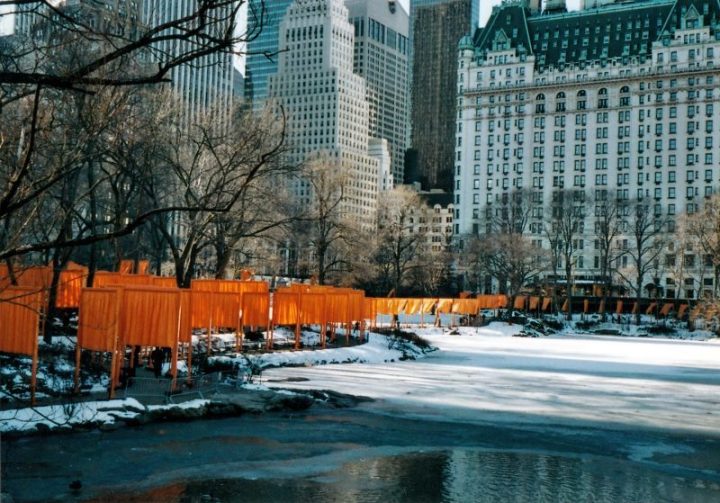
     It is an unfortunate truth that people who live in the immediate environs of major cities, like New York, always bemoan the fact that they “don’t get into the City as much as we used to.” It’s as if the better you know a place, the more you love it, the more you take it all for granted and assume it will always be there. On a bright, snowy day in February, 2005, my husband and I drove into Manhattan to see “The Gates,” Christo’s much-publicized installation in Central Park. It had been open for almost two weeks by then and was scheduled to close the next day; we keep “meaning to get there earlier” when the weather might have been nicer, but … well, nothing waiting till the last minute. This exhibit would not go on forever.

     Not surprisingly, “The Gates” had been in the planning/discussion stages since 1979. This was New York City, after all, so you can imagine the layers and levels of  permissions and petitions and glad-handing and propositioning and patience and cooperation it took to finally reach agreement on an art installation constructed over 23 miles of walkways in Central Park, with 7,503 panels of saffron fabric, each 16 feet tall and of varying widths, hanging 7 feet  above the ground at 12 foot intervals. Negotiations started when Ed Koch was mayor, continued through David Dinkins and Rudy Giuliani, and didn’t come to fruition until Michael Bloomberg was in office — over 25 years in the making!

     Certainly, New York has had more than its share of truly spectacular events and exhibitions, even in Central Park, but “The Gates” was truly an explosion of joy and wonder, a vision of a golden river running right through the trees of midtown Manhattan. Over 4 million visitors came to walk underneath those fluttering saffron “gates” in just two weeks’ time. I will be forever thankful that I picked myself up at the last minute and became one of them.

     I have been a devotee of the arts my whole life; as an academic, I have spent much time and energy studying the arts, not just literature, but also fine arts, applied arts, and theatre. I hardly claim to be an art critic, nor can I boast of more than just a generally well-educated person’s level of knowledge, but I have been fortunate enough to have visited most of the major museums and architectural sites in the world, and to have encountered, often unexpectedly, works that struck me profoundly, both intellectually and emotionally, as to make a deep and lasting impression on my very should. Art or not, “The Gates” in Central Park did that.

     In an interview included in a brochure accompanying “The Gates,” Christo was asked why his work was temporary. He answered: “Our works are temporary in order to endow the works of art with a feeling of urgency to be seen, and the love and tenderness brought by the fact that they will not last. Those feelings are usually reserved for other temporary things such as childhood and our own life. These are valued because we know that they will not last.” (website: chirstojeanneclaude.net Gates project brochure) That explanation speaks to me; it explains, I think, why “The Gates” was so pivotal and was so quintessentially a New York experience for so many.

     I started an art quilt based on one of my photographs of “The Gates” a couple years after that day in Central Park. Good design, good ideas, good intentions. But, I got to a place where I couldn’t go further — lacking the skills, the confidence, the direction, I don’t know … My “Gates” piece is the only quilt that has become a UFO (unfinished object) for me. It has floated around my studio for over 12 years. I have often looked at it longingly, and lovingly, remembering that day in Central Park and feeling a sadness that I couldn’t quite do it just in fabric. 

     Funny thing, though: the coronavirus has me at home in a sort of unintentional “art residency” wherein I have been devoting more and more of my time to my art quilts, to thinking, designing, and creating. On the news of Christo’s death, I resurrected my “Gates” piece and realized that I had improved skills and new ideas for finishing it. It is now coming along nicely, much in the way I had originally envisioned. It doesn’t meet any of the usual size specifications or particular requirements for entry into competitions, but that doesn’t matter. It is being completed from my heart, the way Christo ultimately completed his long-planned work. It is a tribute, and a thank you, to him.

comment 1

The Sound of Silence

       Silence makes people uncomfortable. I say that as a very social, very talkative person, a lecturer, a writer, a lover of words who used to have to deliberately restrain herself in the classroom from asking students follow-up questions too soon without giving them ample time to think and to answer. Silence is uncomfortable in most situations.

     One of the revealing discoveries about the stay-at-home orders of the coronavirus is an awareness of how much noise has infiltrated our daily lives and how blessed silence really is as a quiet time in which to sit and be still and hear the whispers of our inner voice — of the truth, of our vision, of god. Without the beeps and burps of cell phones, the eternal babble of the television, the constant assault of ads and e-mails and internet nonsense, without the endless robocalls and intrusive solicitations, even without the constant social calls from friends, relatives and associates, the silence has been both deafening and blessed.  I realize in these last few weeks that I can, once again, hear myself think, and I realize that I can get used to this as a permanent “new normal.” I am so much better without all the noise. Aren’t we all?

     I’m not the only one who has noticed the benefits of silence. People, especially in cities, are suddenly hearing the coos, chirps and warbles of birds again, and newspaper features all over are heralding the sudden interest in bird watching as a hobby. Sales of binoculars are up, along with photographs of birds on Facebook and how-tos for building birdhouses on YouTube. With the arrival of spring, residents who are eager to get outside have discovered an activity that is interesting, safe, and “socially distanced.”

     Here in Texas, a new analysis released by researchers at Southern Methodist University found that noise levels created by humans —car and truck traffic, airplanes, sirens, music, etc. — have dropped roughly 30 percent since late March when the Governor closed schools and limited activity in the state. “Seismologists are listening for the sounds of silence,” read a recent headline from the Dallas Morning News. (May, 27, 2020)  Seismometers used to detect earthquakes can also detect everything else that makes the ground vibrate. With noice levels significantly down, especially in cities, the hope is that researchers will discover even more creative ways to use seismic stations to monitor and predict other kinds of events.  

     I have written before here about the quiet comfort of snow days in the Northeast, about how they gave me “permission” to suspend all schedules and obligations and thus resulted in “found time.” I now feel as though I am on a perpetual snow day because all schedules have been upended. I have cancelled my hair appointments, my nail appointments, my routine doctor and dental appointments, even the routine visits for my dog at the vet. I don’t have to make any meetings, attend any social engagements — heck, I don’t even have to go to church.  In short, I suddenly seem to have all the time in the world to do what I want and to decide what that is.

     Some of my recent discoveries in this era of silence have been more in the nature of re-discovering old loves and old habits.  For example, I have easily read more than a dozen books in the last twelve weeks while at home. That’s a good thing. Voracious reading used to be part of my regular routine, but in the last few years, even in retirement, other things always got in the way and I was always too tired late at night to grab one of the books on my nightstand. Now, however, without adhering to schedules that often depend on others, I am back to my own biological rhythms: I get up later (8:30 am or so) and then stay up reading till after midnight.

     I find that I am also “studying” my creative projects more carefully, just sitting and sketching and writing and planning what it is that I’m going to do next. This is a habit not constrained by time, but shaped by what it is that I want to accomplish. Sometimes, with the days moving more slowly and the hours lingering in silence, I just sit and wait for the moment, the movement, the inspiration. All that comes from the quiet. 

     These days, I am more “mindful” (if you’ll excuse the cliché) than I’ve been in a long time. Yes, I am canning and preserving, baking bread, cooking and freezing, sewing and creating, reading, writing and corresponding and, of course, cleaning and disinfecting my house as so many others are doing. That may sound as though I’ve become a whirling dervish, but it doesn’t feel like I’m whirling because I concentrate on one thing at a time. “Monkey minds” that are full of distractions find it impossible to focus on even the most mundane activities, much less to do them well, or safely. In our current political, twitter climate, that presence of mind is exactly what we’ve been missing. Nobody makes good decisions when they are frazzled and fractured.

         Perhaps the sequestering of this pandemic will help people rediscover the sound of silence, the solace and wisdom that might be found inside themselves. Maybe if we all slow down and listen carefully, we might once again recognize the truths that matter, about our families, our nation, our moral centers, our inner selves. To rediscover ourselves would be a redemptive outcome from this whole dark disaster:

      Hello darkness my old friend

       I’ve come to talk with you again

       Because the vision softly creeping

       Left its seeds while I was sleeping

       And the vision that was planted in my brain 

       Still remains

       Within the sound of silence.

                                                    Lyrics by Paul Simon, 1964

     Postscript:  Over these last three days or so, the sounds of silence have been broken by the sounds of sirens and shattered glass all across America. The anguish and outrage over the  senseless death of  George Floyd in Minneapolis serves as an urgent message from the future still resounding from the past: we do, indeed, need to return to a “new normal” after the coronavirus epidemic, one that requires a great deal more than just a vaccine and an economic reboot.

comments 2

A Texas Oasis

     For a person who doesn’t really like to drive, I’ve spent most of my life doing it. I’ve had a  driver’s license since I was 14. Back in the 1960s in Texas, a teenager could take driver’s ed in school at 13, get a learner’s permit, and then apply for a regular operator’s license after her 14th birthday.  Because my Mother was a single parent who worked long and irregular hours and we lived with my elderly grandmother who did not drive at all, it might have been a “hardship” provision that enabled me to do this (now available to teenagers in Texas at 15). I don’t remember. All I know is that I was in the 9th grade and I was the only one among my friends who drove for most of our high-school years.

     According to the Federal Highway Administration, there are 303,176 miles of public roads in Texas, more than in any other state. Honestly, I think I’ve driven most of them. From the spaghetti-bowl freeways in the major cities, to the bay area causeways along the Gulf, to the desert routes in West Texas where there are no speed-limits (because there are no cars), Texans have always been deservedly proud of their highways. The roads are generally well-planned and well-maintained and they move people and products across a vast territory where there is little other alternative transport. And of course, let’s not forget all those fabulous wildflowers along the roads in the spring — thank you, LadyBird!

     Almost as cheerful and certainly as welcome as wildflowers along Texas highways are some 600 Dairy Queens®, again, more than in any other state. Contrary to popular perception, Dairy Queens did not originate in Texas, nor are they based here, even though they are ubiquitous throughout the State, even in one-stop-sign towns; in fact, the DQ® sign is often referred to as “the Texas stop sign.” Dairy Queen® was actually founded in Joliet, Illinois, in 1940, and has since used a franchise system to expand all across the United States and into over 30 countries. The company has been a subsidiary of Berkshire Hathaway in Minneapolis since 1998.

     The Dairy Queens in Texas are unique because they are organized under the Texas Dairy Queen Operators Council, a consortium of independent franchise owners. That enables Texas DQs to offer their own unique “Texas country foods” menu (including tacos and a chick’n fried steak sandwiches), to do their own local promotions, and to advertise with their own slogans such as “That’s what I love about Texas…”  The first Dairy Queen in Texas was opened by a Missouri businessman near the UT campus in Austin in 1946, but the title of “the first” usually attaches to the one established in Henderson in 1950, because it is still there and still continuously operating. Regardless, over the last 70 years, Dairy Queen has become a bonafide “Texas thing.” 

     My long driving history is also a long DQ history. When I was a child (before I could actually drive), a Dairy Queen was much anticipated on those interminable Texas road trips. In the blistering heat, with the boredom of riding and the nagging angst of “are we there yet,” a stop at a Dairy Queen provided both respite and delight with its cheerful red sign and its promise of curly-Q-topped soft ice cream cones and thick, tummy-filling milkshakes. The DQ sign has been a symbol of comfort and relief for as long as I can remember.

     We used to joke that a town couldn’t get a name in Texas until it had a Dairy Queen, but it was absolutely true that it couldn’t get a sense of community without one. Before there was McDonald’s, or even before Whataburger showed up (Whataburger was founded in Texas and is headquartered in San Antonio), Dairy Queen was not just the first, but often the only fast-food place in rural Texas towns — not that anybody there necessarily needed the food to be fast. As Texas writer Larry McMurtry wrote in his 1999 memoir, “Before the Dairy Queens appeared the people of the small towns had no place to meet and talk; and so they didn’t meet or talk…” (Walter Benjamin at the Dairy Queen: Reflections on Sixty and Beyond)  Pretty soon, “down at the DQ” identified the place to meet and greet, to celebrate and commiserate, or to just come on in out of the rain. These days, the hospitality of a Dairy Queen extends even to those of us just passing through. 

     During the many years when I lived up East and would come home to Victoria, I spent lots of time on highways driving to and from major airports, driving to take my Mother on little excursions, or driving to see family and friends who lived elsewhere. These drives nearly always included a stop at a Dairy Queen, sometimes because it was a favorite location I remembered, sometimes because it was an equidistant meeting place for me and a friend, and sometimes because it was hot or stormy or I just needed a break. 

     The month we retired and relocated to San Antonio was the very month my Mother turned 85 and was unable to renew her driver’s license. The good news was that I was back in Texas and only 120 miles away, but the bad news was that those 120 miles were on US 87 South, a difficult and dangerous drive on a two-lane highway through the heart of fracking country. Before Eagle Ford, a one-way trip had taken about two hours and, except for occasionally having to pass some slow poke lumbering along with farm equipment, it was not an altogether unpleasant drive.  Once the boom hit, however, the trip stretched into about three hours each way and became a harrowing, white-knuckled drive on deteriorating roads in the middle of convoys of tanker trucks and 18 wheelers. As the drive got worse and my Mother got older, I found myself making more and more frequent trips that turned into longer and longer days. 

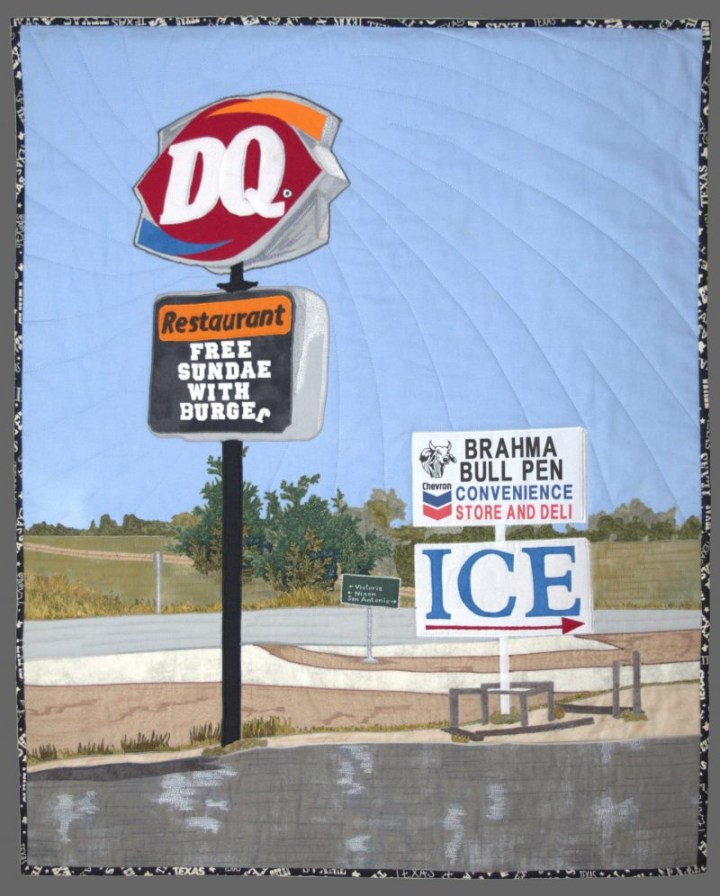
     There are lots of DQs along US 87 and they were a godsend, particularly in the last couple years of my Mother’s life when I was making two or three roundtrips a week.  Through her catastrophic illnesses, the ravages of Hurricane Harvey, and my own beleaguered spirit, the DQ provided an oasis of relief. The quilt above, named “A Texas Oasis,” has been created from my own photograph of a favorite DQ just off the highway less than an hour away from San Antonio. At the end of a long and stressful day, I would pull in to this Texas oasis, thankful to have survived another trip and determined to reward myself with a burger or a shake.

      “A Texas Oasis,” will be submitted for a regional exhibition called “ Sense of Place: Texas Landscape Art Quilts” sponsored by the Studio Art Quilt Associates. If juried in, my work will appear in the show’s opening at the Center for Contemporary Arts in Abilene in September. From there, the exhibit will travel to six other venues throughout the State before closing in a public display at the San Antonio Airport. “A Texas Oasis” recalls a most difficult time in my life and the many hard miles I logged, both literally and figuratively, to get through it. It is also a tribute to the people and places that provide an “oasis” of comfort to others anywhere on life’s journey. 

      Postscript:  I started working on this art quilt last fall, so it has been in progress, often in fits and starts, for a long time. Interestingly, the bulk of it came to completion in these last three months while under stay-at-home orders. I haven’t made any road trips recently and haven’t even visited a local DQ, but once again, this DQ provided an emotional oasis of creative comfort and calm, now through the stress of this coronavirus journey.   

comments 2

The Upside of Down Under

Isolation. It has a long and honored history for promoting profound insight, spriritual renewal and moral courage. For centuries, philosophers, poets, mystics, scientists and holy men and women in every culture have discovered that only by withdrawal from the world can one see more clearly into it. Even Jesus withdrew into the desert for 40 days before beginning his public life.

     Yet, the rigors of isolation can be hard to endure; solitary confinement, for example, is usually considered a punishment. We are social animals and it is in our nature to seek the company of others, to be part of a community The brilliant 17th century French mathematician and theologian Blaise Pascal identified the inability to sit alone in a room as the source of all of humanity’s problems, and concluded that the resulting existential anxiety from being all alone is a defining trait of the human condition. (The Pensées, 1670)

       So now here we are, most of us, sitting in various configurations of  being “alone in a room” due to the coronavirus stay-at-home orders. For an industrious people with a strong Protestant work ethic, being sequestered at home, separated from “our team,” and decidedly unbusy, even if not actually unemployed, presents a tremendous psychological challenge.  Of course we’re anxious because we do, in fact, face a very real, but invisible existential threat, one that cannot be bombed, bullied, or bought.  Most Americans alive today have never faced such a world-wide catastrophe before, so being asked “to fight” for the greater good by simply staying home and staying safe seems counterintuitive at best, and heretical at worst. 

     My husband and I have been “fighting” at home for six weeks now. I am in regular touch with a lot of people, friends and family, but we don’t actually see anyone, not even our son who lives nearby. As retirees, we are among the lucky ones who can afford to stay at home without conflicting responsibilities. With the exception of the occasional hassles of grocery shopping, I have to admit that I have rather begun to enjoy this isolation. The stay-at-home mandate offers the perfect excuse to abandon usual routines, suspend all obligations,  and manage my days for myself.  I’ve even had the uninterrupted time to finish that art quilt I’ve been working on for months.

     Most of all, however, I’ve found the opportunity to just sit and think, to digest all the news (the good, the bad, and the ugly), to observe people’s behaviors (the good, the bad, and the ugly), and to consider the long-term effects of this pandemic on future generations of Americans and the world. And believe it or not, I have found an upside, some reasons to hope — in the good of course, but even in the bad and the ugly. There are possibilities for change.

     COVID-19 has provided nothing if not enlightenment, at least for anyone who is paying attention. It has exposed in glaring daylight all the fault lines in American society, from the gross incompetence of national leadership, to the systemic problems in our healthcare system, to the rampant inequities in labor policies.  And through it all, our persistent social, economic, racial, digital, and political divides not only remain, but grow wider, quietly but decisively dispelling any romantic notion that “we’re all in this together.” No, we are not, and it’s time we admit that we haven’t been together for a very long time.

     So just how does this “enlightened” conclusion represent an upside?  Yes, well,  I too have been angry, disgusted, and depressed about all this at some point, but simply turning off the news and not hearing about all of it is tantamount to being a little kid who, in a tantrum of defiance, puts his hands over his ears and refuses to listen. (One big kid in the room who won’t listen is enough!)  I have decided that the more mature and productive way to use this national time-out is to look at the entire COVID experience with a cold-eyed realism, to examine some of the effects of all this on both the country and on individuals, and to accept some personal responsibility for my own past attitudes and for change going forward.

     Historically, pandemics and other world-wide calamities have always been catalysts for change, mostly because they defy borders and ultimately affect everyone in one way or another. Extreme situations push people to accept extreme solutions, thus normalizing policies and behaviors that might have once been unacceptable, even unthinkable. From the Great Depression, for example, we adopted socialist programs such as social security and the WPA; WWII reversed our nationalist/isolationist policies and brought us into global partnerships through NATO and the UN; the HIV/AIDS epidemic completely changed sexual behavior among young people, normalizing the use of condoms and testing for STDs; post 9-11prompted us to surrender some personal privacy for public safety. 

     So, what will Americans normalize from this pandemic? Might we finally accept that working, or studying, in a brick-and-mortar building is not essential for everyone, but that everyone everywhere in the country must have universal internet access. While we’re at it, let’s reconsider just whose work is essential in the first place and give more respect, and renumeration, to those who keep society up and moving: nurses, doctors, teachers, and first-responders of course, but also all those other essential, often unnoticed people doing everyday ordinary jobs in fields and factories and stores and warehouses and retirement homes. Let’s look at the crisp, clear skylines in our cities, the less congested roads, the improved air quality, and the clearer water in canals and waterways and ask ourselves, once again, how we might make these sudden improvements in our climate last. Finally, let’s recognize that being prepared is not just about adequate testing and PPE, but also about a stable health-care system, sufficient funding for public-health agencies, and support for industry specialists and government career professionals across the board in all departments who know where things are and how to get things done.  

     This whole “America first” attitude has not helped us in confronting this pandemic abroad and now it has trickled down to a “me first” selfishness that threatens to impede our recovery here at home. We have grown impatient; we want to declare defeat, hit the beach, and get on with it, even as our national death rate continues to climb.  A number of states (including Texas) are starting to reopen before meeting even the most basic opening guidelines. Protestors, some carrying guns, have grown louder, resisting not only any shut-down orders, but even simple preventative measures of wearing face masks and maintaining social distancing when in public. Never mind the greater good of protecting others from illness or death, it’s me and my rights first!

     Postscript: Okay, I’ll admit it: I’m having a hard time finding an upside to this latest development of premature openings. Guess I’ll just have to stay at home and think about it a while longer — quite a while longer…

comments 2

Via Dolorosa

 Today is Palm Sunday. For millions and millions of Christians all over the world, it marks the beginning of a week-long spiritual reflection on Christ’s passion and resurrection, culminating in the celebration of Easter Sunday. Those who are not Christian, nor even especially religious at all, still acknowledge and respect the various observances associated with the season, including the Pope’s annual Easter blessing from his balcony. This year, however, there will be no processions, no packed basilicas, and no big crowds gathered — not even in St. Peter’s Square.

     I was raised Roman Catholic, so all the traditions of Holy Week, indeed all the rituals and services of prayer and sacrifice for the full six weeks of Lent from Ash Wednesday to Easter Sunday, are deeply ingrained. My responses are automatic: going to confession, not eating meat on Fridays, making the Stations of the Cross, giving up a favorite treat (candy, ice cream, TV), and giving away to charity (time, money, food). I hardly think twice about the what or the why of  these Lenten practices. I just perform them. But the downside to such automatic practice is that rituals once intended to renew and inspire lose their mystery and power over time.

     Our guide in Jerusalem was named Asher. He was a well-spoken and knowledgeable young man who had traveled widely, who exhibited an impressive command of history and culture, and who genuinely respected the three great religions that make his City sacred: Judaism, Christianity, and Islam. We had begun our tour that day with a typical tourist photo-op from high on the Mount of Olives overlooking the Garden of Gethsemane toward the Old City and the domed Temple Mount.  (There’s a reason this view is on every postcard.) We were a small group, so Asher introduced himself, asked us where we were from, and inquired if there were any historic or religious sites were were especially anxious to see. 

     Now let me make it plain: I am not a pilgrim.  Certainly, in my travels over the years, I have found myself in places that others consider sacred, and I have even had some odd experiences here and there that I couldn’t logically explain, but I do not travel seeking cures or expecting miracles or anticipating a “spiritual awakening” of any kind. Even in the great churches of Europe, while I may be moved by the art and the architecture, it is not because of any particular religious significance. That includes St. Peter’s in Rome. 

     We entered Jerusalem amid a throng of people through the Dung Gate up to the Temple Mount, a compound that has been the scene of momentous historic events for thousands of years and which is sacred to Jewish, Muslim and Christian believers. From there we walked around to the Western Wall, which is the last remaining segment of the second Temple of Jerusalem (built in 515 BC after the first Temple built by Solomon in 957 BC was destroyed). The Western Wall is also called the “Wailing Wall” because pious Jewish pilgrims come to pray and “to wail” over the destruction of their history and heritage. Today, visitors from all faiths come to touch the Wall and to insert prayers of petition on small pieces of paper in between the cracks. They, too, are often moved to tears for purely personal reasons; I was one of them.      

     Up the street, the Via Dolorosa (Way of Sorrow) is a half-mile walk that supposedly follows Christ’s passion through 14 Stations of the Cross marked along the way with plaques and Roman numerals. The first station begins at the Franciscan Monastery of the Flagellation, where Christ was scourged and condemned to death. (Evidence indicates that this probably happened at Herod’s Palace, which no longer remains, but which was about five miles to the southwest.) The stations continue through the alleys and hills of the Old City on uneven pathways and through busy markets, ending with stations 10-14 at the Church of the Holy Sepulchre. This Church, with its side altars and crypts, encloses the various sites of Christ’s crucifixion, death and burial. It was so designated in 326 A.D. by St. Helena, mother of the Emperor Constantine (first Christian Roman Emperor), who claimed that she had found relics of the true cross here. (A short walking pictorial of the Via Dolorosa is available at www.verywellfit.com by searching for “Walking the Via Dolorosa in Jerusalem.”) 

     As we proceeded along, Asher was careful to explain, especially when pressed by someone in the group to clarify apparent factual discrepancies about a particular location, that while the route had been recognized and had been drawing pilgrims since the 8th century, the Way of the Cross was established more by oral tradition than by archeological fact. That qualifier seemed to bother some people, at which point he simply shrugged. “As your guide, I can only relate the stories and traditions, but faith is a matter of personal belief,” he said. “Everyone has to find his own truth.”  

          All I can say is that this tour, this visit to the Temple Mount and the Western Wall and the walk on the Via Dolorosa, profoundly moved me; it refreshed my spirit and brought new appreciation for all those Bible stories, both Old Testament and New, that I’ve heard and read so often. Now, when I make the Stations of the Cross or engage in other Lenten practices, I have visuals. I can draw on first-hand memories of dust and donkeys and a demanding day in Jerusalem. And even though archeologists, historians and religious scholars don’t always agree on factual details, it is the meaning of the larger story, not the details that matter. 

     So this year, while we are all unable to attend religious services or to otherwise engage in our usual Easter celebrations because of COVID 19 restrictions, I am recalling my experiences in  the Holy Land and reflecting on the universal insight I gained there, which seems especially relevant right now. After all, the truth is always greater than the facts. 

comments 2

J-E-L-L-O (or Doubling, Part 3)

 There is a town between San Antonio and my childhood hometown on U.S. 87 that demands notice, either because it thinks so well of itself that drivers passing through should stop and spend some time and money there, or because it long ago recognized the lucrative revenue source that heavy highway traffic coming through the Eagle Ford Shale country offered. Either way, the result is an unusually long, but very effective speed trap of sorts, one that runs from one end of town out to the other. (And yes, I’ve been stopped there more than once.)

     The drive works like this: you come barreling south, radio blaring, at 70-75 mph (if not a bit faster) up to the river bridge over the Guadalupe and then, suddenly, you realize out of the corner of your eye that you have just passed a reduced speed sign reading, you think, 60 mph; while you are still processing and pumping your brakes, there is another sign, now at 55; a few feet later, the speed is down to 50, then to 45, then to 35, and then as you finally crawl into downtown, stop at the traffic light, and make the right turn where the highway continues southward, the speed is down to 30 — unless the lights are blinking in the school zone you’re entering, and then the limit is 20. No matter how often I make this trip, the experience is always one of  being in slow-motion suspension, something I can only describe as “driving through Jell-O ™.”

     These days, life under the increasingly tightening conditions of  COVID-19 has begun to feel just like that, not driving but living in Jello. Sheltered as we are in the home, not the car, we have entered a span of suspended- animation that we think will never end — because this stretch of the pandemic highway is totally unfamiliar. A nurse on TV recently compared the pending hospital crisis to watching a slow rollover of a mass highway accident while being helpless to stop it.  The metaphor is incredibly apt. Unfortunately, over my many trips on U.S. 87 South, I have witnessed right in front of me, and called in to report from the road, more than one fatal rollover or serious accident. The memories of those many Jello-town trips and the anxiety of witnessing those disasters still roll over in my dreams at night; no doubt they now contribute, in a sort of muscle-memory way, to my slowly growing anxieties over the yet uncertain COVID disasters to come.

     San Antonio officially shut down at midnight on March 24, but unofficially we have been “sheltering in place” and “social distancing” (under the advice of an especially astute Mayor) for a while now, especially since community contact with the coronavirus was made very real by the relocation of exposed and infected cruise ship evacuees to a local Air Force Base in early March. While many places across the country, even some communities in Texas, continue to insist that preventative measures are an over-reaction to “this flu,” residents of Texas’s largest cities (Houston, Dallas, Austin, and San Antonio) have already seen their “normal” lives upended by closed schools, bare supermarket shelves, and new work-from-home imperatives. Of course, you don’t need to be ordered to work from home and practice social distancing when you live on a ranch in the middle of nowhere. 

     To date, stay-at-home orders are in place in only 18 states; Texas is not one of them. Gov.  Abbott rightfully claims that there are over 250 counties in Texas, mostly rural, and that only about 50 of them (more densely populated) have reported cases of  COVID 19. Thus, he is reluctant to shut down the entire state in all those Jello-towns across a land mass that is 600 miles wide from east to west and 800 miles deep from north to south. I understand, really, I do. But of course, the gritty little detail in this otherwise logical reasoning is that Texas is woefully under-tested, so that who really knows who is infected and who isn’t, even in the cities, much less in more remote areas. The numbers are hardly finite and the future is far from certain.

     So, here we all are, Texans and Americans everywhere, living in a gelatinous existence of uncertainty, inconsistency and confusion. Time is fluid, one hour, one day, one week spilling into the next without clear demarkations. Situations change so rapidly that it’s hard to keep track, and reliable information is hard to come by when you don’t know whom to trust.

But I feel fortunate.  As retirees without jobs, children, or other obligations, it’s easy for my husband and me to simply stay at home and take care of ourselves. While we’re at it, we can tackle all of those spring chores that were on the to-do list (for when we returned from Australia), read all those books we’ve been meaning to read, write those Eastertime cards and notes, plant all those herbs and vegetables, prepare those flower beds, ready the pool, work on this website, continue the genealogy research, and — let’s not forget — work on that art quilt to be entered in May for a juried exhibition later this year! 

     We are both people who are comfortable with our own company, never at a loss for things to do, and never bored by being alone; nevertheless, when your days are endless and seamless, it’s hard to focus. I find myself floating around, flitting from one thing to another, and not getting much of anything done — unless you count as an accomplishment watching a Carolina Wren for an hour take care of her newly-hatched babies nested in a flower pot on the patio. There may be an urgency on the national front, but it’s hard to muster an urgency in daily life when you are moving through Jello. Which, of course, is exactly the problem.

     Once headed out of Jello-town past the Walmart on U.S. 87, the pace picks up gradually to 45, then to 55, then to —wham! —right on to a 75 mph divided highway all the way to the Gulf Coast. I hope that’s how we progress out the other side of this pandemic crisis. “The virus cannot  infect you if it cannot find you,” said Dr. Craig Spencer of New York Presbyterian Hospital. Maybe, if we all drive fast enough, we can outrun it.   

comment 0

Doubling Down, Part 2

 Early last week, I went to our local supersized supermarket to pick up a prescription. To my complete surprise, I could barely get into the parking lot, much less find a parking space once I got there. “What’s going on here?” I thought. “Spring break isn’t until next week.”

     To avoid the hassle of circling around and around, I decided to pick up my medications in the drive-thru pharmacy.  As I sat with engine idling, I watched a growing parade of shoppers rolling by, their carts stacked with 12-roll economy bundles of toilet paper, huge 6-roll packs of paper towels, shrink-wrapped cartons of 24 bottled waters, and of course, multiple cases of beer — this is Texas, after all. The whole frenzied scene reminded me of the hysteria that erupts when a hurricane is coming, except that this time it was the Coronavirus. 

     No doubt this sudden preparation anxiety was due to to some local news the day before. An evacuee from the Diamond Princess who had been quarantined at Lackland AFB here in San Antonio was mistakenly released to return home. Though the woman had had two previous Coronavirus tests which were negative, she had not yet gotten the results of a third test, which later turned out to be positive. Meanwhile, she had spent about 12 hours downtown at a hotel near the airport, had taken a hotel shuttle to nearby North Star Mall where she had done some shopping and eaten dinner in the food court, before being retrieved by officials at 2 a.m. and taken for treatment to the Texas Center for Infectious Disease. Subsequently, the entire Mall had to be closed down and disinfected and any mall employees who had dealt with the woman had to be notified. Understandably, the Mayor and local citizens were upset.

     Lackland AFB has housed and released over 200 Coronavirus evacuees from the Diamond Princess since February; this week, another 150 or so (exact numbers keep shifting) evacuees from the Grand Princess arrived here from California. Assurances have been given that new arrivals have not tested positive, though whether they have been tested at all is questionable. The speed at which events and conditions change, along with modifications of “the facts,” is just stunning. Who knows what’s what? Even the President had to tweak his address in a tweet just minutes after delivering it Wednesday night.

     In my last post (“Doubling Down Under,” 2/29) about our upcoming trip to Australia/New Zealand, I mentioned that our traveling companions were already nervous about going. Well, they did cancel as I expected they would, but my husband and I remained determined to stay calm and await further information on the situation. That information first came in the form of an announcement from our cruise line that some of our shore excursions in New Zealand were being cancelled; the next day, the president of the company announced that we could cancel the cruise itself without penalty for a full refund (which we read as a a subtle encouragement to do so). Still we hung on. Then came an advisory from the  US State Department discouraging ALL Americans from cruising, not just the “elderly” or those with pre-existing conditions, and not only because the virus more easily spreads on ships, but because the US government could not guarantee repatriation of citizens should we get quarantined or stranded overseas.  At least the State Department was honest and straight-forward.        

     While we were mulling all this over, I went on a cleaning rampage, which I often do in times of stress. Not only did I clean, but I disinfected every surface: doorknobs, phones, TV remotes, light switches  — everything. The house smells like Clorox, but it is clean! I figured if we were going to be secluded here for a few weeks, we might as well start off sanitized. Plus, allergy season is upon us, so it was time for a household anti-allergen treatment anyway.  After this flurry of effort, I felt better, calmer, more in control for being as prepared to stay home as I was to go abroad.

    And so, as of a couple days ago, we are now doubling down, but not ”Down Under.” We will be staying home, and staying close to home, for the next few weeks. The World Health Organization officially declared the COVID-19 a pandemic, and Dr. Fauci, whom I believe, declared that things will get worse before they get better. Events around the country are being cancelled, travel is being curtailed, schools and colleges are closing, and everyone is being advised to take precautions, avoid crowds, and hit the pause button — at least for a while. All this may very well slow the spread of the virus and protect our collective health, but it will also reshape the way we live and play everyday, which could have some longer-term social and economic consequences. 

     While I am now busy, and aggravated, with trying to recoup all our expenses for the trip and cancel all the arrangements we had made for our absence here at home, I am fully aware that many Americans have threats to their livelihoods and wellbeing infinitely more serious than simply worrying about the cancellation of a luxury vacation. And I am grateful that we have the freedom from work and care obligations and the resources to simply stay home and stay safe for however long might be necessary. Of course I am disappointed, since we have been planning and preparing for this big trip since last August. 

     More than that, however, I am angry and alarmed by the blatant incompetence of the federal government laid bear in the face of this disaster. The shameful attempts to “control the optics” and manage the numbers (both economic and pandemic) show just where the priorities of our so-called leaders lie. Members of this administration have resembled a bunch of clowns tumbling out of a circus car, with none of them willing to occupy the driver’s hot seat. Regardless of your political party or policy beliefs, this is disgraceful and dangerous, and it exposes a greater and more fundamental threat to the health of our nation than the coronavirus. That fear keeps me awake at night.

     Meanwhile, hysteria at the grocery store here seems to have subsided, at least for now; maybe everyone has just been away for spring break. I go early in the morning to pick up a few things — mostly wine and beer and fresh vegetables. At the rate I am cooking and that we have been eating and drinking just this week, we will be “doubled” ourselves before we can get Down Under. Something else to worry about …

comments 2

Doubling Down Under

  I have written here before about my love of travel, about how it rejuvenates my soul, restores my equilibrium, and adjusts my perspective. A bit trip, a somewhat exotic trip long-planned, is especially satisfying because of the extensive preparations involved. I love to read about the destinations, learn about the history, cultures and cuisines, and anticipate exciting photo opportunities.  For me, the advanced planning is integral to the joy of travel and key to the ultimate satisfaction of the trip itself. The more I know before I go, the more I can appreciate when I get there, and the more knowledge and memories I can bring back home.

     We are about to embark on a long-planned trip to Australia and New Zealand, destinations that we have anticipate for ages and the sixth continent on our bucket list. But “bucket list” is a trivial goal just of its own sake; we have wanted to do “Down Under” forever, ever since we had friends who went there regularly on business, friends who relocated there, and British friends who lived in New Zealand and owned a B&B. That part of the world has always had the romantic allure of the old “American West” in terms of ancient indigenous people later “descended upon” by intrepid European settlers. I envision Australia especially to be similar to Texas, not only in climate and landscape, but in the rugged individualism of the Aussie style.

     So, we have arranged quite a lengthy trip, a cruise actually, starting in Auckland and ending in Sydney. And we have invited friends, my college roommate and her traveling companion, to join us. Although we have differing interests among us, we a re a congenial group and a cruise offers the perfect balance of “separate and together” activities to make everyone happy. No, after months of anticipation, it’s about time to start packing. “When preparing to travel, lay out all your clothes and all your  money,” the old saying goes. “Then take half your clothes and twice the money!” Sounds like good advice to me.

     Except that now there is the Coronavirus, for which neither clothes nor money can provide an acceptable antidote. At this stage, the virus has been detected in over 50 countries worldwide, inducing in the US; the outbreak is minimal in Australia and was, until this very morning, virtually nonexistent in New Zealand. Of course, the problem with epidemics is that patterns can change at any minute. People everywhere are concerned and travel plans, both international and domestic, are being reevaluated. Because we are facing a long flight (16 hours non-stop from Houston to Auckland), and because we are embarking on a three-week cruise out of Auckland, others are questioning whether we should revise or even cancel our plans altogether. My roommate and her friend are now considering doing just that.

     Here’s the first thing: trip insurance doesn’t usually cover fear as a legitimate cause for cancellation. Unless the airline or the cruise line cancels the trip, you are likely to be out of luck and out of money. (We just went through a similar situation last year when our dedicated cruise to Cuba was cancelled by the Trump administration two weeks before departure.) The second thing is: if you cancel a trip every time there is a current crisis to warrant reluctance, you will likely never go anywhere. My first experience of this was right after 9-11 in New York when I was due to fly down here to Texas only a couple weeks later after regular domestic flights had resumed. Everyone, including my Mother whom I was coming to visit, said I shouldn’t fly. Was I anxious, yes; did I ultimately go anyway? Yes. Had I not, I knew I would have been totally fearful and risk-averse evermore. That is no way to live.

     I have since faced many other similar decision dilemmas. Our trip to Egypt was due to commence only a couple weeks after the 2009 terrorist bombing in the el Khallil Souq in Cairo. Everyone warned against making that trip, but we went anyway, It was fine. We heard similar warnings regarding our previously-scheduled trips after terrorists incidents and uprisings occurred in Europe, Israel, Africa and South America. We went on those trips anyway. We were vigilant, but we were fine. Honestly, given the magnitude of gun violence in the United States in churches, schools, and WalMarts, risks of bodily harm don’t seem any  more dire abroad than here at home. (Actually, I was in a suburban strip mall shoot-out in the 1980s in a dress shop in my own little hometown of Victoria, Texas, so the threat of unanticipated violence is hardly new to me.)

     The Coronavirus is just another threat of a different kind, no more predictable, at least right now, than any other intrusion of fate. It is a risk to be reasonably evaluated, as is flying, sailing, driving, or even leaving your house and walking across the street. I don’t mean to sound cavalier and I certainly don’t consider myself a pillar of courage, but I am also not stupid; I believe in reasonable risk assessment. I would not, for example, visit China right now, and certainly would not enter the Coronavirus epicenter of Wuhan.

     We have, in fact, been to Wuhan and I was dumbfounded by the density of the population of this unknown (at least to me) city on the Yangtze River (about 9 million), Actually, I was dumbfounded by the sheer number of people all over China. Yes, I expected millions in Beijing (20 million) and Shanghai (27 million), but who knew that over 50 cities have a population of 2 million or more, and that 20 have a population of over 5 million? Having experienced first-hand this incredible, uncomfortable crush of bodies pushing and moving me along in the swell of the crowd, it is not hard to understand how a viral epidemic can so quickly spread in the world’s most populous country (1.4 billion) and why it is almost impossible to control and contain.

     Once again, I am faced with the dilemma of whether to go or not to go — to double down on my trip “Down Under” or to retreat to the also uncertain circumstances of home. No doubt things will get worse before they get better, but that doesn’t necessarily mean they will be worse for me.

     So, I’m going to continue to pack, to eliminate half my clothes and double my money and hope for the best, In the words of our Great Leader, “We’ll see what happens.”


comments 2

Have a Heart

     “Sweetheart, dear heart, heart-to-heart, soft heart, half-hearted…” It must be Valentine’s Day because hearts are everywhere: on greeting cards, in shop windows, on candy boxes, in home decorations. A local gourmet grocer is even advertising a hefty ribeye steak that has been butterflied into the shape of a heart. Now what could be more romantic than red meat, especially in Texas! But yes, red is the color of the day, chocolate is the flavor of the month, and roses are the blooms of choice. Love is in the air.

     I’ve been thinking about hearts lately, about the prevalence of heart metaphors in our language and the real meaning of “having a heart” in these difficult times in which we live, and in which nobody seems to have a heart. Since antiquity, the heart has been considered the seat of emotion and affection, kindness and generosity.  In Greek mythology, perfect lovers were initially joined together in the heart, and then sliced in half before they were born; thus, the search for love became the perennial search for the other half,  the “you complete me” refrain of so many wedding vows and the matching half-hearts of so much love-inspired jewelry. 

     The heart symbol, of course, can be traced back to the actual shape of the organ itself, but also to a recurring shape in nature, particularly in leaves and flowers. The heart is a pleasing shape, a symmetrical shape, shot through with the arrow of sudden love or the sudden realization of truth, both equally and universally understood. To be heart-centered is to have a certain wisdom and understanding, a softer, kinder judgment of self and others; to follow one’s heart is to have the courage of one’s convictions.

     In ancient Egypt, the heart was more than just an abstract symbol or a figure of speech, it was a philosophical/physiological reality demanding accountability in both this life and the next. The heart was thought to contain the soul and, thus, the knowledge of good and evil. As such, it was the only organ left intact in the deceased’s body during mummification because it would have to be weighed  immediately after death to determine one’s fate in the afterlife. This ritual, depicted in the ancient papyrus of the Book of the Dead and on tomb scenes throughout the Valley of the Kings along the Nile, shows the heart of the deceased being weighed  on a golden scale against the white feather of  Mà at, the goddess of truth and justice. If the heart is lighter than the feather, then the deceased goes on to live forever in paradise; if not, well … the person (and his heart) is eaten by the crocodile-headed god, Ammut (Ammit). To the ancient Egyptians, being devoured into oblivion was a fate worse than death itself.

       The ideas of life everlasting and a pending judgment of salvation or damnation may have begun with the Egyptians, but it has been refined, codified and celebrated in myriad ways among many religious traditions. Down through the ages, the heart, as both a life-giving organ and a symbol of goodness, has come to be regarded if not as the physical locus of the actual soul itself, at least as the spiritual locus of love and compassion and the embodiment of the higher qualities of humanity. Those associations are reflected in such common idioms as “to follow your heart, being big-hearted, having a heart of gold, a good heart, a true heart …”  The popular expression “getting to the heart of the matter” does, indeed, get at the  essence of the deeply-rooted core of morality and fundamental truth that the heart represents. The primacy of the heart as a foundation of faith and good works — of faith, hope, and charity — can even be found in the Bible: “Above all else, guard your heart, for everything you do flows from it.” (Proverbs 4:23) 

     The first human heart transplant was performed in Cape Town, South Africa, by Dr. Christiaan Barnard on December 3, 1967, and that promptly gave “have a heart” a whole new meaning. Other transplants soon followed as doctors tried to perfect the procedures and extend survival rates. It wasn’t until more effective immunosuppressant drugs were  developed in 1980, however, that the heart transplant became a viable solution for those with end-stage heart failure. Today, about 5,000 heart transplants a year are done, 2,000 in the U.S. alone, with expected survival rates of 5 to 10 years.

     Considered a modern-day miracle, especially among those grateful recipients who are given years of life that they never hoped to have, the procedure is still not without moral and ethical controversies, even today. As is so often the case with dramatic developments in science and medicine, people are accused of trying to “play god.” If the heart is the essence of a person’s identity, then what happens to identities when organs are switched?  Recipients of a transplant have, in fact, acknowledged feeling “different” afterwards or having “different sensibilities.” They often want to learn more about the donor and his/her family so they might express their gratitude in a personal way and gain a better understanding of what they might be feeling.

     February is American Heart Month. February is Valentine’s Day. February is usually a cold and wintery month. So this is an especially good time to “have a heart.”

comments 2

Seeing Red

  If you’ve already broken your New Year’s resolutions and are already bummed out by bad weather and bad news, take heart: you have a chance at a do-over. The Chinese New Year begins this weekend and will continue for about two weeks. Celebrations are sure to be found wherever there is a Chinese community, anywhere from your nearest Chinese restaurant to local cultural centers to the major extravaganzas organized in big cities. You don’t have to be Chinese to participate and you certainly don’t have to be Chinese to wear red and to receive the traditional wish for “great happiness and prosperity”: Gong hei fat choy (Cantonese). 

     Official occasions to welcome a fresh start seem to be a primordial human need since ancient times. The Persians (Iran, Asia, Middle East) began their celebrations around the vernal equinox in March back in the 6th century BCE, probably as an outgrowth of the Zorastrian religion. Their holiday, “Nowruz,” continues today with its bonfires and colored eggs. Likewise, the Babylonians marked the rebirth of the natural world at “Akitu,” also in late March, about 2000 years ago. In ancient Egypt, the new year was celebrated in July, in advance of the rebirth of the land generated by the annual flooding of the Nile River, and in ancient Rome, from which our own Western traditions emanate, the new year honored the god Janus of two faces, change and beginnings, for which the first month of the year is named. Rebirth, rejuvenation, renewal of hope, reiteration of promise — this is the stuff of the new year, wherever, whenever, and by whomever it is celebrated.   

     The Chinese New Year, which is well-known here in America, originated about 3000 year ago during the Shang Dynasty and is based on the lunar cycle. It celebrates a new spring planting season, and centers on home and family, reverence for ancestors and respect for ancient customs. In preparation for a new year,  people clean their houses to rid them of bad luck, repay old debts to start the year afresh, and don new clothes to honor new beginnings. They cook traditional foods, such as springrolls, dumplings, noodles (long for longevity) and rice cakes, and they decorate their homes, their tables and themselves in festive red and gold for good luck. Factories and business will close for at least a week, maybe two, to allow everyone to spend time with their families. (This year, unfortunately, New Year festivities and family reunions will no doubt be severely affected by the quarantine of several cities in China and the threat of the spreading coronavirus around the world.)

     Anyone who has ever seen a Chinese New Year parade knows that a major symbol of the holiday is the giant Nián, the mythical monster that is part dragon, part kirin. (Photo above taken in the Shanghai Art Museum.) Legend has it that the Nián would come out at this time of year to terrorize villages and eat people —  oh my! Once gunpowder was invented in the 10th century, fireworks and firecrackers intended to scare off such demons became an essential part of the Chinese New Year. 

     The most elaborate parades in the US occur in the heart of Chinatowns, the large ethnic neighborhoods that grew up in America’s big cities after waves of Chinese immigration began in the late 1800s. My first exposure to such a “city within a city” was as a girl when my Mother and I visited Los Angeles. Coming from a small South Texas town, I had little frame of reference for anything Asian. (There wasn’t even a Chinese restaurant in my hometown, and I’m not sure if there is one there today.) I still remember feeling overwhelmed as I entered LA’s Chinatown under the piafang, the huge iron gateway with its golden dragons, into an exotic world of totally unfamiliar, sights, sounds, and smells. 

      A few years later while living and working in New York my familiarity and comfort with Chinese customs, foods, traditions and people grew. I worked on Wall Street in lower Manhattan and Chinatown was a popular nearby destination for lunch. The area is huge, its streets busy and bustling with residents and tourists alike, all there to enjoy the restaurants and tea rooms, the open-air markets and souvenir shops that cover some 24 blocks over two square miles. And it keeps growing. Today it has all but swallowed up what’s left of older ethnic immigrant communities such as Little Italy and the Jewish Lower East Side, which may explain why it is still the only major Chinatown in America that doesn’t have a gateway arch! 

     As China’s presence in the world has grown, so have Chinese traditions gone mainstream in the West. Chinatowns now not only welcome and absorb many different ethnic Chinese, but also  Vietnamese, Korean, Thai and other Asian nationalities. There are Panda bears in zoos, frozen spring rolls in the supermarket, Chinese cooking shows on TV, and Chinese language studies in schools. Wonton soup is as ubiquitous as pizza. Like many avid travelers, I have been to China  and I have experienced their society first-hand. I now have Chinese relatives and many Chinese friends. I think all this “melting pot” multi-cultural mingling is only for the better, because people usually fear what they do not know or understand. 

     One of the most familiar aspects of the Chinese New Year for most of us is the zodiac calendar and the designation of one of 12 animals as a namesake for the new year. As you probably know, 2020 is the Year of the Rat. Those born in a rat year (divide by12) are organized, careful, and thrifty. They are often wealthy and successful because they are hard-working and have keen sensibilities, especially for danger. Note, however, that while you may enjoy special favor if this is your zodiac year, you are also more prone to catching the attention of those Nián-like demons. Astrologers advise that you wear red underwear all year to protect yourself.  

     Given how many demons are freely roaming the earth these days, that sounds like good advice for all of us. Red underwear…hmmm.  Are Victoria’s Secret stores still in business?