comment 0

Romjul

   Okay, so the gifts are put away and the wrappings are disposed of, the leftovers have been eaten and the china has returned to the sideboard, the holiday phone calls have been made, the “Year in Review” has been written in the Christmas Memories book, the dates and appointments for 2022 have been entered on the new wall calendar, and the big tin of sugar cookies is all but empty. We are now in that period of interlude between Christmas and New Year’s, and all I’m feeling is the urge for a “long winter’s nap.”

     It happens every year, this listless week between one big holiday and the next. Work schedules are amended, normal routines are out of whack, and no one is even sure what day of the week it is. (Sounds like the years we’ve spent in Covid.)  This year, if you’re visiting friends you find yourself in someone else’s house with uncertain expectations and even less to do than if you were home; if you’re returning home from those visits, then you’re likely spending this week in a long winter’s nightmare rather than in a long winter’s nap — unless, of course, you’re sleeping in an airport. 

     Some people call this awkward time period “Betwixtmas” and blame the general ennui on the ever-expanding Christmas Creep of zealous merchandizing that seems to start counting down “shopping days ‘till” earlier and earlier each year. By the time the Big Day actually arrives, we’re all completely spent, both financially and emotionally. This holiday season, what with Americans’ absolutely defiant determination to have a “normal” Christmas, supply chain issues, extreme labor shortages, and ever-mounting Covid threats be damned, the pre-season shopping FOMO (fear of missing out) was worse than anyone ever thought possible. Holiday decorations were on display before Halloween here where I live, and Christmas trees, both real and artificial, were mostly gone by the first week in December.

      There are cultural traditions that can help weather the discomfort of this in-between period. For example, the British have Boxing Day on December 26, which has nothing to do with boxing, but which honors a practice begun under Queen Victoria in the 1800s. On Christmas Day, boxes were placed in the churches into which the wealthy could contribute gifts and money to be distributed to the poor the next day. Hence, “boxing day.” These days, Boxing Day is celebrated mostly with sports in the UK — rugby, cricket matches, horse races, and most of all, the sport of fox hunting.  Americans’ generosity of toys, gifts, and money to the less- fortunate during the Christmas season, as well as our enthusiasm for celebrating Bowl games and play-offs at this time of year, might be indirect interpretations of  the British Boxing Day.

     Catholics and Christians everywhere honor the Twelve Days of Christmas leading up to the feast of the Epiphany on January 6, also known as the Feast of the Three Kings. Various Christian cultures have different ways of celebrating this feast day, but Spanish cultures honor the Three Kings with a Rosca de Reyes or Three Kings Cake. It is round, shaped like a crown, with a small porcelain figure of the Baby Jesus buried inside. Whoever gets this slice of the cake must then provide the next celebration for everyone on Candlemas Day, February 2. No doubt you recognize the direct legacy of this tradition in the famous King Cake associated with Mardi Gras in New Orleans.

     And then there is Kwanza, which is a distinctly American celebration of African history and heritage held at exactly this time of year, from December 26 to January 1. Created in 1966 in the aftermath of the Watts riots by Black Power figure Maulana Karenga, the seven days of Kwanza honor the seven principles of African heritage. They are invoked with decorations of African art, traditional dress, music and dance, and communal meals, all intended to offer respect and gratitude to ancestors. Although originally envisioned as a cultural rather than a religious occasion, many African-American families today celebrate Kwanza along with Christmas and New Year’s. 

     Search as I might through all these different traditions, however, I am unable to find an antidote to my current restlessness and latent feelings of dread about the year ahead. If you’ll recall, in early December  I was, if not exactly hopeful, at least motivated to resurrect some of our own Christmas traditions and to take responsibility for my own holiday happiness (see “Making A List…” posted Dec.12). I did manage to address every preparation on that list, including touching base with all my far-away friends, mustering my anti-Covid courage to attend Christmas Eve Mass down at the Cathedral, and practicing the piano for my Christmas Day concert (awful though it turned out to be). But the legacy of holiday joy from my Mother has waned more than a bit, and now I’m just tired, and tired of.  What a difference three weeks makes, especially during the course of a pandemic.

     The Norwegians have a word specifically for the days between Christmas and New Year:  Romjul. Literally translated, it means “yule space,” a period of extra time with no expectations, not for anything nor of anyone. That concept suits me well right now and seems to be a reasonable attitude to adopt going forward. After all, who knows what the New Year will bring?

     Meanwhile, let me finish this year with an attitude of gratitude by writing some Christmas thank-you notes.

comments 2

Making A List …

  I’ve always been an avid list-maker, but “avid” is hardly the word for it this year— more like compulsive. Perhaps that’s because I’ve suddenly felt an overwhelming urge to revive some of our old Christmas traditions, most of which we haven’t enjoyed since my Mother was last here to supervise and to enjoy them with us. She was debilitated with a series of strokes in 2017 and then passed away right after Thanksgiving the following year. My spirit for the holiday season sort of passed with her, and Covid finished it off. 

     To say that Christmas was my Mother’s most favorite holiday is an extreme understatement. She was the ultimate Christmas Elf. She started planning for the next Christmas on December 26, hitting the sales to buy greeting cards at half price (something I still do) and looking for after-Christmas bargains for those who were always on her gift list the following year. By Halloween, she was wrapping presents; by Thanksgiving, she was addressing cards; by December 1, her tree was up, her house was decorated, and she was shipping boxes of gifts up East to us in advance of her usual holiday visit. By mid-December, she had organized a “tamalada” with her friends and made several dozen tamales to bring with her in her carry-on on the flight to New York (prompting other passengers to ask about the smell and other Texans on the plane to express a wistful jealousy). She had also made her famous chocolate fudge (to bring up) and sometimes, at my special request, even carried Texas barbecue and smoked sausage. It’s a wonder the entire flight of passengers didn’t erupt in a revolt of feeding frenzy!

     Before she retired, my Mother was a personnel manager at J. C. Penney’s, but through all those years she still maintained that indomitable Christmas spirit. She loved going to work with the store all decorated and meeting the excitement of all the shoppers, even though for her the holidays in retail meant long hours,  staffing headaches, and mediating customer complaints. When I was in high school, she let me and my best friend Judy work in gift wrap. That gave me a crash course in dealing with unruly, unreasonable customers (though my Mother was not sympathetic, since “The customer is always right” was the official Penney motto). To this day, however, I attribute my expert gift wrapping techniques, if not my lack of patience with unruly people, to that that early retail experience. 

     So, back to the present, to the list I’ve made in order to resurrect some of our old Christmas traditions. You can follow along if you’re interested (and I will post recipes and directions if you wish):

  • get the tree up (assemble the artificial one, new this year)     check
  • string lights outside on the fence and make new red bows    check
  • hang the big wreaths over the garage and front door check
  • put bows on the front grills of the cars                                     check
  • take useful, pretty decorations to Goodwill early                     check
  • decorate all rooms inside and cull decorations as we go  check
  • write Christmas letter for greeting cards                                check
  • hand-write and send out all greeting cards (130 or so)          almost
  • find recipes and shop for all baking ingredients                    check
  • make the fudge                                                                       check
  • make the biscotti                                                                    check
  • make the sugar cookies                                                          in progress
  • make the black/white cookies                                                in progress
  • make reservations for our Christmas Eve dinner                   check
  • order/send far-away gifts                                                        check
  • wrap gifts in house                                                                  in progress
  • dig out Christmas china and serving plates                            check
  • practice the piano for the Christmas Eve carols                     not yet
  • plan an outfit for Christmas Eve Mass/dinner                        on order
  • order the prime rib for Christmas Day                                    not yet
  • call close friends far away for an overdue conversation  in progress
  • clean up the whole house and make it sparkle                       check

If this list makes you tired, imagine how I feel. But I promise you, I will feel a whole lot better when it is complete. 

     I think this compulsion to recreate our Christmases past comes not from, frankly, an optimism about the future or a hope for the end of Covid or the resolution of the rancor of politics in the nation, but from a deep sense of gratitude for the years, and holidays, that I have enjoyed in my life. I have a legacy of joy from my Mother and a determination not to allow the state of the world to reduce my expectations for my own happiness in the years, and the Christmases, I have left. 

     So I’ve made my list and I don’t need to check it twice. It’s good. And I’m good to go. I hope you are too. Merry Christmas!

comment 1

Comfort and Joy

As we come to the end of another difficult year and the beginning of another holiday season, we look for reasons to be grateful and, dare I say it —even reasons to be hopeful for the year ahead. No, the pandemic isn’t over, though some act with such bravado that you’d think it never really happened (and they probably do). But there is a fresh-start feeling in the air, a renewed, if cautious sense of optimism and hope. If we have learned anything from two years of this pandemic, it is to embrace the fleeting moments of joy we may experience every day and to take comfort in our simple blessings, even as they may be hard to count during times of hardship. 

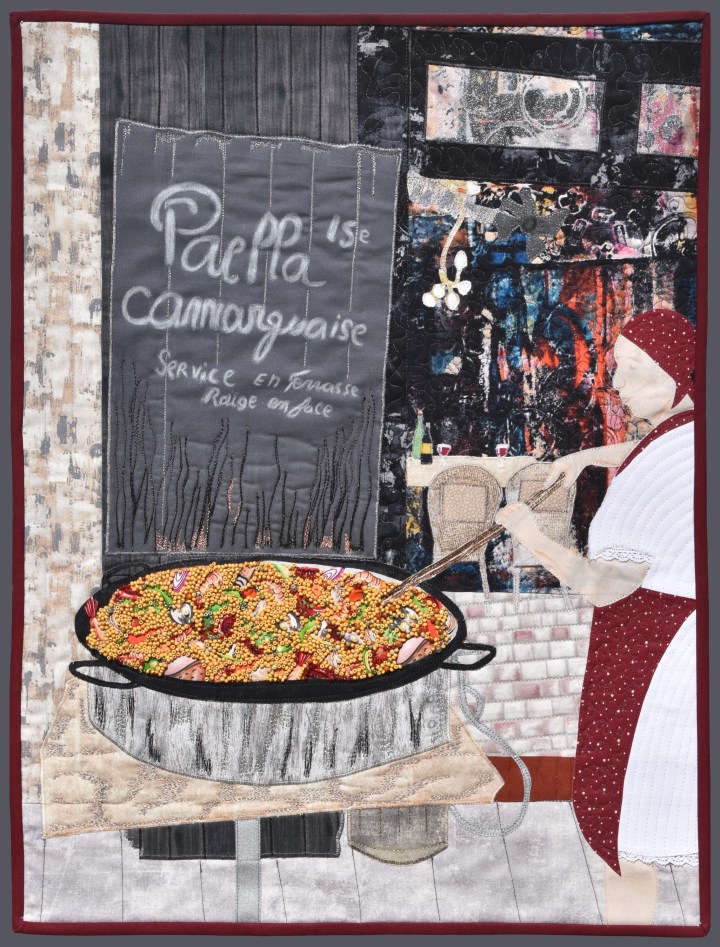
     Buoyed as I was by seeing my art quilt in person in exhibition in Houston late last month (see last post, November 9), I spent this long Thanksgiving weekend determined to finish and submit my latest entry into yet another global exhibition. And I made the deadline! This piece, called “Cuisine Locale” (pictured above), has been adapted from a photograph I took in Arles, France, in 2019, the last overseas trip we took before Covid. Reliving the memories of that 50th anniversary trip to a country we love brought me happiness and, believe it or not, I found the 22 hours of hand-beading that paella to be calmingly meditative. 

     Chief among the blessings I count, of course, is that we are still here, along with our closest friends and relatives. A couple of them came to visit from out-of-state the week before Thanksgiving. Again, encouraged by a boost of confidence through limited social interaction, not to mention those third Covid shots, we were able to plan outings and activities here that involved minimal health risks and they were able to fly in non-stop (from Tampa and Seattle) without long layovers in congested airports. During that week, we mostly just sat and talked and ate and drank, but it was glorious, especially since we hadn’t been together for over two years. What a joyful way to begin this holiday season!

     While almost 800,000 Americans have died during Covid and we are still losing about 1,000 lives a day, at least the availability of vaccines has slowed the spread of infection and stemmed the tide of fear, notwithstanding the latest threat from the Omicron variant. No, vaccines haven’t provided the immediate “cure” and the immediate “return to normal” that everyone (especially politicians) anticipated earlier this year, but they have uplifted confidence in those of us who have been cautious and conservative in our pandemic responses all along. Through it all, we have learned a few things: that vaccines work, but may not last forever; that break-through cases can occur, but aren’t likely to kill you; that masks protect self and others, even from ordinary colds and flu; that personal space and social distance help deflect infection; and that practical, provable, preventative measures in a public-health crisis are NOT a matter of individual choice, but a collective responsibility to the larger society. 

     These are important lessons going forward, because it doesn’t look like Covid or its myriad mutations are likely to just go away anytime soon. In fact, many scenes of a “pre-pandemic normal” are destined to become Rockwell-like images of nostalgia on future Christmas cards, even as more of us realize that we don’t really want a return to some of those “pre-pandemic normals.”  Risk assessment, reasonable choices, common sense, simple courtesy — these are the best ways to manage life in “the new normal.” If we weren’t so bogged down in the politics and craziness of our dystopian “present normal,” maybe we could see that these attitudes offer the best ways to live under any circumstances.

     All in all, I am feeling well going into this holiday season. I will decorate and bake and wrap a few gifts; we will erect our new, first-in-our-entire-lives 9’ artificial tree (and get our no-longer-needed decorations over to Goodwill in time for someone else to enjoy); and I will write those Christmas cards and letters, even though I haven’t much exciting news to report this year (and even though they may not arrive until after the New Year). Our Christmas will be quiet, spent with what I have come to call our little “social triangle” (my husband, our son and me), but a three-legged stool still stands, and I am grateful for that.

     Comfort and joy — key words of the season. And this year not just empty longings.

comments 4

A Quilt Debut

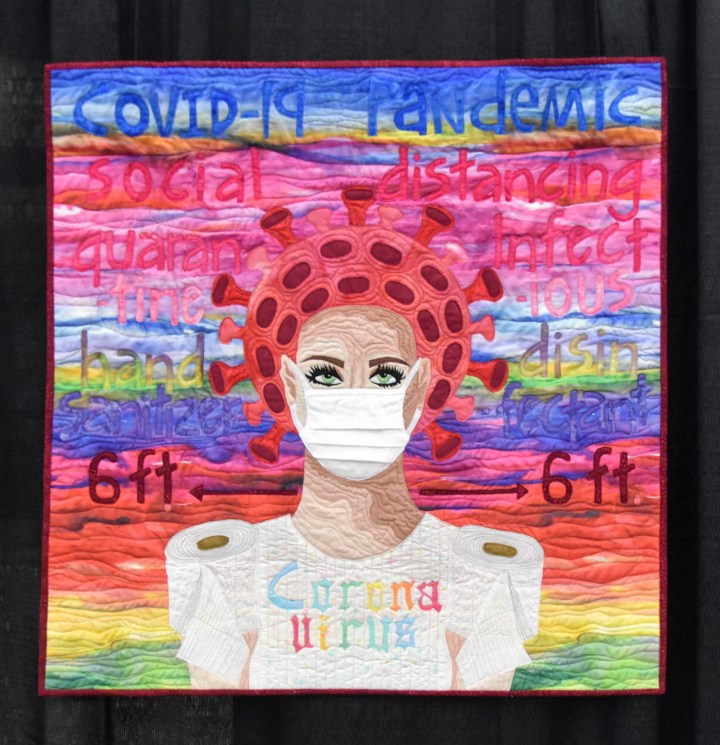
 [Above: “My Pandemic Quilt” by Laurie Ceesay Landree in Pandemic: Life in Lockdown,  a special exhibition at the Houston International Quilt Festival, 2020]

     The Houston International Quilt Festival just closed at the George R. Brown Convention Center downtown. Since Tokyo permanently suspended its quilt festival after 2020, the Houston show is now the largest in the world, as well as the largest in the US. Founded in 1975 by Karey Bresenhan, President and CEO of Quilts, Inc., it draws over 55,000 visitors during its five-day run in late October. “Quilt International,” as it is affectionately called, is nothing short of a fabric extravaganza beckoning bus loads, plane loads, and car loads of quilting pilgrims, artists, collectors, instructors, and vendors from around the Country and all over the world. They come to see, to learn, to shop and to exhibit their work with pride.

      A quilt is generally defined as a three-layer fabric sandwich of any size, shape or pattern, sewn by hand or machine. While quilts have traditionally been made for utilitarian purposes, they have evolved under the hands of talented, creative seamstresses (nearly always women) into prized works of artistic beauty and historical record, such as the famous Amish quilts made by Amish and Mennonite women around Lancaster, PA, or the Gee’s Bend quilts which are still a handwork tradition today in the African-American community of Gee’s Bend, AL.

     Over time, especially in America, as the art of quilting gained interest, so too did the purposes for which they are made. There are records of quilts being used for messaging, hanging on fences to lead the way for fleeing slaves on the underground railroad, for example, or quilts with subtle signs alerting hobos as to which households were welcoming or hostile as they traveled the rails and asked for a handout during  the Great Depression. In the last 50 years or so, we’ve seen the rise of socio-political messaging, in the form of the famous AIDS Memorial Quilt, or the commemorative 9/11 quilts, or the more-recent protest quilts that address racism and gun violence. Such work expands the very definition of a quilt in the public mind and moves it from bed cover to wall art to be displayed, discussed, collected and prized.

     Most of us quilters began by making traditional bed quilts with traditional patterns, thereby learning the basic techniques of designing, piecing and machine quilting. We took classes, built our fabric stashes, acquired specialized tools, joined local guilds, and entered area quilt shows hoping to be awarded a ribbon — if not a blue one, at least an honorable mention (which is what my first quilt garnered). Then, in the 1990’s, a new movement captured our imaginations: the art quilt. For me, who had already decided that I was “a quilter who didn’t quilt” (because I didn’t own a longarm machine and so sent all my big quilts out to professionals to be quilted for me), the introduction to the art quilt came through a class at my local quilt shop on how to translate photographs into fabric art. My very first “art quilt” was from my own photo of the covered bridge in Cornwall, CT.

     In 1989, California quilt artist Yvonne Porcella launched a new organization, the Studio Art Quilt Associates, Inc., whose mission was to promote the art quilt as a fine art medium. SAQA defines an art quilt as “a creative visual work that is layered and stitched or that references this form of stitched layered structure.” Now, over the last 30 years, it has grown into an active community of over 4,000 artists, curators, collectors, and art professionals around the world. Today, SAQA hosts major regional, national, and international juried exhibitions in galleries and cultural centers worldwide, provides publicity and promotion of the art quilt through its various publications, and serves as a resource for quilt artists as well as curators, dealers, consultants, teachers and collectors.  Largely due to the promotional efforts of SAQA, art quilts are commissioned to hang in corporate headquarters and public spaces; they even — gasp! — hang in museums as part of permanent collections. As I have mentioned here before, I am a member of SAQA and proud to have had several of my art quilts accepted into SAQA exhibitions. 

     In the world of fiber arts today, there are traditional quilt displays, specialized exhibitions and juried shows, fabric art spin-offs of wearable art, and even 3-D creations. And then there is Houston Quilt International, where you will find it all in one gigantic place. The 2020 Houston show was cancelled due to Covid, but this year’s show went on as planned albeit under obviously reduced circumstances and with strict Covid protocols (mask mandates for everyone and enhanced sanitary conditions at the Convention Center). Even without the large numbers of international participants, there were still some 1200 quilts and pieces of textile art on display, including 29 special exhibitions, 500 vendor booths and 260 classes all spread over three full floors of the Convention Center. 

     As you may have inferred by now, the Houston International show is a big deal among quilt enthusiasts, so I was thrilled this summer to hear that one of my works, “Look to the Light,” had been juried into a special exhibit there called Tactile Architecture.™  (This is the quilt I spent most of last year working on and which I featured in this blog post on Nov. 25, 2020.) There were only 16 works displayed in this exhibit and I was told that it was quite an honor to have been accepted because of a record number of submissions. I guess everyone else had spent those long Covid months at home making art just as I had.

     Anyway, leave it to the woman who has barely gone out of her house in almost two years to decide to make her debut back into the world at a potential super-spreader event — and I don’t even ride a motorcycle! Now I’m not going to be cavalier about how I made this decision because it was not without fear and anxiety, even up to the very last minute. Beyond the fact that I had already laid out the non-refundable fees for the show and hotel back in June, I still kept a wary eye on Covid case numbers and still fretted over the risks of attending up until the last minute. In the end, though, I decided that seeing my work displayed in Houston at Quilt International was worth the risk — one does have to sacrifice for art after all!  But more importantly, this was the motivation I needed to push myself toward some sort of normalcy.

     I am under no illusion that Covid is over and gone, but I have come to accept that we all must find reasonable ways to accommodate a recurring threat while reclaiming some of our lives. I have been vaccinated (with three shots, actually), I wear a mask everywhere all the time, I wash my hands incessantly, regularly disinfect my house, and am not in the habit of attending motorcycle rallies or events like them. 

     Yes, Houston was crowded, because it is a big city and the Astros were playing in the World Series, but thankfully, Quilt International was less crowded than I remember it being before the pandemic.  You could actually see the exhibited quilts without crushing crowds, linger over them, photograph them, even chat with the artist if present. And the work seemed exceptionally stunning, inspiring and original, such as the Landree quilt pictured above, which is no doubt destined to become part of the record of our times. 

     I am so glad I made the trip to Houston, and feel so much more hopeful and more confident about moving forward now. How odd that an art work that sustained and comforted me through the long months of being shut in last year ultimately pushed me out of my comfort zone and back into my life this year. We both made our quilt debut in Houston together!

comments 2

The Tales of Mr. Poe

     I am in possession of a 1938 Modern Library edition of The Complete Tales & Poems of Edgar Allan Poe (Random House, Inc.). It belonged to my Mother. Along with Charles Dickens, Poe was one of her most favorite authors — 19th century writers being universal favorites of people who grew up and were schooled in the early half of the 20th century. It’s odd, in a way, that she, who was so very optimistic and upbeat and positive about life, would nevertheless love authors who largely concentrated on the bleak and the macabre. But then, she was a true romantic in every sense of the word, including literary genres.

     Anyway, because of my Mother, my association with Mr. Poe goes way back, even before I studied his work in English class or spent Saturday afternoons in the movie theatre watching 1960’s Hollywood renditions of his scariest short stories with Vincent Price, Peter Lorre, and Borris Karloff: The Pit and the Pendulum, House of Usher, Masque of the Red Death, and a cinematic version of Poe’s most famous poem, The Raven. I had read many of these tales before, of course, in her Modern Library edition, so was already something of a Poe critic long before I ever got degrees in American literature.

     During his unfortunately short life (he died at 40), Poe was prolific. He wrote 73 short stories (not all of them macabre), over 50 poems (not all of them dark and grieving), and several rather acclaimed pieces of literary criticism. But yes, he was a “tortured soul,” and that shows in his work overall. He married his cousin Virginia (who was 13 at the time) and they were together only 11 years before she died.The great love of his life, she is immortalized in his most famous grief poems, “Annabel Lee,” “Lenore,” “Ulalume,” and “The Raven.” They are all mournfully melodic, with interior rhymes and durge-like rhythms, and they are beautiful (and I am not a romantic). I delivered these poems repeatedly in oral interpretation of poetry competitions in my undergrad days, successfully, I might add. (It wasn’t hard if you could ignore the sing-song impulses and emphasize the narrative thread.)

     “The Raven” was first published in 1845 in the New York Evening Mirror and, though Poe was already a working writer and an editor, this poem brought him instant success among mainstream readers. The story of a profound sorrow that won’t leave struck a popular nerve, and it was subsequently published in slightly different versions in numerous papers around the Country. (Visit the Edgar Allan Poe Society of Baltimore’s website, http://www.eapoe.org for the various versions of the poem and other author information.) “The Raven” is a long poem, being 18 stanzas of six lines each, which precludes my reprinting it here, but when you read it, you will no doubt recognize several oft-quoted lines and phrases. 

     Good writing and great literature does endure, even when it is sentimental and clearly a product of its time. “The Raven” is a perfect example. The nevermore refrain has come to represent, at least among modern readers, more than just Poe’s loss of his wife, but the loss of everything that cannot be recaptured: our lost loves, our lost youth, our lost innocence, our lost faith. That, I think, is at the core of its continuing appeal — perhaps especially now. The appearance of a  raven was, of course, a sign of death and impending doom since ancient times, which explains the ubiquity of the avian image today at Halloween.

     Poe’s short stories also endure, particularly at Halloween, and he is rightfully considered a master of Gothic horror. In reality, though, only about a third of his stories truly fit the horror classification. He is also considered a master of detective fiction, psychological thrillers, and even some science fiction, and he also wrote satire and even humor. Many of his best-known short stories were inspired by sensational accounts of unsolved mysteries and horrific murders that he read about in newspapers. Some even found their inspiration in historic events, such as The Pit and the Pendulum (about torture in the Spanish Inquisition) and Masque of the Red Death (about the cholera epidemic). 

     In a way, Poe’s life itself became a sad, melancholy tale. Always troubled with psychological problems, with drugs and alcohol and then the loss of his great love, he died of “mysterious circumstances” in October of 1849. He is buried at the Westminster Presbyterian Church in Baltimore. For over fifty years, an unknown visitor came each year and left three roses and a bottle of French cognac at his gravesite. No one is entirely sure of the symbolism of those mementoes, but Poe’s tombstone aptly reads: “Quoth the Raven, Nevermore.”

     And the Baltimore Ravens bear the name of Poe’s most famous poem.

comments 2

That Time of Year

It’s that time of year again, even here in South Texas, when the sounds, if not the sights, of fall are all around us.  The crisp, clear air amplifies the cheering crowds and marching bands of nearby football games, transports the wailing whistles and rushing rails of traveling trains in the distance, and interrupts afternoon naps with the incessant whir of neighborhood leaf blowers. As temperatures cool and the sun sits lower in the sky, children laugh and squeal outside in the last moments of daylight. Soon it will be too dark to ride their bikes in the cul-de-sac or even to go out alone to trick-or-treat. Soon, everyone will be hunkered down for the winter, such as it is in South Texas.

     What with shortages of beef and poultry, container ships with toys and clothes from China sitting idle off coastal ports, and higher prices on everything everywhere, it’s that time of year, particularly this year, to get a jump on the holidays. (We just ordered our 9 foot artificial Christmas tree from Balsam Hill while it’s still in stock.) Postmaster General Louis DeJoy, this year’s candidate for the grinch who is trying to steal Christmas, just announced that first-class mail delays are to be expected starting October 1. Call me crazy, but didn’t those delays begin ages ago? My cards and letters to the Coasts from Texas have been taking five to ten days for a while now, and a small gift from a friend sent via USPS recently took over three weeks to arrive from Connecticut.  Obviously, those of us who still send out holiday cards need to get a move on; at this point, we’re probably already too late to send Halloween surprises and are even cutting it close for Thanksgiving!  

     Speaking of holidays, this coming Monday, the second Monday in October, is Columbus Day, as it has been known since the 1930s. Originally intended to give working people a three-day holiday weekend, it was not officially made a US holiday until 1968. Commemorating the discovery of America by Christopher Columbus in 1492, Columbus Day is one of eleven official federal holidays, although it is only observed by about half the states. Non-essential government offices, banks, post offices, and some other civil services are closed everywhere (as are schools in those states where the holiday is observed), but the stock market and most regular businesses are open. In recent years, the growing controversy over Columbus and his discovery has caused some states and even cities (including Washington D.C.) to change the name of their holiday observance to Indigenous Peoples’ Day in honor of the native Americans who were already here when European explorers arrived.  

     In the Northeastern United States, Columbus Day is almost universally observed and celebrated, especially among Italian Americans who have been celebrating it since the 1860s. The long Columbus Day weekend, generally regarded as the fulcrum of the season, is eagerly anticipated by adults and children alike. “Leaf-peepers” pile into their cars and SUVs and take off on country byways into the hills and mountains of New England in search of Mother Nature’s most vivd last hurrah. Local newspapers and televisions stations actually list “color indexes” for the best routes to follow. Everyone knows it’s that time of year for a final outing before the frenzy of the Christmas holidays ensues and the dark days of winter keep us indoors.

     My birthday also falls on this weekend, as it often does, and yes, for many years, I was among the leaf- peepers traveling upstate Connecticut in search of old country inns, hot apple cider and plentiful pumpkins along our favorite autumn trail. Those day trips inspired me, offered me a brief respite in a calendar year rapidly coming to a close, even as they reminded me that I, too, with each birthday was closing in on the fall and winter seasons of my own life. 

     As usual, my birthday makes me contemplative and circumspect. It’s just that time of year.    

comments 2

Fall Becomes Us

     Fall begins today and not a moment too soon. I am soooo ready for this long, hot, awful summer to be over, with all its natural disasters, pandemic plagues, and combustible rhetoric fanning the flames of fires everywhere, both real and imagined. If weather forecasters are correct, a “norther” should be blowing in to South Texas this week, always a sign of autumn’s imminent arrival, even if the short period of brisk breezes and fluttering leaves are yet bookended by 98º days. I’ll take what I can get.

     Fall has always been my favorite season (probably because of back-to-school, football, and my birthday), even before I lived in Connecticut. But once I experienced the season in New England, where vistas of vivid foliage rekindle the spirit and sunlight filters strobe-like through the canopy of over-hanging trees on country backroads, I was really smitten for life.  We always took a little family field trip upstate into the Housatonic River Valley around Columbus Day when the colors were usually at their peak. We pretty much always took the same route, stopping and shopping in quaint little early American towns along the way, then have lunch at our favorite Fife ’n Drum restaurant in Kent, and finally ending up at the covered bridge in West Cornwall, our traditional photo-op destination. These were only day trips, but they felt much longer, having taken us away from our present-day cares and transported us to an earlier, simpler time. 

     No matter where you are, seasons begin on the solstices and equinoxes of the year. The very word season, from the old French session, means sowing and planting; it entered widespread use in English during the 16th century. The word autumn also comes from the old French autompne, which in turn traces its derivativation to the Latin autumnus. From there, things are less certain, but the common assumption among etymologists is that the original meaning is probably related to the Latin word augere, to increase.

     Calling the season “autumn” in English started around the 12the century. By the 16th century, the word autumn was in common use, but the word “fall” had also begun to appear, probably because of the routine sight of falling leaves at this time of year. “Fall” remains the preferred term here in the US, while “autumn” is still more common in the UK. Before all of this linguistic evolution, however, the season was most commonly called “harvest,” for obvious reasons related to farming and gathering of crops. To this day, it is harvest themes and images that define our seasonal decorations and celebrations, right through into Thanksgiving.

     Changing seasons matter because they help us mark the passage of time and provide a reset button, so to speak, from the relative sameness of everyday routines (even when we aren’t living in the Groundhog days of a pandemic). Though we don’t all experience the seasons in the same way everywhere we live, we still greet them with our own particular memories mingled with some universal images: snowmen in winter, singing birds in spring, beaches in summer, pumpkins in the fall.  Of course, those of us who don’t really have four distinct seasons have to make adaptations. I always wonder, for example, why people in South Texas send Christmas cards with snowmen and bobsleds on them. Is it a nod to nostalgia prompted by memories of growing up somewhere else, or is it just too many Normal Rockwell calendars hanging in Southern kitchens?

     In any event, the changing seasons, even if they don’t visibly change all that much, give us something to look forward to or, if nothing else, to complain about. An old country saying comes to mind: “Everyone complains about the weather, but no one does anything about it.” That observation was never so true as it is right now when we all continue to argue about climate change while the world implodes.

     Meanwhile, seasons change for better or worse and time moves on. To paraphrase an ancient philosopher, the only thing that doesn’t change is change itself. We may not be able to control the changes, but we can do our best to adapt in positive ways. For me, that means remembering those New England day trips fondly rather than sadly, decorating my house with fall leaves indoors rather than bemoaning the lack of color outdoors, and making my own squash soup and pumpkin bread rather than searching for a restaurant with a seasonal menu that offers  my favorite fall fare. 

     And in the early twilight of the evening, I can settle down with a good Italian wine, listen to Vivaldi’s “Autumn,” and let the music paint the scene.

comment 0

Inspiration: Part 2

 Dripping Springs, Texas, is a small, rural town of roughly 6,000 residents located about 25 miles west of Austin. It bills itself as the “Gateway to the Texas Hill Country,” and in truth, it is known for its rolling hills and country character. Long ago, it was a stagecoach stop between Austin and Fredericksburg, now known and promoted as the epicenter of the Texas Hill Country. Dripping Springs is a lovely, quaint little community, but you might be forgiven for not having ever heard of it before.

     And you might not have ever heard of Mr. James Akers, a 15 year resident of Dripping Springs, who recently brought an unusual measure of publicity to his small town. Mr. Akers is a parent of four children, one of whom is still in high school in the Dripping Springs Independent School District (servicing 7200 students — yes, more than the total population of the town because it also serves children of surrounding towns in Hays County). Akers appeared at the August 23 school board meeting to make a case for requiring face masks in the schools (in spite of  the Governor’s ban on such mandates). Dressed conventionally in a jacket and tie, he nevertheless gave an unconventional performance in his allotted 90 seconds of speaking time.

     This routine, small-town event ended up being widely quoted and reported by multiple local and national newspapers and television stations (from which the following synopsis has been compiled). This is the way it went: “I’m here to say I do not like government, or any other entity telling me what to do,” Mr. Akers began. “But sometimes I’ve got to push the envelope a little bit, and I’ve just decided that I’m going to not just talk about it, but I’m going to walk the walk.”  

     He continued: “On the way over here, I ran three stop signs and four red lights.  I almost killed somebody out there, but by God, they’re my roads too, so I have every right to drive as fast as I want to, make the turns that I want to.”  Then, stepping back slightly from the microphone, he began to take off his jacket. “At work, they make me wear this jacket. I hate it. They make me wear this shirt and tie. I hate it,” he added, removing both. 

     Mr. Akers’s not-so-subtle parody of those who oppose a school mask mandate became clear as he continued to disrobe.. “It’s simple protocol, people,” he said, by then having removed his pants. “We follow certain rules for a very good reason.”  

     When his time was up, the School Board President said she understood, but added, “If you wouldn’t mind putting your pants back on for a comment that would be appreciated.” Akers calmly did so and walked away amid a muffle of laughter and applause. “There are too many voices out there that I think are digging in for political reasons, and absolutely just not thinking about the common-sense decisions we make every day,” Akers later explained to Austin TV station KXAN. 

     An earlier order issued by Hays County Judge Ruben Becerra mandating masks in all public schools expired on August 21. No further action has since been taken by the Dripping Springs Board beyond recommending  masks for students and staff. Mr. Akers made his point, even if he didn’t win it, and he did so with dignity and a certain amount of self-deprecating humor. I found his confidence and mature common sense to be inspiring. No doubt even some of those in the audience on the other side of the mask issue found themselves chuckling and clapping, and sheepishly admitting that Akers had a point.

      Compare the tenor of the meeting in Dripping Springs to the insults, threats, heckling and physical confrontations that have erupted over masking in Tennessee and California, particularly the all-out parking lot brawl that occurred in Missouri this week (Sept. 7) when a small town board of education there voted to reinstate a school mask mandate. The issue is about the safety of school children, and these are, supposedly, the adults!  

     Reason, maturity, civility and humor — these have become almost impossible to find in public life in America anymore, locally or nationally. Instead, our leaders exhibit behaviors that would be promptly punished among children on the playground: bullying, name-calling, threatening, extortion, foot-stomping and temper tantrums. When leaders are no longer held accountable for what they say and do, then everyone else down the line feels licensed to act in the same offensive ways. In terms of modeling behaviors for our future citizenry, that promises as much long-term damage to our children as Covid does.

     Humor is the trait I miss most of all these days. No one laughs anymore, especially not at the self. Everyone is soooo self-righteous, soooo self-absorbed, not to mention soooo woefully ignorant of the definitions of humor-related literary tools such as irony, sarcasm, hyperbole, satire, understatement, parody, pun, oxymoron, or malapropism. Everyone frowns and scowls and stomps along so resolutely that they can’t even appreciate the inherent relief and wisdom of moments of comic relief when they happen. 

     But the wisdom of comic relief was appreciated in Dripping Springs on August 23rd and I, for one, was grateful. It gave me a brief, but welcome, reason to be proud of my fellow Texans on both sides of an issue. And it made me smile.

comments 6

Finding Inspiration

     Let’s face it: these have been some long, difficult, somewhat depressing 18 months. Even those of us who were managing fairly well all through last year, buoyed as we were by the hope of Covid vaccines, have now become a little frayed around the edges with the new surge of the Delta variant. Two steps forward, one step back…is this going to be our forever normal and, if so, how do we stay motivated to carry on through an endless repetition of groundhog days?

     You might recall from your high-school English or history classes that people always looked to their heroes to lead and inspire, especially in times of crisis.  In classic literature (think Greek mythology and Shakespearean tragedy), heroes were bigger than life, sometimes considered mortal gods, always willing and able to save the day. Classic heroes shared certain basic characteristics: they were generally high-born or of high position, destined for greatness with exceptional abilities that ordinary mortals didn’t possess. They were devoted to a cause or quest greater than themselves, which made them fearless warriors in the face of great odds, and of course, they were almost always men. But then there was that pesky “tragic flaw,” that particular character weakness that presented a nagging spiritual/moral battle within that usually ended in the hero’s death. (Again, think Achilles or Macbeth.) 

     The problem with classic definitions of heroes is that the line between myth and reality blurs with time, especially as tales of  the hero’s feats morph into legend over generations. To this day, glorious stories about some of the most towering figures of the past, people such as Alexander the Great or Moses, are short on factual corroboration. And when we move from heroes of the ancient world to those of the more recent past, to pivotal leaders such as Winston Churchill or Martin Luther King, reinterpretations of the corroborating facts invite controversy. For example, is Mahatma Gandhi the hero who freed India from British rule and established it as an independent nation, or did he ultimately allow India to be split in two?  

     Thus, the concept of a classic hero, both in modern literature and in modern life, becomes problematic. The cynics among us (or realists, if you prefer) see the “tragic flaws” of character as being at the core of the human condition, so our literary heroes tend to be anti-heroes, characters such as Willy Loman whose greatest flaw is his failure to see beyond the myth of the American Dream. Larger-than-life heroes with super-human strength and power are more commonly found  in fantasy than in fact, which explains the enormous popularity (and the multibillion dollar industry) of superhero figures in comic books, video games, and movies in our current age of cynicism.

     These days we are all more likely to agree on reasons to celebrate and award medals to the “everyman” heroes among us (Rush Limbaugh notwithstanding): our service men and women, firefighters and police, first responders and medics, doctors, nurses and healthcare workers, all of whom do the work that most of us are either unable or unwilling to do. Ironically, most of these everyday people would deny that they are heroes at all, often appearing embarrassed to be singled out for recognition claiming that they are “only doing their jobs” even as they risk their lives.  In a way, I understand their reluctance; hero is a hard title to live up to and the opposite  title of villain is always just a hubristic misstep away.  Ask Andrew Cuomo.

     I have never been much into hero worship, even as a kid. There are, of course, people whom I greatly admire because of their deeds or because of how they have directly affected me, but I don’t expect any of them to be superhuman and without flaws. Rather, as I always say about  love in marriage, you love someone not because he/she is perfect, but in spite of  their all too human faults and foibles. I prefer to look for inspiration in reality, not fantasy.

     This is especially true in my creative life and it has been especially true over these many long months of Covid and natural disasters and political upheaval and national discord. Amid all the bad news and bad behaviors, let me find some inspiration, let me find reasons to smile — please!

     Iris Apfel is a self-described “geriatric starlet.” At age 99 (her birthday is in a few days), she is a businesswoman (still),  an interior designer (still), a social whirlwind in New York City (still), and a style maven known for her iconic high/low style that mixes couture fashion with flea-market finds (still). Her sense of personal style is so original, in fact, that in 2005 the Costume Institute of the Metropolitan Museum of Art featured an exhibition (Rara Avis) of her clothes and accessories making her the first living woman who was not a fashion designer to be so honored. Since then, her fame and her recognition with her big black glasses have exploded; there are books, articles, films, collaborations with multiple brands and retailers, and even Iris Barbie dolls! 

     I have never met Iris Apfel, though I have seen the documentary, read her book and own one of the Barbie dolls, but I don’t need to know her personally to be inspired by her obvious energy and joie de vivre. As Rachel Zoe, a stylist to movie stars, has said, “Style is a way to say who you are without having to speak.”  Iris doesn’t have to speak because she screams with the confidence, gratitude, good humor, and acceptance of each and all that can only come from a life of hard work, well-lived and well-loved. Just thinking about her makes me smile.

     Which is why, here in the doldrums of a hot and hateful summer, I decided to do the thread-painted portrait of her above. “Oh, Iris!” is being sent to the Studio Art Quilts Associates for their traveling trunk show program, which passes samples of these small 10” x 7” quilts to member groups around the world for study and education over a three-year period. 

     Perhaps Iris will inspire them as she has me, or at least make them smile.

comments 2

Going for the Gold

For as long as I can remember, I’ve been a fan of the Olympics, especially the summer Olympics. Oh sure, I love the ice skating in the winter games (doesn’t everybody?).  To this day, the single most significant, moving, memorable Olympic moment for me is still that of watching ice dancers Torville and Dean of Great Britain deliver a gold medal performance to Ravel’s “Bolero” in Sarajevo in 1984. Rarely has any artistic performance moved me to tears even when I’m in the live audience, much less while watching it on TV! Torville and Dean was not only the first non-Russian ice-dance team to capture an Olympic gold medal, but the spontaneous two-minute standing ovation they received from 10,000 spectators in the arena was also a first.

     Nevertheless, it is the star power of summer Olympians that remains in my memory even as I watch the current events unfolding in Tokyo: gymnastics — Olga Korbut, the Russian Olympian called the “Sparrow from Minsk” winning three gold medals in Munich, 1972 (which she later sold as a US citizen at auction in 2017 because she was almost destitute);  14 year old Nadia Comãnece of Romania (Montreal, 1976) winning three gold medals and scoring perfect 10s (she also became a US citizen); Mary Lou Retton of the US, known for her big smile and perky disposition, who won 5 medals including a gold on the balance beam after landing on one foot because of a sprained ankle (Los Angeles, 1984). And now, of course, there’s Simone, a champion among champions and gymnasts for much more than just medals. 

     I think my keen interest in the summer games might be because I spent most of my life teaching and grading papers, and so really only had the leisure time to follow the events closely in the summertime. Once my Mother retired and got older, I would come down to Texas for an extended visit during July or August. She particularly loved all the back-stories of the athletes, especially the underdogs or those who had overcome great odds to make it to the Olympics. I did too. As we watched day after day, we began to feel we knew some of these competitors, had a vested interest in their success or failure, and cheered them on with as much arm-chair enthusiasm as devoted fans cheer on their favorite football or baseball teams. 

     Those “personal connections” fostered interest in sports like track and field that I was never particularly interested in at all, but yet …  I can still see in my mind, for example, the wild, gasping, overjoyed face of Michael Johnson as he sprinted across the finish line in his gold running shoes to take the gold medal in the 400 meter in Atlanta in 1996, thus becoming the first man to win gold in both the 200 and the 400 in the same Games. (He won gold in the 400 again in Sydney in 2000). I can also see the tears running down Johnson’s face when he cried on the podium in Atlanta during the medal awards; my Mother and I cried with him. I watch track and field events all the time now, even know a good bit about the various events and heats and placements and relays, and find myself rooting for my favorites who have come up through the trials. I even got teary today, for example, when Allyson Felix, a 35 year-old new mother, won her 11th Olympic medal in her fifth Olympics, thus becoming the most decorated track-and-field star in history. Good for her, for the US, for women everywhere. Go Felix! 

          One of the Covid casualties of the Tokyo Olympics, besides the obvious absence of cheering crowds, is what I see as a rather disjointed reportage of the events. NBC’s coverage, spread over several different channels each seeming to cover different types of competitions, is hard to follow — and don’t get me started on the the insistent, unrelenting nighttime coverage of the bikini-clad women in beach volleyball almost every single night on the major network NBC channel (even though the American women did ultimately won gold). Please. But beyond the uneven coverage, it’s those “up close and personal” features of individual athletes that I miss the most. Yes, I understand that Covid prevented journalists from having the access or the technical personnel to cover them all, but it’s too bad. Part of the joy of the Olympics is the vicarious experience engendered in spectators like me who aren’t physically present. We want to cheer our favorites, our heroes, our champions even when they aren’t Americans.

     NBC Universal paid more than $1 billion to run some 7,000 hours of Olympic games in Tokyo, yet viewership is averaging about 16.8 million a night, a sharp drop from the 29 million viewers of the Rio games in 2016. TV ratings for the opening ceremonies last week were the lowest in 33 years. Again, I understand, but I also fear the distant drumbeats of doom arising even now as to the viability of the Olympic games going forward in the 21st century. The financial and economic risks for host cities are so great, and the growing political issues over human rights and repressive government regimes are so intensifying that threats to the future of the Olympics are, indeed, very real. 

     The summer games are extravagant and expansive: they typically involve more than 200 participating countries and more than 11,000 competitors, compared to the winter games that involve roughly 92 nations and about 3,000 athletes. (Latest figures from 2016 and 2018, respectively.) So far, the 1984 summer Olympics in Los Angeles are considered the model for financial success, in that they used existing facilities and enlisted corporate sponsors. Otherwise, most host cities go way over budget, with Montreal (summer, 1976) registering the highest overrun ever at 720% over budget. (Obviously, figures aren’t available for Tokyo yet.)

     Whether it’s Covid restrictions or civil rights legislation or college educations, everything these days seems to boil down to money, which is a shame. A major reason that the Olympics are so inspiring and refreshing is that, for the most part, the athletes are amateurs. They are not in it for the money, for big team owners or corporate sponsors, but for their own personal achievement and national pride, much like the motivations of high-school athletes and teams. Even when pro athletes do get involved, such as when the men’s basketball team won gold today under our own San Antonio Spurs Coach Gregg Popovich, there is reason to celebrate their uncontaminated spirit of genuine sportsmanship.  

     This is what the Olympics mean to casual viewers like me who aren’t particular sports fans, to spectators the world over who gain new insights into various countries and cultures, and to young people looking for future inspiration and role models. The Games are a celebration of excellence, of human perseverance and an indomitable human spirit. We need that, especially now.