
There are three things I have always loved about Texas, and which I sorely missed during the 40 or so years I lived out-of-state: 1) the endless, cloudless perfect blue sky; 2) the bluebonnets that blanket the highways and byways during the early spring; and 3) the Hispanic culture woven intricately into the fabric of everyday life, especially here in San Antonio.
Thank goodness the sky hasn’t fallen yet and so is still here and, at least so far, not terribly contaminated by noxious gases and climate change; alas we missed the bluebonnets this year, which everyone claims is because of the drought, but which I think is more the fault of road maintenance crews sticking to their pre-arranged mowing schedules regardless of the late arrival of budding wildflowers. But, hey! Fiesta finally arrived this week, so two out of three reasons to keep loving it here ain’t bad.
Ah Fiesta! Memories that have informed my whole life. When I was a child in Victoria, we would come up to San Antonio during Fiesta even if only for a day or two, just to see the decorations, hear the music, eat the food, shop at El Mercado, and join in the fun. Fiesta always showcased spring since we often passed fields of bluebonnets along the way. Later, when I was in college here, Fiesta provided the ultimate “spring break” right here at home. We never even thought about going to Florida or the Caribbean or even to Mexico; it was all here! My college (Our Lady of the Lake University) was located just outside of downtown San Antonio on Commerce Street, and the Commerce Street bus stopped right on the corner from campus; we students could easily hop on and ride right down to the Riverwalk and La Villita, which we did almost every day during the Fiesta (classes notwithstanding).
San Antonio began as a Spanish mission and colonial outpost founded in 1718, but was named by a Spanish explorer in 1691 for St. Anthony of Padua. Initially, it was a part of the Spanish empire, but then it became part of the Mexican Republic, before the whole territory gained independence from Mexico and became the independent Republic of Texas in 1836. Then the whole of Texas became the 28th state in the United States in 1845. That’s the quick history which gives the outlines, but which does not impart the breadth and depth of the Mexican culture woven into the history of the state of Texas and generations of its people, into our language, our tastes in food and music, our spiritual beliefs, our farming and ranching heritage, and our overall love of color and leather and beef! (Is there anybody who could seriously wonder why the South Texas coastal waters were named the “Gulf of Mexico?”)
When I used to teach American literature and talk about the legacies of various groups and nationalities who settled these United States, I generally introduced the broader definitions of culture to explain that one’s ethnicity or nationality was not the only, or even the most dominant identifying culture of one’s identity. This is especially true in America, where people have historically been on the move since the Westward Expansion and consequently changed and shaped by the natural landscapes, regional traditions, social customs, local industries and occupations, and even the peculiarities of language y’all.
Someone like me, for instance, who is a sixth generation South Texan and the daughter of ranchers, identifies a great deal more with the skills and traditions and customs of the local Mexican ranch hands who helped my immigrant ancestors from Alsace-Lorraine tame the land and build a life here than with the Germanic habits and traditions brought from the old country. My language, my cooking, my use of color and design, my love of an endless sky and open land, and my fiercely independent spirit — all reflect the dominance of those early Mexican and indigenous influences in Texas, not German at all. (I don’t even like German food.) My main culture of identity, if not my national ancestry, is South Texas Mexican; my mixed national ancestry is actually German, but also English, Irish, French, Swedish, and Cherokee Indian.
And yet, I have even diluted that identity by spending most of my adult life not in Texas, but in other parts of the Country. I met and married a New Yorker and so moved to New York City where I became “citified.” My walk and speech got faster, my manner more abrupt, my wardrobe predominantly black and grey, and my humor decidedly Jewish and my everyday expressions infused with Yiddish. My father, who met my mother while stationed in Texas during WWII, was from a large New Jersey family, so my “paternal clan” (except for him) did mainly stay located in the same Trenton/Princeton area from the 1700s, happy it seemed to live and squabble in close proximity to each other. Our son was born in Tennessee (which is where I learned that Texans aren’t really Southerners), and soon after, we three moved to the suburbs of Connecticut, where I fell in love with the New England autumn, learned to can and preserve, and looked forward to lobster bakes (but only in May through August, months without r’s).
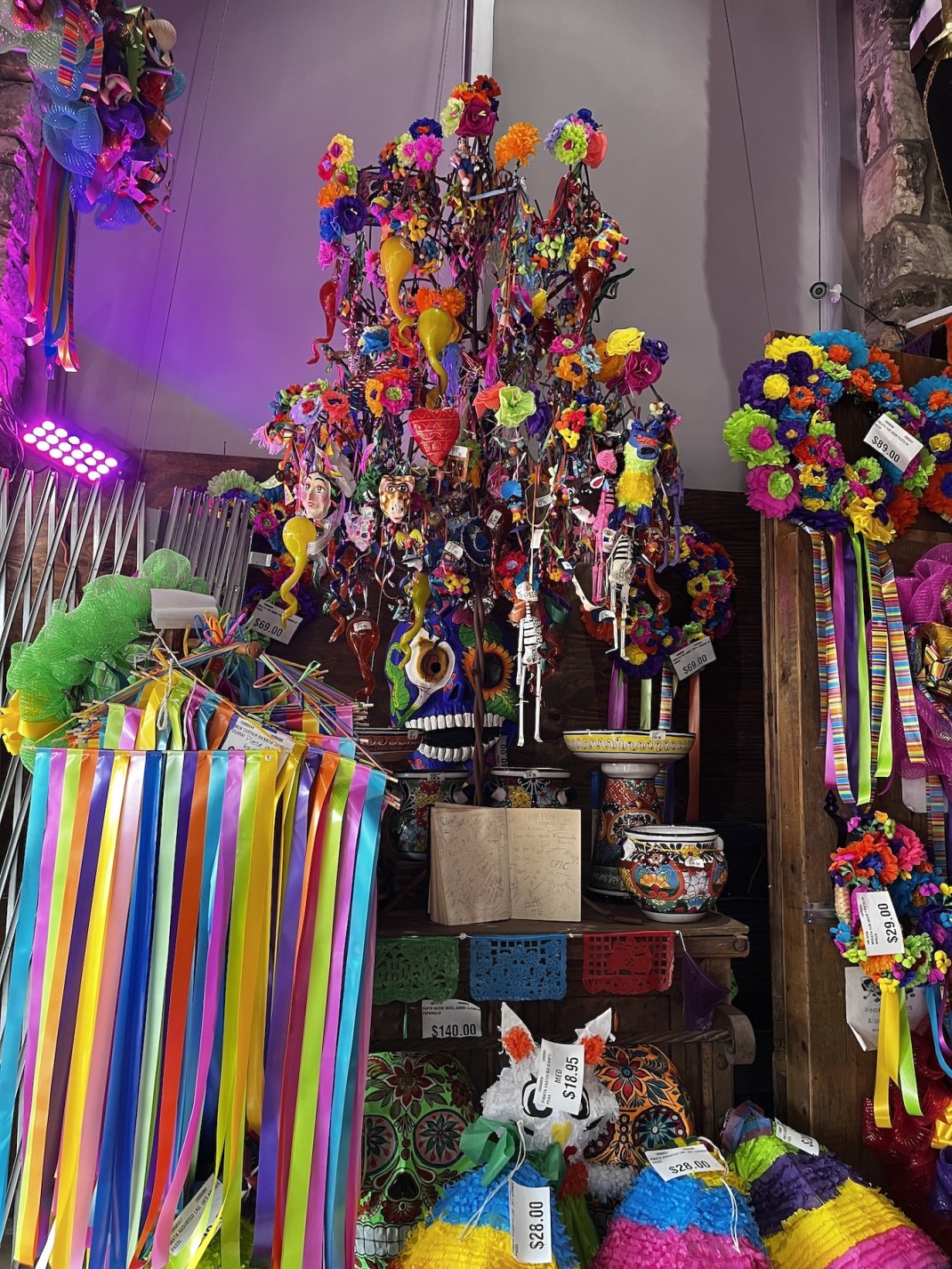
But now, here I am back in Texas for 17 years and back to the light-hearted celebration of Fiesta. This is how I know spring has finally come. In anticipation of its beginning this week, I made a trip down to the Fiesta Store and here is what I found. For those of you who might visit and need a guide, I offer the following list of possible purchases: (See if you can identify any items in the photo above.)
Talavera — beautiful pottery and vases introduced from Spain into Mexico, colorful, signed, and sourced from individual provinces;
La Catrina/La Calavera Catrina — skeletal dolls especially popular during Dia de los Muertos depicting well-dressed men and women in various occupations and endeavors, many are signed by major artists and highly collectible;
Alebrijos— fanciful folk art creatures made of papier-mâche or wood from various provinces;
Huaraches — leather sandals;
Rebozos, ponchos, and sarapes — scarves, shawls, and blankets, often in woven cloth indigenous to various provinces;
Huipil — sleeveless tunics; blusas or camisas —vividly embroidered blouses and shirts, often traditional garments from particular provinces;
Cascarones — confetti -filled eggs, cracked on the heads of loved ones bringing good will, good luck, and messy hair;
Coronas de flores — headbands decorated with artificial flowers, such as those worn by Frida Kahlo;
Papel picados — colorful perforated tissue-paper banners strung together and hung most often outdoors; there are hundreds of different perforated designs;
Guayabera shirts — men’s shirts with four front pockets and two vertical columns of pleats or rich embroidery; also common in Latin America and the Caribbean.
Friday was my husband’s birthday. I gave him a traditional, all white guayabera shirt, which he wore out to a fancy birthday dinner. He looked very handsome in the “Mexican wedding shirt” worn with black dress slacks and black boots — a good look for my favorite native New Yorker who’s turned a “little bit Texas” over the years.
 the narrative thread
Ah, what great memories this brings back for me. Especially visits to the Mercado with all the bright, colorful Mexican art.
LikeLike