
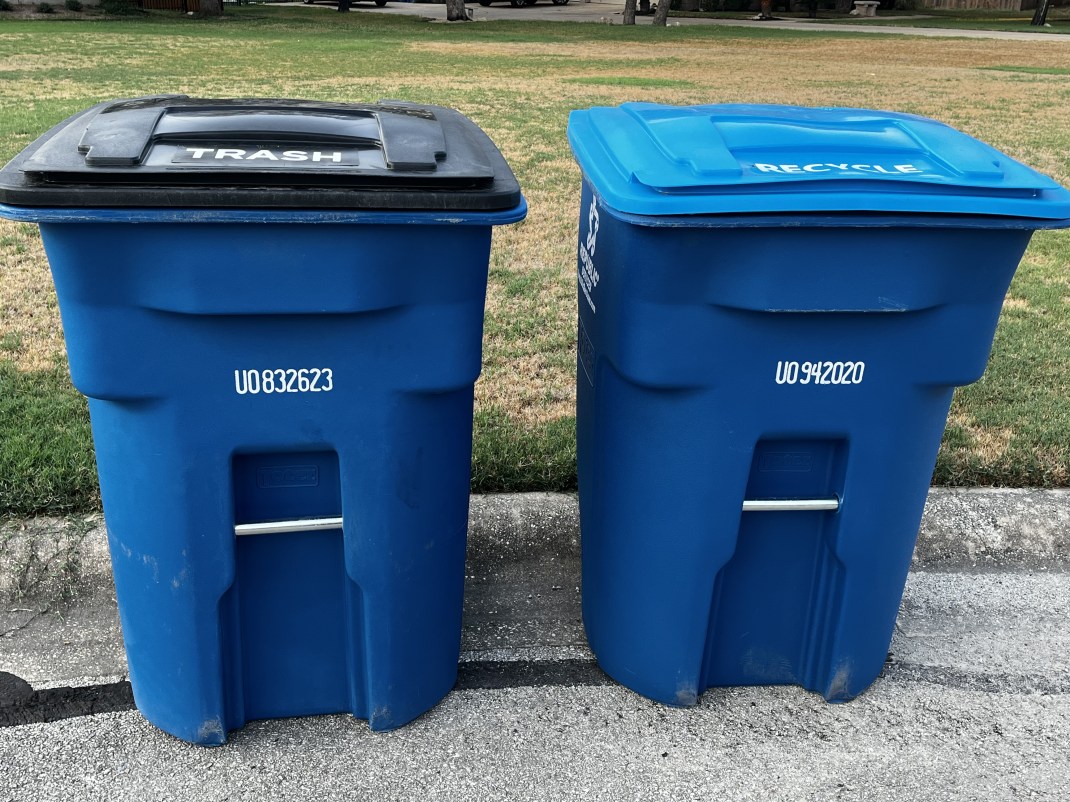
The first notice came in our community newsletter enclosed with the monthly water bill. The local contract for waste removal was expiring and had to be renegotiated. Of course garbage fees would be going up (isn’t everything?), but residents had choices that could mitigate some of the increase. We were encouraged to read the enclosed information sheet with details and comparative rate plans, and then contact our elected officials to express our opinions.
One of our choices was to reduce our current collection schedule from twice a week for garbage and once a week for recycling, to once a week for garbage and once every other week for recycle. Regardless of what we chose, we would be upgrading from traditional manual rear-loading trucks requiring two or three workers to ASLs (automated side loaders) requiring only one human operator. All cans were to be the standard 96 gallon size and those who might need extra cans could rent them for an additional fee.The new equipment promised to be more economical, more efficient, safer and more environmentally responsible. For whom all these benefits were intended wasn’t immediately clear.
Having experienced the challenge of handling these huge, robotic-retrieved cans down at my Mother’s house in Victoria, I knew first-hand how difficult they were to maneuver, how heavy they were when full, how exacting their placement at the curb had to be, and how impossible it was to find somewhere to store them, especially here in Texas where houses don’t have basements and home-owners use their garages for parking everything but their cars. My Mother, slight and elderly as she was, simply could not manage them at all (though she could keep them in the garage since she no longer had a car). Kindly neighbors gave her a hand.
So, I wrote our mayor here about my experience and the problems I foresaw among the many retirees in our own neighborhood. Residential responses to this garbage proposal were robust, to say the least, but I sensed that the deal was already done since we were only negotiating with one company, Republic. (Waste Management had been our previous service.) In the end, “it was decided” (notice past tense, passive voice) that the pick-up schedules would remain the same every week, that a giant dumpster would be located down at city hall for lumber, yard brush, boxes, cans, and any other debris that would not fit into the 96 gallon can with lid closed, and that our bill for all this efficiency and economy would go from $30 a month to $45. (The pick-up truck you would need to haul your bulky debris down to the dumpster was your problem.)
Garbage disposal in growing urban areas has been an issue since the early 20th century. The first open-topped trucks used to collect household refuse began in the 1920s, but foul odors and waste falling from the back soon required covered trucks for better sanitation. In 1937, George Dempster invented the Dempster-Dumpster system in which wheeled-waste containers were mechanically tipped into a truck. Those containers were known as Dumpsters, which is how the word “dumpster” entered our language. The city of Scottsdale, Arizona, introduced the world’s first automated side loader, the grand-daddy of our very own ASLs, in 1969. Interestingly, our new provider, Republic Services, is based in Arizona and is the second largest waste company in the Country with a revenue of $13.5 billion in 2020. (Waste Management Inc., based in Texas, is the largest refuse company with a $19.7 billion revenue in 2020.) Obviously, there’s big money in garbage — just look at our politicians!
Anyway, community arguments aside, friction started in my house once the decision was made and the huge cans (measuring 34” x 28” and 40” deep) were delivered. We have a landing on top of three steps down into the garage from the house, and we have always put our recycle box and garbage can right below the landing. I could simply walk out and toss small garbage bags into the can or drop bottles and papers into the recycle bin without going down the steps. But now, my husband wanted to put both big cans by the banister. I said no. They are so deep and so large that I couldn’t imagine having glass bottles shattering into the recycle bin or having to deep-dive into the garbage can when I inadvertently throw something away by mistake (which happens regularly in my fits of “pick-up and put-away”). But my husband was adamant; he didn’t want the cans stored outside.
So, we argued back and forth. Now he and I have had ONE big argument in our 54 years of marriage, but the garbage threatened to become the second one. I wanted him to leave the smaller can/bins right below the banister where I could easily manage them. Finally, I said, “Either do this for me, or we get a divorce.” Who ever heard of threatening divorce, not over money or the children, but over garbage??!!
Ultimately, I sort of prevailed and we can laugh about this now, but the compromise isn’t all that great either. I have smaller bins right below the stair rails and the huge cans are stored in the garage in our third bay. Getting around them every day is a pain, as is hauling them out to the curb. Moreover, we are now putting out garbage less often than even weekly because we simply don’t have enough to fill such large containers. Is all this more economical? For us, no, but for Republic yes, because they only now pay for one employee on the truck, not two or three. Is it more efficient? Again, not really for us, but it is faster for Republic because the transformer-type arms on the truck do all the work and can collect 300 gallon containers in 30 seconds if the driver doesn’t have to exit the vehicle. Is it safer, perhaps, since there are fewer employees on the routes and no threat of injuries due to lifting. Finally, is it environmentally advantageous? Probably so, if the corporate claims of responsible landfill technology and recycling are true.
The new trucks and the new schedule started just before Labor Day. Our house is at the very end of a small, tight cul-de-sac and I happened to be sitting at my desk facing out when the first big, blue truck with its one, lone driver came lumbering down the street. Of course, people don’t read and don’t follow directions, so on this day, the poor man kept having to stop and climb out to reposition cans correctly before then climbing back into the truck to resume the twenty-point turns needed to get around the cars parked inconsiderately on the street.
And suddenly, the whole scene made me sad.
For 15 years, we had a rear-loading garbage truck operated by three guys who would jump on and off, lift and throw, laugh and wave. Sometimes if a resident was out hauling a bag to the curb, one of the guys would stop to lend a hand. We got to know them all, thanked them when we saw them, even gave them year-end bonuses at Christmas. Their presence always reminded me of the people in Mr. Roger’s Neighborhood, ordinary, everyday people like Mr. McFarley (a deliveryman), Chef Brochett (a baker), or Officer Clemmons (a policeman). They were not titans of industry, but just regular people whose jobs mattered to the community and who did those jobs with joy and pride.
It took the Covid pandemic to make us realize how important some seemingly “unimportant” workers were, and how crucial camaraderie and friendship in the workplace are to one’s self-respect and emotional health. Now, post-pandemic, we have an extreme shortage of “essential workers” and an epidemic of loneliness and alienation. As I watched the young driver of the new garbage truck that day, all I could think of was how lonely and alienating it must be for him to be in the hi-tech cab of that vehicle all day, every day, all by himself, discouraged from even once emerging from the driver’s seat lest his efficiency quota not be met.
I am all for technology and innovation, and I have to admit that researching garbage collection has brought me a new respect for the marvels of engineering that can make our lives easier, safer, and more efficient. But everything comes at a cost, and every move forward loses something from the past.
 the narrative thread
When I moved to CA, I discovered the single arm to collect the garbage/recycling/garden waste bins two years ago. I thought it was cool and immediately focused on the lone driver – who no longer had 2 to 3 mates to chat with and share a smoke (being practical here), lunch, or a beer after work. We have the same system in KS, and the lone driver gets on with his day.
The rates for collection are outrageously high – to pay for the technology, of course.
There is so much about the old days that I miss. I’m not trying to hold on to the past, but keeping some snippets around would be comforting.
As always, Stephanie, you take an everyday event and make it a wonderful reminisce.
Thank you!
Candy
LikeLike
As is so often the date, the biggest truths are often found in the smallest things.
Thank you for your comment.
LikeLike