comment 0

Who Are We?

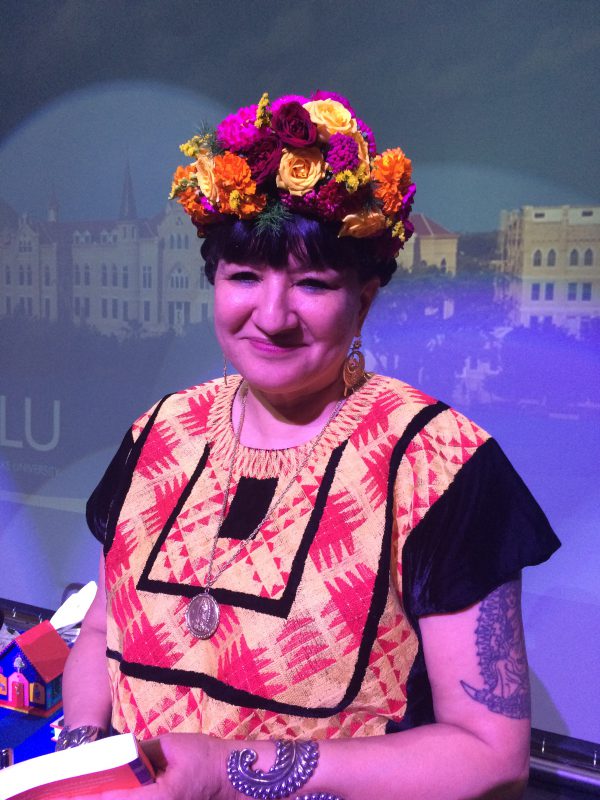
Sandra Cisneros was in San Antonio last week, back from The White House after receiving  the National Medal of Arts, to speak and read from her new book of essays, A House of My Own.  As always, she was warm, funny, articulate, and very serious about her causes and concerns. Ever an advocate for women’s rights and Chicano culture, she is now engaged  in a cause célèbre against the phobias dividing our nation, especially what she calls Mexiphobia.

Her early bestseller, The House on Mango Street, (1984) has been translated into over 20 languages worldwide and is taught in almost every junior/high school in the country, even in college. Her stories of a girl in a Chicano neighborhood allow youngsters to see themselves and to identify with their culture, but the book has remained popular and relevant for more than 30 years because it deals with larger issues facing people everywhere, in every culture: race, class, gender, power, and poverty. When I met Cisneros the other night, I told her I had taught her work and had found it infinitely “teachable” on several levels. She gave me a big hug and said, “Thank you for your service to our young people.” I came away teary-eyed.

Like so many Americans whose ancestors immigrated here (or were indigenous) generations ago, I don’t especially identify with my English, Irish, German, French, Swedish, or Cherokee roots. Other than the fact that I speak English and am blond-haired and blue-eyed, I wouldn’t be readily placed in any one of these groups — except when I’m in Sweden, where almost everybody looks like me.

No, I am simply an American, with all the mixed ancestry and assimilated tastes that implies. My cultural identity is not formed by my family’s ethnic roots, but by the milieus in which I have lived and worked.  As the famous line from “Ulysses” states, “I am a part of all that I have met.” Indeed, how could it be otherwise in a land that is as vast and as diverse as America?

Having grown up in Southwest Texas, I describe my cultural background as Tex-Mex. We lived with my grandmother in an old farmhouse with a big wrap-around porch that stood on the last couple remaining acres of what had once been her family’s sizable ranch. It was in the oldest section of town known  as “Dutch Lane,” not because any Dutch ever lived there, but because the Germans who settled that area in the 1840s were referred to (erroneously) as Dutchmen. My mother was raised in that house and our family had been on the land for five generations.

Many of our neighbors were the descendants of people who had worked that ranch, mostly Mexicans who had lived there forever or who, over time, had left and then returned to establish new homes and businesses.  Needless to say, everyone knew us and we knew them. My grandmother spoke fluent Spanish, as well as German,  and  I was accustomed to hearing her engage in conversations with passers-by. Thus, I picked up the sounds, the rhythms, and the common vocabulary of Spanish. On warm summer nights, música norteña  floated through the air; on Saturday mornings, I was sent down the street to buy freshly-made corn tortillas.  We never ate wienerschnitzel or sauerbraten at my house, but we had enchiladas or tamales several times a week!

Hand-tooled leather, hammered silver, wrought-iron gates, tin ceilings, papel picados, cascarones,  pequeño peppers, cumbia dancing, tres leches cakes, La Semana Sancta, lace mantillas (which I wore instead of a wedding veil) — these are the familiars of my background. The sights, the sounds, the colors, the tastes, the duende of who I am are largely Mexican in origin, though I am not, in fact, of Mexican descent.

Now before somebody gets all “cultural appropriation” on me, let me suggest that the notion of America as a melting pot presumes that centuries of immigration will, if successful, produce a blended family of citizens who hold basic principles in common, while preserving and sharing the best of their own heritage and traditions with each other. That we are no longer a homogeneous society in terms of national origins seems,  to me, a positive sign that our grand experiment in democracy is  working — sometimes overtime, but working nonetheless. The key to success is remembering the “we.”

Sandra Cisneros has taken to wearing huipiles as a statement of her pride and identity as a Mexican American of las Americas, North and South; ironically, she has moved from San Antonio to an American ex-pat community in Mexico. And I find myself back in South Texas after decades in the Northeast, where I formed new tastes, new attitudes, and new traditions that now have to be reincorporated into my current Tex-Mex life.  If that’s appropriation, then so be it; I call it being American.
comments 2

Party Time

October is birthday month: my own, my son’s, even my dog’s. We’ve always made much of birthdays in our family. From the time I was four or five, I had these elaborate, themed birthday parties. My mother went all out. One year, after a summer trip to Disneyland, we recreated the Magic Kingdom in our house: the living room was Main Street, where Mickey and Minnie welcomed everyone with old-fashioned penny candy and arcade games; the dining room was Fantasyland, entered through a cardboard castle erected between double French doors; and the back porch was Adventureland, complete with a jungle boat on a “river” of menacing stuffed animals. Another year it was a Davy Crockett party, with the house decorated to look like the woods of Tennessee and coonskin caps given as favors. Halloween, a perennial favorite of  mine, was an oft-repeated theme, with guests asked to come in costume and our dark, bedroom hallway transformed into a spooky netherworld.

In my small hometown, those birthday parties became one of the social events of the season for both the kids and their mothers, who generally came along not really to chaperone, but to eat and laugh and marvel at the energy of it all. Over the years, I enjoyed the preparations for those parties almost as much as the parties themselves, which probably explains why, as an adult, I still go all out in my own home with themes and decorations for every season and every occasion.

Somehow, though, I don’t anticipate my own birthdays with quite the same enthusiasm as I once did; rather, now the approach of another birthday engenders a “New Year’s Eve” reaction of countdown and contemplation. Not only is it October, but it is also the autumn of my life. A sobering thought, not exactly conducive to a party attitude — unless you look forward to a good Irish wake. No matter how great you look or how well you feel, you still have to own your years, and you still have to accept that you only have a finite number of them left. Time is not on your side.

In an essay about aging, writer Dominique Browning says that while growing older can be terrible, there is also something liberating about being “an older woman.” (The New York Times, “First Person,” 8/9/15) At age 60, having shed old insecurities and shrugged off petty annoyances, she now lives by the mantra, “I’m too old for this.” Browning can spot trouble coming and simply walks away, saving herself a lot of aggravation.

I’ve come to a similar realization, though not because of a landmark birthday. For me, the retirement from a fast-paced life of paid work has made me realize how easy it is to fritter away time on inconsequential matters, especially when your life is less structured. And others are more than willing to help you do that: long waits for scheduled appointments, unproductive meetings in clubs and organizations, endless rehashing of old conversations,   routine chores performed out of habit rather than necessity — all gobble up the minutes, the hours, and the days if you let them.

As the old saying goes, if you want something done, ask a busy person; yes, I was always busy, and yes, somebody was always asking for something. I am proud to say that I have done work that matters my whole life, work that made a difference, but winter’s coming now and I still feel I have more work to do. Ironically, though I’m officially retired, I have even less time to waste; I finally have to learn to say no.

I’ve been practicing. I’ve been looking in the mirror, pursing my lips, putting my tongue to the back of my upper teeth and sounding out, “Noooo, noooo.” I think I’m getting the hang of it and, in the process, have found a mantra of my own: “I don’t have time for that.”

But I could probably make time for a big birthday party, if you’d care to throw me one. A Halloween theme would be nice.

comment 0

my first post

September 22, 2016

Today is the first day of fall. The first day of my favorite season. The first day of the rest of my life.

Firsts are exciting. Most of the firsts in my life have occurred in the fall, starting with my first day of school at age five. I was recently thinking about the new dress I wore that day, a dress that my mother had made with a white top and a blue skirt on which she had hand-embroidered a spool of thread and a scissors (what a portend for my future). I asked her if she remembered it, and she said, “Oh yes, and I still have it. Would you like to see it?” Sure enough, the next time I went to her house, there was that little cotton dress, wrinkled and faded, but still intact.

Whether a student or a teacher, I always eagerly anticipated the first day of the new school year. As the only child of a widowed mother in a small Texas town, I couldn’t wait for school to start. It was so exciting to shop for new supplies — those fresh, pointy crayons in the box, those shiny plastic rulers and protractors and pencils with clean pink erasers, and later for those cool ring binders on top of which you’d casually carry a textbook or two.

And the books! So exciting, even in elementary school, to look through the new books issued on the first day and to realize that by the end of the year I would know all that! All those great stories, all that information, all the people and places just waiting to be explored — there lay a whole world beyond my small-town life, and I could hardly wait to go out and actually meet it.

School was everything to me; I loved it and I was good at it. There I found my identity and my friends, my talents and my opportunities. I found a frame of reference for the larger world, and then a college scholarship that would launch me into it. Years later, newly-married and driving into Connecticut fromNew York for the first time, I almost ran us off the road when I saw the Merritt Parkway sign. “Look,” I screamed, hitting the brakes. “It’s the Merritt Parkway!” My husband, a New Yorker, was non-plussed, but I had read the poem “Merritt Parkway” by Denise Levertov in high school, and now here it was. I had been here before.

This kind of familiar recognition has happened to me all my life, all over the world, and still happens frequently. It’s thrilling. I stand on Fitzgerald’s “bright prayer rug of a beach” in Antibes or meet Ramses II in the sanctuary of Abu Simbel; I hear echoes of Updike’s couples at a Fairfield County dinner party or overhear Capote’s snide remarks at the next table at La Cote Basque (now closed); I stand where Socrates taught at the Acropolis or look across to the Promised Land with Moses from the top of Mount Nebo. My foreknowledge of the people, places and ideas that I have encountered in life has made me unafraid to venture out, and I am forever indebted to the books and authors and teachers, and yes, even to my own students, who have helped me live a life of learning without fear.

So of course I became a teacher and a writer and then a professor. I continued to structure my life around the school calendar, and I did this over a period of 35 years in New York and Connecticut, where I spent more hours commuting on that Merritt Parkway than I can even begin to count. Just for the record, it has only four lanes, not six as the poem says, but the Merritt does have the most spectacular scenery, especially in the fall. As the road climbs and winds and passes over Coastal bridges and threads under Art Deco overpasses, the blinding foliage of a brilliant fall and the sunlight flashing strobe-like through the trees makes you glad to be alive and glad to be experiencing this glorious landscape first hand — even if you are stuck in traffic.

Unfortunately, I don’t live in the Northeast anymore, but at least I know what a real fall is. And it is still my favorite season even if I have to decorate from Michael’s, spray paint my backyard orange and yellow, and push the AC down to 65 degrees. I no longer teach and so no longer live my life according to the school calendar either, but I do still get that feeling of rejuvenation and a fresh start every autumn, that feeling of “firsts.” Often I take a class or begin a new project.

This year I’m writing the first post on my new website. I hope you will come along as I continue to learn and grow, to experience and create. Maybe we’ll become friends. Welcome.