comments 2

Easter Flower Pickin’

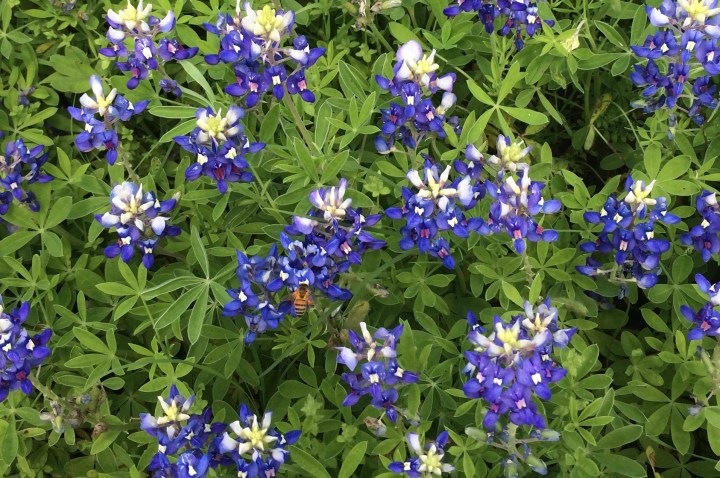
Texas may be known for many wild things, but the best, by far, are its wildflowers. Every spring from early March through April, highways and hillsides in Central Texas and the Hill Country are blanketed in blue and pink. More than just the official state flower, the Texas Bluebonnet (Lupinus texensis) has become THE iconic symbol of Texas, reproduced on t-shirts and souvenirs, notecards and dinner plates, and painted, photographed, woven and stitched by everyone from professional artists to school children. A maroon hybrid called Alamo Fire (Lupinus texenis—Fabaccae) was even developed for cultivation by the Texas A&M AgriLife Extension Service in the University’s school color! (Available from www.wildseedfarms.com ) That just shows how far those Aggies will go for all things Texas!

These days, traditional bluebonnet seeds are sold in nurseries all over the country, though I can tell you from frustrating experience that they rarely grow. That’s probably because indigenous wildflowers need most what home gardeners don’t provide: native soil, some neglect and a drought. Lady Bird Johnson understood the advantage of local conditions when she encouraged President Johnson to get the Highway Beautification Act* passed in 1965. Today, over 50 years later, the explosion of color all along Texas highways owes its profusion to what is unofficially called “Lady Bird’s Bill,” and to the 30,000 pounds of native wildflower seeds sown by the Texas Highway Department each year.

Bluebonnets may be the star of the show here, but certain other varieties have strong supporting roles: my favorite, the Indian paintbrush or Indian pink (Castilleja indivisa) is similar in size and shape to the bluebonnet, but is a strong pinkish orange. Often the two flowers grow together creating broad swaths of vibrant pink and blue in the landscape. Then there is the delicate pink primrose known as buttercup (Oenothera speciosa), which only blooms for a day; the joyful Indian blanket commonly known as firewheel (Gaillardia pulchella), with its starburst of red, orange and yellow; the happy little coneflower or Mexican hat (Ratibida columnifera), with its high crown and broad red-and-yellow brim that resembles a sombrero; and the beautiful, fluttering white Prickly poppy (Argemone Mexicana), which you dare not touch, and which the cattle will avoid even in a drought!

Such floral abundance has always provided ready Easter decorations in Texas. When I was a little girl, Easter preparations began in earnest when Lent was over on Holy Saturday. First, we dyed Easter eggs, always in solid colors and always too many. Then we would head down to Coleto Creek way out in the country toward Fannin to go “Easter flower pickin’.” We carried small buckets, bottles of water, and scissors for clipping, and my Mother would find a spot to park off the side of a little dirt road near the creek. Treading carefully and watching for snakes, we sought  patches of profusion, where we were sure a bucket or two of flowers wouldn’t be missed and wouldn’t impede the proliferation of seeds for next year. Sometimes we’d have to move the car once or twice to get just the right mix. My grandmother, already elderly even when I was small, usually stayed in the car, managed the buckets and water, and complained about the heat.

Back at home, we’d lay out newspapers over the kitchen table where we cut and trimmed all the flowers and got rid of all the bugs. The blooms were sorted by type and condition; the longest, prettiest ones got arranged into one of my Mother’s prized milk glass vases. The smaller, shorter blossoms got woven in with long grasses, which I gathered from the vacant lot next door, and shaped into round Easter nests in front of the fireplace. By the end of the day, spring had come to our house. All we had to do was wait for the Easter bunny.

Interesting how childhood traditions endure and adapt. When I was a newlywed, my Holy Saturday Easter flower pickin’ meant picking out plants and flowers to bring home from a local flower shop, since there were few wildflower-coated hillsides in New York City. Pink and yellow tulips replaced bluebonnets and Indian paintbrush on the dinner table, and a tall, white potted Easter lily had pride of place in the living room. Later, after our son was born and we were living out in the suburbs, Easter flower pickin’ meant cutting some of our own home-grown tulips and daffodils, supplemented with an Easter-flower family field trip to one of the large local nurseries nearby. We still dyed eggs on Holy Saturday and built Easter nests, but with faux grass (less messy).

Now living in Texas again, I eagerly welcome the explosion of wildflowers in the spring and can actually pick bluebonnets myself on my morning walks down a little side road where I live. Easter is somewhat late this year, and the wildflowers have pretty much peaked, but I still have one last cluster of bluebonnets on my kitchen table. I will have to purchase assorted flowers for Easter arrangements, but come Holy Saturday, I will again dye eggs, make a nest for the chocolate bunnies, and begin to prepare our traditional Easter dinner of baked ham and scalloped potatoes. I won’t have to wait for the Easter bunny however, not because I am too old, but because I am the Easter Bunny.

HIP – HOP.

*Note: in the interest of  “factual” information, the Highway Beautification Act was formed to control billboards, advertising and roadside junkyards, as well as to implement native landscaping along highways in all 50 states. Lady Bird Johnson, herself a native of East Texas, was passionate about preserving natural landscapes and cultivating native plants and flowers. In 1982, she and actress Helen Hayes established the Lady Bird Johnson Wildflower Center at the University of Texas, Austin, a 284 acre native plant botanic garden and resource center for conservation and education. www.wildflower.org
comments 2

Something New

Sustained concentration takes a lot out of you, especially when your project gets derailed at the end. (See “Goal Digger, 3/1/17)  Buoyed by the promise of a rescheduled museum exhibition  in the near future, I have now hung “Busted” in my studio in my own one-woman show. It  inspires me to start on something new — as soon as I figure out what that will be.

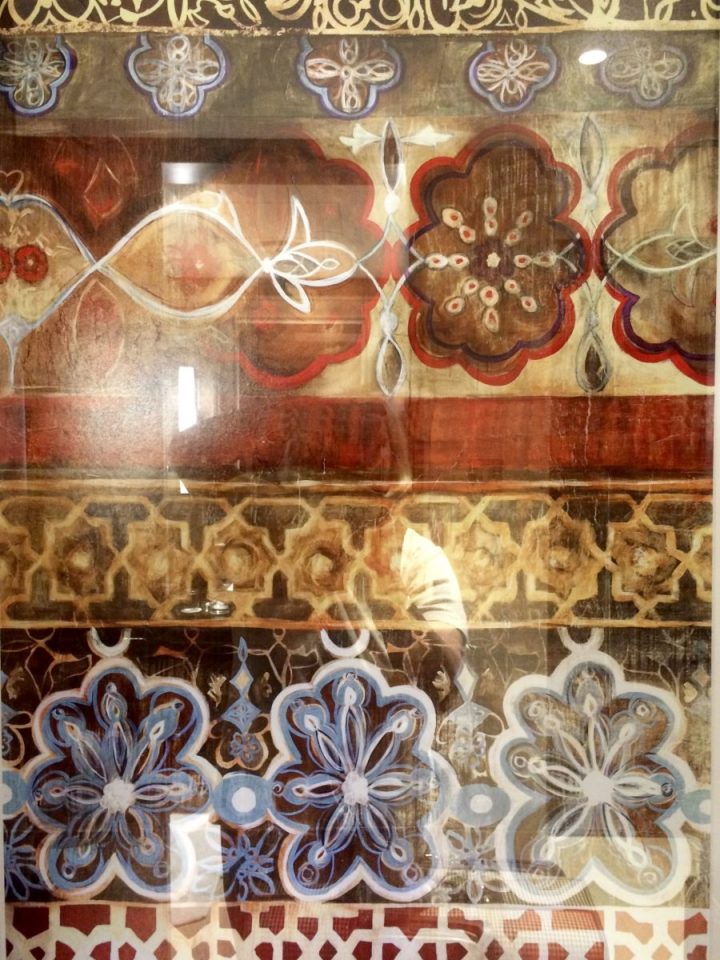
I have several possibilities. Before I got consumed with this museum competition, I had begun yet another small piece in my Istanbul series: a whirling dervish done in rich fabrics with lots of movement. I have been collecting beautiful, distinctive fabrics, (and hauling them in my luggage) ever since my first trip to the Middle East a few years ago. In Egypt I not only learned about the many, many variations of thread count and finish and weave of those famous Egyptian cottons (from a generous and knowledgeable shirtmaker in Luxor), but I also became captivated by the intricate geometrics and artful appliqué of the Tentmakers of Cairo. They, in fact, inspired me to move beyond traditional block quilting into art quilts and appliqué myself, for which I then began to cultivate a more diverse stash of materials.

What quilter doesn’t collect fabric?  For me, this has become one of the great joys of travel, as well as an immediate way to relive memories. Just looking at the fabrics, admiring their designs and feeling their textures reminds me of where I bought them — in a souk in Turkey, on the roadside in Africa, or in a modern shopping mall in Dubai.  I have silks from China, tapestries from Spain, and laces from Greece; I have material that is hand-painted, hand-dyed, hand-embroidered, even hand-woven! Honestly, I have enough fabrics now to last me a lifetime — but of course, I will buy more, even at my local quilt shop.

If I don’t return to my dervish, I might tackle one of the other ideas that have been floating around in my head. I haven’t designed any one of them yet, but I have begun to accumulate fabrics, embellishments and found objects that might be suitable. It’s the old chicken-or-the-egg dilemma: which comes first, the design or the materials? To be sure, beautiful fabrics can be inspirations in themselves, but we need to design with them in mind rather than rushing out to buy something new for every new idea. I recently took a course from a well-known quilt artist and her first rule for our class project was to “Use what you have!”  It’s a good lesson, but still a challenge, no matter how big of a stash you have — and I’m not just talking about fabric.

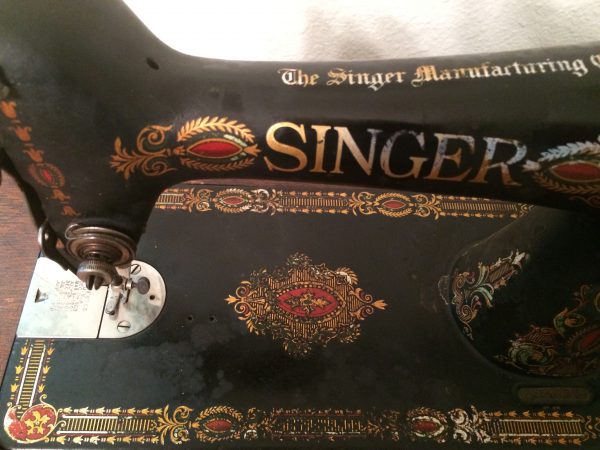
Anyway, after “Busted,” my first order of business was to clean up my studio so I could find what I have. It’s always a good idea to clear the worktable before embarking on a new project, especially when that worktable, and the counters and the cabinets and the couch and the floor and even the ironing board are all littered and cluttered, scattered and piled. I became a whirling dervish with a feather duster; I even took my sewing machine apart and removed all those fuzzy balls under the needle plate. And as I whirled, the ideas swirled around me. I could hardly wait to get started on “something new.”

That was a week ago.

Anyone who has ever worked at home is familiar with the way distractions can derail a good idea. You start off the day with your usual routines — exercise, breakfast, a quick check of your e-mail — but then: Turbo Tax wants me to get started on my taxes, my insurance company has begun processing my surgical bills, a friend sends hotel choices for a trip we’re planning … I take care of these little things, and then remember to take the meat out to thaw for dinner, and then double check that casserole recipe while I’m at it. Since I’m in the kitchen, I rinse out the coffee pot and load the breakfast dishes into the dishwasher. On my way to my studio, I pop in a load of laundry, because it’s Monday and Monday is laundry day.

By the time I get into my sewing room, start flipping through my idea notebook and digging out some of those beautiful fabrics, I am already preoccupied with other things in my day and overwhelmed by the creative possibilities I have laid out before me. Too many ideas can also be a distraction. Besides, it’s almost lunchtime. I decide to have a yogurt, take a nap, and start again refreshed in the afternoon. But of course, the afternoon dribbles away too. Before I know it, a whole week is gone and I have nothing but a tidy house and balanced meals to show for it.

As a writer, I have always rehearsed my pieces in my heard before committing words to paper, so I have perfected the ability “to write” while performing mundane activities such as cooking and cleaning and doing laundry. I’ve even dictated stories while commuting. But you can’t really do that when pursuing a tactile art. Sure, you can roll ideas around in your head, but at some point, there has to be hands-on, focused attention to sketching, tracing, piecing, sewing. No matter how adept you are at mental visualization, that vision has to become a real thing. You simply cannot paint or sculpt, or sew, while you are also doing something else.

So today I am headed into my studio to get started on “something new.”  As soon as I get this posted.

Filed under: art
comment 0

A Goal Digger

I really hate winter; January and February are blah no matter where you live, and March isn’t much better. Here in South Texas, weather varies, wildly, from 85 degrees to 19 degrees, with tornadoes and wind and rain and sleet in between, sometimes all in the space of a day or two.  November has Thanksgiving and December has Christmas, but February has only Mardi Gras for lively diversion (though you really ought to be in New Orleans to enjoy it).

The winter blahs were a big reason I went on and had the knee surgery in January (so I can tango in Buenos Aires, remember? 1/19/17) I figured that six-to-twelve weeks of recovery at this time of year is no great inconvenience. Plus which, I had this March 1 deadline for an art quilt submission to a museum exhibition — quite a gutsy undertaking on my part, given that I have never presumed my art quilts to be museum worthy, even if I have won some ribbons in quilt shows along the way.

Actually, the nature of art, and the creative focus of the artist have been much on my mind for several months, especially since I joined the SAQA (Studio Art Quilt Associates) and decided to move beyond hobby and craft. The quiet concentration, the attention to detail, and the resistance to distraction that creation demands do not come naturally to a type A, goal-oriented  person like me. Type A’s are rarely into process; rather, we are more about getting it done, getting it accomplished, and moving on to the next goal.

In a way, that attitude is endemic to our entire culture. We all want fast, easy, done: quick-and- easy recipes for the holidays, quick-and-easy ways to lose weight… quick-and-easy quilts to make as gifts. Nobody has time for intricacy and contemplation; nobody has time to smell the roses. And I was like that too, until I retired and suddenly realized that I had met all my major goals in life, both professionally and personally.  With the experiences of a lifetime behind me and the time I have left ahead, what would I do now? For a type A “goal digger” like me, that is a dismaying question, because it means finding new goals and redefining the self in light of them.

I returned to where I had always been: in the arts. This time, though, I would study and practice and learn, not to earn degrees or secure a job, but to concentrate on the process involved in creation and the development of my own unique artistic abilities. I took a wide variety of classes and workshops, began to write regularly and publish again, and set up this website. And I started a big, ever-growing inspiration folder in which I collect all sorts of oddities and ideas that “speak to me” for exploration somehow, sometime in the future.

All of which brings me back to this winter and this museum exhibit. Several months ago, I had come across an old photograph of abandoned oil derricks in Kilgore, Texas, taken in 1970 by an EPA photographer. I found it intriguing because the picture embodied a story rooted in the boom-or-bust nature of the Texas oil industry. More than just a static depiction of the busted half of the equation, however, this photo shows the abandoned rigs to have been on a farm, presumably once a working, productive, happy place — especially with the promise of an oil fortune in the back yard. And now it was all dead, defunct. There is a whole narrative implicit here, which makes for great art. Thus, when I came across the call for submissions to an exhibition called “Wild West: A Salute to the American Frontier,” I knew I had the perfect inspiration.

I was well aware that this would be a real creative challenge for me, both in terms of my skills as a quilter and my self-confidence as an “artist,” but it was time to push myself and risk the rejection, just as I had so many years ago when I was starting out as a freelance writer.  Furthermore, I also knew that I was facing knee surgery and a couple months of recuperation, so I had a forced block of time to devote to such a challenge. After all, nothing overrides feelings of pain and discomfort like a concentrated focus on something else that’s important.

“Busted” (see the Gallery) took about three months of steady work start to finish, from initial sketches and pattern making to the final binding. I did the large-scale preliminary work, which involved a great deal of standing, ironing, and getting up and down, before the surgery, and then afterwards, with limited mobility, I was able to sit for most of the sewing, appliquéing, quilting and hand finishing. Toward the end, though, the March 1 submission deadline weighed heavily  and I had to put in some long days to complete the piece in time to get it professionally photographed. (That’s what happens when a “goal digger” deemphasizes the goal and concentrates on the process.)

Nevertheless, I actually beat the deadline by a couple days. Feeling pleased with my work and proud of myself for overcoming the creative challenges I had encountered,  I went on line to the museum’s website to submit my entry application. And there I read, “Wild West: Exhibit Postponed.” They had moved the goal post on me!!!

I reacted as only a true “goal digger” would: I screamed and cried and went to bed — and dreamt of a one-woman show.

Filed under: art
comment 1

A Gift of Words

Instead of giving candy or flowers this Valentine’s Day (so clichéd and old-fashioned ), why not give a gift on the cutting edge of a new trend: a dictionary!

Yep. You read that right (ly).  For decades, English teachers have been bemoaning signs of eroding literacy: the fact that nobody read anymore, nobody wrote letters, nobody subscribed to newspapers or magazines, and nobody who spoke knew how to do so correctly. But now, suddenly, amid all the confusion and debate and hoopla over what is factual and what is not, what is implied and what is not, what is real and what is not, people yearn for something, someone they can count on to provide answers. Thus, they have rediscovered the dictionary, and are actually building their vocabularies and thinking about the meaning of words. Now who says Trump isn’t going to make America great again?

According to an article in The New York Times (February 12, 2017), the use of dictionaries, both in print and on apps/websites, has surged tremendously as people try to make sense of words and phrases currently in the news. Recently, for example, the incident in the Senate with Elizabeth Warren prompted a huge flood on the Merriam-Webster website for the word “impugn.” Nor is it only words IN the news that prompt people to run to the dictionary. Words ABOUT words in the news are educating a whole new generation in such literary terms as hyperbole, satire, oxymoron, allusion, overstatement and, of course, plagiarism. Even words clarifying HOW words are being used are helping people expand their vocabularies; on February 6, for example, dictionary.com’s word of the day was “paralogize.”

At a time when judges are suspected of bias and even the Bible is subject to widely differing interpretations, lexicography, the practice of compiling dictionaries, appears to be the last remaining bastion of impartial information gathering. Typically, editors study the origins of words and the way they are being used to determine meaning. Even when referencing social media to explore contemporary usage, the aim of lexicography is to clearly describe, rather than to dictate or evaluate, usage and meaning.

In an era of “post-truth,” “fake news” and “alternative facts,” a good vocabulary is a powerful tool, a way to get beyond propaganda and to at least identify what the issues are. Furthermore, for a generation who prefers to communicate within the confines of 140 characters, a precise vocabulary is the only real hope to convey any kind of meaningful expression. Otherwise, all is just noise, chaos and confusion, which leads to …heaven help us … just more talking heads on TV trying to dissect it all.

Words matter. “Say what you mean, and mean what you say,” I was told early on in my own journalism education. It’s a good motto for life, in general, I think, because words shape thought and thought shapes character. So give the gift of words this Valentine’s Day, beautiful words, words of kindness, encouragement, and love. Better yet, write a love letter that eschews sentimentality and truly expresses what is in your heart. Whether the recipient is a friend or family member, a lover or a spouse, sincere words from someone who cares is the only truth that really matters.

And who knows? If enough of us start writing letters regularly, we might just find ourselves on the cutting-edge of yet another trend in gift giving: grammar books!

Happy Valentine’s Day.

comments 2

Squirrels Don’t Dance

A friend of mine recently sent me this quotation: “The road of life is littered with the bodies of flattened squirrels.” Exactly. When something is wrong, fix it; if it can’t be fixed, then replace it, or learn how to make do. Whether it’s a car, a job, or a relationship, don’t dither around. Make a decision already!

It’s amazing how many people are so indecisive. You see it in traffic, when a driver can’t just pick a lane and stay in it; you see it in stores, when shoppers keep moving from one check-out line to the next; you experience it with friends — or worse, business associates— who can’t make up their minds about what to do next. They talk and talk and talk about a problem or an issue, but somehow they never resolve it. Or, they finally make a labored decision and then spend weeks, months, years second-guessing it, even where there is no possibility of a do-over! It’s frustrating, especially if you’re affected by the outcome. Who has time for all this?

Everyone faces decisions in life, some more important than others of course, but I have noticed that people address them differently at different stages. For example, when I was younger, I thought I had all the time in the world to analyze a problem, explore possible solutions, and put together a plan A, and even a B. I might let something slide for a while — a broken appliance, say, or a less-than-perfect job situation — not because I couldn’t decide what to do, but because the money or the opportunity, or even the urgency just  wasn’t there.

Not anymore. I’m retired now and I have all the money and the opportunity I’m ever going to get, along with the urgency of the years.  I know I don’t have all the time in the world, and I certainly don’t have time to waste on indecision, inconvenience or petty diversions that slow me down. I don’t even have time for do-overs. I have too many new things to do!

One of them being to learn the tango in Buenos Aires — which is why I’ve decided to have arthroscopic knee surgery. I don’t have time to hobble around with a torn meniscus, and I certainly don’t have time for the pain. I had my other knee totally replaced ten years ago, after putting it off and suffering with it for years, because I was too young for a replacement, because I couldn’t take the time off from work, because I wanted to exhaust all other remedies, blah… blah…blah…Because I was afraid of the surgery.  And I’m afraid now, too, even though this is a minimally-invasive day procedure, “a piece of cake,” according to my surgeon. But decisions made out of fear, or by default because of hesitation like the squirrel in the road, are never good ones.

So, I’m getting on with it lest a painful knee and a lack of mobility limit my choices and waste my time.  After all, I have to be ready to dance!

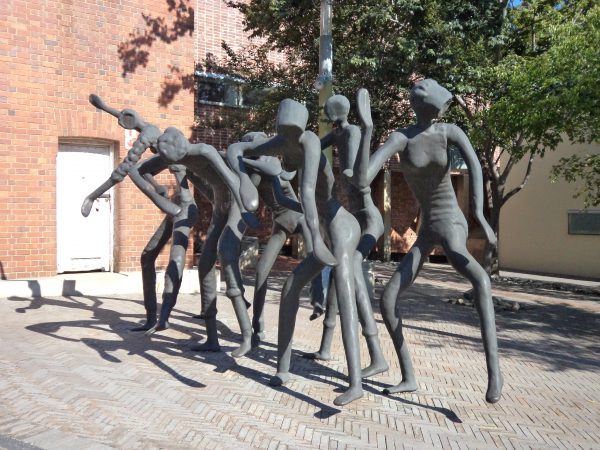
Note on photo above: “Moving Into Dance,” Constitution Square, Johannesburg, SA


comment 0

Resolutions

I am a writer, so I write. Everything. I make lists, jot notes, keep a journal; I pen letters, copy directions, record major events. And yes, I write down New Year’s Resolutions, every year. And then, at the end of every year, I go back and review and see how I did. This year I did pretty well; I actually accomplished almost all of them.

There is something about writing things down, speaking them out loud, putting thoughts into words that makes them real and ingrains them into the subconscious. I have noticed, in more years than one, how prescient I’ve been in anticipating the challenges of the year to come and in formulating goals to meet them. And I have, in fact, often met those goals. Self-help gurus tell us to visualize success; a writer would suggest putting success into words.

In all the years I taught public speaking and English, I always used the example of the “we have to talk” preface with my students to help them understand the power of verbal expression. You know how it is: when you feel a relationship is going south (whatever that relationship is) and the anxieties and resentments nag at you, it is only when you finally vocalize the the problem, “talk about it,” that the situation becomes real and the issues can be examined and resolved — for better or worse. Young people especially relate to this, but so do those in troubled marriages or difficult work situations. People don’t read each other’s minds; you have to say something.

So, if expression concretizes  feelings and ambitions, then writing resolutions is a good thing, as is writing angry letters you don’t send, or writing memories of the past to pass on, or writing though problems to try to solve them, or writing down moments to cherish and remember.  Writing. It is a lost art in our 140 character twitter world. Too bad. People don’t seem to have the time or the attention span that contemplation demands, much less  the language skills that written expression requires to be effective. Sound bites and slogans may sell a product, or even a person, but they don’t create meaningful discourse.

According to some, one way to ensure successful New Year’s Resolutions is to “resolve small.”  In other words, scale back: don’t resolve to lose 50 lbs., but try for 10 or 20; don’t aim to pay off all credit cards, but endeavor to reduce debt by half and incur less going forward. You get the idea. As we get older (as I am afraid I am), we gain a broader perspective about New Years and resolutions in general. We realize that it is the awareness of our intentions that matter, not so much the tally of success or or failure.

In spite of the ways people have tried to rationalize all the angry, hateful words of the recent presidential campaign, and regardless of the apparent lack of collective concern about our  being in a “post truth” world, words DO matter. Once a thought or feeling has been expressed, you can’t really take the words back; they are there, forever, even if you apologize. They might be forgiven, but they probably won’t be forgotten.

In the end, you are only as good as your word, and the words are all we have — or all we have left. They continue to speak long after we are gone, to impart wisdom and insight, fact and folly, through the books, articles, letters, transcripts, plays and recordings in which they reside.

If only we resolve to listen …

comment 0

Mi Tierra

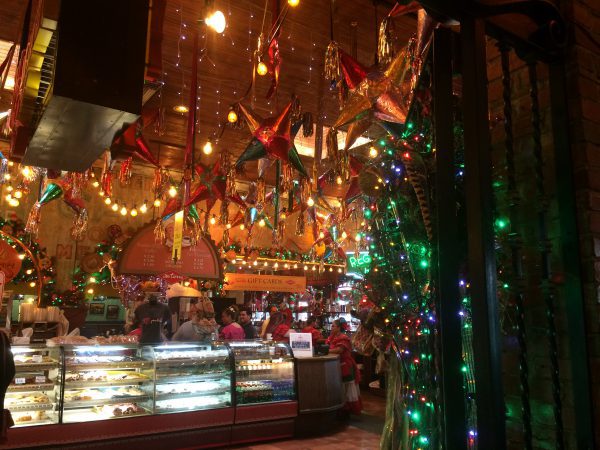
Mi Tierra is a San Antonio institution. What began in 1941 as a little three-table cafe for farmers and early-morning workers in the downtown market district has now expanded into a landmark restaurant that occupies an entire city block; it seats 500 people, is open 24 hours a day, and is one of four eateries owned by the Cortez family, now in its third generation. Tour busses clog the parking lot and waiting patrons spill out the door onto Market Square. The atmosphere is Christmas Fiesta all year long (photo above), the waitstaff  is bi-lingual and also multi-generational, and the food is the same as it was fifty years ago when I was an undergrad in San Antonio and my college friends and I used to go there for affordable, comforting Tex-Mex.

Besides the food and the atmosphere, though, a big draw these days, especially for tourists, artists, and history buffs, is the floor-to-ceiling mural that covers the back room walls. Called The American Dream, it was originally commissioned by Jorge Cortez to honor his parents, the founders of Mi Tierra Café. It celebrates the hard work and dedication of the family and staff who made their dreams for a better life come true — hence, the name. Over time, the mural has also  expanded to include key figures in Hispanic history and culture, and even contemporary celebrities with San Antonio ties such as Eva Longoria, Carlos Santana, and of course, the Castro brothers. Well-known muralist Roberto Ytuarte is the artist in residence who keeps The American Dream updated and restored.  When he’s around, he is more than happy to talk about the history behind his portraits and to discuss his techniques in detail, as he was last year with my grand-niece who is, herself, quite an emerging artist — at the ripe old age of 8!

Mi Tierra, “my land;” El Sueño Americano, “the American Dream.” Cultures, languages and contributions may differ, but the story has been the same for wave after wave of immigrants, for my people and yours, for well over two hundred years. Even those who came on the Mayflower came in search of a better life. From Europe, Asia, Africa, Australia and all the Americas people have come to the United States, because their dreams of freedom and opportunity were compelling and their chances of making it here were as good as the next person’s. People risked their very lives to come, and they still do. What greater testament to our greatness, our democracy, and our way of life than that?

America doesn’t need to be made great again, it already IS great. Anyone who has spent even a modicum of time outside of the US, especially in some of the more remote parts of the world, knows that. Having been to more than 30 countries myself, including many in Africa, Asia, and the Middle East, I know first-hand how much people admire America and covet the freedoms we enjoy. And for the most part, they even like us!

Our technology, our economy, our medicine, our military, our universities, our standard of living — all are the envy of the world. We may be teased about being flag-waving workaholics, but even Europeans admit that in building our democracy, Americans undertook the grandest, greatest governance experiment in human history. We’ve had some rocky periods here and there, but so far, it has worked.  In welcoming all and building one nation with people from every corner of the globe, we have created a diverse, multi-cultural society that truly defines who we are by who we all are together: the melting pot, the tossed salad, the modern mosaic, e pluribus unum. If we lose our will to form our one people from our many, we will lose our collective soul.

This is Mi Tierra: the ethnic foods, the cultural celebrations, the traditional dress and customs, the churches, synagogues, temples, mosques, and meeting houses, the foreign words coopted into English, the intermarriage, the multi-lingual children, the integrated neighborhoods, the noise, the nonsense, the misunderstandings. .. all of it, all of us. This is My Land and I’m proud of it.

My prayer for the year ahead is that this will continue to be the Mi Tierra that I know and love, and that I can continue to be proud of us. Feliz año nuevo!

comments 2

Silent Night

Four months into WWI, in early December of 1914, Pope Benedict XV called for a temporary Christmas cease-fire between the Germans and the British then fighting on the Western Front. The warring commanders refused, but late on Christmas Eve, the soldiers themselves created a spontaneous peace. With the no-man’s land between them only a few hundred feet wide, soldiers could see, hear, and even smell each other. So, when the Germans started singing Christmas carols, and then emerged unarmed calling out “Merry Christmas” from the trenches at dawn,  men from both sides came together. They exchanged small gifts, sang Silent Night, and according to some reports, even played a friendly game of soccer. “The Christmas Truce of 1914” was the only such example of chivalry in WWI, which ultimately became one of the deadliest conflicts in human history (38 million casualties, 18 million deaths).

Calls for cease-fires in wars since haven’t worked out too well, not even for humanitarian reasons, much less religious ones. For one thing, the nature of war itself has changed. Air strikes, bombs and drones have depersonalized combat, world-wide terrorism has decentralized the battlefield, and unfamiliar adversaries in unfamiliar places have dehumanized the enemy. So many wars — civil wars, gang wars, drug wars, tribal wars — there’s something for everybody almost everywhere, so that even ordinary people just trying to live their lives, civilians not soldiers, are forced to fight or flee.

That the story of “The Christmas Truce of 1914” endures is a testament to the power of hope; a hundred years later, though, it seems to be the hope of power rather than the power of hope that most often prevails. Witness Aleppo: the failed cease-fires, the thousands killed and displaced, and the thousands still stuck in a war-torn country. This Christmas of 2016 delivers not a truce, but “a complete meltdown of humanity,” according to one UN relief officer. The real tragedy of Aleppo is that after four long years, the world has grown weary of the conflict, and wary of the refugees it has created; the travesty of Aleppo is that we still have people, even people who aspire to positions of power, who have to ask what Aleppo is.

For those everywhere who have grown accustomed to the sounds of gunfire and the ravages of violence, a silent night is a fearful night, full of unholy threats. But for me and my family, who are fortunate enough to sit right here right now in front of our lovely Christmas tree, surrounded by comfort and safety and love, the silent night is a gift of grace, a song to be sung at midnight.

If the worst thing about Christmas is that it comes too soon, then the best thing about Christmas is that it comes at all — because in so many places in the world, it doesn’t. Let us be grateful, then, and let us pray that the calm and the bright will find the darkest corners of the earth.

comment 0

I’m Dreaming Of …

Here’s what’s wrong with Christmas: it comes too soon.

I know, I know, not for children, and not for those earnest holiday celebrators and decorators, those invested in commercial profits, and those for whom the holidays mean being transported to the nostalgic realm of Christmases past, whether those memories are real or not. But for the rest of us, cynics and otherwise, those of us without small children and without any illusions of former firesides and Hallmark family moments, Christmas comes too soon, with way too much stress and way too many expectations.

It starts, of course, with the retail establishment, which has Christmas decorations on display by Halloween and discounted by Thanksgiving. You begin to feel consumer pressure: What is your decorating theme this year? Are all your lights from last year in working order? Will you have enough paper plates, holiday napkins, candles, tinsel, wrapping paper, bows, ribbons, garlands …the worry grows. You have to order your turkey (or prime rib or leg of lamb), or make your holiday reservations in time. Once you’ve gotten your gift shopping done, the USPS urges getting your packages in the mail. Then there are the television and newspaper ads, building momentum for holiday events: Christmas Ranch, Festival of Lights, and other local celebrations. And let’s not forget the internet, with its assaulting sales pitch for holiday specials — and these from retail websites to which you don’t even subscribe! And over it all are the regular reruns of the classic holiday movies: Miracle on 34th Street, It’s a Wonderful Life, Holiday Inn, and the various incarnations of A Christmas Carol. Whew! How can you possibly avoid the pressure?

It’s too much.

Here in South Texas, where most people don’t get real trees and favor yard decorations by Walmart, if you don’t get out to the nursery early — like right after Thanksgiving — and get your real tree tagged, you lose. And so we did on December 1. We are now in the process of putting it up. It’s early; the tree, a beautiful Nordman fir of 9 feet, will be dead by Christmas, but no matter. We still cling to our “real tree” commitment and we still love the feel and smell of a real tree and the sight of a majestic fir decorated in tiny, hand-painted bronze lights (that’s yet another story, but let’s leave my own compulsions out of this). Our son has to help us get it loaded into his truck and get it inside our house, of course, and the time will come when we can no longer manage this great arbor undertaking, but we’re not quite there yet. (I shudder to imagine the guilt and regret when we have to resort to a fake tree.)

And that is my point: people undertake so many traditions and try to live up to so many expectations during the holidays that when they finally recognize that those standards are untenable,  and maybe even unreasonable to begin with, the seeds of depression and loneliness are sown. It is not surprising that more suicides and deaths occur during the holidays than in any other time of year. When your life doesn’t match media images, however unrealistic those images are, you are bound to feel somehow lacking, and sad.

The holidays in San Antonio begin on Thanksgiving night, with the lighting of the tree at the Alamo and the illuminations along the Riverwalk and the River Parade downtown. It is festive, but somehow also non-commercial, inclusive, contemplative, lovely in a distinctively San Antonio way. The “Saga” of Texas history projected on the face of the San Fernando Cathedral (photo above) illuminates the cultural context of our heritage all year round, not just at Christmas. In an odd way — yes, a nostalgic way — it all reminds me of Christmastime in New York, of the lighted angels with trumpets along Rockefeller Center Plaza, the live-animal nativity scene in the Radio City Christmas Show, and the tiny tree lights and holiday menus at Tavern on the Green. Even in a big city, you have to get beyond the noise, beyond the commerce, and beyond the stock images and clichéd greetings to the quiet, the calm, and the beauty of this time of year that we can all share, whether we’re Christian or not.

So I am going to ease into the season this year, and claim my bit of quiet contemplation. We don’t have any big plans, no big company, no big events planned, and I’m glad. I would be foolish to dream of a white Christmas here in this climate, but I can dream of  “…a long winter’s nap,”  and maybe a bit of enlightened rejuvenation to come for the New Year.

comment 0

Turkey Trotting

Thanksgiving is our most adaptable, most inclusive national holiday. It is celebrated by everyone who lives in America (whether they are descended from the Pilgrims or not), it has no particular religious or political connotations (beyond the debate over whether Native Americans really shared a meal with the first settlers), and it has not been totally coopted and commercialized by retail madness (unless you count the last-minute scramble at the supermarket). Beyond the common conventions of a day off, a big meal, and the Macy’s parade followed by football, people are free to adapt their celebrations, even their menus, to suit their own tastes and styles.

In the early days of my marriage when we lived in New York, we did the obligatory trek out to my in-laws. One year we missed the dinner entirely because we were sitting in traffic on the Long Island Expressway. After that, we moved across the country away from family and  Thanksgiving became a quiet dinner with friends.

By the time we moved back to Connecticut a few years later, the older relatives were ready to pass the drumstick, and so Turkey Day trotted out to our house because we could accommodate the crowd. Of course, everyone still had to have, and therefore bring, their traditional family favorites; after all, what does a a relocated Texas girl know from pickled herring, creamed onions, and mashed potatoes with turnips?

Apologies to those few remaining family members who might read this, but a couple years of that production — the three days of prep work, the iffy weather, the clean-up that took another three days — prompted us to search for a new tradition of our own. We decided that we would henceforth “go away” for Thanksgiving.

As it happened, we had good friends who had a vacation home on Cape Cod and spent most of their holidays there. “Why don’t you come up to the Cape and spend Thanksgiving with us?” they asked.  And since Plymouth, the historic site of that first Thanksgiving with the native Wampanoags in 1602, lies on the Northwestern corner of the Cape, and since the cranberry bogs of Cape Cod are world renowned, producing 67 percent of the total cranberry supply, what better place could there possibly be to celebrate Thanksgiving?

Now most people go to the Cape in the summer, as we had done once before. The Cape’s year-round population is about 200,000, but it swells by roughly 2.5 million “summer people” between Memorial Day and Labor Day.  Ah yes — this storied place in the American imagination, associated with the whalers of Nantucket, the moneyed rich of Martha’s Vineyard, and the Kennedys of Hyannis, becomes a nightmare of outrageous hotel rates, long lines at restaurants and attractions, and stand-still traffic along Route 6 from late May to early September. This is what we remembered from an August visit.

But as we discovered, the Cape in late fall is a totally different experience, magical and more beautiful in the equinox than in the summer shine. The light reflected from the Ocean, which artists have long admired, still shimmers and reflects the fading colors of fall, and the moody mist of the Atlantic floats over the seashore like a dream. You are free to enjoy it all, to walk the beaches in early morning, to dine by the fireplace in the country inns, to shop the quaint stores in Chatham or the galleries of Provincetown, because the big crowds are gone, the locals are friendlier, and the hotel rates are reduced. Cape Cod is the perfect Thanksgiving venue.

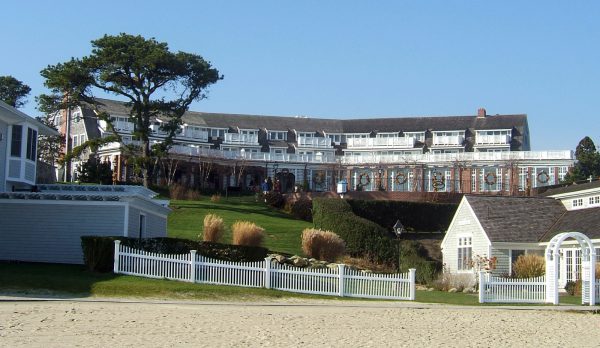
We stayed in several places there over the years, but our favorite was always The Chatham Bars Inn (photo above). Begun as a semi-private hunting lodge in 1914, it is today a much- expanded grand resort, but one that retains its New England character amid Chatham’s 18th century charm. You can still play croquet on the lawn here, or you can go fishing, hiking, biking, sailing, or whale watching. And you can have the most bounteous, elegant Thanksgiving dinner  in a sparkling formal dining room facing the Ocean, whether you are staying at the Inn or not.

Our first Thanksgiving at the Chatham Bars was in 1987, the very first season they began to remain open year round, and our very last Thanksgiving there was 20 years later, before we retired and relocated to Texas. To say that I’ve missed New England in the fall and Cape Cod at Thanksgiving is an understatement.

Somehow the annual Turkey Trot in nearby Cuero is hardly any consolation, even if they do claim to be the “turkey capitol of the world.” Come to think of it, though, I’ve missed that too, since it was held in October.