comment 0

When I Am Old

(Photo above of Leah Chase, philanthropist, chef and owner of the famous Dooky Chase Restaurant in New Orleans, joyfully cooking at age 95.)

      When I am an old woman I shall wear purple

      With a red hat which doesn’t go, and doesn’t suit me,

      And I shall spend my pension on brandy and summer gloves

     Thus begins a well-known poem named “Warning” (often titled with the opening line) by English poet Jenny Joseph (1932-2018). It was written when Joseph was just 28 years old, and  has often been reprinted and included in anthologies by and about women.  Ostensibly, its specific meaning is about a woman’s desire to shed society’s expectations and embrace a carefree life as she gets older, but the larger theme of women at any age rebelling against social conventions and pursuing their rights to individual self-expression has been an on-going issue for women over the decades. 

     I’ve been thinking a lot about age lately as our son approaches a “landmark” birthday, as the grim reaper claims more and more of my life-long friends and family members, as my husband and I wear ourselves out trying to manage and maintain our large home and garden, and as my priorities shift regarding how I want to spend my time. Am I getting old? When did it happen? How would I know?

     Old age isn’t what it used to be. Back in the early 20th century, people who were 50 or 60 considered themselves old, and they were old, probably because they had worked hard at labor-intensive jobs and enjoyed few of the comforts and conveniences that we now take for granted. But with today’s emphasis on health and fitness, people are generally more active and in better physical shape than they used to be. And then there are the cosmetic enhancements and nips-and-tucks of eternal youth so readily available. I don’t know about you, but I find it very difficult to assess someone else’s age by appearance alone; heck, sometimes when I look in the mirror I find it difficult to asses my own!

     In spite of all those retirees who are out sky diving or trekking as intrepid tourists through ancient ruins, the onset of older age has generally been marked by retirement age. Demographers call this category of 65-74 the “young old.” The “middle old” designation is 75-84, and then the “old old” (or over-the-hill crowd) is anyone beyond 85. But chronological age alone is not the only classifier that matters; today, 24% of Americans live to be 90 or older — 30% of women because we live longer. Take a look at 92 year old Joan Collins, who is 32 years older than her husband, and tell me if she is “over the hill!”

         Beyond the birthdays, demographers point to functional age as a more realistic indication of how old a person really is. Qualities such as fitness, vitality, cognition, and overall health affect not only the lifestyle one can continue to enjoy, but also how one feels about that life. We have all known people who are “old” in attitude and behavior way before their time, people who give up, opt out and drown themselves in a pool of pity over whatever ailments and limitations befall them; hopefully, though, we have also known those who continue to live life with joyful exuberance in spite of the their physical limitations. 

   I am not a doctor or a psychologist, but having spent much of my life around very old people (90+) —my mother, my mother-in-law, my grandmother, my aunts, and even some friends —I have arrived at some key attitudes and behaviors that I believe guard against becoming truly “old before your time.” While I have a healthy suspicion of the whole “golden years” myth and the notion of “aging gracefully,” I do believe that we can help ourselves navigate the inevitability of age in a way that makes it less lonely and foreboding. So here’s what I’m trying to do:

     Keep moving: I may not walk as far or work out as long as I used to, but I try to adhere to an exercise regimen every day. Walking (not running or jogging) just 30 minutes a day or so is the simplest and most beneficial daily routine anyone can do. I also do the recumbent bike every day (for my knees) and lift weights and/or do yoga on other days. Low-intensity, but regular exercise does more than just work out the kinks, it keeps you out of that Barcalounger. 

     Learn something new every day:  Whether it’s the foods I eat or the places I visit or the books I read, I try to push out of my comfort zone and try something different now and then. Whatever seems new or strange or confusing, I research for a better understanding. On-line courses and You Tube videos offer a world of easy-to-access information and instruction to keep me growing.

     Stay current: I always knew that computers and digital technology would be a lifeline for Boomers as we aged, and I was fortunate to be in professions (writing, publishing, education) that forced computer literacy early on. I had my first home desktop, an AT&T System 2, in 1983, because even then, newspaper and magazine articles were submitted on line through dial-up, not on paper through the mail. The continuing challenge, of course, is staying current by upgrading systems and integrating all devices to remain in the conversation and function in a world that is increasingly paperless and robotic. Covid-19 underscored the incredible benefits the digital age has to offer in services and communication for everyone, not just the elderly or home-bound. E-mail, smart phones, social media, on-line learning, banking, investing, shopping including groceries, telehealth, video streaming and Zoom meetings for clubs and groups — absolutely everything can be managed from home, including personal relationships.

     Live in the present: It isn’t always easy, particularly when your present isn’t so great, but except for being grateful for those good times and happy memories, I don’t want to waste my time by dwelling on what once was. After all, the only reality we have is right now; the past is over and the future hasn’t happened yet. 

     Letting go: I’m not sentimental and except for my cars, I don’t tend to get very attached to things, but still…letting go as we age, both emotionally and physically, becomes harder.  Old habits, useless beliefs, hurts and disappointments along with the people who precipitated them, all weigh us down and keep us mired in the past; likewise, a house full of stuff, maybe even the house itself, ends up becoming a chore for us and/or a burden for others after we’re gone. I am determined to lighten this load while I can.

     To help with that, I offer my brother-in-law’s very effective five-step guide for downsizing:

1. Do I need it? If the answer is no … 2. Do I want it? If the answer is no … 3. Would the kids want it? The answer is always no… 4. Do I think I could sell it? If no … 5. Could I donate it? If the answer to this one is no, then it gets kicked to the curb. This checklist works well, if for no other reason than by the time you ask all these questions about every tchotchke you’ve accumulated, you’ve grown so tired of the clutter that you just get rid of it all! 

     Don’t complain: No use complaining about anything — about the weather, politics, other people, all the things that you cannot change. Most of all, I do not complain about my physical aches and pains except to a doctor. Talking about problems and ailments only reinforces them, and nobody needs to hear the litany of our afflictions. 

     Keeping up appearances: A good haircut, a manicure, moisturizing skin care, personal hygiene, appropriate clothing, and even a little make-up (with a light touch and fresh cosmetics, not ones you’ve had forever) can do wonders to lift my spirit when I look in the mirror.

     Having a sense of humor: My humor has always been on the dark side, tinged with sarcasm and satire. These days, the worse the news, the more I am inclined to laugh, especially at myself. Sometimes that’s all you can do to relieve the absurdity and hopelessness of a situation. 

     Jenny Joseph’s poem ends with this short stanza:

     But maybe I ought to practice a little now?

     So people who know me are not too shocked and surprised

     When suddenly I am old, and start to wear purple.

Frankly, I’ve been “wearing purple” and shocking people most of my life, so I don’t think I need more practice. Besides, nothing can prepare us for the shock of getting old. 

comment 0

Flooding Back

 It was early September of 1961. I was just beginning my freshman year of high school, excited about being an upperclassman, and eager to pursue the academic classes and special extracurriculars that would pave my way to college and beyond. Already I had my sights set on editing the school newspaper and maybe even trying out for cheerleader for next year. But already my enthusiasm was being tempered: a hurricane was coming and everything, including school and work and Friday-night football, was shutting down.

     As early as September 1, the weather service was aware of a tropical “disturbance” tracking westward across the Caribbean Sea. Low-level wind circulations continued to develop and then shifted west a couple days later. On September 4, when the depression was situated about 250 miles east-southeast of Nicaragua, the Weather Bureau Office in Miami issued its first bulletin. The depression strengthened into a tropical storm on September 5 and was named Carla. The very next day, September 6, observations obtained by reconnaissance aircraft compelled the Weather Bureau to issue another bulletin indicating that Carla had reached hurricane intensity. In light of her new-found strength, Carla promptly curved northward in the Caribbean and intensified into a Category 2 hurricane.

     And this is how I found myself at home on that Thursday afternoon, September 7, with school cancelled for the next day and maybe for days into the next week, depending on the path Carla would decide to take. Interesting that even in 1961, without any sirens much less the kind of sophisticated tracking equipment we have today, people in South Texas were always alert during hurricane season (June through November), especially so when there was a growing storm headed toward the Gulf. Preparations born of past experience started early. In Victoria where I lived, we were just 20 miles inland from some of the small coastal towns of Port Lavaca and Indianola, and not that much farther from the larger ones like Corpus Christi. 

     Carla crossed the Yucatán Channel on Friday, September 8, entered the Gulf of Mexico and become a Category 3 storm. By then, many of us were already plotting her position at home on our hurricane tracking maps given out around town every season. By then, community angst was visible: cars queued up at gas stations, harried shoppers mobbed grocery stores, and scores of the faithful lined up outside church doors. By then, Mother and I had filled the bathtub with water (no bottled waters then), gathered candles and kerosene lanterns, assembled canned goods on the kitchen table, and collected old towels to sop up water coming in through the porches’ doors. And by then, squalls of wind and rain were already approaching. My grandmother, who was both religious and superstitious, was pacing the floor, praying out loud, and exclaiming with certainty that we were all going to blow away. 

     “Never mind, Mom,” my Mother told me. “She’s always been hysterical in bad weather. This old house has weathered many a storm. We’ll be fine.”

     But a lot of people didn’t share that confidence. As Carla entered the Gulf of Mexico and headed toward the South Texas coastline on Saturday, September 9, over a half-million residents  in low-lying areas were encouraged to leave. Most did, and that became the largest mass evacuation ever in Texas up to that date. Carla kept coming straight at us, and on September 10, she was upgraded to a Category 4. Moving into the northwestern Gulf on Monday, September 11, she was believed to have strengthened into a Category 5 hurricane with sustained winds of 175 mph (though a reanalysis of data in 2018 concluded that she did not reach a Cat 5 intensity).

     But let’s not quibble: all I know is that Carla made landfall at Matagorda Island just a few miles south of Victoria on Monday, September 11. Officially, she was a Category 4 storm with sustained winds of 145 mph. It was my first major hurricane and it was outrageous: hours of howling, house-shaking winds, sheets of torrential rains delivered with thunderous applause as the northern-most eyewall approached. 

     And then, all of a sudden, a stunning quiet. Clouds lifted, rain stopped, sunshine peeked through; we were in the eye. 

     Those who didn’t know any better might have thought the whole disaster was over, but they would have been wrong. I don’t remember how long the lull of the eye lasted in Carla; it can range anywhere from a half hour or so to several hours, depending on the size of the storm and where you are in relation to the outer eyewall.  But once the eye passes, the worst is yet to come: the winds on the other side of the eyewall rotate and blow in the opposite direction, bringing with them all the accumulated debris and the heaviest rains.   

          The rain continued to fall steadily, but tapered off by the next day. Carla was downgraded to a Category 2 on September 12 after passing over Port Lavaca, and then down to a Cat 1 as it moved inland. As she headed due north into Oklahoma, she became simply a tropical cyclone. Hurricanes are generally a long time in coming, but they dissipate quickly. Carla became the largest hurricane (in terms of area) then on record in Texas. The severe damage along the Coast due to prolonged winds, high tides, and flooding from torrential rains resulted in $326 million worth of damage, $3.4 billion in today’s monetary value. Incredibly, though, only 46 people lost their lives, a miracle attributed to early warnings, massive evacuations, and sensible preparations by coastal residents. Experience counts in hurricanes.

     However, the effects of Carla lingered. Resulting flood waters rose in the aftermath because of the sea surge and heavy rains pounding previously dry earth. The highest storm surge reached about 22 feet above sea level at Port Lavaca, and the waters spread inland for miles. As well as I can remember, we had a couple feet of flooding around our house, maybe more. I had sat on our screened back porch during the waning hours of the storm watching things fly by in the wind, things like sheds and cars; days later, I sat on the porch and watched the remnants of what was left float by in the flood water: lumber, furniture, tools, toys, and trees.

     I sat out during the daylight, of course, because we had no electricity for several days, no phone lines, and no potable water except that which we had stored in advance. I don’t remember exactly how many days we were at home or how long it took for things to get back to normal, but it seemed a long time to me since I was anxious to get back to school. But I can still see those bent fences looking like strainers for the debris and the uprooted trees that blocked the streets for a very long time. (Similar remnants of Hurricane Harvey are still around in Victoria now eight years later).

     The constant news coverage of the recent flooding of the Guadalupe River up in the Hill Country has caused all my own memories of major storms to come flooding back, some of the worst prompting moments of PTSD. Victoria, you see, is also on the Guadalupe River, and so all of my past experiences, whether begun with hurricanes from the south or converging rivers from the north, somehow end up with the Guadalupe. Coincidentally, I recently found a photo of myself at 5 years old standing on the edge of our front porch and pointing down to roughly three feet of water in the flood of 1951 caused by Tropical Storm Dog (yes, “Dog”). It made landfall in August of that year and subsequently caused the Guadalupe to rise and flood almost all of Victoria for days..

     I have been both amused at the ignorance and irritated by the statements of politicians and others attempting to deflect blame over what happened — or what didn’t happen —in Kerrville.  “Nobody could have seen this coming,” some said. “Who’s to blame is the word choice of losers,” accused the Governor. “Nothing like this has happened for 200 years,” the President proclaimed. Wrong, wrong, and wrong again. They don’t call that area of the Hill Country “Flash Flood Alley” for nothing. In my lifetime, I have directly experienced the two disasters recounted above, plus the River Flood of 1998 and Hurricane Harvey in 2017 and I’m not  200 years old, though I may feel like it sometimes. [Scroll back to see blog posts about those on this site:  “Come Hell or High Water,” 9/4/2017  and “Part II: The Debris,” 9/17/2017.] 

     People who live in disaster-prone areas, even if not actually in a designated flood plain, are aware of the risks, or should be. I have always longed for a home right on the Gulf, but Mother Nature has no obligation to accommodate my dreams. Better to rent a condo for a while in late summer, but even then … 

     As all these memories come flooding back to me, the one thing I appreciate, besides my survival, is the knowledge gained through experience. Who knows? I might need it again sometime.

comment 0

By the Board with Viola

When I was a little kid, I spent a lot of time on our back porch. Our house, built by my grandfather in the late 1920s, was an early Craftsman style, high up on piers with five very large rooms inside, many tall, double-hung windows, and wide French doors separating the living room and the dining room. There was a huge wrap-around front porch with a hanging swing and a screened-in L-shaped back porch from which you could access the back yard. Supposedly, our  house had been the first private residence in Victoria to have both an indoor bathroom and electric lights, and I’m told people came from all over just to see such modern innovations when my grandparents first moved in.

     Of course, what it did NOT have was air-conditioning, and it was well into the 20th century after I had left for college before my mother finally installed some window units. Yes, we had fans and we could open those tall, double-hung windows to let the breezes blow through (when there were breezes), but South Texas is hot. In my memory, it seems almost my entire childhood was in the summer, which is why I spent most of my time on one of the porches.

     We lived in this house with my grandmother who was at home with me while my mother, a young widow, went to work. She was only about 60 when I was born, but she seemed already old with all sorts of ailments as far back as I can remember. She cooked some, made chili or mustard greens or malfouf, and she talked on the phone a lot, but mostly she complained of the heat and sat in the kitchen or on the front porch fanning herself and watching the world go by. Everyone knew “Miss Annie,” since she had lived in this same house since she was a young married woman, and she knew who to call for whatever needed to be done.

     And most things got done on the back porch. When I was really little, we still had an “ice box” and a man with giant tongs would come regularly to put a giant ice cube inside it. Service men — plumbers, electricians, repairmen, exterminators, yardmen (yes, they were always men) — would come to the back of the house first to check with my grandmother about what was to be done. Many of our own everyday chores also took place on the back porch: that was where we peeled pecans (from a tree in our front yard), where we shucked corn (bought from one of the local farmers who sold from his truck), where we made homemade ice cream (the old-fashioned way with rock salt), where we did the laundry (in a rattling, “walking” washing machine), and where Viola did the ironing. 

     As soon as the screen door slammed and I heard her lilting voice lamenting the heat, I knew “Aunt Viola” had arrived and I’d come running. She wasn’t really my aunt, of course, but children back then were not supposed to call adults by their first names, so women friends were addressed as “Aunt” first name or “Ms” first name.  Viola might as well have been a relative, though, since she had such a long history with three generations of women in my family. Long since retired by the time I came along, Viola was still a regular part of our lives and made herself available to help out when needed, when one of us was sick, for example, or with chores that my mother couldn’t get to. One of them was ironing, and we had a lot of ironing because, in those days, we wore nothing but natural cotton and linen fabrics. Even the bedsheets were all cotton.

     For me, it was a delight when Aunt Viola came to iron. After depositing her purse and in the kitchen and exchanging small talk with my grandmother, she would head out to the porch, gather up the laundry basket, and start sprinkling the clothes and rolling them up like jelly rolls to absorb the moisture. (We had an electric iron by then, a GE if I remember correctly, but one without a spray steamer.) Viola had a whole system, a set of rituals if you will, to her ironing and she was deservedly proud of her crisp and wrinkle-free results. 

     I, meanwhile, would settle myself in the doorway on a step down from the kitchen to watch her. I brought my dolls or my books or my drawing paper and Aunt Viola always engaged me with questions about what I was doing. “What you got there, Missy?” she’d ask, and then she’d listen as I went on and on about the stories I had made up for my dolls or the pictures I had drawn in my tablet. She never failed to be anything but interested and encouraging. “I do believe, you are one smart lit’l girl,” she’d say smiling and nodding her head. “You sure do have one smart granddaughter, Miss Annie,” she’d then shout up to my grandmother who was usually sitting at the kitchen table. 

     As I got older, the conversations with Aunt Viola got more interesting. She told me stories about my grandparents, how the family got their first car and Viola’s husband drove them everywhere (and fixed the car when it regularly broke down). She talked about my mother when she was a little girl, how her older brother was always trying to drag her into mischief and how she always had sense enough to say no. “Your mama was a smart little girl too, just like you,” Viola would tell me. 

     Sometimes she’d just hum softly while she was ironing, moving back and forth with a mesmerizing rhythm, and I would just sit still and listen. Naturally, she was the one who eventually taught me how to iron, how to begin with the collar and cuffs on a shirt and finish with the back yoke, or how to fold a pair of pants or shorts so as to iron the front creases sharply down the center. Once done, Viola would carefully put each garment on a wire hanger, hold it up for inspection, and then say, “See there? If you’re gonna’ do it, do it right.” Later on, when I was a teen and Viola was no longer able, the ironing fell to me. I think I made her proud.

     My mother, my grandmother, Aunt Viola — even the house I grew up in — are all gone now, but I think of those afternoons on the back porch every time I’m at the ironing board myself, which is often. I don’t have a back porch these days, but I do have an ironing board permanently set up in my sewing room, (because you can’t sew without an iron at the ready). And since I have always preferred natural fabrics and we now live in South Texas where every season is summer, we wear cottons and linens all year long. Most of all, I actually like to iron. For me, it’s a domestic meditation. In my mind’s ear, I can hear the humming and I find that soothing, as soothing as I did when I was a child and actually sat by the board with Viola.

comments 2

Me and My HEB

  I never paid much attention to grocery shopping when I was a kid, mainly because we ate out or ordered in a lot and, when my mother did grocery shop, it was an expedient experience. But that was a very long time ago. These days, however, the word “expedient” can hardly be applied to the task of shopping in one of the local massive supermarkets dominated by Texas’ own HEB chain. 

     Yes, everything’s bigger in Texas, but just to give you a concrete idea about how much bigger our big supermarkets are, the largest HEB store to date is here in San Antonio and is 182,000 sq.ft.; that’s about four football fields or roughly four acres. Even if you just need to “pop in” for a couple little things (under 10 items for self-checkout), walking across one of the huge HEB Plus stores to dairy (always in the far back corner), to meats (always in the opposite far corner), to produce and flowers (generally right up front), the only thing truly expedited on such a “pop in” is the 10,000 steps registered on your Fitbit! 

     The first HEB had come to my hometown of Victoria in 1934, but by the time I was growing up there in the 1950s, it had been considerably remodeled, enlarged and air-conditioned. It was still a small supermarket by today’s standards, but large compared to any of the other grocers in town. Over the years, the HEB stores grew throughout Texas and, eventually, put almost all competitors of any size out of business. Even Albertsons, a national grocery store chain once common in Texas and second only to Kroger in market share, eventually shut its South Texas operations. Interestingly, the last one to close was the one in Victoria in 2002, by which time there were two huge HEB stores in town.

     When I first married and moved to the Northeast, I was dismayed by the absence of what I considered to be real supermarkets. Yes, there were small local markets, bodegas, convenience stores, and specialty markets for meat and deli and breads in New York, but you had to go in search of who sold what to put it all together.  Even when we moved out into the suburbs of Fairfield County, CT in the mid-1970s, the only real grocery store in our area was an aging A&P, functional but cramped and without much non-food merchandise. I missed those wide, brightly-lit aisles and long, high freezer banks, not to mention the excitement of seasonal products and promotions. It took years before any truly big supermarkets such as Stop & Shop or Big Y moved into Connecticut, but even then they were only half the size of most HEBs.

      Once my Mother retired and had the time, she used to love to shop for groceries in Victoria and to peruse all the new products and choices available. She did her own shopping, even though she wasn’t exactly a gourmet cook, but when I would come down to visit from Connecticut we would make a special day trip to the new HEB Plus. I would even buy products there myself to take back home such as freshly made tortillas or tamales or Dia de los Muertos decorations.  

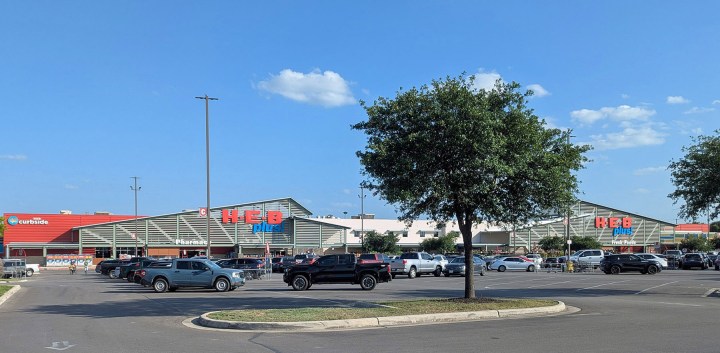
         Eventually, I retired here in San Antonio and had my very own HEB Plus nearby (the one pictured above, 135,000 sq. ft.) Gradually, as my Mother got older, she could no longer navigate an HEB, so then I would go down to Victoria and take her to the one small, older market in town, Dick’s Food Store, a family-owned grocery since 1955 that many elderly people patronized. It was sad because our shopping trips still took forever and she still couldn’t get everything there, so I would then have to “pop in” later without her to the local HEB Plus to pick up items that she liked. The days were hot and long and exhausting, but she had to have enough to last a couple weeks before I returned because she no longer drove.

     The H E B Grocery Company is a privately-owned supermarket chain headquartered in San Antonio. It was founded in 1905 when Florence Butt opened the C.C. Butt Grocery Store on the ground floor of her family home in Kerrville. With more than 440 stores throughout Texas and Mexico, the Company today has annual sales of $46.5 billion, was #5 on Forbes’ list of “America’s Largest Private Companies” in 2024, and was just named one of the best companies to work for in 2025 by U.S. News & World Report. It is the largest private employer in Texas claiming over 50 percent of the Texas grocery market and completely dominating the South Texas area in and around Corpus Christi, San Antonio, Austin, Laredo, and Houston. In short, when you talk about going grocery shopping in Texas, you’re talking about the HEB.

     And you are talking about a trip. In fact, friends of mine who come to visit from other areas of the Country always want to go to my local HEB because they just don’t have such stores where they live. Sure there are Walmarts and Costcos, but their focus is not predominantly on groceries. My HEB Plus has a huge parking lot, has gasoline, a car wash, and rows of charging stations. Inside there is a complete pharmacy providing some health services, an extensive cosmetics and personal care section, and even pet supplies.The store’s gift shop, Mia’s Mirror, sells clothing and imported items, and other aisles feature baby items, toys, party and picnic supplies, greeting cards, gift wrap, seasonal decorations, and housewares and cookware. Oh, and did I mention that there is a florist, along with a patio area that has plants and shrubs and garden accents such as Talavera planters and metal art.  

     It goes without saying that in a store this size there would be a butcher with traditional meats including Wagyu beef, and also a poultry section, a fish market and a sushi bar.  There is a full-service deli, a bakery and pastry shop, and a huge fresh-food section devoted to soups, salads, grab-n-go items and “meal simples” for one — all made in house, along with the ever-popular roasted chickens, turkey breasts, and fresh tamales. On top of all that, there is a restaurant (or two) inside the store featuring True Texas BBQ, Flaming Bird, or Cocina. 

     No matter how big or varied they are, the emphasis is always on the food and the products in the grocery aisles. HEB has its own providers, growers, fisheries, and floral nurseries, and its own product manufacturing plants for their own private-label brands of  milk, ice cream, bread, snacks, canned goods and much more. They are forever introducing new things and there are always kiosks with samples to try and “partners” (employees) walking around with featured seasonal goodies to tempt you as you shop. 

     In addition to all of this, HEB is a true “partner” in the communities they serve. They do a tremendous amount of philanthropy, disaster food relief, school promotional projects, and civic awareness programs. They offer their full-time employees a full range of benefits and opportunities, and because they have their own brands and resources, they are very, very price competitive.  Like the San Antonio Spurs here in town, this company is a source of community pride and appreciation. For the most part, I truly enjoy shopping at my HEB, but … 

     If all this sounds exhausting, it is, especially when you are of “a certain age,” as I have now become. Like my Mother before me, I appreciate the abundance and the privilege of the grocery  shopping experience, but it can also be overwhelming — particularly on very hot Texas days when you have spent two hours or more in the store and then have to face the brutal blacktop of the parking lot, load the groceries into the car, and get it all home to unload it once again. On more than once occasion, I have become faint and light-headed in the store; I see a headline in my future: “Woman Keels Over at HEB: News at Six!”

     So I have now learned to “strategize” my grocery shopping. Often, I split my list into two parts, using the Curbside pick-up convenience for the non-perishable items, and then going back later to personally select fresh produce and meats. I also choose my times carefully, trying not to shop on weekends or right before holidays when working people need to shop. I also plan my shopping route within the store in advance and always have my cell phone at the ready for coupon discounts and item locations.

     Even though we are retired, my husband and I still make almost all our meals at home and dinner is an event every evening. I plan my menus a couple weeks in advance and make my shopping lists accordingly. Cooking is a passion for me, and good food well prepared and beautifully presented is one of life’s enduring pleasures. The day may come when I can no longer manage this, but for now, my HEB makes it all still possible.

     And on those hot, exhausting days when I come home with a carload of groceries and start to whine that I have to put it all away, I remember what my Mother used to say in the same circumstance: “We shouldn’t complain, because aren’t we lucky that we have all this food when so many people in the world have none.” 

comments 2

Mise En Place Outside the Kitchen

  Mise en place: a French phrase meaning “everything in its place.”  As any competent cook knows, it also describes a time-honored culinary technique. Sounds fancy, but really, it isn’t; it is just common sense. In the kitchen, or anywhere else, you should know what you’re planning to do and have everything logically arranged in advance to ensure a smooth process and ultimate success. Otherwise, you lose your timing, invite catastrophe, and end up with an unwelcome mess. 

     Long before I ever took any culinary courses, and really before I hardly cooked at all, I learned what eating well really meant when I moved to New York City. My mother, bless her, was not a great cook, but she was a great single mother with a demanding professional job who took care of both her mother and me. Except for her meatloaf and her potato salad (recipes I still make now), we ate out or took out most of our meals. And in the South Texas town where I grew up, those meal choices were pretty much limited to Mexican food, barbecue, and hamburgers.

     When my husband, a New Yorker, asked my mother for my hand in marriage long ago, she answered that while I had many admirable qualities, domestic skills weren’t among them; in fact, she added without any sense of irony at all, that I “couldn’t even boil water.” We married anyway and moved up East. It was there as a newlywed living and working in the City that I learned what really good food was about, all kinds of good food. From roasted chestnuts on the street to loaded  sandwiches at a Jewish deli, from authentic ethnic dishes in immigrant neighborhoods to fresh off-the-boat seafood at South Street Seaport, to traveling way uptown for “uptown fine dining” at the Four Seasons or La Cote Basque, New York had it all — and I think I ate most of it!

     One blustery autumn evening on the way home from work, I stopped at a corner newsstand and discovered a copy of Gourmet Magazine. And the rest, as they say, is history, in this case the history of someone who learned how to eat well, then learned how to cook well, and then learned how to appreciate the centrality of food in culture and history and nature and almost everything else! As award-winning chef and World Central Kitchen humanitarian José Andrés said when asked about the importance of food writing,  “The connection of food to everything; national security, climate, immigration, dignity.” ( New York Times Book Review, 5/11/2025)

     Ultimately, it was Gourmet Magazine that began my real education into food significance and preparation, though the recipes I found there were not easy, especially for someone who didn’t cook. They demanded considerable study and cultural curiosity, and lots of  planning ahead. You could say that I discovered the technique of mise en place out of sheer necessity before I even knew what that term meant. Putting “everything in its place” was an absolute necessity when trying to navigate a complicated and difficult recipe. Now, almost 50 years later, one of those early challenges has become one of my “signature dishes,” one of which I am most proud. 

     The recipe is for Roast Pork à l’ Orange with Braised Onions (photo from the original magazine above) and it was printed in an early 1970’s issue of Gourmet. It involves 28 different ingredients and takes a minimum of 6-8 hours to complete (including at least 4 hours to marinate the pork), along with an initial hour or so to mise en place. The end result of all the work is well worth it; it is a showy, beautiful dish, ideal for a dinner party and easily adaptable for family leftovers, and it is delicious. (And yes, it gets a easier with practice.)

     As taught in every basic culinary class, mise en place involves five basic steps. The first, of course, is to thoroughly read the recipeall the way through. In cooking, one step logically leads to the next. Carefully reading the recipe allows you to review the list of ingredients, the methods of preparation, the necessary equipment, and the amount of time involved. It also alerts you to any unfamiliar words or phrases in the instructions, such as beurre manié or bouquet garni, that could present stumbling blocks once the cooking is underway. In cooking, as in life, you need to anticipate surprises and know where you’re headed before you begin.

     The second step is to gather all the necessary tools and equipment as well as ingredients,including even the most ordinary things like measuring cups and spoons and sharp knives. How many pots have boiled over on the stove while the cook is frantically looking for a misplaced utensil! Once again, as in life serendipity is one thing, but careless oversight can spell disaster.  

     Your work gets really serious in the third step, especially if the list of ingredients is long. This is the crucial step where you wash, brush, and rinse, chop, dice, and mince, steep, peel, and grate, and otherwise prepare and precisely measure ALL the ingredients exactly as the recipe instructs. Once all this is done, then you set up your workspace, making sure that all appliances are working and that all your tools are clean and organized. 

     And then it’s time for step four, the real marching orders of mis en place!  Line up ALL ingredients, each in its own place in dishes on trays or along a counter, each readily accessible in the order in which it is to be used once you start cooking. Once you are underway,  you will need to incorporate the fifth step, which is to clean up as you go — and not just by throwing dishes in the sink. Anyone who has attended a hands-on culinary class knows how insistent chef instructors are about this last on-going step, not only for safety concerns (sharp knives buried under dishes or cutting boards contaminated by raw meat), but also because some items may have to be used over and over again in the preparation. Besides, mess means chaos and in cooking, as in life, chaos means confusion.

     I have always been a compulsive planner, one even determined to plan ahead in situations like sudden illness or natural disaster where planning is almost impossible. Yet, cooking has brought me consolation and imparted lessons in life even in the most dire situations.  The whole concept of mise en place speaks both to my natural impulses and my common sense. Would that the concept could be understood and embraced by those in authority who are  “cooking up” more than just dinner.

     Note: the Four Seasons Restaurant closed in 2019 and La Cote Basque closed in 2004. Gourmet Magazine ceased publication in 2009 and, while I have the original copy of the Roast Pork from an issue (the photo above), I cannot find an on-line complete recipe for that exact dish to link for you. Sorry.

comment 1

Viva Fiesta!

There are three things I have always loved about Texas, and which I sorely missed during the 40 or so years I lived out-of-state: 1) the endless, cloudless perfect blue sky; 2) the bluebonnets that blanket the highways and byways during the early spring; and 3) the  Hispanic culture woven intricately into the fabric of everyday life, especially here in San Antonio.

     Thank goodness the sky hasn’t fallen yet and so is still here and, at least so far, not terribly contaminated by noxious gases and climate change; alas we missed the bluebonnets this year,  which everyone claims is because of the drought, but which I think is more the fault of road  maintenance crews sticking to their pre-arranged mowing schedules regardless of the late arrival of budding wildflowers. But, hey! Fiesta finally arrived this week, so two out of three reasons to keep loving it here ain’t bad.

     Ah Fiesta! Memories that have informed my whole life. When I was a child in Victoria, we would come up to San Antonio during Fiesta even if only for a day or two,  just to see the decorations, hear the music, eat the food, shop at El Mercado, and join in the fun. Fiesta always showcased spring since we often passed fields of bluebonnets along the way. Later, when I was in college here, Fiesta provided the ultimate “spring break” right here at home. We never even thought about going to Florida or the Caribbean or even to Mexico; it was all here!  My college (Our Lady of the Lake University) was located just outside of downtown San Antonio on Commerce Street, and the Commerce Street bus stopped right on the corner from campus; we students could easily hop on and ride right down to the Riverwalk and La Villita, which we did almost every day during the Fiesta (classes notwithstanding). 

     San Antonio began as a Spanish mission and colonial outpost founded in 1718, but was named by a Spanish explorer in 1691 for St. Anthony of Padua. Initially, it was a part of the Spanish empire, but then it became part of the Mexican Republic, before the whole territory gained independence from Mexico and became the independent Republic of Texas in 1836. Then the whole of Texas became the 28th state in the United States in 1845. That’s the quick history which gives the outlines, but which does not impart the breadth and depth of the Mexican culture woven into the history of the state of Texas and generations of its people, into our language, our tastes in food and music, our spiritual beliefs, our farming and ranching heritage, and our overall love of color and leather and beef! (Is there anybody who could seriously wonder why the South Texas coastal waters were named the “Gulf of Mexico?”)

     When I used to teach American literature and talk about the legacies of various groups and nationalities who settled these United States, I generally introduced the broader definitions of culture to explain that one’s ethnicity or nationality was not the only, or even the most dominant identifying culture of one’s identity. This is especially true in America, where people have historically been on the move since the Westward Expansion and consequently changed and  shaped by the natural landscapes, regional traditions, social customs, local industries and occupations, and even the peculiarities of language  y’all. 

     Someone like me, for instance, who is a sixth generation South Texan and the daughter of ranchers, identifies a great deal more with the skills and traditions and customs of the local Mexican ranch hands who helped my immigrant ancestors from Alsace-Lorraine tame the land and build a life here than with the Germanic habits and traditions brought from the old country. My language, my cooking, my use of color and design, my love of an endless sky and open land, and my fiercely independent spirit — all reflect the dominance of those early Mexican and indigenous influences in Texas, not German at all. (I don’t even like German food.) My main culture of identity, if not my national ancestry, is South Texas Mexican; my mixed national ancestry is actually German, but also English, Irish, French, Swedish, and Cherokee Indian. 

     And yet, I have even diluted that identity by spending most of my adult life not in Texas, but in other parts of the Country. I met and married a New Yorker and so moved to New York City where I became “citified.” My walk and speech got faster, my manner more abrupt, my wardrobe predominantly black and grey, and my humor decidedly Jewish and my everyday expressions infused with Yiddish. My father, who met my mother while stationed in Texas during WWII, was from a large New Jersey family, so my “paternal clan” (except for him) did mainly stay located in the same Trenton/Princeton area from the 1700s, happy it seemed to live and squabble in close proximity to each other. Our son was born in Tennessee (which is where I learned that Texans aren’t really Southerners), and soon after, we three moved to the suburbs of Connecticut, where I fell in love with the New England autumn, learned to can and preserve, and looked forward to lobster bakes (but only in May through August, months without r’s). 

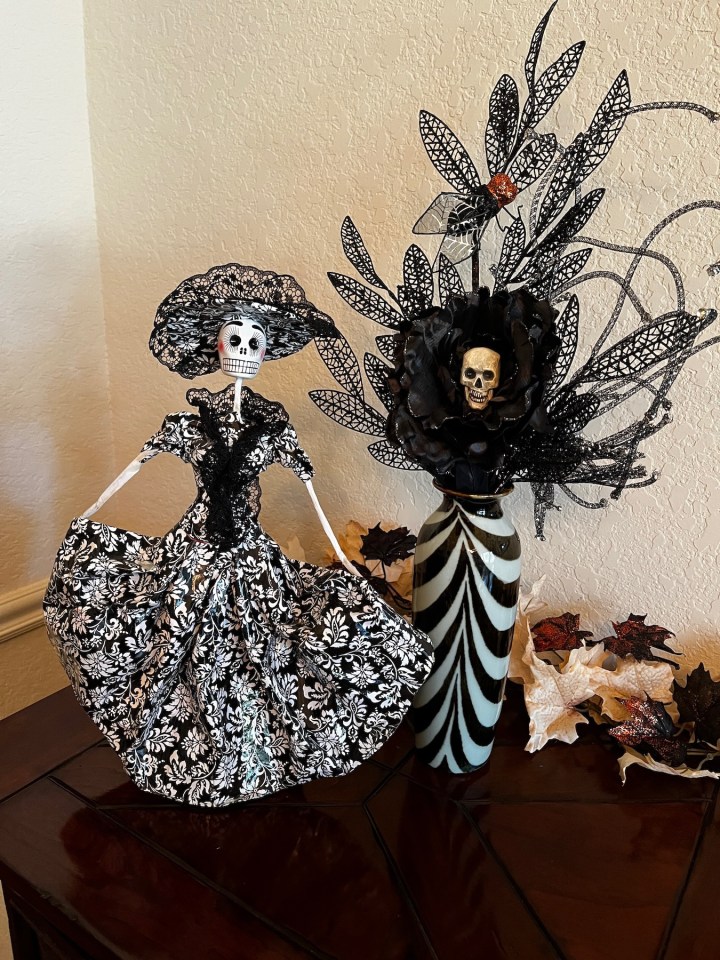
          But now, here I am back in Texas for 17 years and back to the light-hearted celebration of Fiesta. This is how I know spring has finally come. In anticipation of its beginning this week, I made a trip down to the Fiesta Store and here is what I found. For those of you who might visit and need a guide, I offer the following list of possible purchases: (See if you can identify any items in the photo above.)

     Talavera — beautiful pottery and vases introduced from Spain into Mexico, colorful, signed, and sourced from individual provinces;

     La Catrina/La Calavera Catrina — skeletal dolls especially popular during Dia de los Muertos  depicting well-dressed men and women in various occupations and endeavors, many are signed by major artists and highly collectible;

     Alebrijos— fanciful folk art creatures made of papier-mâche or wood from various provinces;

     Huaraches — leather sandals;

     Rebozos, ponchos, and sarapes — scarves, shawls, and blankets, often in woven cloth indigenous to various provinces;

     Huipil — sleeveless tunics; blusas or camisas —vividly embroidered blouses and shirts, often traditional garments from particular provinces;

     Cascarones — confetti -filled eggs, cracked on the heads of loved ones bringing good will, good luck, and messy hair;

     Coronas de flores — headbands decorated with artificial flowers, such as those worn by Frida Kahlo;

     Papel picados — colorful perforated tissue-paper banners strung together and hung most often outdoors; there are hundreds of different perforated designs;

     Guayabera shirts — men’s shirts with four front pockets and two vertical columns of pleats or rich embroidery; also common in Latin America and the Caribbean.

     Friday was my husband’s birthday. I gave him a traditional, all white guayabera shirt, which he wore out to a fancy birthday dinner. He looked very handsome in the “Mexican wedding shirt” worn with black dress slacks and black boots — a good look for my favorite native New Yorker who’s turned a “little bit Texas” over the years.

comments 2

Money, Money, Money, Money $$$

 So here we are moving up to tax time. I don’t mean to be smug, but I got our taxes completed and in at the end of February. Not that I am expecting any big refund or anything, but in light of the dismantling of government agencies and the slashing of staff, I thought I’d better clear up any questions or difficulties I might have well before the lights went out and the phones were disconnected at the IRS. 

     I also calculated my RMD (required minimum deduction) from my IRA for 2025. Figured I’d go on and take the cash before the whole account melted away. Also had a small stock trading account that I had been playing with for years which I cleared out before Inauguration Day. Again, take the money and run,  tax or no tax, before the “market hits the roller coaster.”  (No, I’m no genius market predictor, though I did work on Wall Street for a few years; mostly I just have a healthy skepticism, and some good sense.)

      “Money, Money, Money, Mooo—ney” Remember that opening chorus from Donald Trump’s reality show The Apprentice? It came from a song by the O’Jays called “For the Love of Money” (1973). Ironically, that title comes from the Bible, 1 Timothy 6:10: “For the love of money is the root of all evil.” Most people don’t remember any of the lyrics of that song, much less any of the lessons from the Bible or the series. God + Money: “It’s not personal, it’s just business.”

     If you look in the dictionary, you will find money defined as a “medium of exchange, coins or banknotes,” for goods or services. Lydia, an ancient country located in today’s central Turkey, is widely credited with minting coins as the first standardized currency around 650 BCE, but the use of various metals as a form of exchange dates back to ancient Babylon around 2000 BCE. Paper money goes back thousands of years to China, Carthage, and the early Roman Empire. In its long history, “coins of the realm” have been, for the most part, regarded simply as a method of convenient transfer. 

     America was late to the money game, and some might say that once we entered it, we broadened the definition way beyond efficiency.  On April 2, 1792, Congress established a coinage system in “The Mint Act” and the first U.S. mint was created in Philadelphia. While early forms of paper money, called “bills of credit” or IOUs, existed in the colonies in the 1690s, the U.S. government didn’t begin to issue official paper bills until 1861 in order to finance the Civil War. In 1869, the Bureau of Engraving and Printing started to print U.S. banknotes for general circulation. 

     It seems to me, as a life-long student of American history and culture, that money has come to represent a great deal more from the very beginning than just a convenience of exchange. Back in Colonial days, Puritan John Winthrop (1588-1649)  promoted the notion of a “godly commonwealth.” He was a lawyer, not a minister, but he still can be credited for having laid the foundation for what has become America’s overriding dedication to the power and the privilege of wealth. Let’s not forget that our “founding fathers” were all wealthy landowners who believed in noblesse oblige, even as they also believed that their own good fortunes meant God was smiling on them. God means for everyone to be happy and well; through hard work and right reason, everyone can become successful (just ask Ben Franklin as “Poor Richard”). 

     From Andrew Carnegie and his gospel of wealth (1889), to Oral Roberts and his prosperity gospel (1947), to Joel Osteen at Lakewood Church in Houston (1999), this is the clarion call  from America, that “shining city on a hill” —  oddly enough, a phrase first used by John Winthrop and which later became the center of Ronald Reagan’s political career: God means for everyone to be happy and well-off; those who aren’t must be doing something wrong. 

     Think about the through-line from all of this, from power and privilege and noblesse oblige to prosperity gospels and the “city on a hill,” and then consider how we, as a culture and a government, view the less-fortunate among us, the poor, the disenfranchised, the disabled, the different, the other. “In God We Trust” first appeared on U.S. coins during the Civil War and was later declared our national motto. In 1955, the 84th Congress mandated that the motto appear on all American currency. And thus we make the connection: God + Money = the American Dream. If you can’t achieve at least a version of it, you must be doing something wrong.

     I first read Scott Fitzgerald’s The Great Gatsby in junior high. I was immediately captivated by the romance of the Roaring Twenties society, the opulence of the settings of wealthy enclaves on Long Island, and the blatant hedonism of the characters. The novel is narrated by a wide-eyed friend and observer, Nick Carraway, who claims to be normal and moral, but who also admits that he, himself, is a member of a well-to-do Midwestern family. Already, just a couple pages in, even a youngster like me began to mistrust him as a narrator. “The rich are different from you and me,” Fitzgerald wrote. “Yes,” came Ernest Hemingway’s famous retort. “They have more money.”

     Over the years, I have read this book countless times. I have studied this novel in graduate school, I have written about it in publications, I have taught it in high-school honors classes, and I have instructed graduate students in education on how to teach it. Each time I reread it, I gain new insights into the American experience and our collective character. To me, The Great Gatsby is the one, true Great American Novel because it explores the disillusions and dilemmas of the  American Dream; sadly, it also explores how that Dream goes bad. The Great Gatsby merits required reading in every American lit class (provided schools haven’t banned it yet). 

     Nick has a line in the very first chapter about the story he is about to impart: “… as my father snobbishly suggested, and I snobbishly repeat, a sense of the fundamental decencies is parcelled [sic] out unequally at birth.” In other words, morality is a rarity in the pursuit of wealth and power. God + Money -minus- character = a corrupted Dream.

      Money, Money, Money, Mooo—ney “For the Love of Money” could be our national anthem.

comment 0

Sacred Silence

   As a youngster, I went to a girls’ Catholic school. Those were the days when an order of nuns were still the teachers and the ones in charge. Our school was across the street from the nuns’ convent, which was adjacent to the church (photo above) built in 1903. This is the church my Mother and I attended and where I was married, but my history with this church and school goes back even further: my grandmother went to this Catholic school, but never converted nor graduated; my Mother went to this Catholic school and converted when she was 12; and I had been “converted” as a baby and so went there for a full twelve years and graduated.

     The school emphasized all religious traditions and holidays, of course, but Lent was taken especially seriously at Nazareth Academy. Each year, we would have a Lenten Retreat of some sort, even in the lower grades. In the upper school, the retreat usually consisted of two full days, during which we were encouraged to be serious in demeanor and not to talk, except out of necessity. Academic classes were suspended so that we could attend religious services, hear speakers, engage in study groups, go to confession, and take time to meditate and reflect. Since the church and convent were in close proximity, we were allowed to wander the quiet convent grounds and gardens in our free time, which made contemplation, prayer and reflection much, much easier. No noise, no distractions — way before cell phones.

     Those early years of retreat may be where my initial association of a sacred silence with a  spiritual life began. Notwithstanding the Old Testament stories of a booming voice in a burning bush, I don’t think God shouts. Rather, I think God can only be heard through our own inner voice in the silence of the heart. Back in the early days of my Catholic education, one could attend Mass and still pray and think and reflect in the moments of silence that existed within the larger ritual of the service. The few prayers that were recited or the songs that were sung were “incantational” in nature, meditative and soothing in their rhythmic familiarity, even if the words were in Latin.

     I sometimes attended Protestant or Jewish services with my non-Catholic friends, but those services were pretty much as reserved and predictable as my own. My first exposure to a different kind of worship was through the Pentecostal tent revivals that regularly came to town. My best friend and I used to sneak into the back of the tents just to see what all the crowds and commotion were about. And commotion it was: the preacher, generally a non-denominational firebrand, oversaw the laying of hands, the expulsion of demons, the speaking in tongues, the conversions to faith, and the general praising, glorifying, singing, swaying and other emotional manifestations attributed to the influence of the Holy Spirit. It was wild, but we didn’t make fun of these revivals, as some people who attended did; we simply watched and listened and then talked about how very different and yes, odd, this kind of experience was.

      The Second Vatican Council of the Roman Catholic Church took place from 1962-1965 with the express purpose of updating and directing the life of the Church into the 20th century and beyond. It was a historic event that introduced big changes to the Church both in liturgy and in structure. The vernacular replaced Latin as the language of the Mass, the importance of scripture was revitalized, the roles of lay people, including women, were  expanded, and the foundation for updating the Rules of Canon Law were laid. As the saying goes, “the windows were opened for the breeze to blow through” — which I welcomed, by the way, but those windows also opened to some of the evangelical influences already stirring in society. Eventually, we had our own charismatic Catholics, healing ceremonies, and congregational celebrations of what used to be private rites and rituals (baptisms, funerals). Everything was about fellowship and community ministry. We got away from the quiet contemplation of religious observance just as society also got away from the quiet contemplation of everything else.

     Last week I went to Mass on Ash Wednesday for the service to be followed by the distribution of ashes, but I left before the ashes. The church was too crowded and I had had enough of people praising and singing, and coughing and talking and babies crying. In the Mass of my local church, there is not even a 30 second period of quiet (I’ve timed it): every single minute is filled with either prayer, singing, praising, preaching, or greeting. It makes me tired. I’m afraid I can’t find solace in the noisy community of a congregation; rather, I now like church best when there is no else one around. 

     This attitude was no doubt solidified by Covid, when for over two years I watched the Mass being live-streamed from a church without attendees in the peace and quiet of my own home. I looked forward to those Masses every week and found them to be the most spiritually rewarding church services I had experienced in a very long time. Once we got passed Covid, though, the whole world seemed to have erupted with some sort of evangelical fervor, whether that fervor is religious, political, ideological, or the “Swifties!” The pre-Covid noise resumed again, at even higher decibels.

     So now I seek the quiet corners in a church when no one else is there. It isn’t easy, because a lot of churches are locked during the day, but I try the side doors. Sometimes I attend a weekday Mass because it is lower-key and there are fewer people, and sometimes I just go to visit at an off-time. I can pray the rosary or make the Stations of the Cross or read my meditations. Most of all, the silence of an empty church invites me to sit and think, or not to think; it allows me to listen to the whispers of the Lord.

     This Lent I will once again recall and try to capture the peace and quiet I found in the Garden of Gethsemane on a trip to the Holy Land in 2015. On dusty paths amid scraggly olive vines, there truly does exist a sacred place of sacred silence in that Garden just outside the city walls of Jerusalem. Christ knew he would be able to hear his Father there before the crucifixion.  Likewise, if I can find some sacred silence in my life, maybe I can hear some words of encouragement for the trials I face. Remember, God doesn’t shout. 

comment 1

About the Presidents (But Not This One)

    I have a thing for Presidential Libraries. It doesn’t matter who the president was, when he was in office, or what politics he espoused. If he was a President of the United States and has a library to visit, then I”m there, not so much because of the man himself, but because of the insight into the history of the times that he and his administration represents. 

     The Presidential Libraries are not libraries in the downtown on-the-corner sense; rather, they are a combination of  archives and museums, a repository of artifacts and documents available for study and discussion. Operated by the National Archives, the libraries and their holdings are declared  to belong to the American people. The idea of a Presidential Library was conceived by Franklin D. Roosevelt in his second term as a way to preserve and protect for future generations the vast amount of presidential papers, gifts, mementos, and other materials he had accumulated while in office.  (Up until that time, previous presidential papers had been lost, destroyed, or sold for profit — hmmm — not totally unheard of even in recent times.)

     Roosevelt raised private funds for his initiative, and then turned everything over to the US Government to be administered through the National Archives. In 1955, Congress institutionalized this policy through the Presidential Libraries Act, amended in 1986. The tradition of an archival library of former presidents continues — at least so far (although current government firings and significant funding reductions are impacting both the preservations of the archives and the operations of the Presidential libraries. Check for times and availability before you go to visit.)

     There are officially 13 Presidential Libraries (for which you can obtain a stamp in a Library “Passport” to record your visit at the Library’s admission desk.)  So far, I have visited 8 of those existing 13. In addition, the National Archives and Records Administration also operates three other Presidential collections which I have also visited: Washington at Mt. Vernon, VA, John Adams at the Boston Library, and Jefferson at Monticello, VA. Like any visitor, I have my own opinions on which are “the best and the worst,” according to my own standards, of course.

     I’ll begin with Roosevelt’s, which is at his home in Hyde Park, NY. It was the first such library and the only one to have been used by the sitting President. It is impressive, and beautiful, probably because Roosevelt was a wealthy aristocrat, as well as being a formidable leader in formidable times. The Kennedy Library, located at Columbia Point outside of Boston, is impressive on the outside, having been designed by noted architect I.M. Pei, but a bit shallow on the inside, in part because of the very short tenure of the 35th president, but also because “Mama Rose” narrates her son’s life within the larger context of the Kennedy family.

     By all accounts, the most visited Library is the Ronald Reagan Library opened in 1991 in Simi Valley, California. Without question, it is stunning in both setting and design, but it seems to me to be more about “Ronnie and Nancy’s love story” and their finely-curated image forged  along their journey from Hollywood to Sacramento to the White House.  A portion of the fallen Berlin Wall, however, is a noteworthy monument to what was arguably Reagan’s greatest  achievement as President.  

     Personally, though, I prefer the Nixon Library in Yorba Linda, California, which has much, much more to offer in the way of historical record and honest reflection. It underwent a $15 million renovation in 2016, and today presents, unabashedly, a staggering collection of  papers, tapes, films, photographs and gifts related to one of the most completely documented, complicated, and troubled administrations in American history. Remember, this was the administration of the moon landing, Watergate, Vietnam and trade with Red China. 

     But my favorite Library is Bill Clinton’s in Little Rock, AK, and for some of the same reasons as Nixon’s. The archival and museum holdings here are also among the largest in the Presidential Library system, and the candor with which it is ALL presented and available to the public (including the scandals of Whitewater, Travelgate, Monica Lewinsky) shows a rare willingness to be totally open by a living politician. But beyond the historic collections, as a writer, the uniformity of the Library’s design and theme has enormous appeal to me. First of all, the building is done in a steel and glass modernist design which cantilevers from downtown out over the Arkansas River, echoing his campaign slogan of “Building a bridge to the 21st century.”  The building is also the first silver certified LEED design (Leadership in Energy and Environmental Design), later upgraded to platinum (2009), meaning that it is fully sustainable, made of renewable materials and totally energy and water efficient. It is a design wonder and perfectly suited  to its downtown Little Rock location.

     Of course I have been to the libraries of my “home-boys’” in Texas often, and I mostly  appreciate them for their design and their research facilities. The George H. W. Bush Library on the campus of Texas A & M University in College Station is a sprawling marvel. While a rather modest library of artifacts, it is an incredible facility for research and study facilities for national and international conferences including housing for participants and scholars. The LBJ Library on the University of Texas campus in Austin is, likewise, a Mecca for scholars and historians.  The 10 story building houses documents and materials recording LBJ’s 40 year political career, most notably his pivotal contributions to Civil Rights. I especially love the remarkable sense of humor shown in all the proudly displayed foreign gifts that characterize his unique features and foibles. 

     Finally, when we were in Dallas recently, I got to visit the George W. Bush Library on the campus of Southern Methodist University. I was never a big fan of “Bushie” at the time of his presidency, but the library, which focuses on the key decisions and significant issues of his administration, made me realize in retrospect what monumental events occurred during W’s presidency: 9-11, the Iraq War and Saddam Hussain, Hurricane Katrina. The “Steel of American Resolve,” a section from the World Trade Center that dominates the 9-11 area of the Library (photo above), along with photos and other artifacts including the bullhorn The President used in lower Manhattan after the attack, is a moving reminder of that terrible event. Overall this Library is a humble, respectful and factual record of an ordinary man suddenly in charge of a nation in extraordinary times.  

     The Barack Obama Presidential Library is the 14th Presidential Library to be administered by the National Archives and Records Administration. Unlike all others, this is the first fully digital Presidential Library. An estimated 95 percent of all the records of the Obama administration were born as digital records and so they are stored and preserved as such. The more accessible Obama Presidential Center is currently being constructed on Chicago’s South Side by The Obama Foundation and is scheduled to open in 2026. 

     The Presidential Libraries offer an accessible and informative view into American history through the lens of the times and the events of the era. That view is perhaps more important and urgent today than ever before. The Spanish philosopher George Santayana famously said, “Those who cannot remember the past are condemned to repeat it.”(1905). The Presidential Libraries of the United States provide a valuable link to our collective past and a tacit warning about the failure to learn the lessons from our mistakes. We need to heed that warning.

comment 0

You Never Know …

     A dear old friend of mine texted me last week that he was in the hospital and had just been told that he had only a few months to live. His text was bizarre, full of Woody Guthrie quotes and quixotic quips that gave lie to the seriousness of the message. As well as I thought I knew this person, I still wasn’t sure how he wanted me to respond. Besides, I didn’t even know he was sick, much less seriously so. 

     Three days later, he was dead. 

     As well as you think you know someone or something or some situation, you never really know… But I should have known. After a lifetime of working with and listening to students and their families, after interviewing countless couples and writing about their weddings and marriages and family dynamics, after being a journalist for an alternate newspaper and reporting on politics and education and women’s issues, and after being generally one of those people who, even as a girl, apparently always walked around with a sign on her back reading “lay it on me,” you’d think I’d be beyond misreading insouciance and better at deciphering subtle messages.

     Aside from personal experience, I have a long professional history and expertise in classic literature, especially American literature, to draw on for lessons that have informed my life and themes that have shaped my perspective on reality. The biggest take-away from all of this reading and study is quite simply that “things are never as they seem.” From Gatsby’s outward appearance of wealth and success to Macbeth’s misperceptions of“fair is foul and foul is fair,” to Poe’s untrustworthy narrator in “The Tell-Tale Heart,” looks are deceiving and words are not always truthful. It is a surprisingly universal literary message across time and place and cultures, one that we would do well to heed today even if we haven’t read all the books.

     The warning about duplicity also rings true in our interpersonal relationships. Leo Tolstoy ,in the opening to his novel Anna Karenina, wrote: “All happy families are alike; each unhappy family is unhappy in its own way.” There’s a guiding principle for marriage counselors everywhere. An old truism among those counselors and professionals is that you cannot know a marriage from the outside. No one else outside of an intimate relationship can ever really know what someone else is feeling, fearing, or going through. Sometimes, even those involved in those very intimate relationships misread each other’s feelings. It would do well for friends and extended family members to remember that before they butt in to a personal situation.

     Ultimately, the truth or accuracy of any situation always depends on one’s perspective. This is probably the reason that eye witness testimony in legal cases is considered the least reliable. No doubt most of us at some point have been an eyewitness — to a protest, an altercation, an accident etc. — where different viewpoints and prejudices affect the interpretations, the actual truth of what happened. Just look at the events of January 6 in our own recent history. “The truth” of what we all witnessed in real time on television has been reinterpreted and repackaged according to the prevailing perspectives of a few. We’re back to the what-is-truth controversy.

     The confusion of image with reality is especially dangerous today, when social media promotes not who you are, but who you appear to be. All the markers of appearance — clothing, houses, cars, fame, companions, performance — lead us back to The Great Gatsby again. Who are these people anyway? What makes them worthy of notice, much less emulation? Sadly it is the very promotion and constant exposure to all those media influencers that create such devastating effects on personal identity and self-image, particularly among our young people, while also inculcating moral and cultural values that have no real foundations in truth.

     If I sound circumspect, even a bit jaded, perhaps it’s because I have become so over the years. I’ve often been told that I am unflappable, rarely ever surprised by the behavior of others, much less shocked. In the context of teaching and reporting and working with the public, that’s a positive attribute I think; in the context of personal relationships, I’ll admit that it’s something of a protective posture. I like to think that if I have reasonable expectations of others, then I will rarely be hurt or disappointed by their actions, nor will I easily misread them.

     But in the case of my friend last week, I did misread his missives. I thought he was just being his usual overly-dramatic self, and while I ended up saying “Vaya con Diós, mi amigo,” (following his Spanish lead in the texts), I was surprised, and then saddened, by the sudden result. We don’t always anticipate events as well as we like to think we do. You just never know…