
When you think of deserts, no doubt you picture the great exodus scene in The Ten Commandments when Moses (Charlton Heston) leads his people out from Egypt onto the wide sands of the Sahara. Certainly, the Sahara is the quintessential desert, the largest “hot” desert in the world covering 3,600,000 square miles and spanning 12 countries in North Africa. It is massive, powerful in its vast immensity and wise in the scenes and secrets its desert sands have buried over its 4.6 million year history. The first time I set foot on the Sahara in Egypt, I cried.
I love deserts, but not all deserts are like the Sahara, or even like each other. Experts say that there are roughly 30 major desert areas in the world as defined by the amount of precipitation they receive, the temperatures that prevail, and the geographic locations where living conditions create unique biómes and ecosystems. There are “hot” deserts and “cold” deserts, “polar” deserts and “oceanic” deserts; some are barren of any visible life or vegetation, and some, such as the Kalahari in South Africa/Zimbabwe, are actually sandy savannas with trees and bushes and grasses over which wild animals roam. (I’ve been to the Kalahari too, and was profoundly moved by the primordial connections I felt there — but not moved to tears.)
A couple weeks ago, we went to Scottsdale in the Sonoran Desert for a few days. Needed a nice little get-away, and Phoenix is an easy trip from here: 2 hours non-stop and you land when you left (because of the time change). Fabulous resorts, great restaurants, and lots to see and do without crowds in the end-of-summer off season. (Gee, wonder why tourists don’t flock to Arizona in late August???) Yes, it was hot, but we had been running weeks of triple-digit days here in San Antonio, so we were prepared. Really, once the thermometer hits 100°, why quibble about the number of additional degrees. Besides, as they say, “It’s dry heat.”
One third of the earth’s surface is arid or semi-arid. While those conditions are not strictly synonymous with deserts, they do describe most of them based on their low levels of precipitation. We typically picture deserts as hot, dry, sandy landscapes, but they can also be cold and feature various terrains. In a desert ecosystem, it is the extreme lack of usable water rather than temperature that is the defining characteristic. The subtropical Chihuahuan Desert in West Texas is recognized as a desert (the 11th largest), but much of the surrounding western areas of the State have semi-arid climates and desert ecosystems. San Antonio, situated between the semi-arid climate of the west and the humid subtropical climate to the east, is considered a “transitional” subtropical climate, though San Antonio residents continually worry about water shortages and fear that our ultimate “transition” into a bona fide desert is soon to come.
All of this is by way of explaining why we didn’t think twice about going to Scottsdale in the summer. The climate is familiar and we have the hats for it. Moreover, the town sits at the foot of the beautiful McDowell Mountains in the Sonoran Desert, home of the famous Saguaro cactus (its blossom is Arizona’s state flower). And let’s not forget that I love deserts!
Scottsdale didn’t disappoint. At first glance, it’s reminiscent of Palm Springs, which sits in the low desert of the Coachella Valley at the foot of Mt. Jacinto. Scottsdale has a similar look, with its palm trees and upscale shops and galleries, but without that retro-mid-century vibe (though you can visit Taliesin West, Frank Lloyd Wright’s home and studio in Scottsdale, and you can’t get a better mid-century vibe that that!) Like so many other popular desert cities — Las Vegas, Taos, Santa Fe— Scottsdale is a casual, comfortable destination offering cultural amenities, a lively arts and dining scene, and numerous outdoor activities (besides golf) all set in a stunning desert landscape at the foot of Camelback Mountain. Somehow, even if you get a little over-heated now and then, you still feel good in Scottsdale.
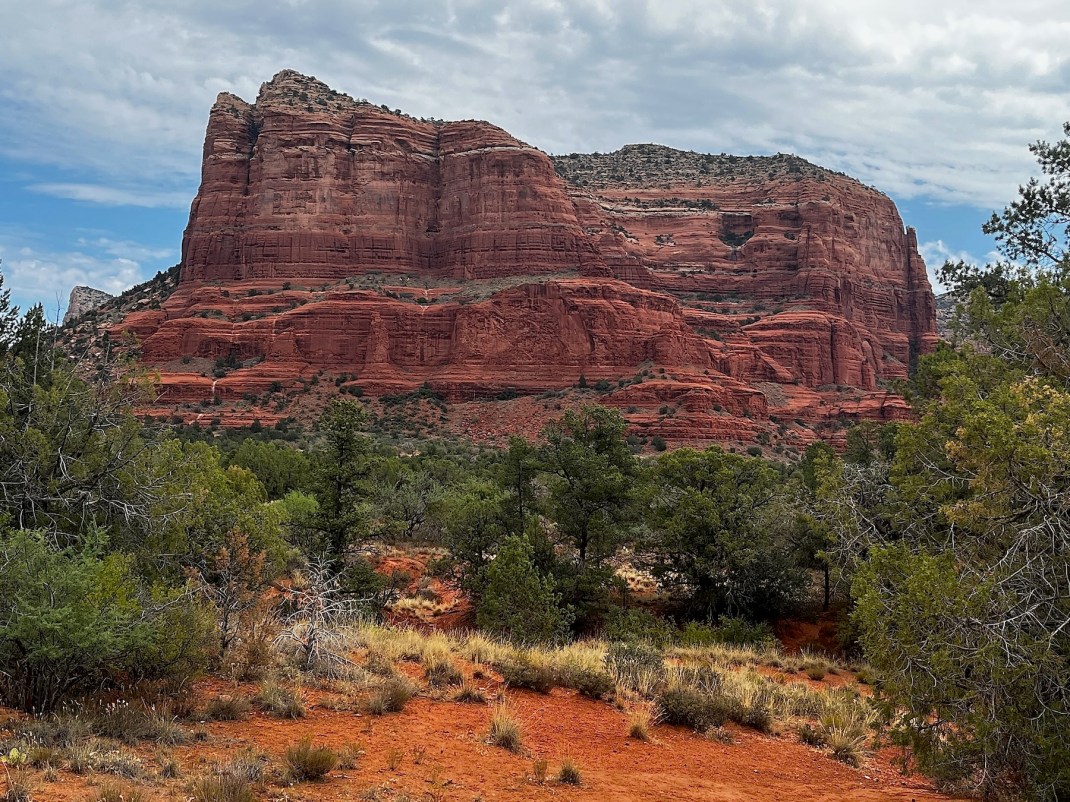
A few days into our visit, we realized that Sedona, that Mecca of mystic renewal, was just a two-hour drive north from Scottsdale, and that — surprise! — it is located in yet another desert. But this is a different kind of desert, a cold winter high desert of the Colorado Plateau with red rock canyons and multi-layered formations created over some 350 million years. People use the word “awesome” all the time to describe the most mundane things, but the landscape of Sedona is so massive, so magnificent, and so truly awesome as to figuratively, and literally, take your breath away (especially given the town’s moderately high 4,350 foot elevation). One of the massive red rocks is pictured above.
Sedona is best known, of course, for its energy vortexes, four of the most powerful in the world. (Some other major vortexes are at the Great Pyramid of Giza, Stonehenge, Machu Picchu, and Ayers Rock.) According to the Sedona Visitors’ Bureau, vortexes are areas where the earth’s energy is thought to be highly concentrated, creating a unique environment that promotes healing, introspection and personal transformation.
Now I won’t claim to have been transformed by the vortexes, but I will say that I felt calm and collected among them, and completely at home among the colorful canyons and sandstone monoliths. I also felt small and insignificant, realizing that the things I worry about are as minuscule as the grains of red sand in the rocks. Given the millions of years of history and the collective wisdom of all the ancient people who have been there before, my life, indeed my very existence, is but a nanosecond in time. Somehow I find that as comforting as it is humbling.
I have been to ten of the 30+ major deserts in the world, and every one of them has left me with some lasting memory or lingering insight about myself, whether there were vortexes or not. The Bible is full of desert stories symbolizing places (periods) of hardship and despair where strength is tested and clarity results. Prophets of old emerged from the desert with messages of hope and redemption; Jesus himself went to the desert to be fortified and prepared for his public ministry. When you step outside of yourself into the vast stillness of a desert, you make some profound discoveries.
Sometimes that discovery is you.
 the narrative thread