
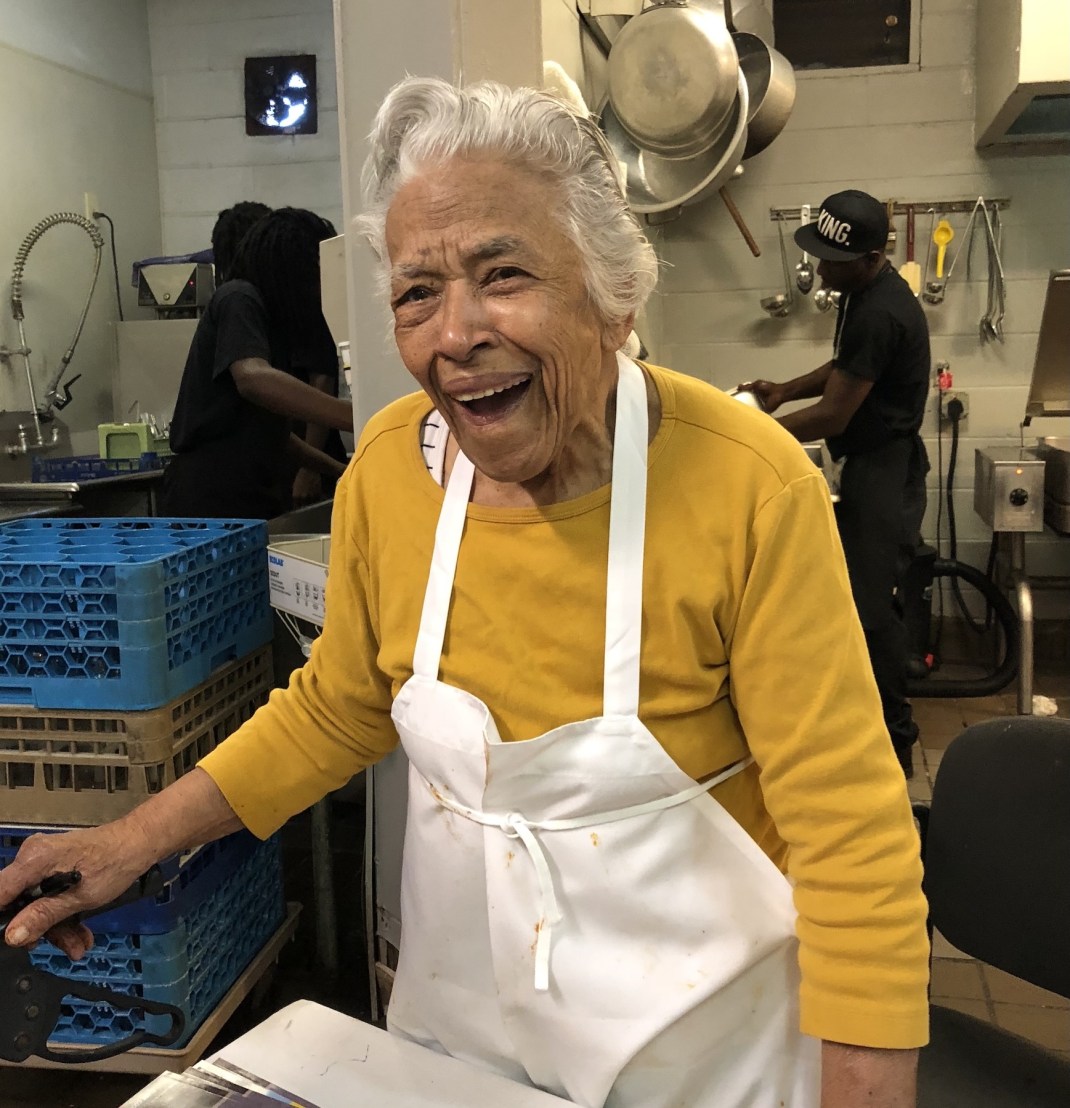
(Photo above of Leah Chase, philanthropist, chef and owner of the famous Dooky Chase Restaurant in New Orleans, joyfully cooking at age 95.)
When I am an old woman I shall wear purple
With a red hat which doesn’t go, and doesn’t suit me,
And I shall spend my pension on brandy and summer gloves
Thus begins a well-known poem named “Warning” (often titled with the opening line) by English poet Jenny Joseph (1932-2018). It was written when Joseph was just 28 years old, and has often been reprinted and included in anthologies by and about women. Ostensibly, its specific meaning is about a woman’s desire to shed society’s expectations and embrace a carefree life as she gets older, but the larger theme of women at any age rebelling against social conventions and pursuing their rights to individual self-expression has been an on-going issue for women over the decades.
I’ve been thinking a lot about age lately as our son approaches a “landmark” birthday, as the grim reaper claims more and more of my life-long friends and family members, as my husband and I wear ourselves out trying to manage and maintain our large home and garden, and as my priorities shift regarding how I want to spend my time. Am I getting old? When did it happen? How would I know?
Old age isn’t what it used to be. Back in the early 20th century, people who were 50 or 60 considered themselves old, and they were old, probably because they had worked hard at labor-intensive jobs and enjoyed few of the comforts and conveniences that we now take for granted. But with today’s emphasis on health and fitness, people are generally more active and in better physical shape than they used to be. And then there are the cosmetic enhancements and nips-and-tucks of eternal youth so readily available. I don’t know about you, but I find it very difficult to assess someone else’s age by appearance alone; heck, sometimes when I look in the mirror I find it difficult to asses my own!
In spite of all those retirees who are out sky diving or trekking as intrepid tourists through ancient ruins, the onset of older age has generally been marked by retirement age. Demographers call this category of 65-74 the “young old.” The “middle old” designation is 75-84, and then the “old old” (or over-the-hill crowd) is anyone beyond 85. But chronological age alone is not the only classifier that matters; today, 24% of Americans live to be 90 or older — 30% of women because we live longer. Take a look at 92 year old Joan Collins, who is 32 years older than her husband, and tell me if she is “over the hill!”
Beyond the birthdays, demographers point to functional age as a more realistic indication of how old a person really is. Qualities such as fitness, vitality, cognition, and overall health affect not only the lifestyle one can continue to enjoy, but also how one feels about that life. We have all known people who are “old” in attitude and behavior way before their time, people who give up, opt out and drown themselves in a pool of pity over whatever ailments and limitations befall them; hopefully, though, we have also known those who continue to live life with joyful exuberance in spite of the their physical limitations.
I am not a doctor or a psychologist, but having spent much of my life around very old people (90+) —my mother, my mother-in-law, my grandmother, my aunts, and even some friends —I have arrived at some key attitudes and behaviors that I believe guard against becoming truly “old before your time.” While I have a healthy suspicion of the whole “golden years” myth and the notion of “aging gracefully,” I do believe that we can help ourselves navigate the inevitability of age in a way that makes it less lonely and foreboding. So here’s what I’m trying to do:
Keep moving: I may not walk as far or work out as long as I used to, but I try to adhere to an exercise regimen every day. Walking (not running or jogging) just 30 minutes a day or so is the simplest and most beneficial daily routine anyone can do. I also do the recumbent bike every day (for my knees) and lift weights and/or do yoga on other days. Low-intensity, but regular exercise does more than just work out the kinks, it keeps you out of that Barcalounger.
Learn something new every day: Whether it’s the foods I eat or the places I visit or the books I read, I try to push out of my comfort zone and try something different now and then. Whatever seems new or strange or confusing, I research for a better understanding. On-line courses and You Tube videos offer a world of easy-to-access information and instruction to keep me growing.
Stay current: I always knew that computers and digital technology would be a lifeline for Boomers as we aged, and I was fortunate to be in professions (writing, publishing, education) that forced computer literacy early on. I had my first home desktop, an AT&T System 2, in 1983, because even then, newspaper and magazine articles were submitted on line through dial-up, not on paper through the mail. The continuing challenge, of course, is staying current by upgrading systems and integrating all devices to remain in the conversation and function in a world that is increasingly paperless and robotic. Covid-19 underscored the incredible benefits the digital age has to offer in services and communication for everyone, not just the elderly or home-bound. E-mail, smart phones, social media, on-line learning, banking, investing, shopping including groceries, telehealth, video streaming and Zoom meetings for clubs and groups — absolutely everything can be managed from home, including personal relationships.
Live in the present: It isn’t always easy, particularly when your present isn’t so great, but except for being grateful for those good times and happy memories, I don’t want to waste my time by dwelling on what once was. After all, the only reality we have is right now; the past is over and the future hasn’t happened yet.
Letting go: I’m not sentimental and except for my cars, I don’t tend to get very attached to things, but still…letting go as we age, both emotionally and physically, becomes harder. Old habits, useless beliefs, hurts and disappointments along with the people who precipitated them, all weigh us down and keep us mired in the past; likewise, a house full of stuff, maybe even the house itself, ends up becoming a chore for us and/or a burden for others after we’re gone. I am determined to lighten this load while I can.
To help with that, I offer my brother-in-law’s very effective five-step guide for downsizing:
1. Do I need it? If the answer is no … 2. Do I want it? If the answer is no … 3. Would the kids want it? The answer is always no… 4. Do I think I could sell it? If no … 5. Could I donate it? If the answer to this one is no, then it gets kicked to the curb. This checklist works well, if for no other reason than by the time you ask all these questions about every tchotchke you’ve accumulated, you’ve grown so tired of the clutter that you just get rid of it all!
Don’t complain: No use complaining about anything — about the weather, politics, other people, all the things that you cannot change. Most of all, I do not complain about my physical aches and pains except to a doctor. Talking about problems and ailments only reinforces them, and nobody needs to hear the litany of our afflictions.
Keeping up appearances: A good haircut, a manicure, moisturizing skin care, personal hygiene, appropriate clothing, and even a little make-up (with a light touch and fresh cosmetics, not ones you’ve had forever) can do wonders to lift my spirit when I look in the mirror.
Having a sense of humor: My humor has always been on the dark side, tinged with sarcasm and satire. These days, the worse the news, the more I am inclined to laugh, especially at myself. Sometimes that’s all you can do to relieve the absurdity and hopelessness of a situation.
Jenny Joseph’s poem ends with this short stanza:
But maybe I ought to practice a little now?
So people who know me are not too shocked and surprised
When suddenly I am old, and start to wear purple.
Frankly, I’ve been “wearing purple” and shocking people most of my life, so I don’t think I need more practice. Besides, nothing can prepare us for the shock of getting old.
 the narrative thread