
Spring has come to South Texas, though it isn’t a spring as most people visualize it. Spring here means clean-up, much like the fall season in New England, with leaf blowers whirring and edgers shaving and big lawnmowers riding over and over the grass to mulch the detritus of winter. Live Oaks have shed their leaves and covered the ground in February and then, in March, the buds start to appear for new growth. All the lawn maintenance crews are out and about and all the neighbors are assessing the damage from this winter’s brief, but significant, freezes. And so here we go again, another season of unexpected surprises in South Texas, which actually, has always characterized Texas weather.
What has been nice these days is that the sun rises a little after 7 and so it is daylight by the time I get myself out to walk with the girls at 8. The daylight wakens me early enough that I can go in, do my recumbent bike, lift weights, and even strike some yoga poses before heading out for my walk. But, alas, that will change this weekend with the return of Daylight Savings Time. Springing forward an hour means that, at least for a few weeks, it will be dark again in the morning. Bummer. I am not a morning person to begin with.
But what has come seemingly early this year are the bluebonnets, god bless ‘em. They are suddenly everywhere — down the side streets in my neighborhood, along all the highways and interstates, even in patches on individual farms and ranches. They seem especially plentiful this year — not sure why — maybe because there were a couple really deep cold freezes, and then a lot of rain in earlier January. A mystery, for sure, especially since grass and lawns aren’t yet green. But I’ll take it. Next to the expansive Texas sky, the bluebonnets along all the roadways are the most beautiful, spirit-lifting signs Mother Nature has to offer.
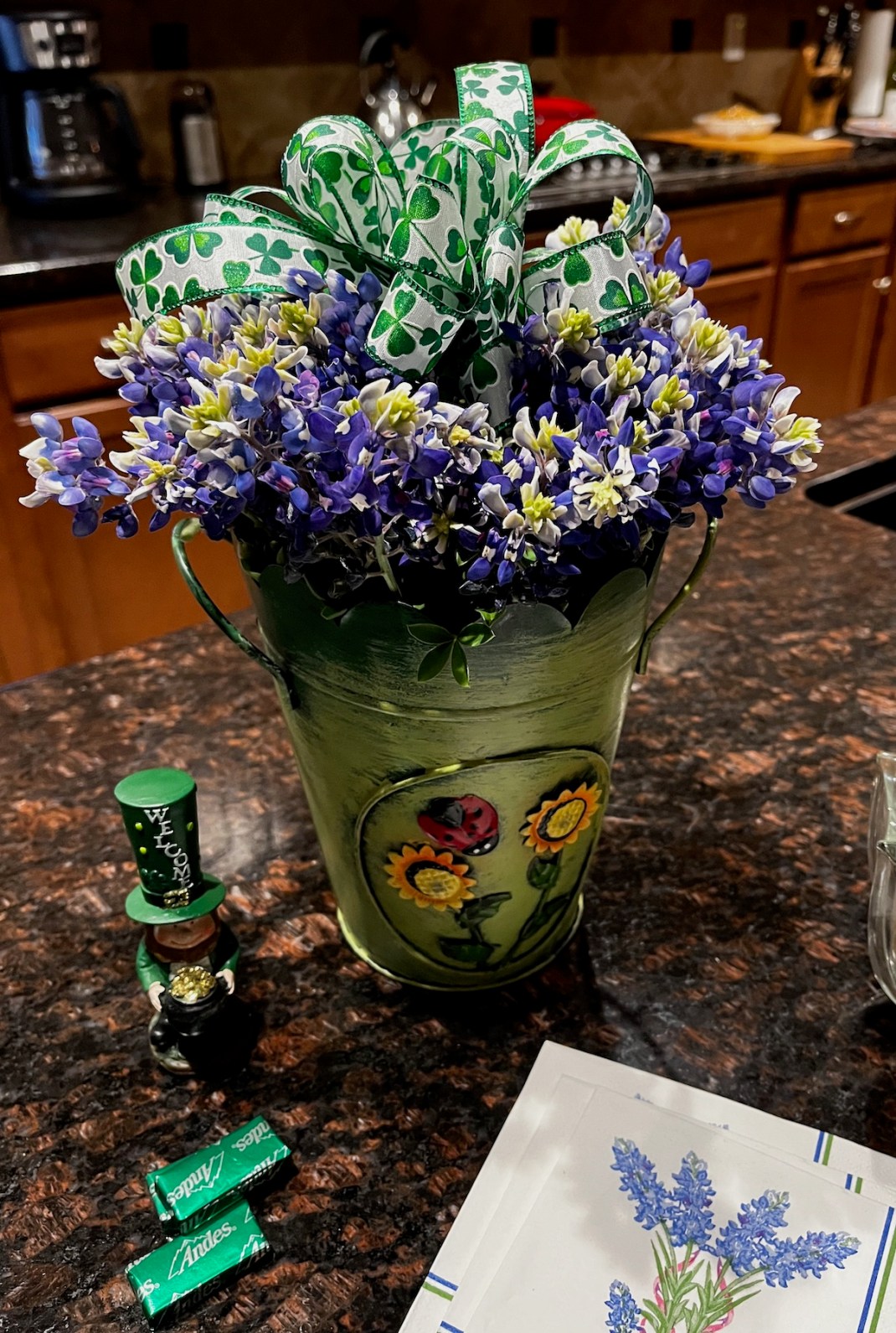
So, I go down a side street where I walk every morning and where the bluebonnets are plentiful in the spring. I take my floral clippers, so as not to rip up the flowers by the roots, and I gather enough bluebonnets to make a bouquet for my kitchen and a small one for my desk. In Texas, if the law is the same as it was when I was growing up (I’m not sure it is, but I don’t care), people are free to cut wildflowers alongs roadsides as long as they are not along public Texas highways where TXDOT continues to seed them each year (and, given the speed limits, where you would be killed if you tried). If you cut them early, like now, they are tall and sturdy; as they grow taller and stronger, over the next couple weeks, however, they block the sunlight for the ones coming up later, which are then shorter and weaker.
As I have written here before, when I was a kid, my Mother and I would go down to Colletta Creek, out on the country roads south of Victoria, and we would pick bluebonnets and Indian pinks and Indian paintbrush by the buckets-full. There were sooo many. The biggest worry was not replenishing the beds, but the snakes that could be lurking underneath. This was always the week or so before Easter, and then we would come home and make huge wildflower arrangements for the house. I would use the leftovers to “feather” my Easter nest in front of the fireplace and the flowers would last, somehow, for days!
Wildflowers were the ultimate symbol of spring, but a distant cousin of ours, Mrs. Ernst, cultivated a yard full of Easter lilies for sale every year. A yard full — front and back, tall and white, like trumpets blowing in the breeze. Still can’t imagine how she did that, since I can’t ever get my purchased Easter lily to grow again even when I take meticulous care of it and try to follow all the instructions for saving and replanting. Anyway, from Mrs. Ernst we had vases full of regal, white Easter lilies in the house, which also lasted incredibly long. You don’t see Easter lilies as cut flowers anywhere anymore, and you only see a few potted ones for sale in garden centers for a short time. People used to put fresh lilies on gravesites at Easter, but you don’t see that anymore either. Everything these days is artificial — ain’t that the truth!
Traditions, practices and, of course, trends change over time. Easter in Texas was always about lilies and wildflowers, new outfits and Easter bonnets, bunny nests and baked hams, holy week and the stations of the cross, and no meat on Good Friday, even if you weren’t a Catholic. Some of us hold on to the remnants of these practices in an attempt to keep faith and hope alive.
And then we spring forward from there, as in this weekend, in an effort to save the daylight in our hearts.
 the narrative thread