
I have always loved the sky. My father did too. Having been an Army Air Corps flight instructor during WWII, he became a commercial airline pilot afterward. His passion was planes and flying. When I was little — I mean really little, like 4 or 5 — he and I used to lie on our backs in the vacant lot next to my childhood home down in Victoria. During the day, we’d watch the clouds (if there were any) and identify types, shapes and movements, and at night, we’d look at the stars. He taught me to find the constellations, showed me how to locate the North Star and recognize the visual differences between a star and a planet. Whenever there were forecasts of planetary sightings, the Milky Way, dramatic moon phases, or any other phenomena, we were out there, on our backs, getting dirty and getting chigger bites.
Those are among the most vivid memories I have of my father, and I still remember much of what he taught me. He died before Sputnik was launched (1957), but by then I was already going out by myself to study the sky, looking for shooting stars or, later, satellites. Fortunately for me, I married a man who went to a maritime college and spent years at sea, so he too loves the sky, as well as the water (as do I). We think nothing of setting our alarms to get up to view comets or passing space stations, or driving to a perfect spot for a better photograph of a super moon, or even making a 400 mile trip out to West Texas to see the Marfa Lights!
So of course, with solar glasses and newly-acquired special camera lenses in hand, my husband, son and I were psyched for the solar eclipse on October 14. Although San Antonio offered a prime location in the viewing path, we elected to go down to the Gulf Coast. A friend had generously offered us his lovely condo down in Rockport for the weekend, and we were grateful for the chance to get away together and excited about the seeing the eclipse over the Bay.
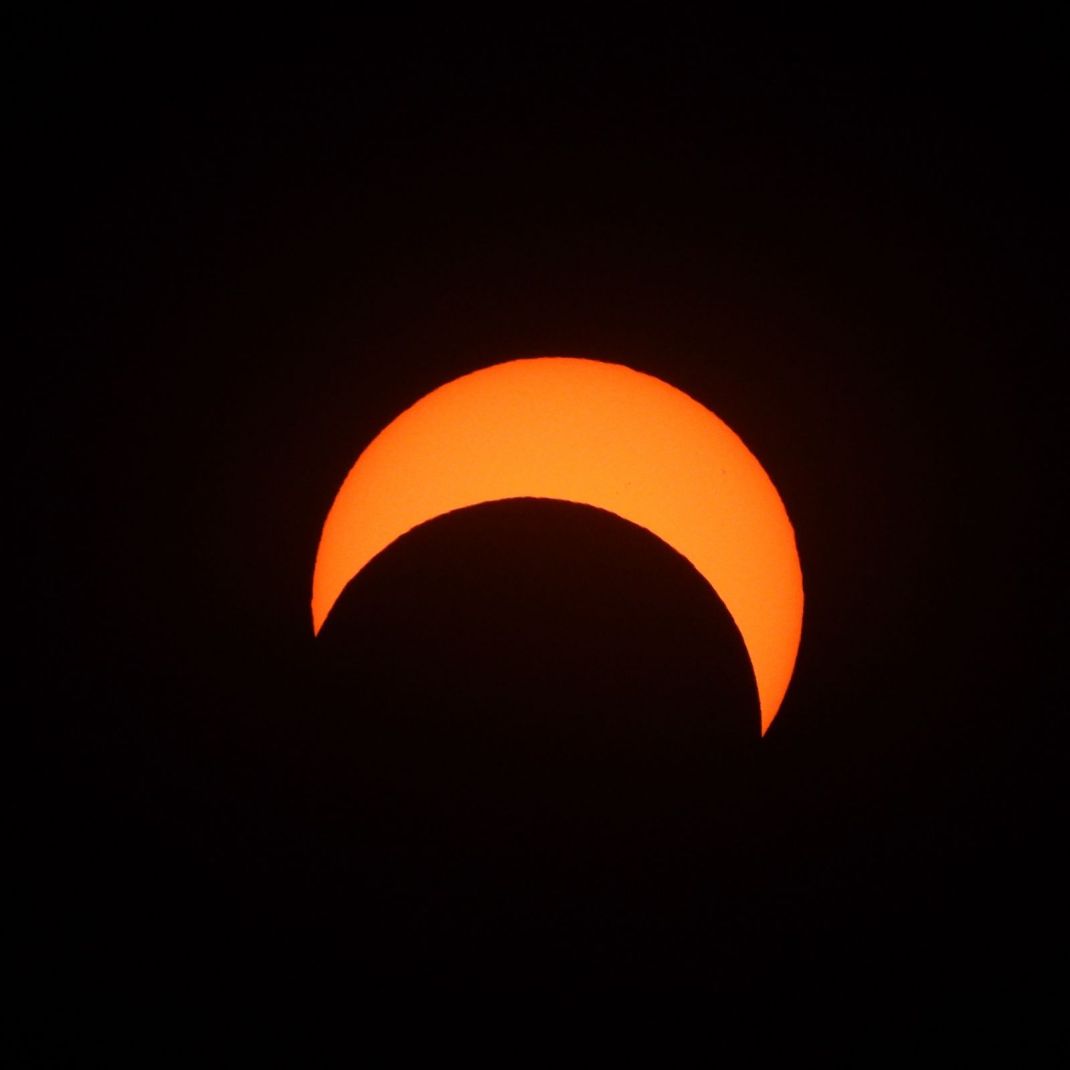
The October eclipse was what is called an “annular” eclipse, which means that the moon is closer than its maximum distance from the earth so that its shadow is not quite large enough to completely cover the sun during the eclipse. Our view did not reveal the so-called “ring of fire,” but more of a ring of bright white (which explains why I chose the more dramatic photo of the partial passing above for this post). Nor did the annular eclipse create a total darkness at 11:54 a.m., but rather a glowing dimness more akin to dusk.
We have another eclipse to follow, this time a total one coming up on April 8, 2024. Once again, San Antonio is centrally placed in the 10,000 mile path that will stretch from Mazatlán in Mexico, up into Texas through the Edwards Plateau in the Hill Country, and then Northeast through 13 states all the way up to Maine and into Canada. In a total eclipse, the moon falls within the darkest part of the earth’s shadow called the umbra and, thus, it completely covers the sun. This creates total darkness for about 4 minutes, depending on where you are in the path. (Just a note: many religious scholars and historians have suggested that a total eclipse is what took place when Christ was crucified.)
Accounts of solar eclipses go all the way back to the ancient Greeks. The poet Archilochus spoke about the eclipse of April, 647 B.C.E. The Greeks believed that the heavenly phenomenon was the work of the gods, that the sun and the moon were fighting. No doubt this is what spawned the many beliefs that have arisen through the centuries and and found their way into not just Western culture and mythology, but into the traditions and beliefs of countless other cultures. In in spite of modern science and recorded data about solar and lunar eclipses, many of these superstitions persist (as they do about other heavenly phenomena).
Some of these superstitions read like “old wives’ tales,” such as pregnant women shouldn’t watch an eclipse lest it harm their baby, or that food prepared during an eclipse will be poisoned. Sort of reminds you of some of our more recent superstitions, such as those theories about wind turbines or Covid vaccines, doesn’t it? Beyond all the particular beliefs, however, is the enduring myth that eclipses are generally harbingers of things to come — mostly bad things.
The catalogue of bad omens includes war, natural disasters, major life changes, world-wide health epidemics, calamitous celestial events, even the end of the world itself. These astrological forecasts are all perfect examples of confirmation bias in that they are based on coincidence and presume to establish a cause/effect relationship between the cosmic universe and human events. Never mind the scientific fact that eclipses happen with regularity and can be mathematically plotted and predicted across thousands of years, as Sir Issac Newton noted over 300 years ago.
So, if something awful happens during an eclipse, some people will forever link the two events and insist that the eclipse caused, or at least foretold, their personal disaster. Meanwhile, they will overlook any good things that might have also happened during an eclipse in their lifetimes. Maybe the basic human impulse is to find somebody or something else to blame for one’s own misfortune. That certainly seems to be the dominant human behavior today.
As for me, whomever or whatever I might try to blame for my failures and disappointments, it will never be the sky. During the forty years I lived in the Northeast, the single greatest thing I missed about Texas was the sky, that pure and perfect blue, cloudless, limitless daytime sky that stretches from horizon to horizon from almost any vantage point, even in cities. The pure gold of a sunrise, the brilliant fire of a sunset, the deep blackness of a starry night, or the rolling storm clouds that bring bolts of lightening and torrents of rain — there are always reasons to look up to the sky. Infinite beauty, spiritual inspiration, and personal humility are to be found there.
I’ll be looking up this weekend because there is a full moon out and a forecast for our first arctic mass bringing cooler fall temperatures. Promises a perfect night for Halloween, don’t you think?
 the narrative thread
Those are perfect and precious memories of your dad..Thank you for sharing that and also the mention of chigger bites. I also remember star gazing I’m our neighborhood, looking for a spot to lay down away from sticker burrs as well. Simpler times and beautiful memories.
LikeLike
Sometimes the smallest memories are the most long-lasting.
Thank you for your comment.
LikeLike
Sometimes the smallest memories are the most lasting.
Thank you for your comments.
LikeLike